Page 156 of 195

Battery
A
Warning!
Risk ofshort circuit andfire.
I>
Observe allwarning notesonthe battery.
I>
Disconnect thebattery duringallwork onthe
electrical system.
I>
Donot laytools orother metal objects onthe
battery asthey could cause ashort circuit
across thebattery terminal.
Hydrogen gasgenerated bythe battery
could cause anexplosion, resultinginsevere
personal injuries.
I>
Donot expose thebattery toan open flame,
electrical sparkoralit cigarette.
Risk ofsevere personal injuryanddamage to
the fabric, metalorpaint.
I>
Wear eyeprotection.
I>
Donot allow battery acidtocome incontact
with your skin, eyes, fabric orpainted surfac-
es.
I>
Ifyou getelectrolyte, whichisan acid, inyour
eyes oron your skin, immediately rinsewith
cold water forseveral minutes andcalladoc-
tor.
I>
Spilled electrolyte mustberinsed offatonce
with asolution ofbaking sodaandwater to
neutralize theacid.
Battery posts,terminals andrelated acces-
sories contain leadandlead compounds,
chemicals knowntothe State ofCalifornia to
cause cancer andreproductive harm.
I>
Always protect yourskinbywashing thorough-
ly with soap andwater.
Charge
state
A well charged batterywillnotonly prevent start-
ing problems butwill also lastlonger.
In order toavoid discharging thebattery
unintentionally:
I>
Curtail unnecessary powerconsumption, par-
ticularly incity traffic orwhen travelling short
distances only.
I>
Always remove theignition keywhen leaving
the car.
Practical Tips,Emergency Service
Page 157 of 195

Battery care
I>
Ensure thatbattery issecurely mounted.
I>
Keep terminals andconnections cleanand
properly tightened.
Corrosion canbeprevented bycoating theter-
minals andconnections withpetroleum jellyor
silicone spray.
I>
Ensure thatvent caps aresecurely tightened
to prevent spillage.
Practical Tips,Emergency Service Checking
theelectrolyte fluidlevel
Generally, theelectrolyte levelmust bechecked
more ofteninsummer thaninthe winter, andmore
often when driving longdistances.
I>
When adding water,useonly clean vessels.
In no case mayalcohol (e.g.window cleaner
residues) bepermitted toenter thebattery.
I>
Unscrew andopen thefiller ventcaps ofeach
cell.
With thecarhorizontal, thefluid level should meet
the indicator markineach cell.
i>
Ifnecessary, topupwith distilled water.
Do not use acid.
Only fillup tothe mark, otherwise theelectro-
lyte willoverflow whenthebattery isbeing
charged andcause damage. Battery
charging
Automotive batteriesloosetheirefficiency when
not inuse.
The charge available inyour battery canbemea-
sured withabattery hydrometer.
We recommend thatthebattery voltage betested
by your Porsche dealerwhohastheappropriate
equipment.
If the car isnot driven forprolonged periods,the
battery mustbecharged atleast every 6weeks.
A discharged batteryallowsrapidformation ofsul-
fates, leading topremature deterioration ofthe
plates.
Page 158 of 195

j!\
Warning!
Hydrogen gasgenerated bythe battery
could cause anexplosion, resultinginsevere
personal injuries.
c> Charge battery inawell ventilated area.
c> Never charge afrozen battery. Itmay explode
because ofgas trapped inthe ice. Allow afro-
zen battery tothaw outfirst.
c> Ifyou getelectrolyte, whichisan acid, inyour
eyes oron your skin, immediately rinsewith
cold water forseveral minutes andcalladoc-
tor.
Slow
battery charging
1. Pay attention toallwarnings andfollow instruc-
tions thatcome withyour battery charger.
2. When charging, ensureadequate ventilation.
3. Remove battery.
Please observe thechapter "REMOVING THE
BATTERY" onPage 158.
4. Allvent caps should beopen.
The fluid level should meettheindicator mark
in each cell.
5. Ensure thatcharger isswitched off-danger of
short circuit!
6. Connect chargercables.
Charger cablesmustbeconnected
POSITIVE
(+1
toPOSITIVE
(+)
and
NEGATIVE (-)toNEGATIVE
(-I.
7. Switch oncharger.
Normally, abattery shouldbecharged atno
more than10percent ofits rated capacity.
Rated capacity ofthe battery inyour vehicle is
listed onthe battery housing.
8. After charging, turnoffcharger anddiscon-
nect charger cables.
9. Tighten thevent caps andreinstall battery
Please observe thechapter "INSTALLING THE
BATTERY" onPage 158. Winter
operation
During thewinter months, batterycapacity tends
to decrease astemperatures drop.
Additionally, morepower isconsumed whilestart-
ing, andtheheadlights, heater,rearwindow de-
fogger, etc.,areused more frequently.
c> let your Porsche dealertestthebattery's
capacity beforewintersetsin.
Replacing battery
The service lifeofthe battery issubject tonormal
wear; itdepends graetlyoncare, climatic condi-
tions, anddriving conditions (distances, loads).
c> Only useanoriginal Porsche battery,withthe
correct partnumber, asareplacement.
c> Please observe thedisposal instructions for
batteries.
c>c>c>
Practical Tips,Emergency Service
Page 159 of 195

Removing thebattery
The requisite toolisinthe tool kit.
The battery islocated inthe luggage compart-
ment under ablack plastic lid.
A
Warning!
Risk ofdamage toalternator andelectronic
control units.
t> Donot disconnect thebattery whiletheengine
is running.
This also applies tocars equipped withabat-
tery main switch.
c> Never drivethecarwith adisconnected bat-
tery.
Risk ofcaustic burnsfromescaping acid.
c> Keep ventcaps ontoavoid spillage.
c>
Donot tiltthe battery whenremoving andin-
stalling
it.
158
PracticalTips,Emergency Service 1.
Switch offengine andallelectrical loads.
2. Open turn-locks
A.
Remove plasticlid.
3. Pull offcentral venthose
B.
4. Important: disconnect thenegative (-)ground
wire first, andthen thepositive (+lcable.
Danger ofshort circuit'
5. Unscrew fastening screwC.
6. Remove battery.
Installing
thebattery
1. Put battery in.
2. Screw infastening screwC.
3. Important: connectthepositive
(+)
cable first,
and then thenegative (-)ground wire.
Danger ofshort circuit
l
4. Push oncentral venthose
B.
5. Fitplastic lid.Lock turn-locks
A.
Page 160 of 195
Replacing theremote-control battery
A weak battery mayberecognized bythe clearly
reduced actionrangeofthe remote controlor
when the
light-emitting diode2
inthe key grip
no longer flashes whentheremote controlis
operated. 1.
Using yourfinger nailorasmall screwdriver,
carefully liftoff the cover ofthe key grip.
2. Replace battery(observe polarity).
A spare battery (Lithium CR2032, 3volts) is
available atyour authorized Porschedealer.
3. Replace coverandpress together firmly.
Note
Any disposal regulations forbatteries mustbeob-
served'
PracticalTips,Emergency Service
159
Page 161 of 195

Emergency StartingwithJumper
Cables
If the battery isdischarged, e.g.inwinter orafter
the car has been parked foralong time, thebat-
tery ofanother carcan beused forstarting with
the help ofjumper cables.
Make surethevoltage ofboth batteries isthe
same.
The capacity (Ampere hours,Ah)ofthe booster
battery mustnotbesubstantially lessthan thatof
the discharged battery.
The discharged batterymustbecorrectly con-
nected tothe vehicle's electrical system.
I>
Please observe thechapter "BATTERY" on
Page 155.
I>
Please observe thechapter "EMERGENCY UN-
LOCKING OFTHE LUGGAGE COMPARTMENT
LID AND ENGINE COMPARTMENT LID"on
Page 154.
Note
I>
Donot trytostart thecarbypushing ortow-
ing. Damage tothe catalytic converters and
other components ofthe car may result.
160
PracticalTips,Emergency Service
A
Warning!
Risk ofdamage andserious personal injury
due toshort circuit.
I>
Use only jumper cablesofadequate diameter
cross-section andfitted withcompletely insu-
lated alligator clips.
I>
Follow allwarnings andinstructions ofthe
jumper cablemanufacturer.
I>
When connecting jumpercables, makesure
that they cannot getcaught inany moving
parts inthe engine compartment.
The jumper cablesmustbelong enough so
that neither vehicles norcables touchanother.
I>
The vehicles mustnotbeincontact, otherwise
current mightflowassoon asthe positive ter-
minals areconnected.
I>
The cable clamps mustnotbeallowed tocon-
tact each other whenoneendofthe jumper ca-
bles areconnected toabattery.
I>
Ensure thattools orconductive jewellery
(rings, chains, watchstraps) donot come into
contact withliveparts ofthe vehicle.
I>
Improper hook-upofjumper cablescanruin
the alternator.
Danger
ofcaustic burns.
I>
Donot lean over thebattery.
Danger ofgas explosion.
I>
Improper useofbooster batterytostart a
vehicle maycause anexplosion, resultingin
severe personal injuries.
I>
Keep sources ofignition awayfromthebat-
tery, e.g.open flame, burning cigarettes or
sparking duetocable contact orwelding work.
I>
Adischarged batterycanfreeze evenat
WFj-lOoC.
Before connecting Jumpercables, afrozen bat-
tery must bethawed out.
Page 162 of 195

+
=Positive terminal
for
jump starting
- =Grounding point
for
jump starting
Connect jumpercablesinthe following
sequence:
1. Check electrolyte levelofeach cell.Ifneces-
sary, fillwith distilled watertojust above
plates.
2. Onavehicle withadischarged battery:turnoff
all consumers andaccessories, movethegear
shift lever intotheneutral position andsetthe
parking brake.
3. Open thecap ofthe positive terminal forjump
starting
(+).
4.
Attach the
positive cable
firsttothe positive
terminal forjump starting (+),
then tothe positive terminal ofthe booster bat-
tery.
5. Connect the
negative cable
firsttothe nega-
tive terminal ofthe booster battery,thentothe
grounding pointforjump starting (-).
6. Run theengine ofthe booster caratahigher
speed.
7. Start theengine.
An attempted startusing jumper cablesshould
not last more than15seconds. Thenallowa
waiting periodofatleast oneminute.
8. With theengine running, disconnect bothjump-
er cables inreverse order.
Close thelidofthe jump startbox.
PracticalTips,Emergency Service
Page 181 of 195
Vehicle Identification
When ordering sparepartsormaking
inquiries. pleasealwaysquotethevehicle
identification number.
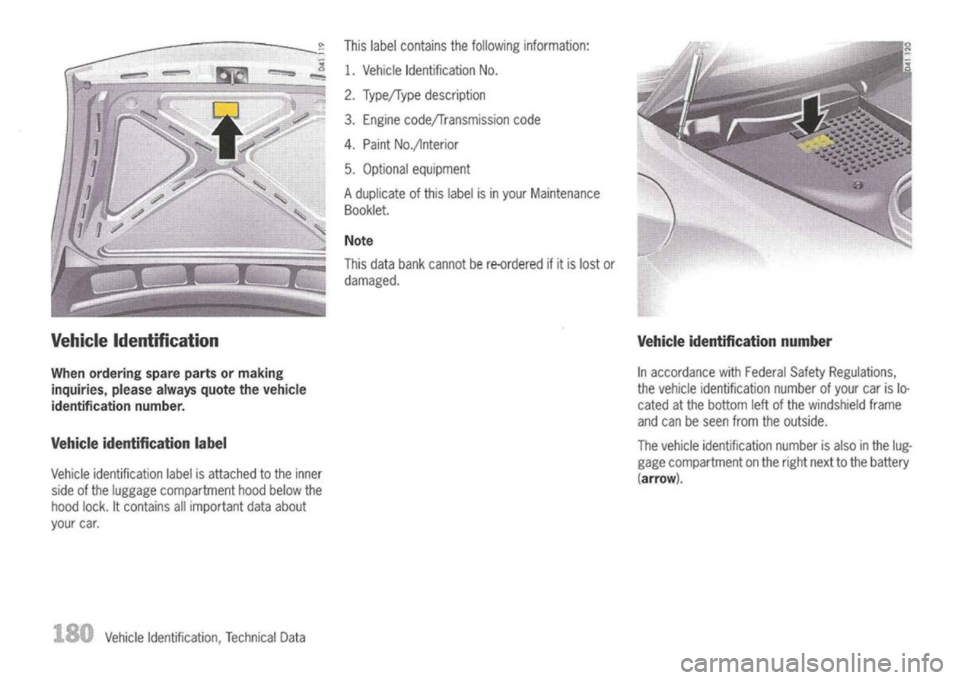
Vehicle identification label
Vehicle identification labelisattached tothe inner
side ofthe luggage compartment hoodbelow the
hood lock.Itcontains allimportant dataabout
your car.
Vehicle Identification, TechnicalData This
label contains thefollowing information:
1. Vehicle Identification No.
2. TypejType description
3. Engine codejTransmission code
4. Paint No.jlnterior
5. Optional equipment
A duplicate ofthis label isinyour Maintenance
Booklet.
Note
This data bank cannot bere-ordered ifit is lost or
damaged.
Vehicleidentification number
In accordance withFederal SafetyRegulations,
the vehicle identification numberofyour carislo-
cated atthe bottom leftofthe windshield frame
and canbeseen from theoutside.
The vehicle identification numberisalso inthe lug-
gage compartment onthe right nexttothe battery
(arrow).