2004 PONTIAC VIBE engine coolant
[x] Cancel search: engine coolantPage 246 of 370

How to Add Coolant to the Radiator
1. You can remove the radiator pressure cap when
the cooling system, including the radiator pressure
cap and upper radiator hose, is no longer hot.
Turn the pressure cap slowly counterclockwise until
it ®rst stops. (Don't press down while turning the
pressure cap.)
If you hear a hiss, wait for that to stop. A hiss
means there is still some pressure left.
2. Then keep turning the pressure cap, but now push
down as you turn it. Remove the pressure cap.3. Fill the radiator with the proper coolant mixture, up
to the base of the ®ller neck. SeeEngine Coolant
on page 5-27for more information about the proper
coolant mixture.
5-36
Page 247 of 370

4. Then ®ll the coolant recovery tank to the
FULL mark.
5. Put the cap back on the coolant recovery tank,
but leave the radiator pressure cap off.6. Start the engine and let it run until you can feel the
upper radiator hose getting hot. Watch out for the
engine cooling fan.
7. By this time, the coolant level inside the radiator
®ller neck may be lower. If the level is lower, add
more of the proper coolant mixture through the
®ller neck until the level reaches the base of the
®ller neck.
8. Then replace the pressure cap. At any time during
this procedure if coolant begins to ¯ow out of the
®ller neck, reinstall the pressure cap. Be sure
the ears on the pressure cap are in line with the
vent tube.
5-37
Page 250 of 370
Notice:
·When using concentrated washer ¯uid,
follow the manufacturer's instructions for
adding water.
·Don't mix water with ready-to-use washer ¯uid.
Water can cause the solution to freeze and
damage your washer ¯uid tank and other parts
of the washer system. Also, water doesn't
clean as well as washer ¯uid.
·Fill your washer ¯uid tank only three-quarters
full when it's very cold. This allows for
expansion if freezing occurs, which could
damage the tank if it is completely full.
·Don't use engine coolant (antifreeze) in your
windshield washer. It can damage your
washer system and paint.
Brakes
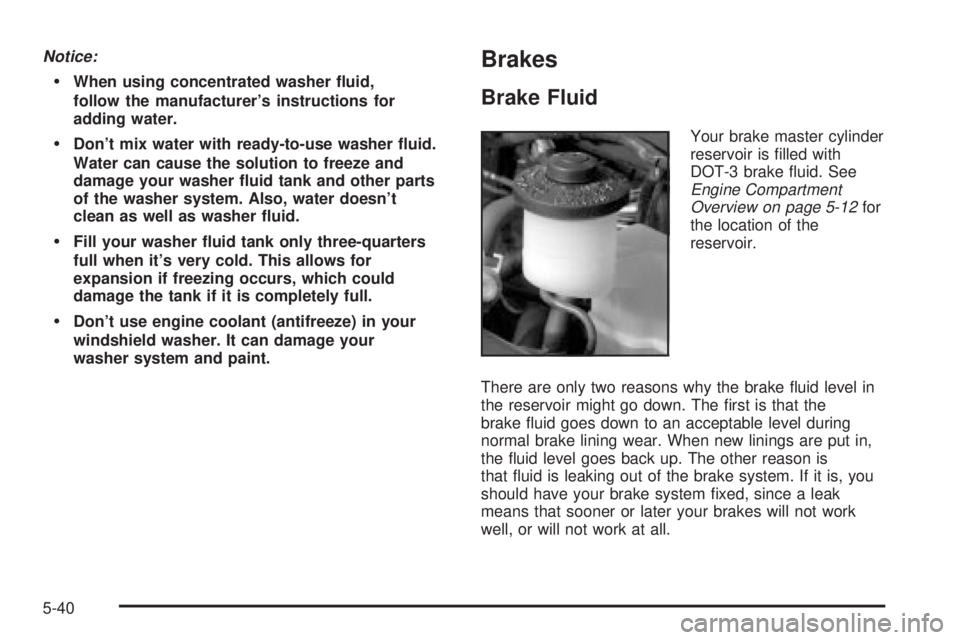
Brake Fluid
Your brake master cylinder
reservoir is ®lled with
DOT-3 brake ¯uid. See
Engine Compartment
Overview on page 5-12for
the location of the
reservoir.
There are only two reasons why the brake ¯uid level in
the reservoir might go down. The ®rst is that the
brake ¯uid goes down to an acceptable level during
normal brake lining wear. When new linings are put in,
the ¯uid level goes back up. The other reason is
that ¯uid is leaking out of the brake system. If it is, you
should have your brake system ®xed, since a leak
means that sooner or later your brakes will not work
well, or will not work at all.
5-40
Page 323 of 370

30,000 Miles (50 000 km)
qChange engine oil and ®lter (or every 3 months,
whichever occurs ®rst).An Emission Control Service.
qReplace passenger compartment air ®lter.
qReplace engine air cleaner ®lter (or every 24 months,
whichever occurs ®rst).
An Emission Control Service.
qInspect fuel tank, cap, cap gasket and lines for
damage or leaks (or every 24 months, whichever
occurs ®rst). Replace parts as needed.
An Emission
Control Service. (See footnote ².)
qRotate tires. SeeTire Inspection and Rotation on
page 5-68for proper rotation pattern and additional
information.(See footnote +.)
qDrain, ¯ush and re®ll cooling system (or every
24 months, whichever occurs ®rst). SeeEngine
Coolant on page 5-27for what to use. Inspect hoses.
Clean radiator, condenser, pressure cap and neck.
Pressure test cooling system and pressure cap.
An Emission Control Service. (See footnote ².)
qChange manual transaxle ¯uid every 30,000 miles
(50 000 km) only if your vehicle is used to tow a
trailer.qCheck automatic transaxle ¯uid.
qChange transfer case ¯uid when doing frequent
trailer towing.
qChange rear differential ¯uid when doing frequent
trailer towing.
33,000 Miles (55 000 km)
qChange engine oil and ®lter (or every 3 months,
whichever occurs ®rst).An Emission Control Service.
36,000 Miles (60 000 km)
qChange engine oil and ®lter (or every 3 months,
whichever occurs ®rst).An Emission Control Service.
qRotate tires. SeeTire Inspection and Rotation
on page 5-68for proper rotation pattern and
additional information.(See footnote +.)
qInspect engine air cleaner ®lter if you are driving
in dusty conditions. Replace ®lter if necessary.
An Emission Control Service. (See footnote ².)
6-9
Page 325 of 370

60,000 Miles (100 000 km)
qChange engine oil and ®lter (or every 3 months,
whichever occurs ®rst).An Emission Control Service.
qReplace passenger compartment air ®lter.
qInspect engine accessory drive belts (or every
48 months, whichever occurs ®rst).
An Emission
Control Service.
qReplace engine air cleaner ®lter (or every 24 months,
whichever occurs ®rst).An Emission Control Service.
qRotate tires. SeeTire Inspection and Rotation
on page 5-68for proper rotation pattern and
additional information.(See footnote +.)
qInspect for tappet noise and engine vibration. Adjust
valve clearance to factory speci®cations if necessary
(or every 48 months, whichever occurs ®rst).
An Emission Control Service.
qInspect fuel tank, cap, cap gasket and lines for
damage or leaks (or every 24 months, whichever
occurs ®rst). Replace parts as needed.
An Emission
Control Service. (See footnote ².)
qDrain, ¯ush and re®ll cooling system (or every
24 months, whichever occurs ®rst). SeeEngine
Coolant on page 5-27for what to use. Inspect hoses.
Clean radiator, condenser, pressure cap and neck.
Pressure test cooling system and pressure cap.
An Emission Control Service. (See footnote ².)
qChange manual transaxle ¯uid every 30,000 miles
(50 000 km) only if your vehicle is used to tow a
trailer.
qChange automatic transaxle ¯uid every 60,000 miles
(100 000 km) if the vehicle is mainly driven under
one or more of these conditions:
þ In heavy city traffic where the outside
temperature regularly reaches 90ÉF (32ÉC)
or higher.
þ In hilly or mountainous terrain.
þ When doing frequent trailer towing.
þ Uses such as found in taxi, police or delivery
service.
If you do not use your vehicle under any of these
conditions, check the ¯uid. See Part D: Recommended
Fluids and Lubricants on page 6-26
for the proper
¯uid to use.
qChange transfer case ¯uid when doing frequent
trailer towing.
qChange rear differential ¯uid when doing frequent
trailer towing.
63,000 Miles (105 000 km)
qChange engine oil and ®lter (or every 3 months,
whichever occurs ®rst).An Emission Control Service.
6-11
Page 327 of 370

84,000 Miles (140 000 km)
qChange engine oil and ®lter (or every 3 months,
whichever occurs ®rst).An Emission Control Service.
qRotate tires. SeeTire Inspection and Rotation
on page 5-68for proper rotation pattern and
additional information.(See footnote +.)
qInspect engine air cleaner ®lter if you are driving in
dusty conditions. Replace ®lter if necessary.An
Emission Control Service. (See footnote ².)
87,000 Miles (145 000 km)
qChange engine oil and ®lter (or every 3 months,
whichever occurs ®rst).An Emission Control Service.
90,000 Miles (150 000 km)
qChange engine oil and ®lter (or every 3 months,
whichever occurs ®rst).An Emission Control Service.
qReplace passenger compartment air ®lter.
qInspect engine accessory drive belts (or every
12 months since last inspection).
An Emission Control
Service.
qReplace engine air cleaner ®lter (or every 24 months,
whichever occurs ®rst).An Emission Control Service.
qInspect fuel tank, cap, cap gasket and lines for
damage or leaks (or every 24 months whichever
occurs ®rst). Replace parts as needed.
An Emission
Control Service. (See footnote ².)
qRotate tires. SeeTire Inspection and Rotation on
page 5-68for proper rotation pattern and additional
information.(See footnote +.)
qDrain, ¯ush and re®ll cooling system (or every
24 months, whichever occurs ®rst). SeeEngine
Coolant on page 5-27for what to use. Inspect hoses.
Clean radiator, condenser, pressure cap and neck.
Pressure test cooling system and pressure cap.
An Emission Control Service. (See footnote ².)
qChange manual transaxle ¯uid every 30,000 miles
(50 000 km) only if your vehicle is used to tow a
trailer.
qCheck automatic transaxle ¯uid.
qChange transfer case ¯uid when doing frequent
trailer towing.
qChange rear differential ¯uid when doing frequent
trailer towing.
6-13
Page 329 of 370

7,500 Miles (12 500 km)
qChange engine oil and ®lter (or every 12 months,
whichever occurs ®rst).An Emission Control
Service.
qRotate tires. SeeTire Inspection and Rotation on
page 5-68for proper rotation pattern and additional
information.(See footnote +.)
15,000 Miles (25 000 km)
qChange engine oil and ®lter (or every 12 months,
whichever occurs ®rst).An Emission Control
Service.
qReplace passenger compartment air ®lter.
qRotate tires. See
Tire Inspection and Rotation on
page 5-68for proper rotation pattern and additional
information.(See footnote +.)
22,500 Miles (37 500 km)
qChange engine oil and ®lter (or every 12 months,
whichever occurs ®rst).An Emission Control
Service.
qRotate tires. SeeTire Inspection and Rotation on
page 5-68for proper rotation pattern and additional
information.(See footnote +.)
30,000 Miles (50 000 km)
qChange engine oil and ®lter (or every 12 months,
whichever occurs ®rst).An Emission Control
Service.
qReplace passenger compartment air ®lter.
qRotate tires. See
Tire Inspection and Rotation on
page 5-68for proper rotation pattern and additional
information.(See footnote +.)
qReplace engine air cleaner ®lter.An Emission
Control Service.
qInspect fuel tank, cap, cap gasket and lines for
damage or leaks (or every 24 months, whichever
occurs ®rst). Replace parts as needed.
An Emission
Control Service. (See footnote ².)
qDrain, ¯ush and re®ll cooling system (or every
24 months, whichever occurs ®rst). SeeEngine
Coolant on page 5-27for what to use. Inspect hoses.
Clean radiator, condenser, pressure cap and neck.
Pressure test cooling system and pressure cap.
An Emission Control Service. (See footnote ².)
qChange manual transaxle ¯uid every 30,000 miles
(50 000 km) only if your vehicle is used to tow a
trailer.
qCheck automatic transaxle ¯uid.
6-15
Page 330 of 370

37,500 Miles (62 500 km)
qChange engine oil and ®lter (or every 12 months,
whichever occurs ®rst).An Emission Control
Service.
qRotate tires. SeeTire Inspection and Rotation on
page 5-68for proper rotation pattern and additional
information.(See footnote +.)
45,000 Miles (75 000 km)
qChange engine oil and ®lter (or every 12 months,
whichever occurs ®rst).An Emission Control
Service.
qReplace passenger compartment air ®lter.
qRotate tires. See
Tire Inspection and Rotation on
page 5-68for proper rotation pattern and additional
information.(See footnote +.)
52,500 Miles (87 500 km)
qChange engine oil and ®lter (or every 12 months,
whichever occurs ®rst).An Emission Control
Service.
qRotate tires. SeeTire Inspection and Rotation on
page 5-68for proper rotation pattern and additional
information.(See footnote +.)
60,000 Miles (100 000 km)
qChange engine oil and ®lter (or every 12 months,
whichever occurs ®rst).An Emission Control
Service.
qReplace passenger compartment air ®lter.
qRotate tires. See
Tire Inspection and Rotation on
page 5-68for proper rotation pattern and additional
information.(See footnote +.)
qInspect engine accessory drive belts (or every
48 months, whichever occurs ®rst).An Emission
Control Service.
qReplace engine air cleaner ®lter (or every 24 months,
whichever occurs ®rst).An Emission Control Service.
qInspect fuel tank, cap, cap gasket and lines for
damage or leaks (or every 24 months, whichever
occurs ®rst). Replace parts as needed.
An Emission
Control Service. (See footnote ².)
qInspect for tappet noise and engine vibration. Adjust
valve clearance to factory speci®cations if necessary
(or every 48 months, whichever occurs ®rst).
An
Emission Control Service.
qDrain, ¯ush and re®ll cooling system (or every
24 months, whichever occurs ®rst). SeeEngine
Coolant on page 5-27for what to use. Inspect hoses.
Clean radiator, condenser, pressure cap and neck.
Pressure test cooling system and pressure cap.
An Emission Control Service. (See footnote ².)
6-16