Page 191 of 326
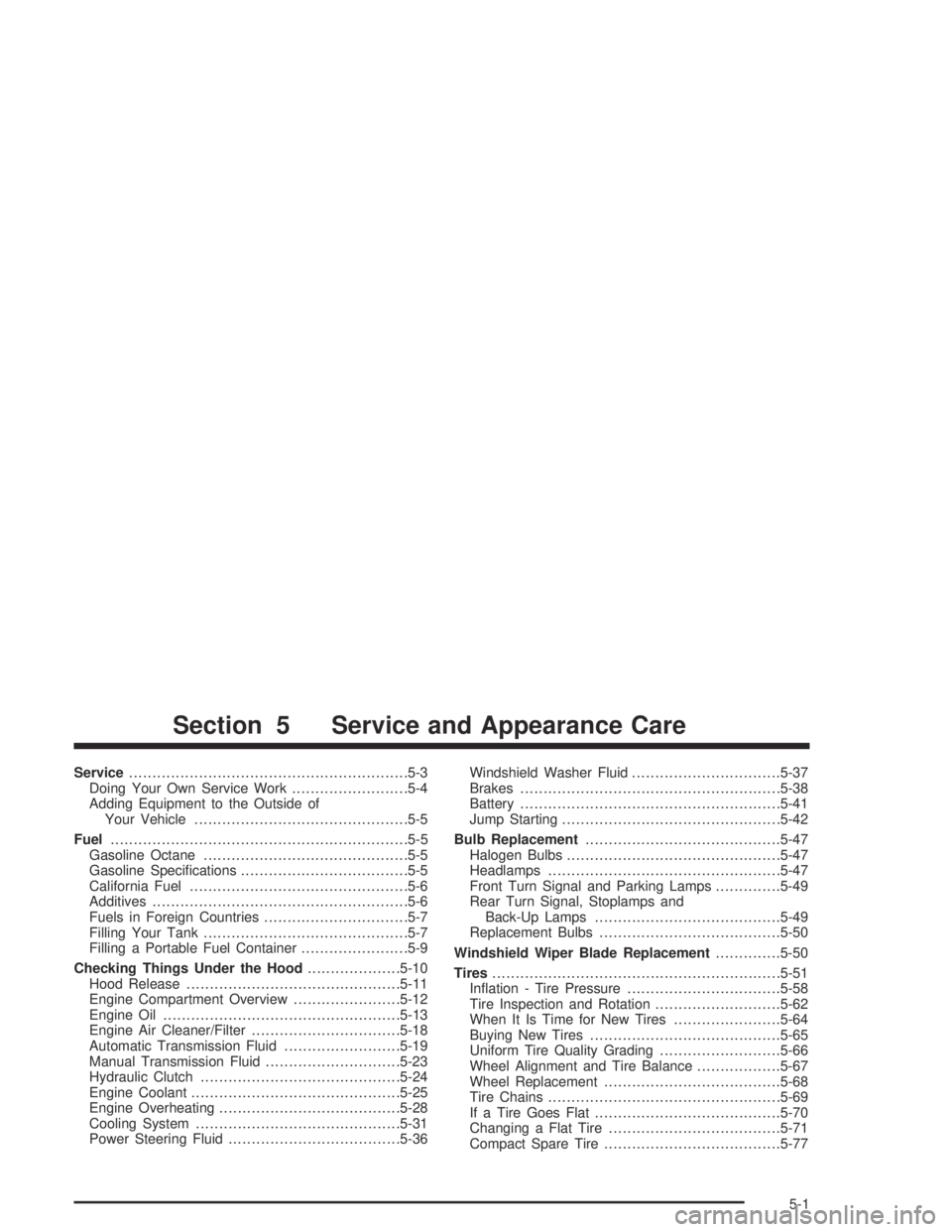
Service............................................................5-3
Doing Your Own Service Work.........................5-4
Adding Equipment to the Outside of
Your Vehicle..............................................5-5
Fuel................................................................5-5
Gasoline Octane............................................5-5
Gasoline Specifications....................................5-5
California Fuel...............................................5-6
Additives.......................................................5-6
Fuels in Foreign Countries...............................5-7
Filling Your Tank............................................5-7
Filling a Portable Fuel Container.......................5-9
Checking Things Under the Hood....................5-10
Hood Release..............................................5-11
Engine Compartment Overview.......................5-12
Engine Oil...................................................5-13
Engine Air Cleaner/Filter................................5-18
Automatic Transmission Fluid.........................5-19
Manual Transmission Fluid.............................5-23
Hydraulic Clutch...........................................5-24
Engine Coolant.............................................5-25
Engine Overheating.......................................5-28
Cooling System............................................5-31
Power Steering Fluid.....................................5-36Windshield Washer Fluid................................5-37
Brakes........................................................5-38
Battery........................................................5-41
Jump Starting...............................................5-42
Bulb Replacement..........................................5-47
Halogen Bulbs..............................................5-47
Headlamps..................................................5-47
Front Turn Signal and Parking Lamps..............5-49
Rear Turn Signal, Stoplamps and
Back-Up Lamps........................................5-49
Replacement Bulbs.......................................5-50
Windshield Wiper Blade Replacement..............5-50
Tires..............................................................5-51
Inflation - Tire Pressure.................................5-58
Tire Inspection and Rotation...........................5-62
When It Is Time for New Tires.......................5-64
Buying New Tires.........................................5-65
Uniform Tire Quality Grading..........................5-66
Wheel Alignment and Tire Balance..................5-67
Wheel Replacement......................................5-68
Tire Chains..................................................5-69
If a Tire Goes Flat........................................5-70
Changing a Flat Tire.....................................5-71
Compact Spare Tire......................................5-77
Section 5 Service and Appearance Care
5-1
Page 242 of 326
Winter Tires
If you expect to drive on snow or ice covered roads
often, you may want to get winter tires for your vehicle.
High performance tires, like the original equipment
tires installed on your vehicle, are designed for very
responsive driving on wet or dry pavement and may not
offer the traction you would like or the same level of
performance as winter tires on snow or ice covered
roads. If you choose to use winter tires:
•Use tires of the same brand and tread type on all
four wheel positions.
•Use only radial ply tires of the same size as your
original equipment tires.
See your Pontiac dealer for details regarding winter tire
availability and proper tire selection. Also, seeBuying
New Tires on page 5-65.
Tire Sidewall Labeling
Useful information about a tire is molded into its
sidewall. The examples below show a typical passenger
car tire and a compact spare tire sidewall.
Passenger Car Tire Example
5-52
Page 253 of 326

If your vehicle has 235/40ZR18 tires, they must roll in a
certain direction for the best overall performance.
The direction is shown by an arrow on the tire sidewall.
Because these tires are uni-directional, they should
be rotated as shown here. These tires should only be
moved from front to rear and rear to front on the
same side of the vehicle.
Don’t include the compact spare tire in your tire rotation.After the tires have been rotated, adjust the front and
rear inflation pressures as shown on the Tire and
Loading Information label. Make certain that all wheel
nuts are properly tightened. See “Wheel Nut Torque”
underCapacities and Specifications on page 5-92.
{CAUTION:
Rust or dirt on a wheel, or on the parts to
which it is fastened, can make wheel nuts
become loose after a time. The wheel could
come off and cause an accident. When you
change a wheel, remove any rust or dirt from
places where the wheel attaches to the vehicle.
In an emergency, you can use a cloth or a
paper towel to do this; but be sure to use a
scraper or wire brush later, if you need to, to
get all the rust or dirt off. See “Changing a Flat
Tire” in the Index.
5-63
Page 255 of 326

Buying New Tires
To find out what kind and size of tires you need, look at
the Tire and Loading Information label. For more
information about this label and where to find it, see
Loading Your Vehicle on page 4-30.
Make sure the replacements are the same size,
load capacity, speed rating and construction type
(bias, bias-belted or radial) as your original tires.
{CAUTION:
Mixing tires could cause you to lose control
while driving. If you mix tires of different sizes
or types (radial and bias-belted tires), the
vehicle may not handle properly, and you
could have a crash. Using tires of different
sizes may also cause damage to your vehicle.
Be sure to use the same size and type tires on
all wheels. It’s all right to drive with your
compact spare temporarily, it was developed
for use on your vehicle. See “Compact Spare
Tire” in the index.
{CAUTION:
If you use bias-ply tires on your vehicle, the
wheel rim anges could develop cracks after
many miles of driving. A tire and/or wheel
could fail suddenly, causing a crash. Use only
radial-ply tires with the wheels on your vehicle.
5-65
Page 262 of 326
Removing the Spare Tire and Tools
The equipment you’ll need is in the trunk. The temporary
spare wheel is stored in a compartment under the
trunk floor.
1. Open the trunk and remove the spare wheel cover.
The spare wheel cover has a vehicle jacking label
on it showing the instructions that should be
followed.
2. Turn the wing nut on the spare tire counterclockwise
and remove it. Then lift the spare tire out of the
vehicle. SeeCompact Spare Tire on page 5-77later
in this section for more information about the
compact spare.3. Remove the jack, wheel wrench, and nut cap
removal tool from storage. Your vehicle’s jack,
wheel wrench, and nut cap removal tool are stored
in a container in the floor, under the spare tire.
5-72
Page 263 of 326
Removing the Flat Tire and Installing
the Spare Tire
Remove the wheel nut caps as follows:
1. Remove each wheel nut cap individually with the
wheel nut cap tool provided. Insert the nut cap tool
into the nut cavity, squeeze the tool to grasp the
nut cap, and pull out to remove it. Store the
nut caps in a clean area to avoid dirt getting
into them.
If the nut caps are hard to remove, use the tip of
the wheel wrench to remove the nut caps.2. Then use the wheel wrench to loosen all the wheel
nuts. Don’t remove them yet.
3. Fit the jack handle onto
the jack by sliding the
open end of the
handle over the nut
end of the jack.
Position the jack and
raise the jack head until
it fits firmly into
notches A and B in the
vehicle’s frame
closest to the tire being
changed.
Put the compact spare tire near you.
5-73
Page 264 of 326
{CAUTION:
Getting under a vehicle when it is jacked up is
dangerous. If the vehicle slips off the jack you
could be badly injured or killed. Never get
under a vehicle when it is supported only by
a jack.
{CAUTION:
Raising your vehicle with the jack improperly
positioned can damage the vehicle and even
make the vehicle fall. To help avoid personal
injury and vehicle damage, be sure to t the
jack lift head into the proper location before
raising the vehicle.4. Raise the vehicle by turning the wheel wrench
clockwise. Raise the vehicle far enough off the
ground so there is enough room for the compact
spare tire to fit underneath the wheel well.
The jack handle must be unfolded to a right angle
before it is used.
5. Remove all of the wheel nuts.
6. Remove the flat tire.
5-74
Page 265 of 326
7. Remove any rust or dirt
from the wheel bolts,
mounting surfaces, and
spare wheel.
{CAUTION:
Rust or dirt on the wheel, or on the parts to
which it is fastened, can make the wheel nuts
become loose after a time. The wheel could
come off and cause an accident. When you
change a wheel, remove any rust or dirt from
the places where the wheel attaches to the
vehicle. In an emergency, you can use a cloth
or a paper towel to do this; but be sure to use
a scraper or wire brush later, if you need to, to
get all the rust or dirt off.
{CAUTION:
Never use oil or grease on studs or nuts. If
you do, the nuts might come loose. Your wheel
could fall off, causing a serious accident.
8. Install the compact spare tire.
9. Put the wheel nuts back on with the rounded end of
the nuts toward the wheel. Tighten each nut by
hand until the wheel is held against the hub.
5-75


