2004 Oldsmobile Bravada power steering
[x] Cancel search: power steeringPage 325 of 420

(D) Construction Code:A letter code is used to
indicate the type of ply construction in the tire. The letter
“R” means radial ply construction; the letter “D” means
diagonal or bias ply construction; and the letter “B”
means belted-bias ply construction.
(E) Rim Diameter:Diameter of the wheel in inches.
(F) Service Description:The service description
indicates the load range and speed rating of a tire. The
load index can range from 1 to 279. Speed ratings
range from “A” to “Z”. The light truck tire size example
above shows dual or single tire congurations.
Tire Terminology and Denitions
Air Pressure:The amount of air inside the tire pressing
outward on each square inch of the tire. Air pressure
is expressed in pounds per square inch (psi) or
kilopascal (kPa).
Accessory Weight:This means the combined weight
of optional accessories. Some examples of optional
accessories are, automatic transmission, power steering,
power brakes, power windows, power seats, and air
conditioning.
Aspect Ratio:The relationship of a tire’s height to
its width.Belt:A rubber coated layer of cords that is located
between the plies and the tread. Cords may be made
from steel or other reinforcing materials.
Bead:The tire bead contains steel wires wrapped by
steel cords that hold the tire onto the rim.
Bias Ply Tire:A pneumatic tire in which the plies are
laid at alternate angles less than 90 degrees to the
centerline of the tread.
Cold Ination Pressure:The amount of air pressure in
a tire, measured in pounds per square inch (psi) or
kilopascals (kPa) before a tire has built up heat
from driving. SeeInation - Tire Pressure on page 5-64.
Curb Weight:This means the weight of a motor
vehicle with standard and optional equipment including
the maximum capacity of fuel, oil and coolant, but
without passengers and cargo.
DOT Markings:A code molded into the sidewall of a
tire signifying that the tire is in compliance with the U.S.
Department of Transportation motor vehicle safety
standards. The DOT code includes the Tire Identication
Number (TIN), an alphanumeric designator which can
also identify the tire manufacturer, production plant,
brand and date of production.
GVWR:Gross Vehicle Weight Rating, seeLoading
Your Vehicle on page 4-43.
5-61
Page 378 of 420

Maintenance Footnotes
†The U.S. Environmental Protection Agency or the
California Air Resources Board has determined that the
failure to perform this maintenance item will not nullify
the emission warranty or limit recall liability prior to
the completion of the vehicle’s useful life. We, however,
urge that all recommended maintenance services be
performed at the indicated intervals and the
maintenance be recorded.
(a)Visually inspect brake lines and hoses for proper
hook-up, binding, leaks, cracks, chang, etc. Inspect
disc brake pads for wear and rotors for surface
condition. Inspect other brake parts, including calipers,
parking brake, etc.
(b)Visually inspect front and rear suspension and
steering system for damaged, loose or missing parts or
signs of wear. Inspect power steering lines and
hoses for proper hook-up, binding, leaks, cracks,
chang, etc.
(c)Visually inspect hoses and have them replaced if they
are cracked, swollen or deteriorated. Inspect all pipes,
ttings and clamps; replace with genuine GM parts as
needed. To help ensure proper operation, a pressure test
of the cooling system and pressure cap and cleaning the
outside of the radiator and air conditioning condenser is
recommended at least once a year.(d)Visually inspect wiper blades for wear or cracking.
Replace blade inserts that appear worn or damaged
or that streak or miss areas of the windshield.
(e)Make sure the safety belt reminder light and all your
belts, buckles, latch plates, retractors and anchorages
are working properly. Look for any other loose or
damaged safety belt system parts. If you see anything
that might keep a safety belt system from doing its
job, have it repaired. Have any torn or frayed safety belts
replaced. Also look for any opened or broken air bag
coverings, and have them repaired or replaced. (The air
bag system does not need regular maintenance.)
(f)Lubricate all key lock cylinders, hood latch assembly,
secondary latch, pivots, spring anchor, release pawl,
rear compartment hinges, outer liftgate handle pivot
points, rear door detent link, roller mechanism, liftgate
handle pivot points, latch bolt, fuel door hinge, cargo
door hinge, locks and folding seat hardware. More
frequent lubrication may be required when exposed to a
corrosive environment. Applying silicone grease on
weatherstrips with a clean cloth will make them
last longer, seal better and not stick or squeak.
(g)Add uid as needed. A uid loss could indicate a
problem; repair as needed. Check vent hose at transfer
case for kinks and proper installation.
6-8
Page 383 of 420
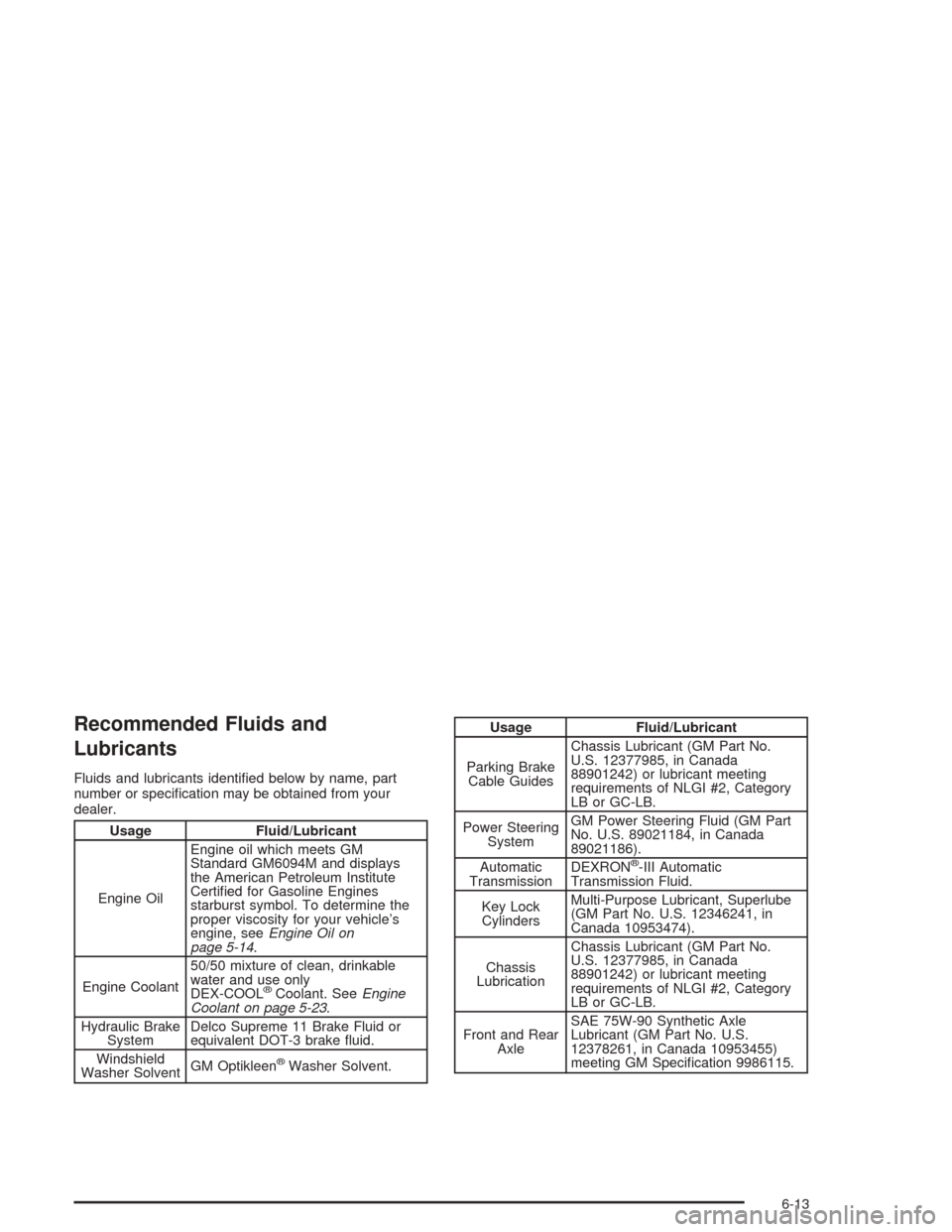
Recommended Fluids and
Lubricants
Fluids and lubricants identied below by name, part
number or specication may be obtained from your
dealer.
Usage Fluid/Lubricant
Engine OilEngine oil which meets GM
Standard GM6094M and displays
the American Petroleum Institute
Certied for Gasoline Engines
starburst symbol. To determine the
proper viscosity for your vehicle’s
engine, seeEngine Oil on
page 5-14.
Engine Coolant50/50 mixture of clean, drinkable
water and use only
DEX-COOL
®Coolant. SeeEngine
Coolant on page 5-23.
Hydraulic Brake
SystemDelco Supreme 11 Brake Fluid or
equivalent DOT-3 brake uid.
Windshield
Washer SolventGM Optikleen
®Washer Solvent.
Usage Fluid/Lubricant
Parking Brake
Cable GuidesChassis Lubricant (GM Part No.
U.S. 12377985, in Canada
88901242) or lubricant meeting
requirements of NLGI #2, Category
LB or GC-LB.
Power Steering
SystemGM Power Steering Fluid (GM Part
No. U.S. 89021184, in Canada
89021186).
Automatic
TransmissionDEXRON
®-III Automatic
Transmission Fluid.
Key Lock
CylindersMulti-Purpose Lubricant, Superlube
(GM Part No. U.S. 12346241, in
Canada 10953474).
Chassis
LubricationChassis Lubricant (GM Part No.
U.S. 12377985, in Canada
88901242) or lubricant meeting
requirements of NLGI #2, Category
LB or GC-LB.
Front and Rear
AxleSAE 75W-90 Synthetic Axle
Lubricant (GM Part No. U.S.
12378261, in Canada 10953455)
meeting GM Specication 9986115.
6-13
Page 403 of 420

A
Accessory Inator...........................................5-71
Accessory Power Outlets.................................3-20
Adding a Snow Plow or Similar Equipment.........4-49
Adding Washer Fluid.......................................5-36
Additional Program Information........................... 7-9
Additives, Fuel................................................. 5-6
Add-On Electrical Equipment............................5-98
Adjusting the Speakers (Balance/Fade)......3-62, 3-72
After Off-Road Driving.....................................4-28
Air Bag
Readiness Light..........................................3-32
Air Bag Systems.............................................1-46
How Does an Air Bag Restrain?....................1-52
Servicing Your Air Bag-Equipped Vehicle.........1-55
What Makes an Air Bag Inate?....................1-52
What Will You See After an Air Bag Inates?......1-53
When Should an Air Bag Inate?...................1-51
Where Are the Air Bags?..............................1-48
Air Cleaner/Filter, Engine.................................5-19
Airbag Sensing and Diagnostic Module (SDM)....7-10
All-Wheel Drive...............................................5-47
All-Wheel Drive (AWD) System.........................2-24
All-Wheel-Drive Service Light............................3-42
AM ...............................................................3-96
Antenna, Fixed Mast.......................................3-98
Anti-lock Brake System..................................... 4-7Anti-Lock Brake, System Warning Light..............3-35
Appearance Care............................................5-88
Care of Safety Belts....................................5-91
Chemical Paint Spotting...............................5-95
Cleaning the Inside of Your Vehicle................5-88
Cleaning the Outside of Your Vehicle..............5-91
Finish Damage............................................5-94
Sheet Metal Damage...................................5-94
Underbody Maintenance...............................5-95
Vehicle Care/Appearance Materials................5-96
Weatherstrips..............................................5-91
Approaching a Hill..........................................4-21
Ashtrays........................................................3-20
Audio Output..................................................3-90
Audio System(s).............................................3-58
Audio Steering Wheel Controls......................3-95
Care of Your Cassette Tape Player................3-96
Care of Your CD and DVD Player..................3-97
Care of Your CDs and DVDs........................3-97
Chime Level Adjustment...............................3-98
Fixed Mast Antenna.....................................3-98
Navigation/Radio System..............................3-81
Audio Systems
Radio Personalization...................................3-94
Audio System(s)
Radio with Cassette and CD.........................3-59
Radio with Six-Disc CD................................3-69
1
Page 408 of 420

Engine (cont.)
Fan Noise..................................................5-34
Oil .............................................................5-14
Overheating................................................5-26
Reduced Power Light...................................3-42
Starting......................................................2-20
Engine Compartment Fuse Block......................5-99
ENGINE COOLANT HOT/ENGINE
OVERHEATED............................................3-55
Engine Oil Additives........................................5-17
Entertainment System
Cleaning the Video Screen...........................3-98
DVD Distortion............................................3-96
Entry Lighting.................................................3-18
Environmental Concerns..................................4-18
Erasing HomeLink
®Buttons..............................2-37
Event Data Records (EDR)..............................7-10
Exit Lighting...................................................3-18
Express–Down Window....................................2-15
Extender, Safety Belt.......................................1-26
Exterior Lamps...............................................3-15
F
Filter
Engine Air Cleaner......................................5-19
Finding a PTY Station.............................3-63, 3-73
Finding a Station....................................3-60, 3-71
Finish Care....................................................5-92
Finish Damage...............................................5-94
Fixed Mast Antenna........................................3-98
Flash-to-Pass................................................... 3-9
Flat Tire........................................................5-73
Flat Tire, Changing.........................................5-74
Fluid
Automatic Transmission................................5-20
Power Steering...........................................5-35
Windshield Washer......................................5-36
FM ...............................................................3-96
Fog Lamps....................................................3-17
Following Distance..........................................4-57
Front Axle......................................................5-48
Front Storage Area.........................................2-39
6
Page 410 of 420

HomeLink®Transmitter, Programming................2-34
Hood
Checking Things Under................................5-10
Release.....................................................5-10
Horn............................................................... 3-7
How to Add Coolant to the Coolant Recovery
Tank ..........................................................5-29
How to Add Coolant to the Radiator..................5-32
How to Add Fluid............................................5-23
How to Check........................................5-21, 5-64
How to Check Lubricant...................................5-48
How to Check Power Steering Fluid..................5-35
How to Inspect...............................................5-20
How to Use This Manual...................................... ii
How to Wear Safety Belts Properly...................1-13
Hydroplaning..................................................4-32
I
ICE POSSIBLE..............................................3-56
If No Steam Is Coming From Your Engine..........5-27
If Steam Is Coming From Your Engine...............5-26If the Light Is Flashing.....................................3-38
If the Light Is On Steady.................................3-38
If You Are Caught in a Blizzard.........................4-40
If You Are Stuck in Sand, Mud, Ice or Snow.......4-42
If You Do Decide To Pull A Trailer.....................4-51
Ignition Positions.............................................2-19
Infants and Young Children, Restraints...............1-29
Ination - Tire Pressure...................................5-64
Instrument Panel
Cluster.......................................................3-29
Overview..................................................... 3-4
Instrument Panel Brightness.............................3-17
Interior Lamps................................................3-17
J
Jump Starting.................................................5-41
K
Keyless Entry System....................................... 2-4
Keys............................................................... 2-3
8
Page 414 of 420

Playing a Specic Loaded
Compact Disc.............................................3-77
Playing the Radio...................................3-59, 3-69
Power
Accessory Outlets........................................3-20
Door Locks.................................................. 2-8
Electrical System.........................................5-98
Lumbar Controls........................................... 1-2
Reclining Seatbacks...................................... 1-4
Reduced Engine Light..................................3-42
Seat............................................................ 1-2
Steering Fluid.............................................5-35
Windows....................................................2-15
Power Steering...............................................4-11
Programmable Automatic Door Locks.................. 2-9
Programmable Locking Feature.........................2-10
Programmable Unlocking Feature......................2-11
Programming the HomeLink
®Transmitter...........2-34
Q
Questions and Answers About Safety Belts.........1-12
R
Radiator Pressure Cap....................................5-25
Radios..........................................................3-58
Care of Your Cassette Tape Player................3-96
Care of Your CD and DVD Player..................3-97
Care of Your CDs and DVDs........................3-97
Navigation/Radio System..............................3-81
Radio Personalization...................................3-94
Radio with Cassette and CD.........................3-59
Radio with Six-Disc CD................................3-69
Rear Seat Audio..........................................3-93
Setting the Time..........................................3-58
Theft-Deterrent............................................3-94
Understanding Reception..............................3-96
Rainsense™ Wipers........................................3-10
RDS Messages......................................3-64, 3-75
Reading Lamps..............................................3-19
REAR ACCESS OPEN....................................3-56
Rear Axle......................................................5-48
Locking......................................................4-11
Rear Climate Control System............................3-26
12
Page 420 of 420

Wheels
Alignment and Tire Balance..........................5-69
Replacement...............................................5-69
When to Add Engine Oil..................................5-15
When to Change Engine Oil
(GM Oil Life System)...................................5-18
When to Check..............................................5-64
When to Check and Change............................5-20
When to Check Lubricant.................................5-48
When to Check Power Steering Fluid................5-35
When to Inspect.............................................5-19
When You Are Ready to Leave After Parking
on a Hill.....................................................4-59
Where to Put the Restraint...............................1-35
Why Safety Belts Work..................................... 1-9Window Lockout.............................................2-15
Windows.......................................................2-14
Power........................................................2-15
Windshield Washer.........................................3-11
Fluid..........................................................5-36
Windshield Wiper
Blade Replacement......................................5-52
Fuses........................................................5-98
Windshield Wipers..........................................3-10
Winter Driving................................................4-38
Y
Your Vehicle and the Environment....................... 6-2
18