Page 207 of 306
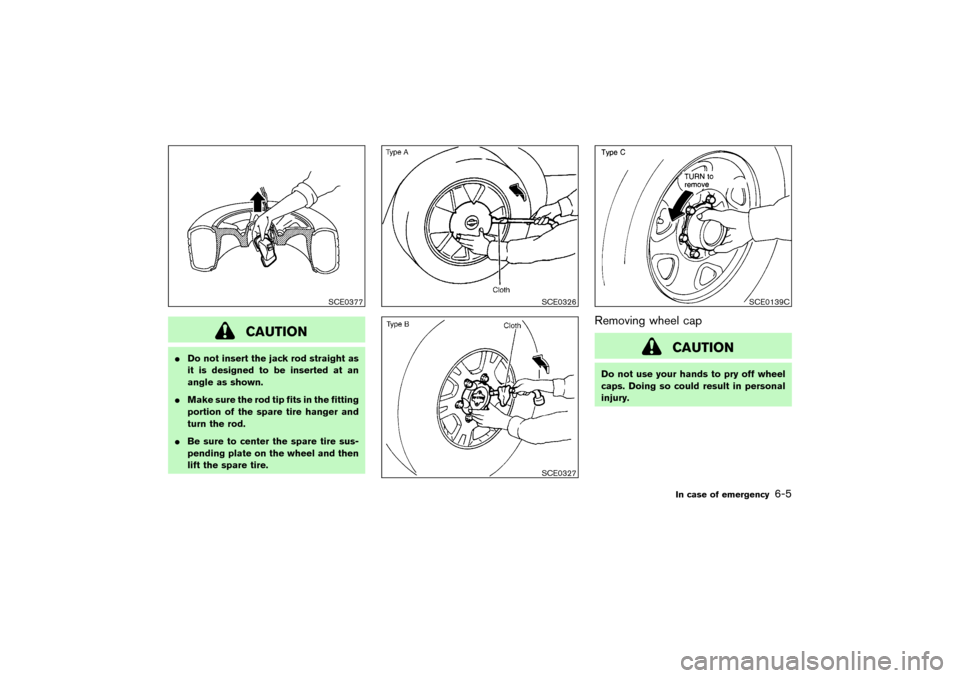
CAUTION
�Do not insert the jack rod straight as
it is designed to be inserted at an
angle as shown.
�Make sure the rod tip fits in the fitting
portion of the spare tire hanger and
turn the rod.
�Be sure to center the spare tire sus-
pending plate on the wheel and then
lift the spare tire.
Removing wheel cap
CAUTION
Do not use your hands to pry off wheel
caps. Doing so could result in personal
injury.
SCE0377
SCE0326SCE0327
SCE0139C
In case of emergency
6-5
�
04.3.9/R50-D/V5
�
Page 208 of 306
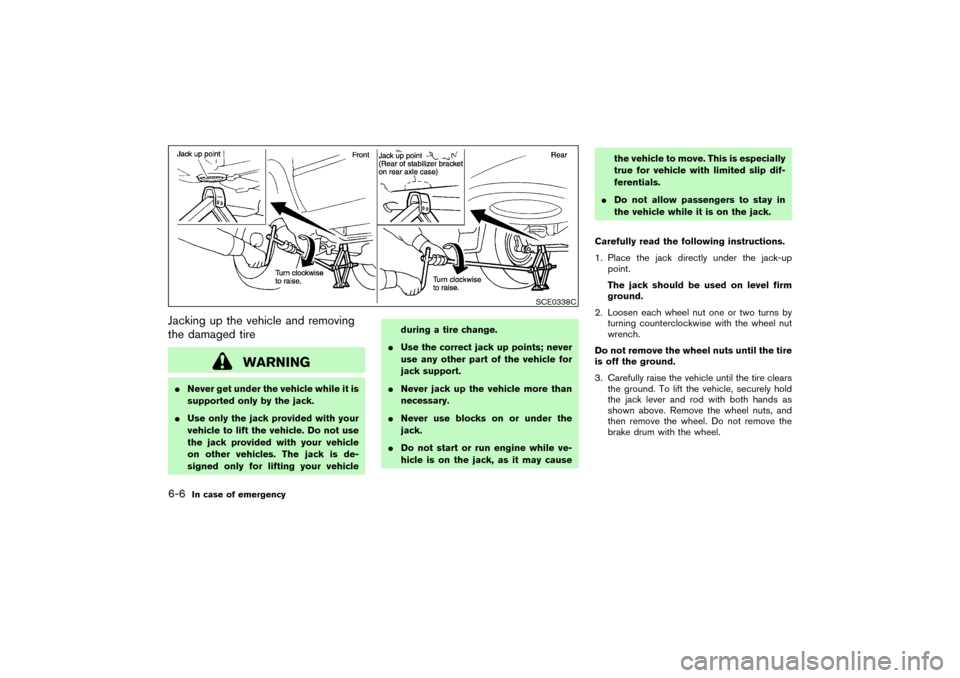
Jacking up the vehicle and removing
the damaged tire
WARNING
�Never get under the vehicle while it is
supported only by the jack.
�Use only the jack provided with your
vehicle to lift the vehicle. Do not use
the jack provided with your vehicle
on other vehicles. The jack is de-
signed only for lifting your vehicleduring a tire change.
�Use the correct jack up points; never
use any other part of the vehicle for
jack support.
�Never jack up the vehicle more than
necessary.
�Never use blocks on or under the
jack.
�Do not start or run engine while ve-
hicle is on the jack, as it may causethe vehicle to move. This is especially
true for vehicle with limited slip dif-
ferentials.
�Do not allow passengers to stay in
the vehicle while it is on the jack.
Carefully read the following instructions.
1. Place the jack directly under the jack-up
point.
The jack should be used on level firm
ground.
2. Loosen each wheel nut one or two turns by
turning counterclockwise with the wheel nut
wrench.
Do not remove the wheel nuts until the tire
is off the ground.
3. Carefully raise the vehicle until the tire clears
the ground. To lift the vehicle, securely hold
the jack lever and rod with both hands as
shown above. Remove the wheel nuts, and
then remove the wheel. Do not remove the
brake drum with the wheel.
SCE0338C
6-6
In case of emergency
�
04.3.9/R50-D/V5
�
Page 209 of 306
Installing the spare tireThe spare tire is designed for emergency
use. See specific instructions under the
heading “Wheels and tires” in the “Main-
tenance and do-it-yourself” section.
1. Clean any mud or dirt from the surface
between the wheel and hub.
2. Carefully put the wheel on and tighten the
wheel nuts finger tight.
3. With the wheel nut wrench, tighten wheel
nuts alternately and evenly until they are tight.
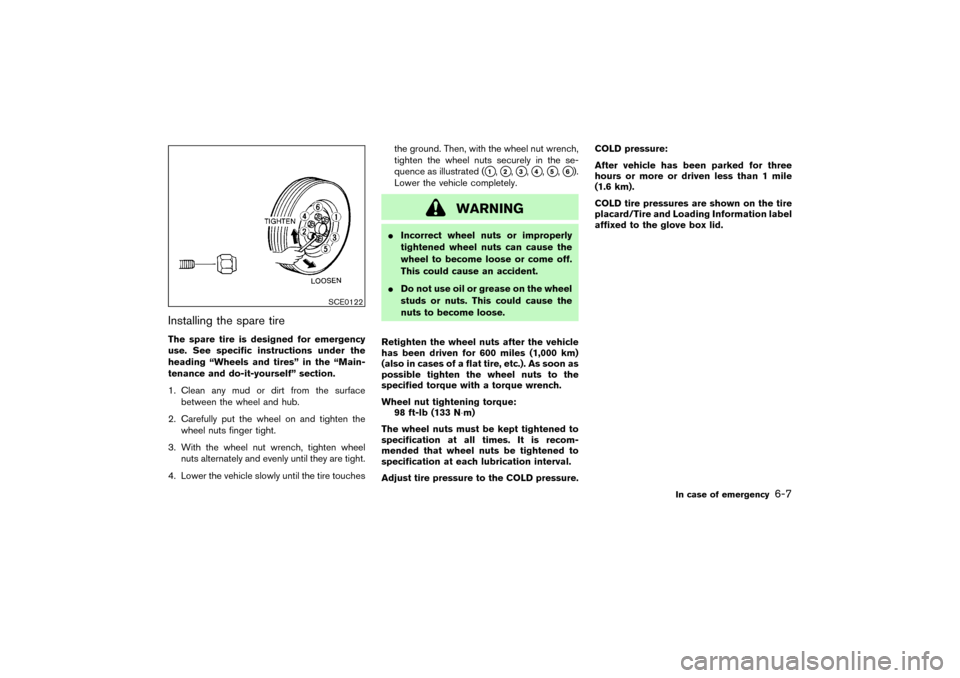
4. Lower the vehicle slowly until the tire touchesthe ground. Then, with the wheel nut wrench,
tighten the wheel nuts securely in the se-
quence as illustrated (
�1,�2,�3,�4,�5,�6).
Lower the vehicle completely.
WARNING
�Incorrect wheel nuts or improperly
tightened wheel nuts can cause the
wheel to become loose or come off.
This could cause an accident.
�Do not use oil or grease on the wheel
studs or nuts. This could cause the
nuts to become loose.
Retighten the wheel nuts after the vehicle
has been driven for 600 miles (1,000 km)
(also in cases of a flat tire, etc.). As soon as
possible tighten the wheel nuts to the
specified torque with a torque wrench.
Wheel nut tightening torque:
98 ft-lb (133 N⋅m)
The wheel nuts must be kept tightened to
specification at all times. It is recom-
mended that wheel nuts be tightened to
specification at each lubrication interval.
Adjust tire pressure to the COLD pressure.COLD pressure:
After vehicle has been parked for three
hours or more or driven less than 1 mile
(1.6 km).
COLD tire pressures are shown on the tire
placard/Tire and Loading Information label
affixed to the glove box lid.
SCE0122
In case of emergency
6-7
�
04.3.9/R50-D/V5
�
Page 210 of 306
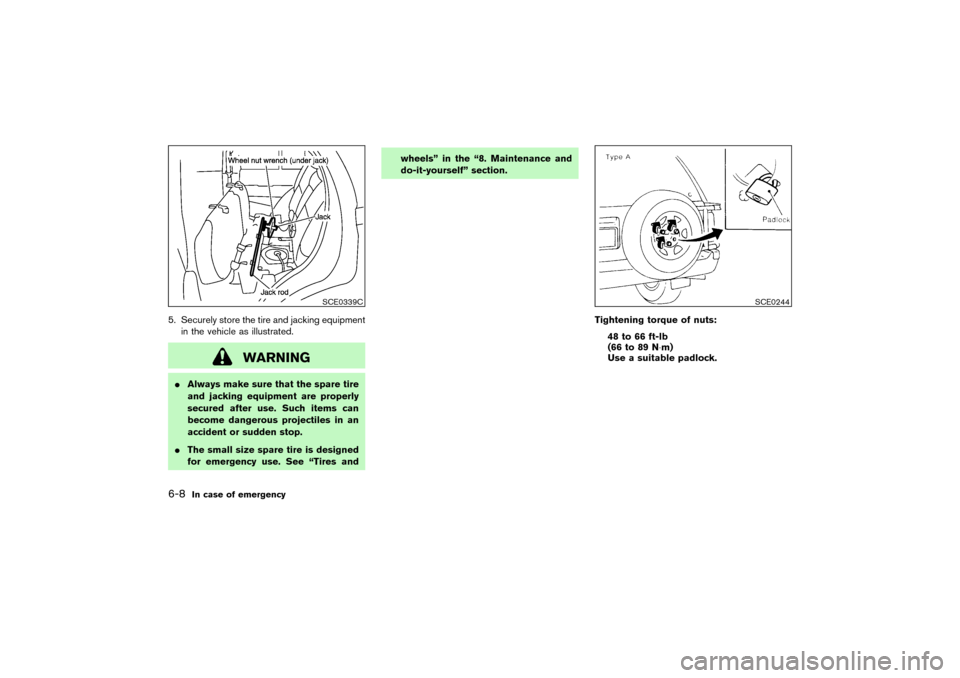
5. Securely store the tire and jacking equipment
in the vehicle as illustrated.
WARNING
�Always make sure that the spare tire
and jacking equipment are properly
secured after use. Such items can
become dangerous projectiles in an
accident or sudden stop.
�The small size spare tire is designed
for emergency use. See “Tires andwheels” in the “8. Maintenance and
do-it-yourself” section.
Tightening torque of nuts:
48 to 66 ft-lb
(66 to 89 N⋅m)
Use a suitable padlock.
SCE0339C
SCE0244
6-8
In case of emergency
�
04.3.9/R50-D/V5
�
Page 211 of 306
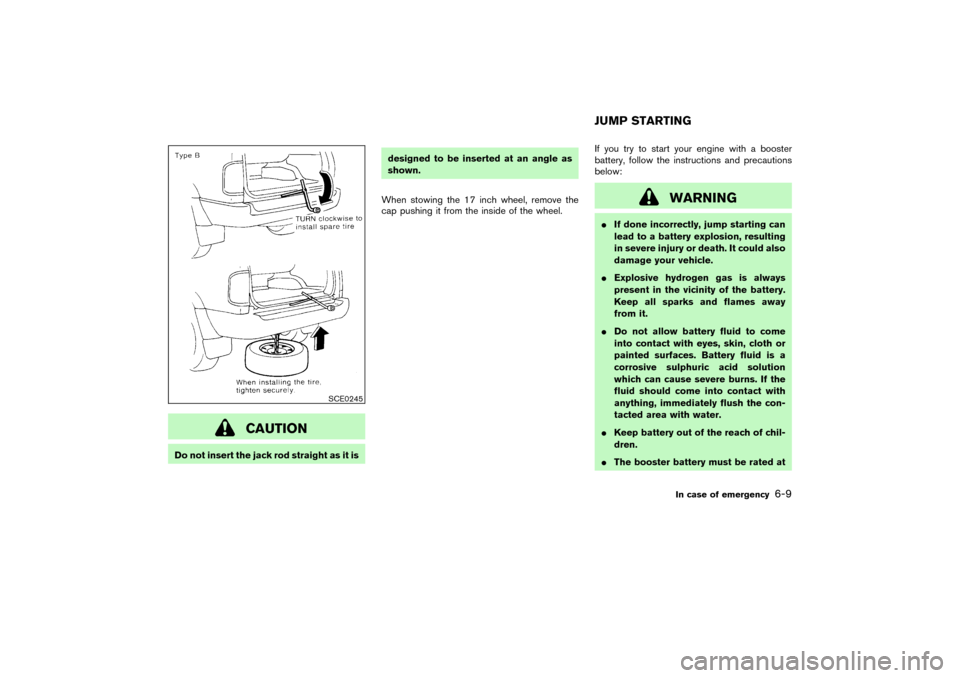
CAUTION
Do not insert the jack rod straight as it isdesigned to be inserted at an angle as
shown.
When stowing the 17 inch wheel, remove the
cap pushing it from the inside of the wheel.If you try to start your engine with a booster
battery, follow the instructions and precautions
below:
WARNING
�If done incorrectly, jump starting can
lead to a battery explosion, resulting
in severe injury or death. It could also
damage your vehicle.
�Explosive hydrogen gas is always
present in the vicinity of the battery.
Keep all sparks and flames away
from it.
�Do not allow battery fluid to come
into contact with eyes, skin, cloth or
painted surfaces. Battery fluid is a
corrosive sulphuric acid solution
which can cause severe burns. If the
fluid should come into contact with
anything, immediately flush the con-
tacted area with water.
�Keep battery out of the reach of chil-
dren.
�The booster battery must be rated at
SCE0245
JUMP STARTING
In case of emergency
6-9
�
04.3.9/R50-D/V5
�
Page 216 of 306
TOWING RECOMMENDED BY
NISSAN
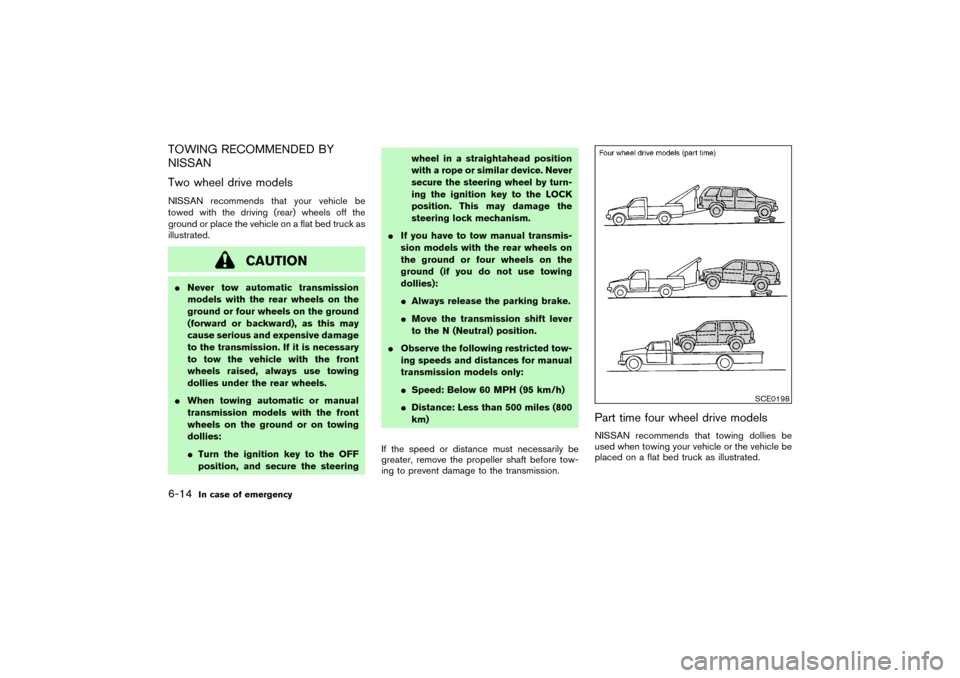
Two wheel drive modelsNISSAN recommends that your vehicle be
towed with the driving (rear) wheels off the
ground or place the vehicle on a flat bed truck as
illustrated.
CAUTION
�Never tow automatic transmission
models with the rear wheels on the
ground or four wheels on the ground
(forward or backward), as this may
cause serious and expensive damage
to the transmission. If it is necessary
to tow the vehicle with the front
wheels raised, always use towing
dollies under the rear wheels.
�When towing automatic or manual
transmission models with the front
wheels on the ground or on towing
dollies:
�Turn the ignition key to the OFF
position, and secure the steeringwheel in a straightahead position
with a rope or similar device. Never
secure the steering wheel by turn-
ing the ignition key to the LOCK
position. This may damage the
steering lock mechanism.
�If you have to tow manual transmis-
sion models with the rear wheels on
the ground or four wheels on the
ground (if you do not use towing
dollies):
�Always release the parking brake.
�Move the transmission shift lever
to the N(Neutral) position.
�Observe the following restricted tow-
ing speeds and distances for manual
transmission models only:
�Speed: Below 60 MPH (95 km/h)
�Distance: Less than 500 miles (800
km)
If the speed or distance must necessarily be
greater, remove the propeller shaft before tow-
ing to prevent damage to the transmission.
Part time four wheel drive modelsNISSAN recommends that towing dollies be
used when towing your vehicle or the vehicle be
placed on a flat bed truck as illustrated.
SCE0198
6-14
In case of emergency
�
04.3.9/R50-D/V5
�
Page 217 of 306
CAUTION
�Never tow automatic transmission
models with the rear wheels on the
ground or four wheels on the ground,
as this may cause serious and expen-
sive damage to the transmission. If it
is necessary to tow the vehicle with
the front wheels raised, always use
towing dollies under the rear wheels.
�When towing automatic or manual
transmission models with the front
wheels on the ground or on towing
dollies:
�Move the transfer case shift lever
to the 2H position.
�Turn the ignition key to the OFF
position, and secure the steering
wheel in a straight ahead position
with a rope or similar device. Never
secure the steering wheel by turn-
ing the ignition key to the LOCK
position. This may damage the
steering lock mechanism.�If you have to tow manual transmis-
sion models with the rear wheels on
the ground (if you do not use towing
dollies) or four wheels on the ground:
�Move the transfer case shift lever
to the 2H position.
�Move the transmission shift lever
to the N(Neutral) position.
�Always release the parking brake.
�Observe the following restricted tow-
ing speeds and distances manual
transmission models only:
�Speed: Below 60 MPH (95 km/h)
�Distance: Less than 500 miles (800
km)
If the speed or distance must necessarily be
greater, remove the front and rear propeller
shafts before towing to prevent damage to the
transmission.
In case of emergency
6-15
�
04.3.9/R50-D/V5
�
Page 218 of 306
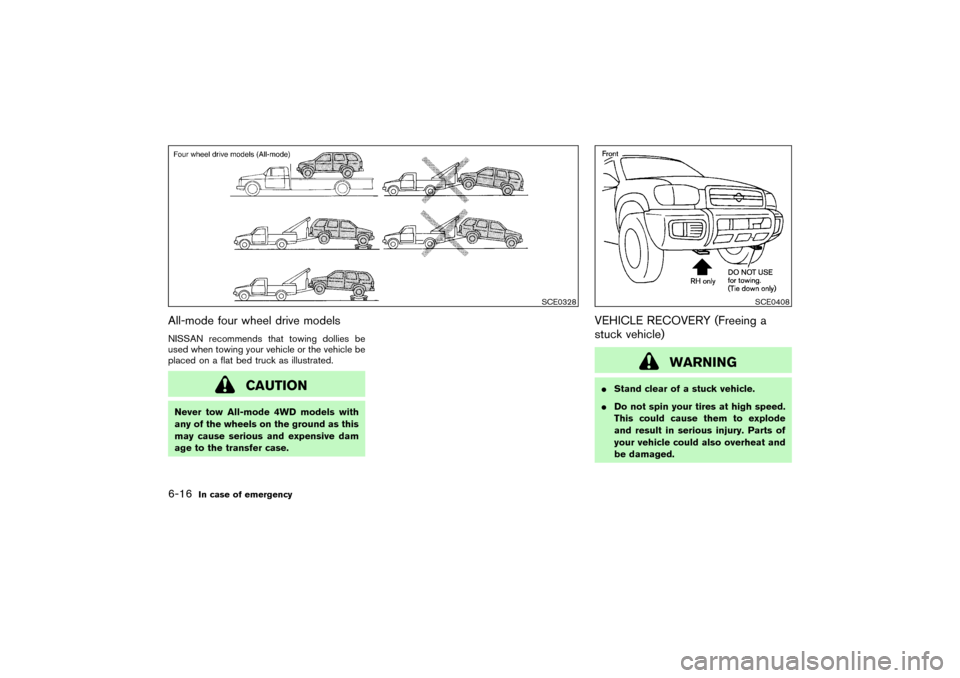
All-mode four wheel drive modelsNISSAN recommends that towing dollies be
used when towing your vehicle or the vehicle be
placed on a flat bed truck as illustrated.
CAUTION
Never tow All-mode 4WD models with
any of the wheels on the ground as this
may cause serious and expensive dam
age to the transfer case.
VEHICLE RECOVERY (Freeing a
stuck vehicle)
WARNING
�Stand clear of a stuck vehicle.
�Do not spin your tires at high speed.
This could cause them to explode
and result in serious injury. Parts of
your vehicle could also overheat and
be damaged.
SCE0328
SCE0408
6-16
In case of emergency
�
04.3.9/R50-D/V5
�