Page 251 of 283
aftermarket fuel additives (for example, fuel in-
jector cleaner, octane booster, intake valve de-
posit removers, etc.) which are sold commer-
cially. Many of these additives intended for gum,
varnish or deposit removal may contain active
solvent or similar ingredients that can be harmful
to the fuel system and engine.Octane rating tipsUsing unleaded gasoline with an octane
rating lower than stated above can cause
persistent, heavy spark knock. (Spark
knock is a metallic rapping noise.) If se-
vere, this can lead to engine damage. If you
detect a persistent heavy spark knock even
when using gasoline of the stated octane
rating, or if you hear steady spark knock
while holding a steady speed on level
roads, have your dealer correct the condi-
tion. Failure to correct the condition is
misuse of the vehicle, for which NISSAN is
not responsible.
Incorrect ignition timing will result in knocking,
after-run or overheating. This in turn may cause
excessive fuel consumption or damage to the
engine. If any of the above symptoms are en-
countered, have your vehicle checked at a
NISSAN dealer or other competent service fa-
cility.
However, now and then you may noticelight spark knock for a short time while
accelerating or driving up hills. This is no
cause for concern, because you get the
greatest fuel benefit when there is light
spark knock for a short time under heavy
engine load.9-4
Technical and consumer information
�
04.4.5/Z50-D/V5.0
�
Page 265 of 283
than these or using improper towing equipment
could adversely affect vehicle handling, braking
and performance.
The ability of your vehicle to tow a trailer is not
only related to the maximum trailer loads, but
also the places you plan to tow. Tow weights
appropriate for level highway driving may have to
be reduced on very steep grades or in low
traction situations (for example, on slippery boat
ramps).
Temperature conditions also can affect towing.
For example, towing a heavy trailer in high
outside temperatures on graded roads can af-
fect engine performance and cause overheating.
The transmission high fluid temperature protec-
tion mode, which helps reduce the chance of
transmission damage, could activate and auto-
matically decrease engine power. Vehicle speed
may decrease to 40 to 50 MPH (65 to 80 km/h)
under high load. Plan your trip carefully to ac-
count for trailer and vehicle load, weather, and
road conditions.
WARNING
Overheating can result in reduced en-
gine power and lower vehicle speed.Also, when the high temperature mode
operates, vehicle speed may be gradu-
ally reduced. On highways, the reduced
speed may be lower than other traffic
which could increase the chance of a
collision. Be especially careful when
driving. If necessary, pull to the side of
the road at a safe place and allow the
engine to cool or the transmission to
return to normal operation.
Tongue loadKeep the tongue load between 9 to 11% of the
total trailer load within the maximum tongue load
limits shown in the following Towing
Load/Specifications Chart. If the tongue load
becomes excessive, rearrange cargo to allow for
proper tongue load.
Maximum gross vehicle weight/
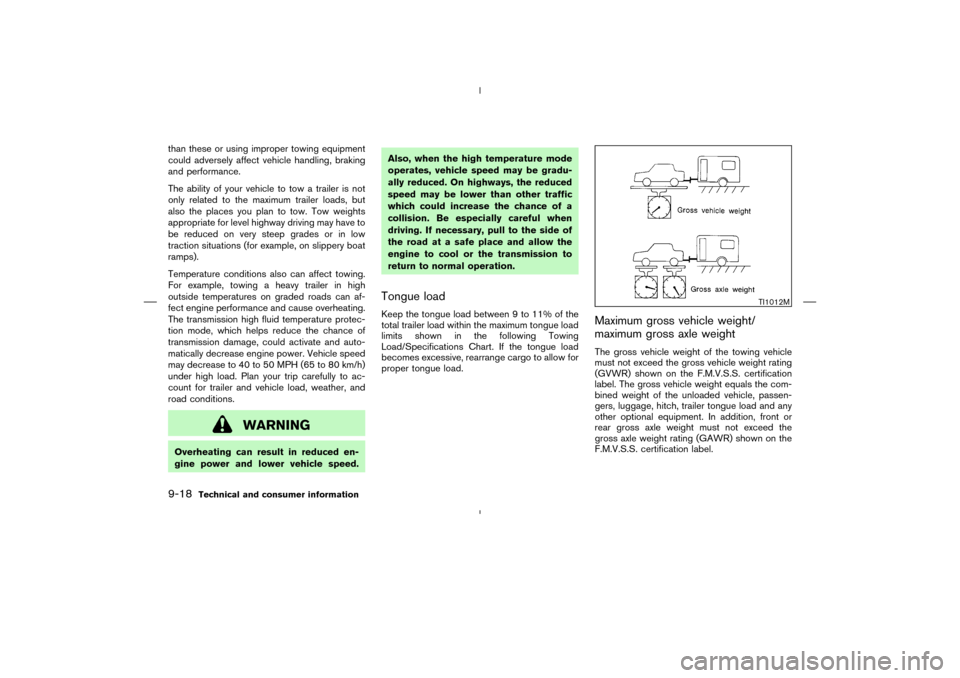
maximum gross axle weightThe gross vehicle weight of the towing vehicle
must not exceed the gross vehicle weight rating
(GVWR) shown on the F.M.V.S.S. certification
label. The gross vehicle weight equals the com-
bined weight of the unloaded vehicle, passen-
gers, luggage, hitch, trailer tongue load and any
other optional equipment. In addition, front or
rear gross axle weight must not exceed the
gross axle weight rating (GAWR) shown on the
F.M.V.S.S. certification label.
TI1012M
9-18
Technical and consumer information
�
04.4.5/Z50-D/V5.0
�
Page 268 of 283
recommended; however, if you must do so,
first block the wheels and apply the parking
brake, and then move the selector lever into
the P (Park) position. If you move the selector
lever to the P (Park) position before blocking
the wheels and applying the parking brake,
transmission damage could occur.
�When going down a hill, shift into a lower
gear and use the engine braking effect.
When going up a long grade, downshift the
transmission to a lower gear and reduce
speed to reduce chances of engine overload-
ing and/or overheating.
�If the engine coolant rises to an extremely
high temperature when the air conditioning
system is on, turn off the air conditioner.
Coolant heat can be additionally vented by
opening the windows, switching the fan con-
trol to high and setting the temperature con-
trol to the HOT position.
�If the transmission fluid rises to an extremely
high temperature, a high fluid temperature
protection mode may operate. See page
5-13 for details. If necessary, pull to the side
of the road at a safe place and let the
transmission cool before continuing.
�Trailer towing requires more fuel than normal
circumstances.�Avoid towing a trailer for the first 500 miles
(800 km).
�Have your vehicle serviced more often than at
intervals specified in the recommended main-
tenance schedule.
�When making a turn, your trailer wheels will
be closer to the inside of the turn than your
vehicle wheels. To compensate for this, make
a larger than normal turning radius during the
turn.
�Crosswinds and rough roads will adversely
affect vehicle/trailer handling, possibly caus-
ing vehicle sway. When being passed by
larger vehicles, be prepared for possible
changes in crosswinds that could affect ve-
hicle handling. If swaying does occur, firmly
grip the steering wheel, steer straight ahead,
and immediately (but gradually) reduce ve-
hicle speed. This combination will help stabi-
lize the vehicle. Never increase speed.
�Be careful when passing other vehicles.
Passing while towing a trailer requires con-
siderably more distance than normal passing.
Remember the length of the trailer must also
pass the other vehicle before you can safely
change lanes.
�Avoid holding the brake pedal down too long
or too frequently. This could cause the brakesto overheat, resulting in reduced braking ef-
ficiency.
Technical and consumer information
9-21
�
04.4.5/Z50-D/V5.0
�