Page 20 of 280
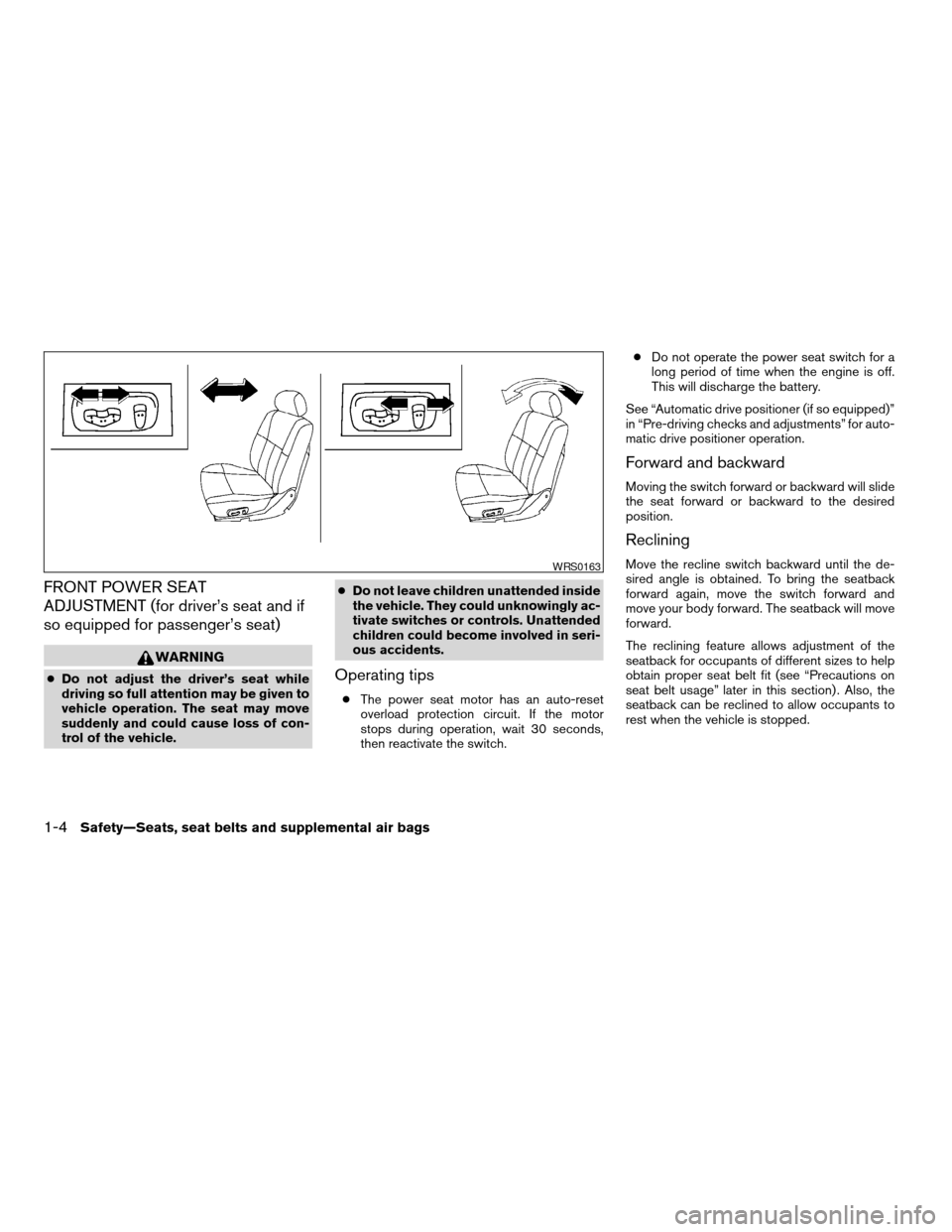
FRONT POWER SEAT
ADJUSTMENT (for driver’s seat and if
so equipped for passenger’s seat)
WARNING
cDo not adjust the driver’s seat while
driving so full attention may be given to
vehicle operation. The seat may move
suddenly and could cause loss of con-
trol of the vehicle.cDo not leave children unattended inside
the vehicle. They could unknowingly ac-
tivate switches or controls. Unattended
children could become involved in seri-
ous accidents.Operating tips
cThe power seat motor has an auto-reset
overload protection circuit. If the motor
stops during operation, wait 30 seconds,
then reactivate the switch.cDo not operate the power seat switch for a
long period of time when the engine is off.
This will discharge the battery.
See “Automatic drive positioner (if so equipped)”
in “Pre-driving checks and adjustments” for auto-
matic drive positioner operation.
Forward and backward
Moving the switch forward or backward will slide
the seat forward or backward to the desired
position.
Reclining
Move the recline switch backward until the de-
sired angle is obtained. To bring the seatback
forward again, move the switch forward and
move your body forward. The seatback will move
forward.
The reclining feature allows adjustment of the
seatback for occupants of different sizes to help
obtain proper seat belt fit (see “Precautions on
seat belt usage” later in this section) . Also, the
seatback can be reclined to allow occupants to
rest when the vehicle is stopped.WRS0163
1-4Safety—Seats, seat belts and supplemental air bags
ZREVIEW COPY:Ð2004 Maxima(max)
Owners Manual(owners)ÐUSA English(nna)
10/20/03Ðskoniecz
X
Page 22 of 280
FOLDING REAR SEAT (if so
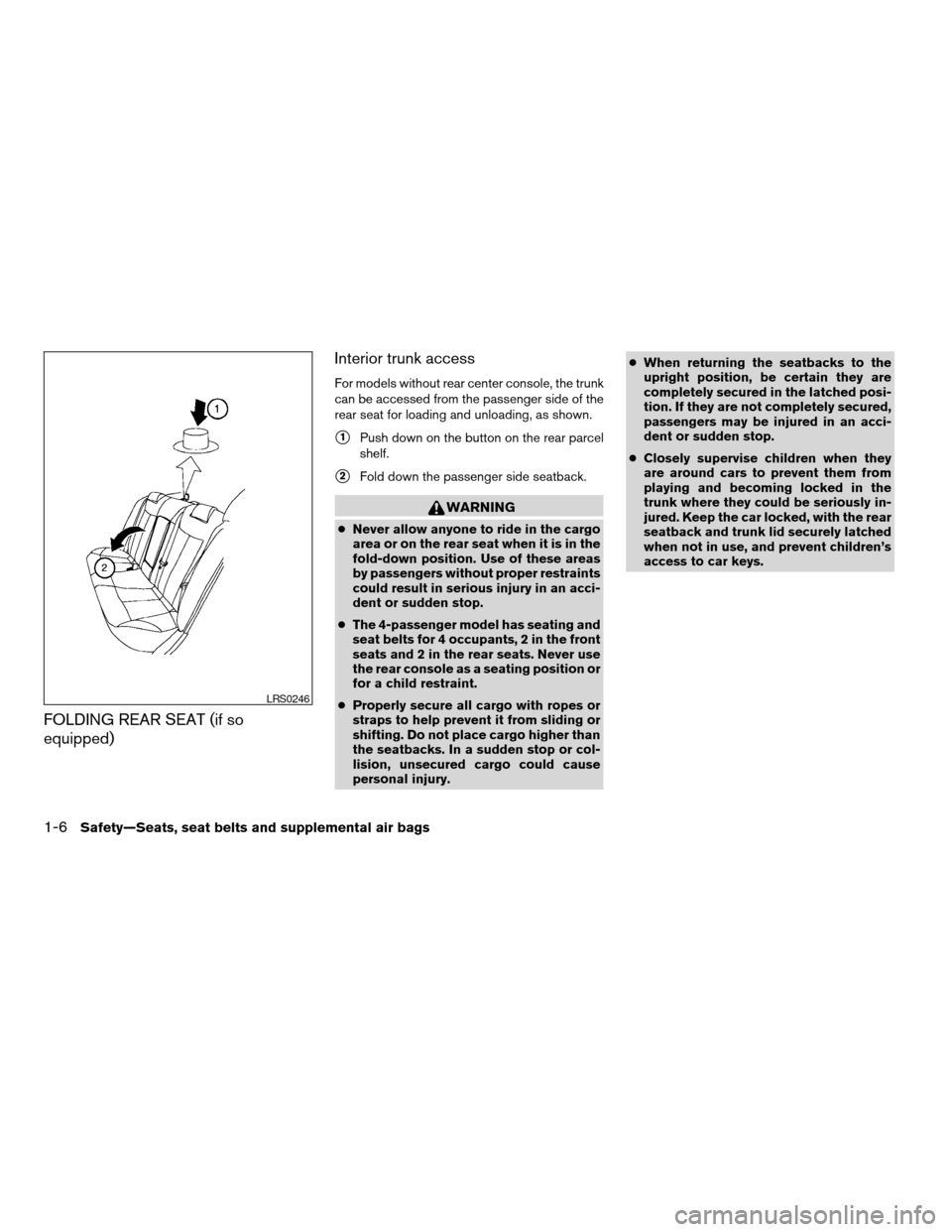
equipped)Interior trunk access
For models without rear center console, the trunk
can be accessed from the passenger side of the
rear seat for loading and unloading, as shown.
s1Push down on the button on the rear parcel
shelf.
s2Fold down the passenger side seatback.
WARNING
cNever allow anyone to ride in the cargo
area or on the rear seat when it is in the
fold-down position. Use of these areas
by passengers without proper restraints
could result in serious injury in an acci-
dent or sudden stop.
cThe 4-passenger model has seating and
seat belts for 4 occupants, 2 in the front
seats and 2 in the rear seats. Never use
the rear console as a seating position or
for a child restraint.
cProperly secure all cargo with ropes or
straps to help prevent it from sliding or
shifting. Do not place cargo higher than
the seatbacks. In a sudden stop or col-
lision, unsecured cargo could cause
personal injury.cWhen returning the seatbacks to the
upright position, be certain they are
completely secured in the latched posi-
tion. If they are not completely secured,
passengers may be injured in an acci-
dent or sudden stop.
cClosely supervise children when they
are around cars to prevent them from
playing and becoming locked in the
trunk where they could be seriously in-
jured. Keep the car locked, with the rear
seatback and trunk lid securely latched
when not in use, and prevent children’s
access to car keys.
LRS0246
1-6Safety—Seats, seat belts and supplemental air bags
ZREVIEW COPY:Ð2004 Maxima(max)
Owners Manual(owners)ÐUSA English(nna)
10/07/03Ðtbrooks
X
Page 24 of 280
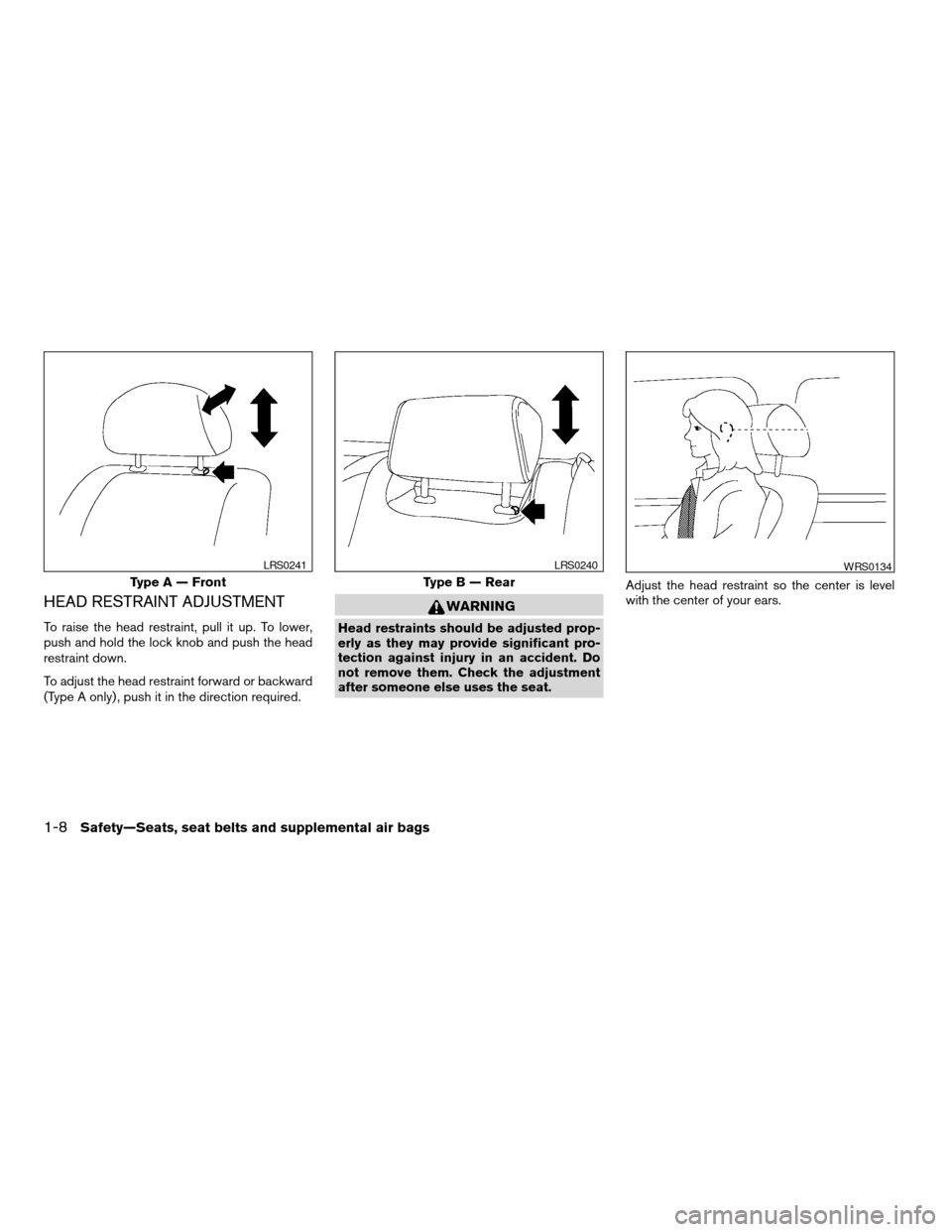
HEAD RESTRAINT ADJUSTMENT
To raise the head restraint, pull it up. To lower,
push and hold the lock knob and push the head
restraint down.
To adjust the head restraint forward or backward
(Type A only) , push it in the direction required.
WARNING
Head restraints should be adjusted prop-
erly as they may provide significant pro-
tection against injury in an accident. Do
not remove them. Check the adjustment
after someone else uses the seat.Adjust the head restraint so the center is level
with the center of your ears.
Type A — Front
LRS0241
Type B — Rear
LRS0240WRS0134
1-8Safety—Seats, seat belts and supplemental air bags
ZREVIEW COPY:Ð2004 Maxima(max)
Owners Manual(owners)ÐUSA English(nna)
10/07/03Ðtbrooks
X
Page 25 of 280
ACTIVE HEAD RESTRAINT (front
seats)
WARNING
cAlways adjust the head restraints prop-
erly as specified in the previous section.
Failure to do so can reduce the effec-
tiveness of the active head restraint.
cActive head restraints are designed to
supplement other safety systems. Al-
ways wear seat belts. No system can
prevent all injuries in any accident.cDo not attach anything to the head re-
straint stalks. Doing so could impair
active head restraint function.
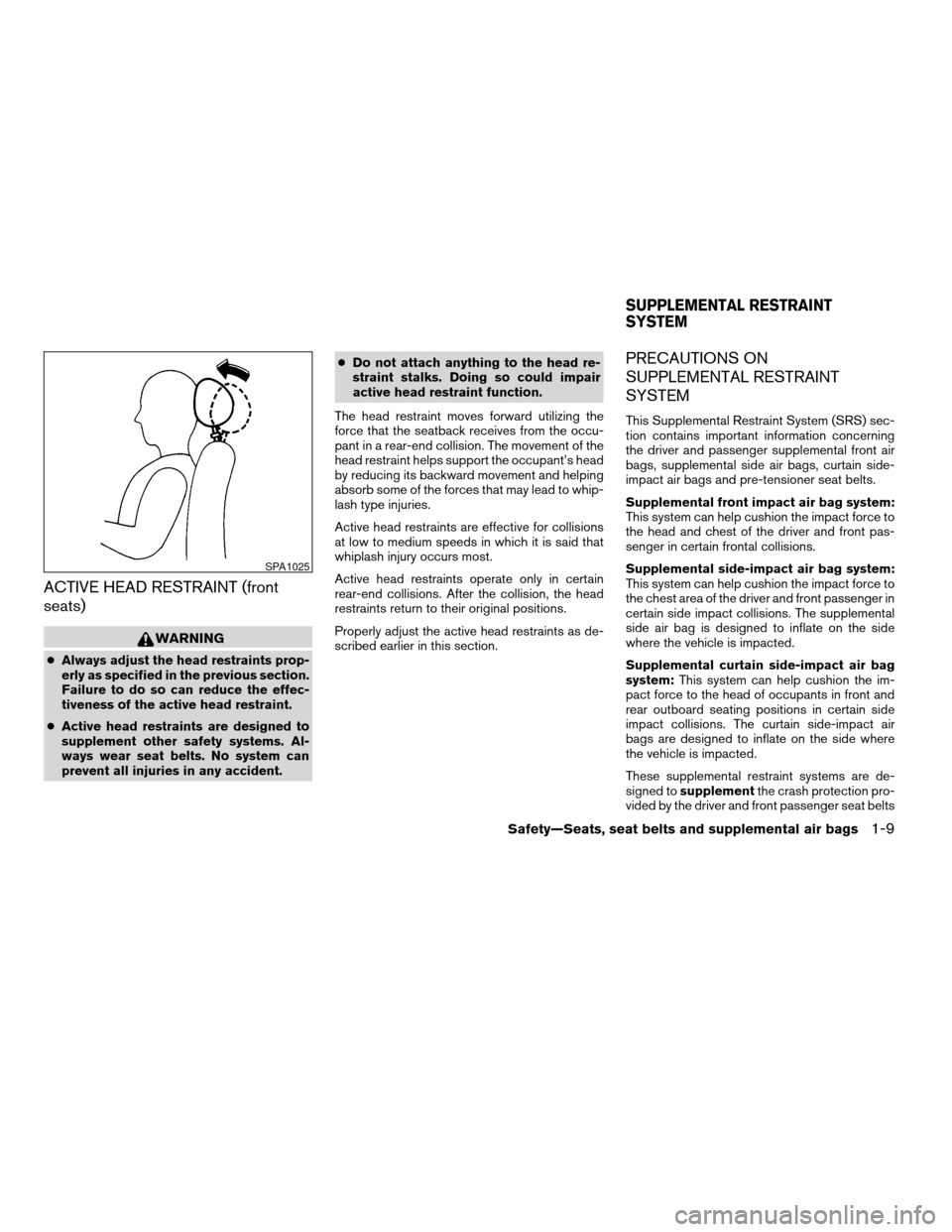
The head restraint moves forward utilizing the
force that the seatback receives from the occu-
pant in a rear-end collision. The movement of the
head restraint helps support the occupant’s head
by reducing its backward movement and helping
absorb some of the forces that may lead to whip-
lash type injuries.
Active head restraints are effective for collisions
at low to medium speeds in which it is said that
whiplash injury occurs most.
Active head restraints operate only in certain
rear-end collisions. After the collision, the head
restraints return to their original positions.
Properly adjust the active head restraints as de-
scribed earlier in this section.
PRECAUTIONS ON
SUPPLEMENTAL RESTRAINT
SYSTEM
This Supplemental Restraint System (SRS) sec-
tion contains important information concerning
the driver and passenger supplemental front air
bags, supplemental side air bags, curtain side-
impact air bags and pre-tensioner seat belts.
Supplemental front impact air bag system:
This system can help cushion the impact force to
the head and chest of the driver and front pas-
senger in certain frontal collisions.
Supplemental side-impact air bag system:
This system can help cushion the impact force to
the chest area of the driver and front passenger in
certain side impact collisions. The supplemental
side air bag is designed to inflate on the side
where the vehicle is impacted.
Supplemental curtain side-impact air bag
system:This system can help cushion the im-
pact force to the head of occupants in front and
rear outboard seating positions in certain side
impact collisions. The curtain side-impact air
bags are designed to inflate on the side where
the vehicle is impacted.
These supplemental restraint systems are de-
signed tosupplementthe crash protection pro-
vided by the driver and front passenger seat belts
SPA1025
SUPPLEMENTAL RESTRAINT
SYSTEM
Safety—Seats, seat belts and supplemental air bags1-9
ZREVIEW COPY:Ð2004 Maxima(max)
Owners Manual(owners)ÐUSA English(nna)
10/07/03Ðtbrooks
X
Page 26 of 280
and arenot a substitutefor them. Seat belts
should always be correctly worn and the occu-
pant seated a suitable distance away from the
steering wheel, instrument panel and door finish-
ers. (See “Seat belts” later in this section for
instructions and precautions on seat belt usage.)
The supplemental air bags operate only
when the ignition switch is in the ON or
START position.
After turning the ignition key to the ON
position, the supplemental air bag warning
light illuminates. The supplemental air bag
warning light will turn off after about 7
seconds if the system is operational.
WARNING
cThe supplemental front air bags ordi-
narily will not inflate in the event of a
side impact, rear impact, rollover, or
lower severity frontal collision. Always
wear your seat belts to help reduce the
risk or severity of injury in various kinds
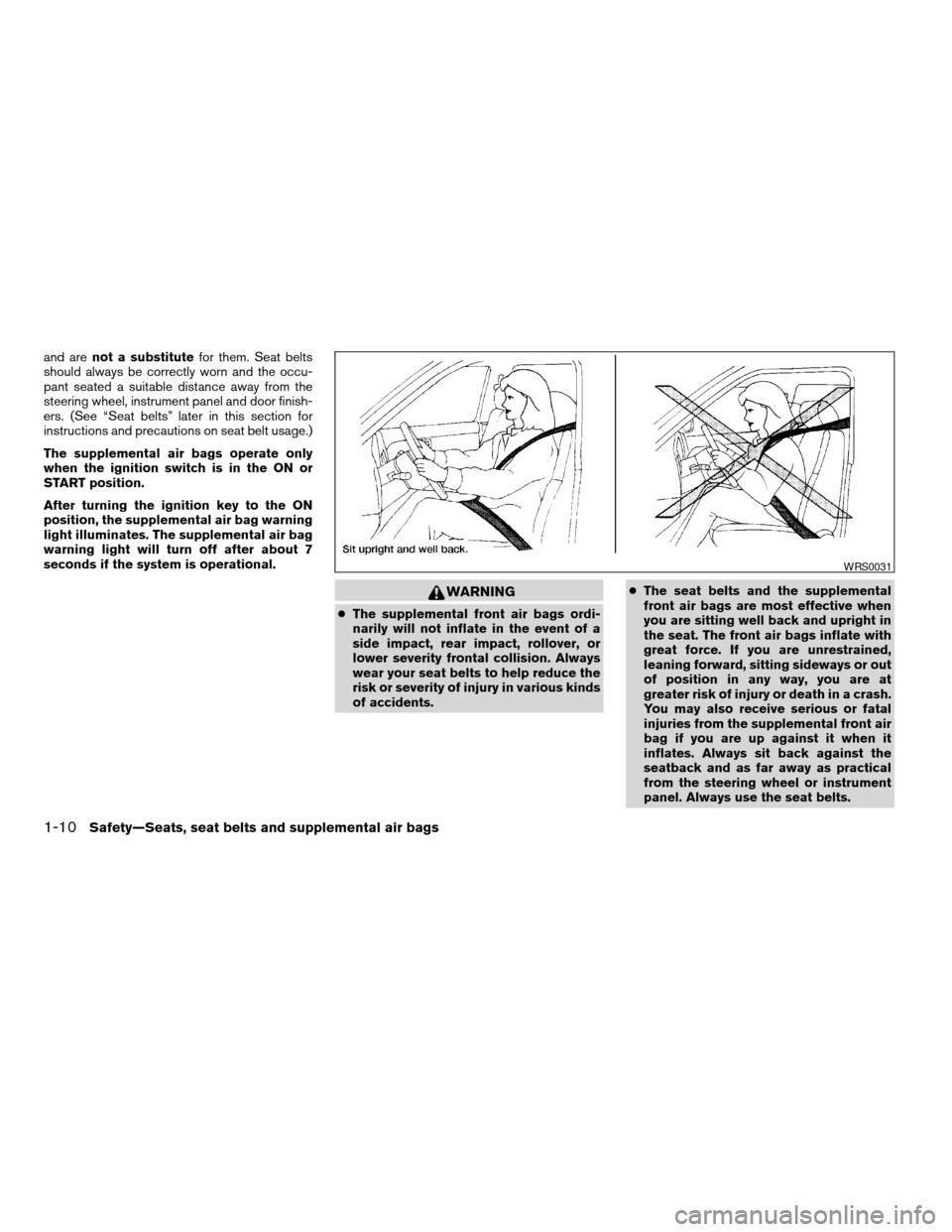
of accidents.cThe seat belts and the supplemental
front air bags are most effective when
you are sitting well back and upright in
the seat. The front air bags inflate with
great force. If you are unrestrained,
leaning forward, sitting sideways or out
of position in any way, you are at
greater risk of injury or death in a crash.
You may also receive serious or fatal
injuries from the supplemental front air
bag if you are up against it when it
inflates. Always sit back against the
seatback and as far away as practical
from the steering wheel or instrument
panel. Always use the seat belts.
WRS0031
1-10Safety—Seats, seat belts and supplemental air bags
ZREVIEW COPY:Ð2004 Maxima(max)
Owners Manual(owners)ÐUSA English(nna)
10/07/03Ðtbrooks
X
Page 27 of 280
cThe driver and front passenger seat belt
buckles are equipped with sensors that
detect if the seat belts are fastened. The
air bag system monitors the severity of
a collision and then inflates the air bags
based on belt usage. Failure to properly
wear seat belts can increase the risk or
severity of injury in an accident.
cKeep hands on the outside of the steer-
ing wheel. Placing them inside the
steering wheel rim could increase the
risk that they are injured when the
supplemental front air bag inflates.
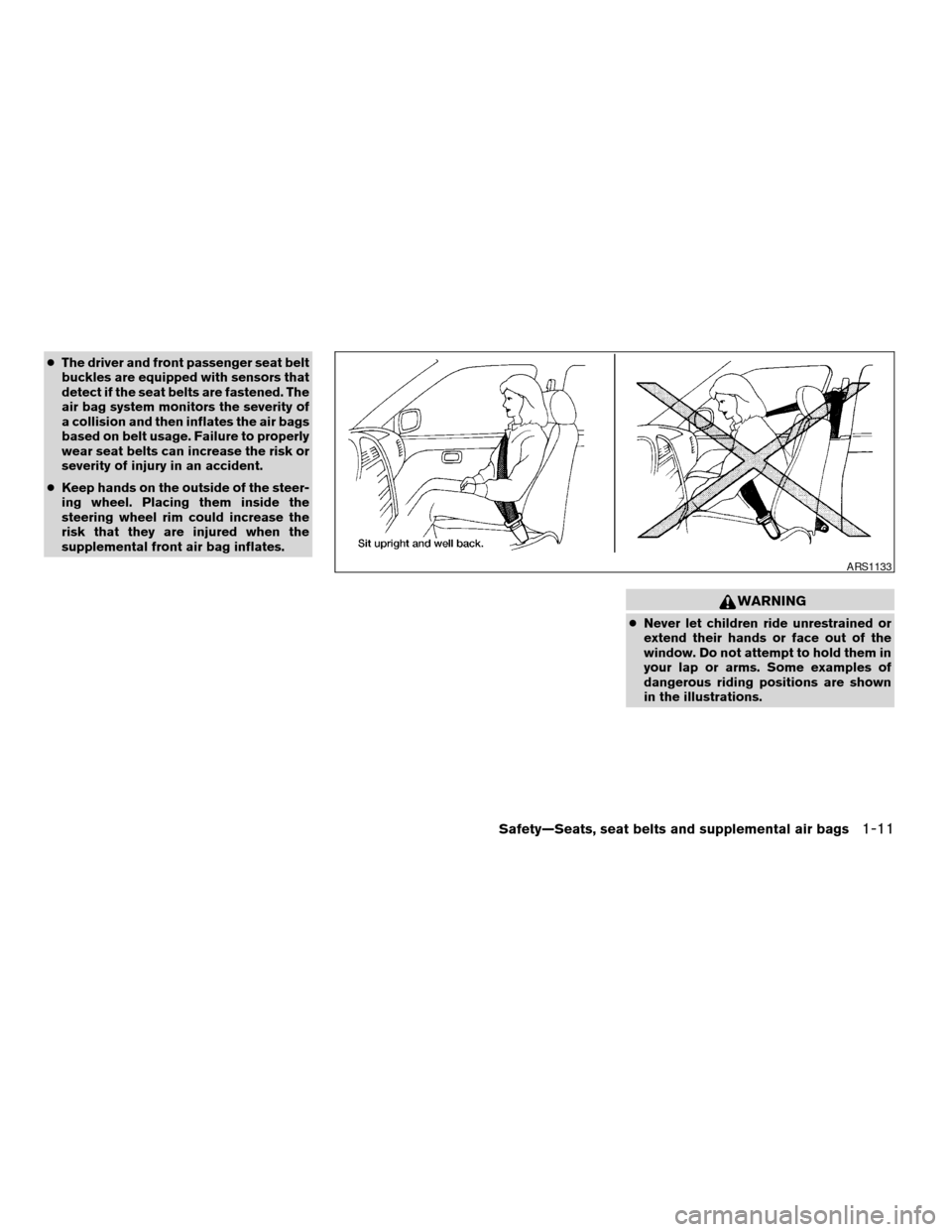
WARNING
cNever let children ride unrestrained or
extend their hands or face out of the
window. Do not attempt to hold them in
your lap or arms. Some examples of
dangerous riding positions are shown
in the illustrations.
ARS1133
Safety—Seats, seat belts and supplemental air bags1-11
ZREVIEW COPY:Ð2004 Maxima(max)
Owners Manual(owners)ÐUSA English(nna)
10/07/03Ðtbrooks
X
Page 29 of 280
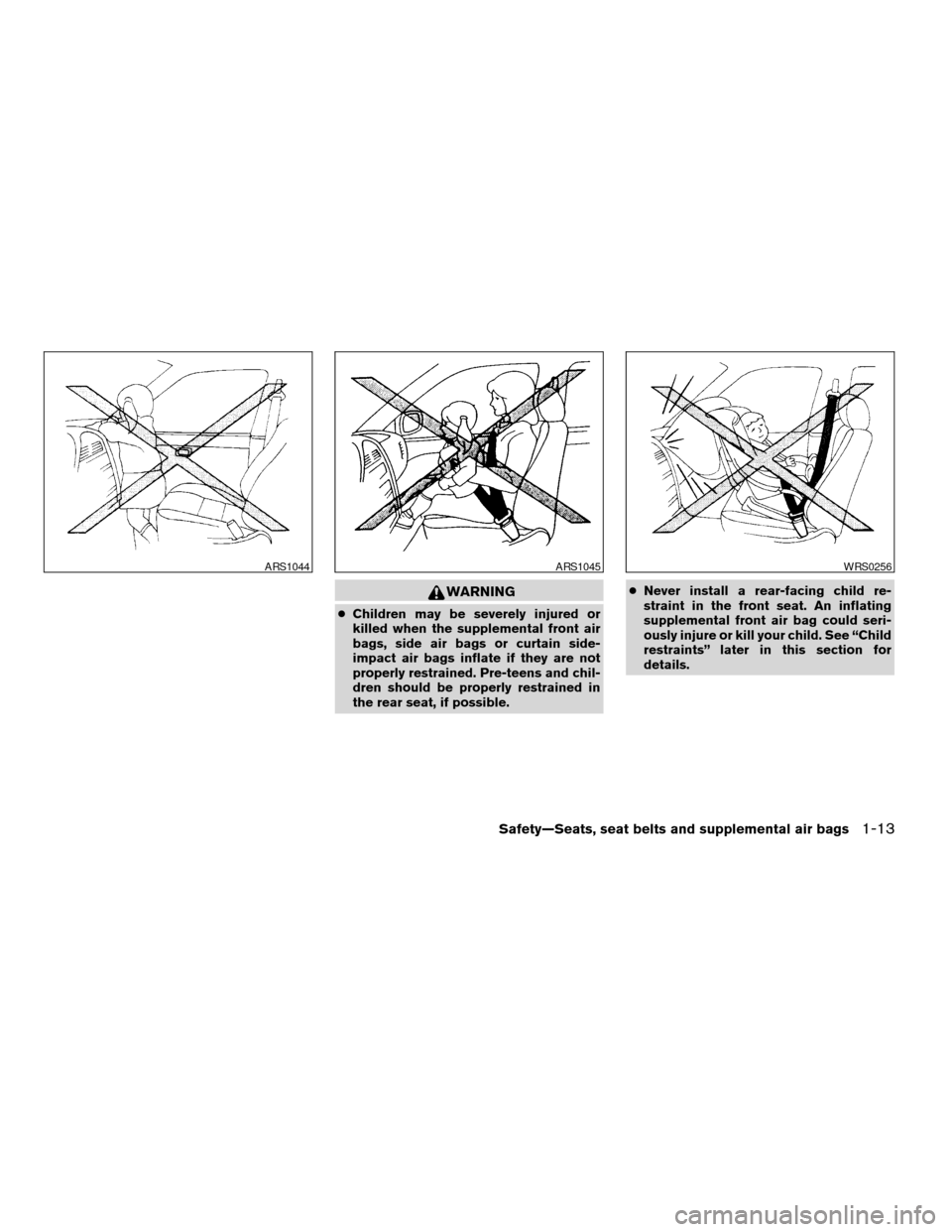
WARNING
cChildren may be severely injured or
killed when the supplemental front air
bags, side air bags or curtain side-
impact air bags inflate if they are not
properly restrained. Pre-teens and chil-
dren should be properly restrained in
the rear seat, if possible.cNever install a rear-facing child re-
straint in the front seat. An inflating
supplemental front air bag could seri-
ously injure or kill your child. See “Child
restraints” later in this section for
details.
ARS1044ARS1045WRS0256
Safety—Seats, seat belts and supplemental air bags1-13
ZREVIEW COPY:Ð2004 Maxima(max)
Owners Manual(owners)ÐUSA English(nna)
10/07/03Ðtbrooks
X
Page 30 of 280
WARNING
Supplemental side air bag and curtain
side-impact air bag:
cThe supplemental side air bag and cur-
tain side-impact air bag ordinarily will
not inflate in the event of a frontal im-
pact, rear impact, rollover or lower se-
verity side collision. Always wear your
seat belts to help reduce the risk or
severity of injury in various kinds of
accidents.
WARNING
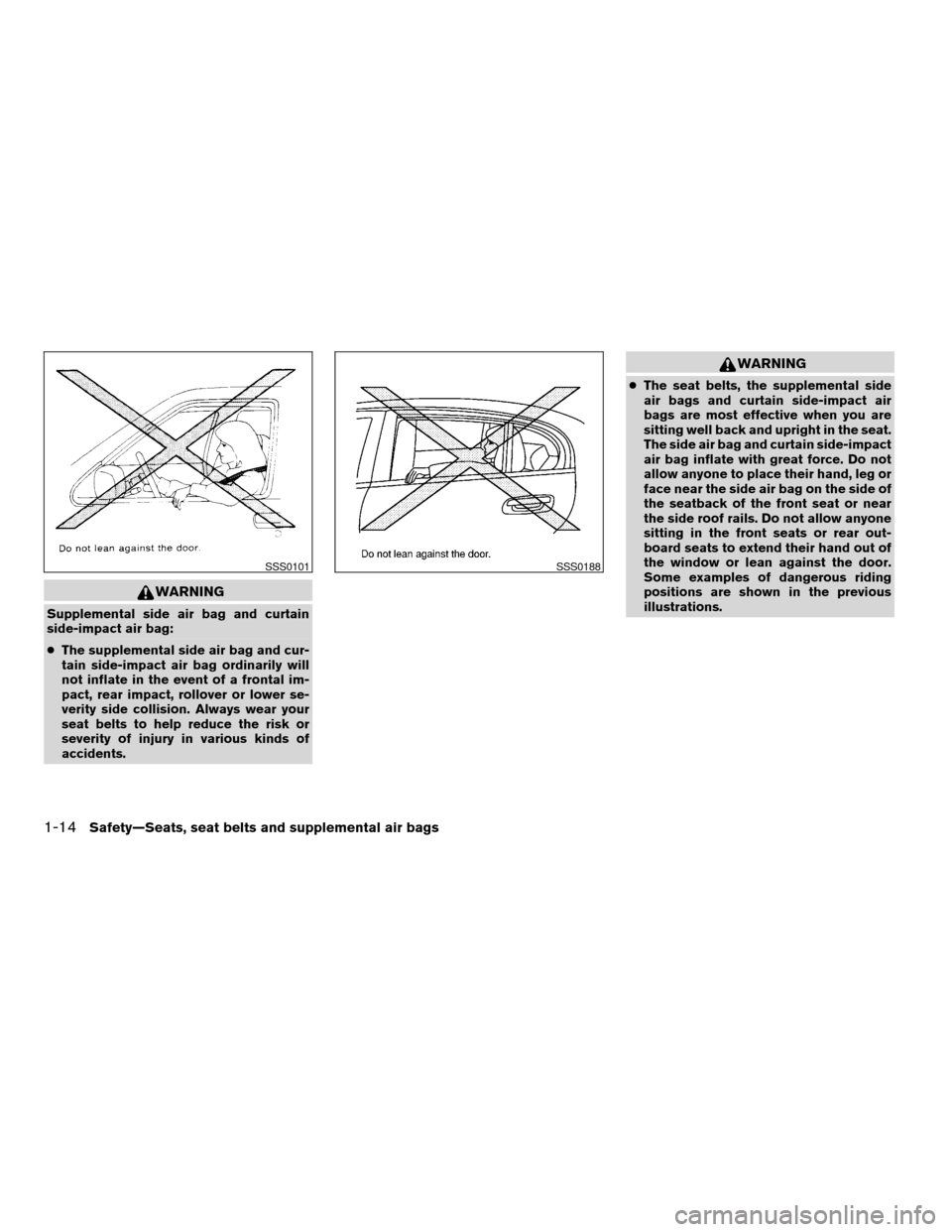
cThe seat belts, the supplemental side
air bags and curtain side-impact air
bags are most effective when you are
sitting well back and upright in the seat.
The side air bag and curtain side-impact
air bag inflate with great force. Do not
allow anyone to place their hand, leg or
face near the side air bag on the side of
the seatback of the front seat or near
the side roof rails. Do not allow anyone
sitting in the front seats or rear out-
board seats to extend their hand out of
the window or lean against the door.
Some examples of dangerous riding
positions are shown in the previous
illustrations.
SSS0101SSS0188
1-14Safety—Seats, seat belts and supplemental air bags
ZREVIEW COPY:Ð2004 Maxima(max)
Owners Manual(owners)ÐUSA English(nna)
10/07/03Ðtbrooks
X