2004 NISSAN ALTIMA flat tire
[x] Cancel search: flat tirePage 230 of 264

Snow tires
If snow tires are needed, it is necessary to select
tires equivalent in size and load rating to the
original equipment tires. If you do not, it can
adversely affect the safety and handling of your
vehicle.
Generally, snow tires have lower speed ratings
than factory equipped tires and may not match
the potential maximum vehicle speed. Never ex-
ceed the maximum speed rating of the tire.
If you install snow tires, they must be the same
size, brand, construction and tread pattern on all
four wheels.
For additional traction on icy roads, studded tires
may be used. However, some U.S. states and
Canadian provinces prohibit their use. Check
local, state and provincial laws before installing
studded tires. Skid and traction capabilities of
studded snow tires on wet or dry surfaces may be
poorer than that of non-studded snow tires.
TIRE CHAINS
Use of tire chains may be prohibited according to
location. Check the local laws before installing
tire chains. When installing tire chains, make sure
they are the proper size for the tires on your
vehicle and are installed according to the chain
manufacturer’s suggestions.Use only SAEclass “S” chains.Class “S” chains are used on
vehicles with restricted tire to vehicle clearance.
Vehicles that can use Class “S” chains are de-
signed to meet the minimum clearances between
the tire and the closest vehicle suspension or
body component required to accommodate the
use of a winter traction device (tire chains or
cables) . The minimum clearances are determined
using the factory equipped tires. Other types may
damage your vehicle. Use chain tensioners when
recommended by the tire chain manufacturer to
ensure a tight fit. Loose end links of the tire chain
must be secured or removed to prevent the pos-
sibility of whipping action damage to the fenders
or underbody. If possible, avoid fully loading your
vehicle when using tire chains. In addition, drive
at a reduced speed. Otherwise, your vehicle may
be damaged and/or vehicle handling and perfor-
mance may be adversely affected.
Tire chains must be installed only on the
front wheels and not on the rear wheels.
Never install tire chains on a TEMPORARY USE
ONLY spare tire.
Do not use tire chains on dry roads. Driving with
chains in such conditions can cause damage to
the various mechanisms of the vehicle due to
some overstress.
CHANGING WHEELS AND TIRES
Tire rotation
NISSAN recommends rotating the tires every
7,500 miles (12,000 km) .
See “Flat tire” in the “In case of emergency”
section of this manual for tire replacing proce-
dures.
As soon as possible, tighten the wheel nuts
to the specified torque with a torque
wrench.
Wheel nut tightening torque:
80 ft-lb (108 N·m)
WDI0258
8-40Maintenance and do-it-yourself
ZREVIEW COPY:Ð2004 Altima(l30)
Owners Manual(owners)ÐUSA English(nna)
10/13/03Ðtbrooks
X
Page 231 of 264
The wheel nuts must be kept tightened to
specifications at all times. It is recom-
mended that wheel nuts be tightened to
specification at each tire rotation interval.
WARNING
cAfter rotating the tires, check and ad-
just the tire pressure.
cRetighten the wheel nuts when the ve-
hicle has been driven for 600 miles
(1,000 km) (also in cases of a flat tire,
etc.) .
cDo not include the spare tire in the tire
rotation.
cFor additional information regarding
tires, refer to “Important Tire Safety In-
formation” (US) or “Tire Safety Informa-
tion” (Canada) in the Warranty Informa-
tion Booklet.
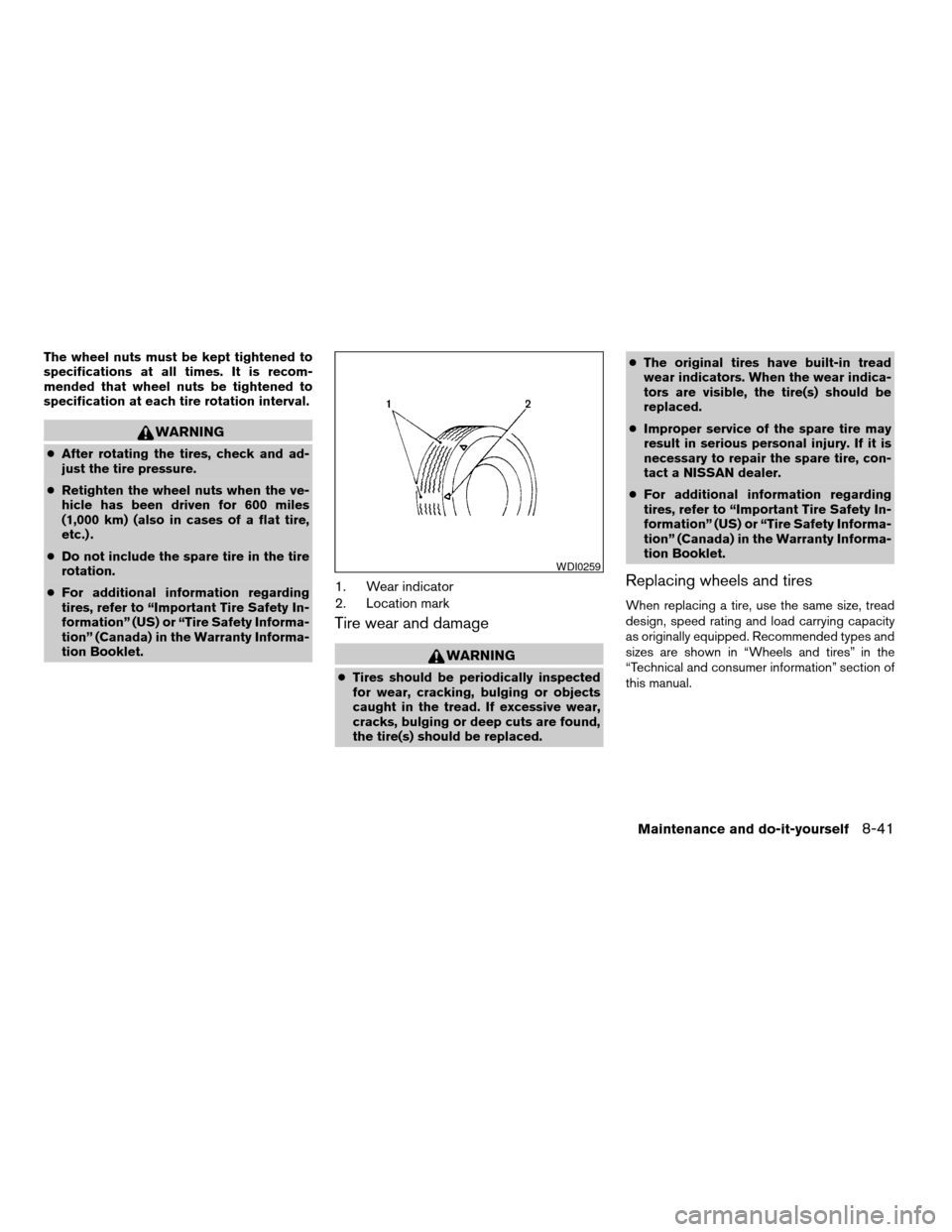
1. Wear indicator
2. Location mark
Tire wear and damage
WARNING
cTires should be periodically inspected
for wear, cracking, bulging or objects
caught in the tread. If excessive wear,
cracks, bulging or deep cuts are found,
the tire(s) should be replaced.cThe original tires have built-in tread
wear indicators. When the wear indica-
tors are visible, the tire(s) should be
replaced.
cImproper service of the spare tire may
result in serious personal injury. If it is
necessary to repair the spare tire, con-
tact a NISSAN dealer.
cFor additional information regarding
tires, refer to “Important Tire Safety In-
formation” (US) or “Tire Safety Informa-
tion” (Canada) in the Warranty Informa-
tion Booklet.
Replacing wheels and tires
When replacing a tire, use the same size, tread
design, speed rating and load carrying capacity
as originally equipped. Recommended types and
sizes are shown in “Wheels and tires” in the
“Technical and consumer information” section of
this manual.
WDI0259
Maintenance and do-it-yourself8-41
ZREVIEW COPY:Ð2004 Altima(l30)
Owners Manual(owners)ÐUSA English(nna)
10/13/03Ðtbrooks
X
Page 233 of 264
WARNING
cThe spare tire should be used for emer-
gency use only. It should be replaced
with the standard tire at the first oppor-
tunity to avoid possible tire or differen-
tial damage.
cDrive carefully while the TEMPORARY
USE ONLY spare tire is installed. Avoid
sharp turns and abrupt braking while
driving.
cPeriodically check spare tire inflation
pressure. Always keep the pressure of
the TEMPORARY USE ONLY spare tire
at 60 psi (420 kPa, 4.2 bar) .
cWith the TEMPORARY USE ONLY spare
tire installed do not drive the vehicle at
speeds faster than 50 MPH (80 km/h) .
cWhen driving on roads covered with
snow or ice, the TEMPORARY USE
ONLY spare tire should be used on the
rear wheels and the original tire used
on the front wheels (drive wheels) . Use
tire chains only on the front (original)
tires.cTire tread of the TEMPORARY USE
ONLY spare tire will wear at a faster rate
than the standard tire. Replace the
spare tire as soon as the tread wear
indicators appear.
cDo not use the spare tire on other
vehicles.
cDo not use more than one spare tire at
the same time.
cDo not tow a trailer when the TEMPO-
RARY USE ONLY spare tire is installed.
CAUTION
cDo not use tire chains on a TEMPO-
RARY USE ONLY spare tire. Tire chains
will not fit properly and may cause dam-
age to the vehicle.
cBecause the TEMPORARY USE ONLY
spare tire is smaller than the original
tire, ground clearance is reduced. To
avoid damage to the vehicle, do not
drive over obstacles. Also, do not drive
the vehicle through an automatic car
wash since it may get caught.
Maintenance and do-it-yourself8-43
ZREVIEW COPY:Ð2004 Altima(l30)
Owners Manual(owners)ÐUSA English(nna)
10/13/03Ðtbrooks
X
Page 235 of 264

9 Technical and consumer information
Capacities and recommended fuel/lubricants.........9-2
Fuel recommendation...........................9-3
Engine oil and oil filter recommendation...........9-5
Recommended SAE viscosity number............9-6
Air conditioner system refrigerant and
lubricant recommendations......................9-6
Specifications.....................................9-7
Engine........................................9-7
Wheels and tires...............................9-8
Dimensions and weights........................9-8
When traveling or registering your vehicle in
another country...................................9-9
Vehicle identification...............................9-9
Vehicle identification number (VIN) plate..........9-9
Vehicle identification number
(chassis number)...............................9-9
Engine serial number...........................9-10
F.M.V.S.S. certification label....................9-10
Emission control information label...............9-11Tire placard...................................9-11
Air conditioner specification label................9-11
Installing front license plate........................9-13
Vehicle loading information........................9-12
Terms........................................9-12
Determining vehicle load capacity...............9-13
Loading tips..................................9-13
Towing a trailer...................................9-14
Maximum load limits...........................9-14
Towing load/specification chart.................9-15
Towing safety.................................9-15
Flat towing....................................9-17
Uniform tire quality grading........................9-18
Emission control system warranty..................9-19
Reporting safety defects (US only).................9-19
Readiness for inspection/maintenance (I/M) test.....9-19
Owner’s Manual/Service Manual order information . . . 9-21
In the event of a collision.......................9-22
ZREVIEW COPY:Ð2004 Altima(l30)
Owners Manual(owners)ÐUSA English(nna)
10/13/03Ðtbrooks
X
Page 249 of 264
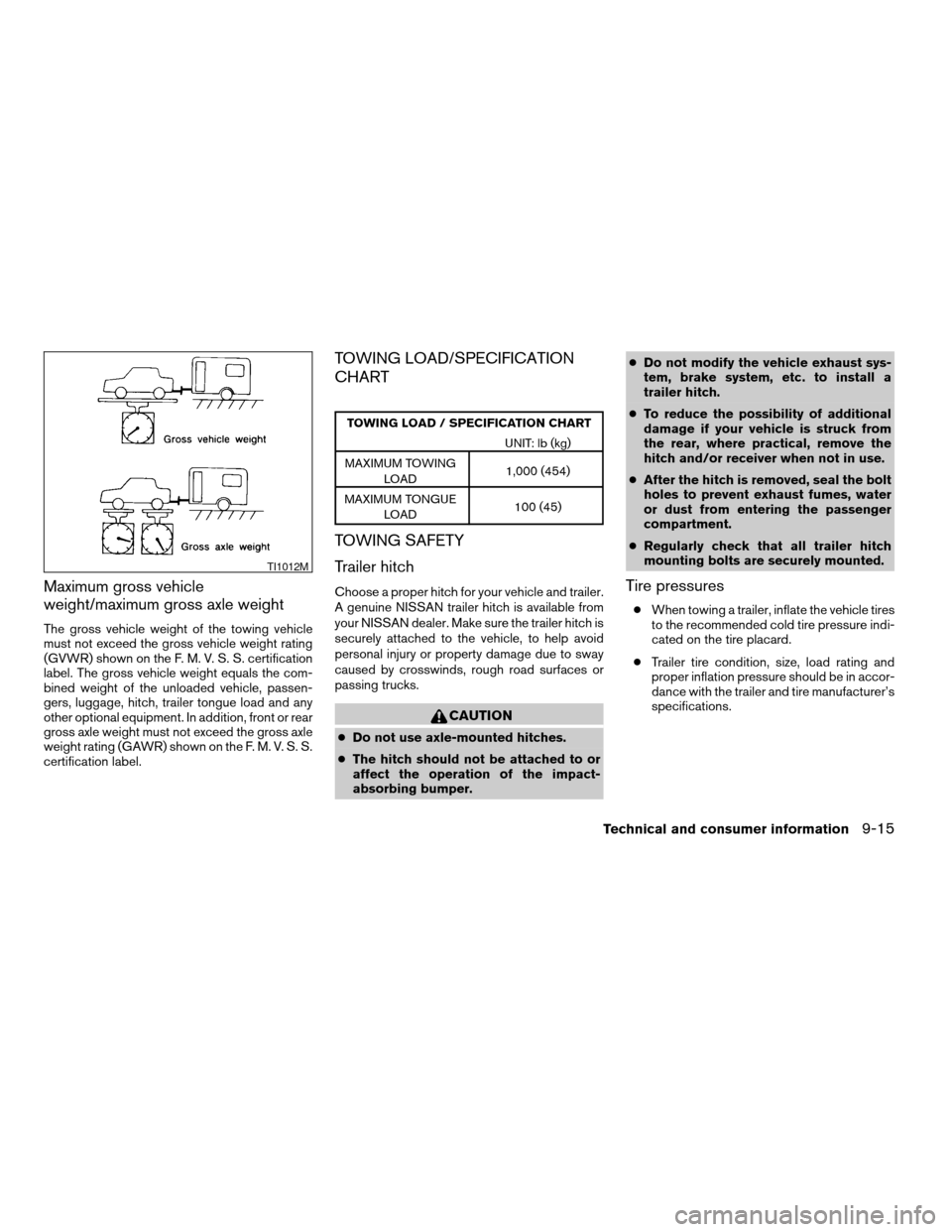
Maximum gross vehicle
weight/maximum gross axle weight
The gross vehicle weight of the towing vehicle
must not exceed the gross vehicle weight rating
(GVWR) shown on the F. M. V. S. S. certification
label. The gross vehicle weight equals the com-
bined weight of the unloaded vehicle, passen-
gers, luggage, hitch, trailer tongue load and any
other optional equipment. In addition, front or rear
gross axle weight must not exceed the gross axle
weight rating (GAWR) shown on the F. M. V. S. S.
certification label.
TOWING LOAD/SPECIFICATION
CHART
TOWING LOAD / SPECIFICATION CHART
UNIT: lb (kg)
MAXIMUM TOWING
LOAD1,000 (454)
MAXIMUM TONGUE
LOAD100 (45)
TOWING SAFETY
Trailer hitch
Choose a proper hitch for your vehicle and trailer.
A genuine NISSAN trailer hitch is available from
your NISSAN dealer. Make sure the trailer hitch is
securely attached to the vehicle, to help avoid
personal injury or property damage due to sway
caused by crosswinds, rough road surfaces or
passing trucks.
CAUTION
cDo not use axle-mounted hitches.
cThe hitch should not be attached to or
affect the operation of the impact-
absorbing bumper.cDo not modify the vehicle exhaust sys-
tem, brake system, etc. to install a
trailer hitch.
cTo reduce the possibility of additional
damage if your vehicle is struck from
the rear, where practical, remove the
hitch and/or receiver when not in use.
cAfter the hitch is removed, seal the bolt
holes to prevent exhaust fumes, water
or dust from entering the passenger
compartment.
cRegularly check that all trailer hitch
mounting bolts are securely mounted.
Tire pressures
cWhen towing a trailer, inflate the vehicle tires
to the recommended cold tire pressure indi-
cated on the tire placard.
cTrailer tire condition, size, load rating and
proper inflation pressure should be in accor-
dance with the trailer and tire manufacturer’s
specifications.
TI1012M
Technical and consumer information9-15
ZREVIEW COPY:Ð2004 Altima(l30)
Owners Manual(owners)ÐUSA English(nna)
10/13/03Ðtbrooks
X
Page 252 of 264
DOT (Department of Transportation) Quality
Grades: All passenger car tires must conform to
federal safety requirements in addition to these
grades.
Quality grades can be found where applicable on
the tire sidewall between tread shoulder and
maximum section width. For example:
Treadwear 200 Traction AA Temperature A
Treadwear
Treadwear grade is a comparative rating based
on tire wear rate when tested under controlled
conditions on specified government test courses.
For example, a tire graded 150 would wear one
and a half (1-1/2) times as well on the govern-
ment course as a tire graded 100. However,
relative tire performance depends on actual driv-
ing conditions, and may vary significantly due to
variations in driving habits, service practices and
differences in road characteristics and climate.
Traction AA, A, B and C
The traction grades, from highest to lowest, are
AA, A, B, and C. Those grades represent the
tire’s ability to stop on wet pavement as mea-
sured under controlled conditions on specified
government test surfaces of asphalt and con-
crete. A tire marked C may have poor traction
performance.WARNING
The traction grade assigned to your ve-
hicle tires is based on straight-ahead
braking traction tests and does not in-
clude acceleration, cornering, hydroplan-
ing or peak traction characteristics.
Temperature A, B and C
Temperature grades are A (the highest) , B, and
C. They represent a tire’s resistance to heat
build-up, and its ability to dissipate heat when
tested under controlled conditions on a specified
indoor laboratory test wheel. Sustained high tem-
perature can cause tire material to degenerate,
reducing tire life. Excessive temperatures can
lead to sudden tire failure. Grade C corresponds
to a performance level which all passenger car
tires must meet under the Federal Motor Vehicle
Safety Standard No. 109. Grades A and B rep-
resent higher levels of performance on laboratory
test wheels than the minimum required by law.
WARNING
The temperature grade for this tire is es-
tablished for a tire that is properly inflated
and not overloaded. Excessive speed,
under-inflation, or excessive loading, ei-
ther separately or in combination, can
cause heat build-up and possible tire
failure.
UNIFORM TIRE QUALITY GRADING
9-18Technical and consumer information
ZREVIEW COPY:Ð2004 Altima(l30)
Owners Manual(owners)ÐUSA English(nna)
10/13/03Ðtbrooks
X
Page 258 of 264

Coolant
Capacities and recommended
fuel/lubricants.................9-2
Changing engine coolant..........8-9
Checking engine coolant level........8-8
Engine coolant temperature gauge.....2-7
Corrosion protection...............7-5
Cruise control..................5-12
Cup holders...................2-28
D
Daytime running light system
(Canada only)..................2-21
Defogger switch
Rear window defogger switch.......2-17
Dimensions and weights.............9-8
Door locks....................3-3
Door open warning light............2-10
Drive belts....................8-18
Driving
Cold weather driving............5-20
Driving with automatic transmission.....5-7
Driving with manual transmission.....5-10
Precautions when starting and driving . . .5-2
E
Economy - fuel.................5-14
Emission control information label.......9-11
Emission control system warranty.......9-19
Engine
Before starting the engine..........5-6Capacities and recommended
fuel/lubricants.................9-2
Changing engine coolant..........8-9
Changing engine oil............8-10
Changing engine oil filter..........8-12
Checking engine coolant level........8-8
Checking engine oil level..........8-9
Engine compartment check locations. . . .8-8
Engine coolant temperature gauge.....2-7
Engine cooling system............8-8
Engine oil...................8-9
Engine oil and oil filter recommendation . .9-5
Engine oil viscosity..............9-5
Engine serial number............9-10
Engine specifications.............9-7
Starting the engine..............5-6
Engine oil pressure low/engine coolant
temperature high warning light.........2-10
Exhaust gas (Carbon monoxide)........5-2
Eyeglass case..................2-27
F
Flashers
(See hazard warning flasher switch)......2-23
Flat tire......................6-2
Floor mat positioning aid.............7-4
Fluid
Automatic transmission fluid (ATF). . . .8-13
Brake fluid..................8-15
Capacities and recommended
fuel/lubricants.................9-2
Clutch fluid.................8-15
Engine coolant................8-8
Engine oil...................8-9Power steering fluid.............8-14
Window washer fluid............8-16
F.M.V.S.S. certification label..........9-10
Fog light switch.................2-22
Front seats....................1-2
Fuel
Capacities and recommended
fuel/lubricants.................9-2
Fuel economy................5-14
Fuel filler cap................3-13
Fuel filler lid.................3-13
Fuel filler lid and cap............3-13
Fuel filler lid lock opener lever.......3-13
Fuel gauge..................2-8
Fuel octane rating..............9-4
Fuel recommendation............9-3
Fuses......................8-26
Fusible links...................8-27
G
Garage door opener, HomeLinkTUniversal
Transceiver...................2-38
Gascap.....................3-13
Gauge
Engine coolant temperature gauge.....2-7
Fuel gauge..................2-8
Odometer...................2-4
Speedometer.................2-4
Tachometer..................2-6
Trip odometer.................2-4
General maintenance..............8-2
Glove box....................2-29
Glove box lock.................2-29
10-2
ZREVIEW COPY:Ð2004 Altima(l30)
Owners Manual(owners)ÐUSA English(nna)
10/13/03Ðtbrooks
X
Page 261 of 264

Shift lock release.................5-9
Shifting
Automatic transmission...........5-8
Manual transmission............5-10
Shoulder belt height adjustment........1-28
Spark plug replacement............8-19
Speedometer...................2-4
Spotlights (See map light)...........2-37
SRS warning label...............1-20
Starting
Before starting the engine..........5-6
Jump starting.................6-6
Precautions when starting and driving . . .5-2
Push starting.................6-8
Starting the engine..............5-6
Steering
Power steering fluid.............8-14
Power steering system...........5-16
Tilting steering wheel............3-14
Stop light....................8-31
Storage.....................2-27
Sunglasses case................2-27
Sunglasses holder...............2-27
Sunroof.....................2-34
Supplemental air bag warning light . . .1-20, 2-11
Supplemental restraint system
Information and warning labels.......1-20
Precautions on supplemental restraint
system.....................1-8
Supplemental restraint system
(Supplemental air bag system).........1-8
Switch
Autolight switch...............2-20
Automatic power window switch.....2-34
Fog light switch...............2-22
Hazard warning flasher switch.......2-23Headlight and turn signal switch......2-18
Ignition switch................5-4
Power door lock switch...........3-4
Rear window defogger switch.......2-17
Traction control system (TCS) off
switch....................2-25
Windshield wiper and washer switch . . .2-16
T
Tachometer....................2-6
Temperature gauge
Engine coolant temperature gauge.....2-7
Engine oil pressure low/engine coolant
temperature high warning light.......2-10
Theft (Nissan vehicle immobilizer system) ,
engine start..............2-15, 3-2, 5-5
Three-way catalyst................5-2
Tilting steering wheel..............3-14
Tire
Flat tire....................6-2
Spare tire................6-3, 8-42
Tire chains..................8-40
Tire placard.................9-11
Tire pressure................8-38
Tire rotation.................8-40
Types of tires................8-39
Uniform tire quality grading.........9-18
Wheels and tires..............8-38
Wheel/tire size................9-8
Top tether strap child restraint.........1-38
Towing
Flat towing..................9-17
Tow truck towing...............6-9
Towing load/specification chart......9-15Trailer towing................9-14
Traction control system (TCS) off switch . . .2-25
Transceiver
HomeLinkTUniversal Transceiver.....2-38
Transmission
Automatic transmission fluid (ATF). . . .8-13
Driving with automatic transmission.....5-7
Driving with manual transmission.....5-10
Selector lever lock release..........5-9
Travel (See registering your vehicle in another
country)......................9-9
Trip odometer...................2-4
Trunk access through the rear seat.......1-6
Trunk lid lock opener lever...........3-11
Trunk light....................2-38
Turn signal switch (See headlight and
turn signal switch)............2-18, 2-22
U
Uniform tire quality grading...........9-18
V
Vanity mirror...................3-15
Vehicle dimensions and weights........9-8
Vehicle identification...............9-9
Vehicle identification number (VIN)
(Chassis number).................9-9
Vehicle identification number (VIN) plate. . . .9-9
Vehicle loading information...........9-12
Vehicle recovery.................6-11
Vehicle security system.............2-13
10-5
ZREVIEW COPY:Ð2004 Altima(l30)
Owners Manual(owners)ÐUSA English(nna)
10/13/03Ðtbrooks
X