Page 282 of 435
281 Operation
Engine compartment
Windshield washer system and headlamp cleaning system*
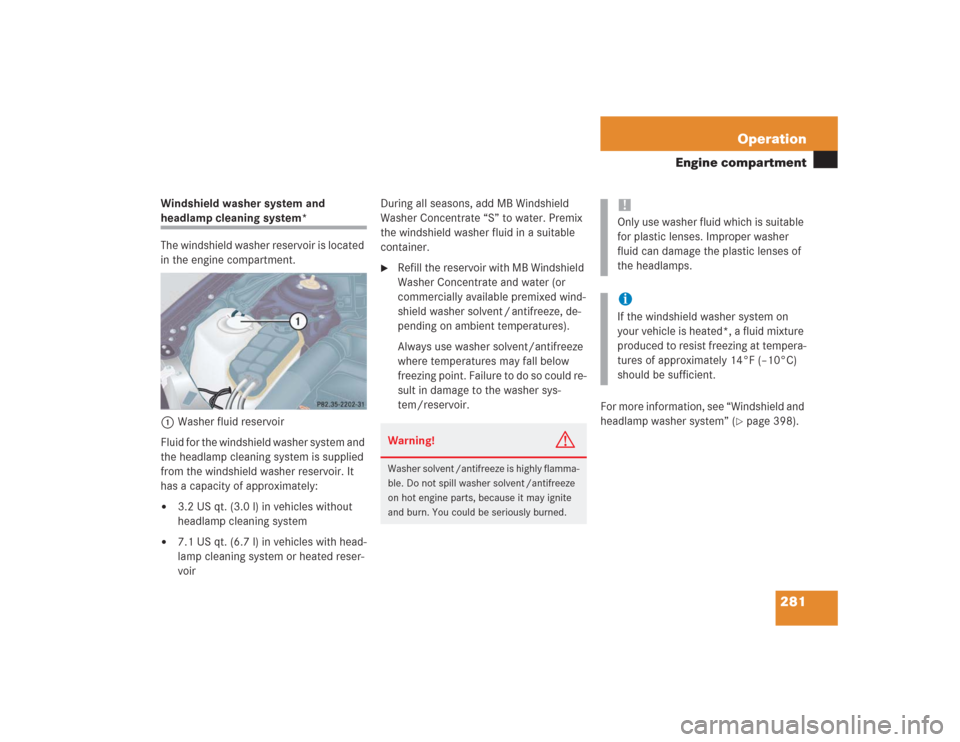
The windshield washer reservoir is located
in the engine compartment.
1Washer fluid reservoir
Fluid for the windshield washer system and
the headlamp cleaning system is supplied
from the windshield washer reservoir. It
has a capacity of approximately: �
3.2 US qt. (3.0 l) in vehicles without
headlamp cleaning system
�
7.1 US qt. (6.7 l) in vehicles with head-
lamp cleaning system or heated reser-
voirDuring all seasons, add MB Windshield
Washer Concentrate “S” to water. Premix
the windshield washer fluid in a suitable
container.
�
Refill the reservoir with MB Windshield
Washer Concentrate and water (or
commercially available premixed wind-
shield washer solvent / antifreeze, de-
pending on ambient temperatures).
Always use washer solvent/antifreeze
where temperatures may fall below
freezing point. Failure to do so could re-
sult in damage to the washer sys-
tem/reservoir.
For more information, see “Windshield and
headlamp washer system” (
�page 398).
Warning!
G
Washer solvent /antifreeze is highly flamma-
ble. Do not spill washer solvent /antifreeze
on hot engine parts, because it may ignite
and burn. You could be seriously burned.
!Only use washer fluid which is suitable
for plastic lenses. Improper washer
fluid can damage the plastic lenses of
the headlamps.iIf the windshield washer system on
your vehicle is heated*, a fluid mixture
produced to resist freezing at tempera-
tures of approximately 14°F (–10°C)
should be sufficient.
Page 293 of 435
292 OperationWinter driving
�Winter drivingBefore the onset of winter, have your vehi-
cle winterized at an authorized
Mercedes-Benz Center. This service in-
cludes:�
Check of anticorrosion and antifreeze
concentration.
�
Addition of cleaning concentrate to the
water of the windshield and headlamp
cleaning system. Add MB Concentrate
“S” to a premixed windshield washer
solvent / antifreeze which is formulated
for temperatures below freezing point
(�page 396).
�
Battery test. Battery capacity drops
with decreasing ambient temperature.
A well charged battery helps to ensure
that the engine can be started even at
low ambient temperatures.
�
Tire change. Mercedes-Benz recom-
mends M+S rated radial-ply tires with a
minimum tread depth of approximately 1⁄6 in (4 mm) on all four wheels for the
winter season.
Winter tires
Always use winter tires at temperatures
below 45°F (7°C) and whenever wintry
road conditions prevail. Use of winter tires
is the only way to achieve the maximum ef-
fectiveness of the ABS, ESP, and 4MATIC
in winter operation.
For safe handling, make sure that all
mounted winter tires are of the same make
and have the same tread design.Always observe the speed rating of the
winter tires installed on your vehicle. If the
maximum speed for which your tires are
rated is below the speed rating of your ve-
hicle, you must place a notice to this effect
where it will be seen by the driver. Such no-
tices are available at your tire dealer or any
authorized Mercedes-Benz Center.Warning!
G
Winter tires with a tread depth of less than 1⁄6in (4 mm) must be replaced. They are no
longer suitable for winter operation.
Warning!
G
If you use your spare tire when winter tires
are fitted on the other wheels, be aware that
the difference in tire characteristics may
very well impair turning stability and that
overall driving stability may be reduced.
Adapt your driving style accordingly.
Have the spare tire replaced with a winter
tire at the nearest authorized
Mercedes-Benz Center.
Page 300 of 435

299 Operation
Vehicle care
Cleaning the Distronic* system sensor
cover
1Distronic* system sensor cover�
Use a mild car wash detergent, such as
Mercedes-Benz approved Car Sham-
poo, with plenty of water to clean sen-
sor cover1.
To prevent scratches, never apply strong
force and use only a soft, non-scratchy
cloth when cleaning the sensor cover. Do
not attempt to wipe dirty sensors with a
dry cloth or sponge.Cleaning the Parktronic* system
sensors
1Parktronic* sensors
�
Use a mild car wash detergent, such as
Mercedes-Benz approved Car Sham-
poo, with plenty of water to clean
sensors1.
When using a steam cleaner or power
washer, aim nozzle only briefly from a min-
imum distance of 4 in (10 cm) at
sensors1.To prevent scratches, never apply strong
force and use only a soft, non-scratchy
cloth when cleaning the sensor. Do not at-
tempt to wipe dirty sensors with a dry cloth
or sponge.
Wiper blades
�
Turn on the wipers and place it in a ver-
tical position.
For information on placing the wipers to a
vertical position, see “Replacing wiper
blades” (
�page 359).
!Fold the windshield wiper arms away
from the windshield to a vertical posi-
tion only. They could otherwise dam-
age the hood.
Page 301 of 435
300 OperationVehicle care�
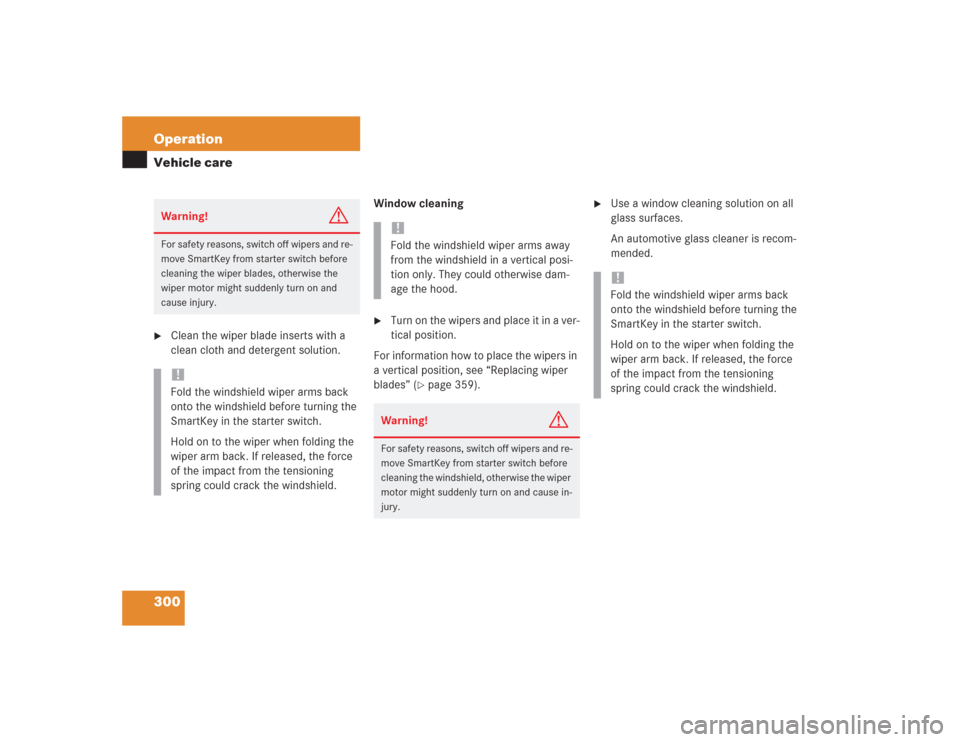
Clean the wiper blade inserts with a
clean cloth and detergent solution.Window cleaning
�
Turn on the wipers and place it in a ver-
tical position.
For information how to place the wipers in
a vertical position, see “Replacing wiper
blades” (
�page 359).
�
Use a window cleaning solution on all
glass surfaces.
An automotive glass cleaner is recom-
mended.
Warning!
G
For safety reasons, switch off wipers and re-
move SmartKey from starter switch before
cleaning the wiper blades, otherwise the
wiper motor might suddenly turn on and
cause injury.!Fold the windshield wiper arms back
onto the windshield before turning the
SmartKey in the starter switch.
Hold on to the wiper when folding the
wiper arm back. If released, the force
of the impact from the tensioning
spring could crack the windshield.
!Fold the windshield wiper arms away
from the windshield in a vertical posi-
tion only. They could otherwise dam-
age the hood. Warning!
G
For safety reasons, switch off wipers and re-
move SmartKey from starter switch before
cleaning the windshield, otherwise the wiper
motor might suddenly turn on and cause in-
jury.
!Fold the windshield wiper arms back
onto the windshield before turning the
SmartKey in the starter switch.
Hold on to the wiper when folding the
wiper arm back. If released, the force
of the impact from the tensioning
spring could crack the windshield.
Page 361 of 435
360 Practical hintsReplacing wiper bladesInstalling wiper blades�
Slide the wiper blade onto wiper arm
until it locks in place
�
Rotate the wiper blade into position
parallel to wiper arm.
�
Fold the wiper arm backward to rest on
the windshield. Make sure you hold
onto the wiper when folding the wiper
arm back.
!Never open the hood when the wiper
arm is folded forward.
Hold on to the wiper when folding the
wiper arm back. If released, the force
of the impact from the tensioning
spring could crack the windshield.
Do not allow the wiper arms to contact
the windshield glass without a wiper
blade inserted.
Make certain that the wiper blades are
properly installed. Improperly installed
wiper blades may cause windshield
damage.
For your convenience, we recommend
that you have this work carried out by
an authorized Mercedes-Benz Center.
Page 381 of 435
380 Technical dataIdentification labels
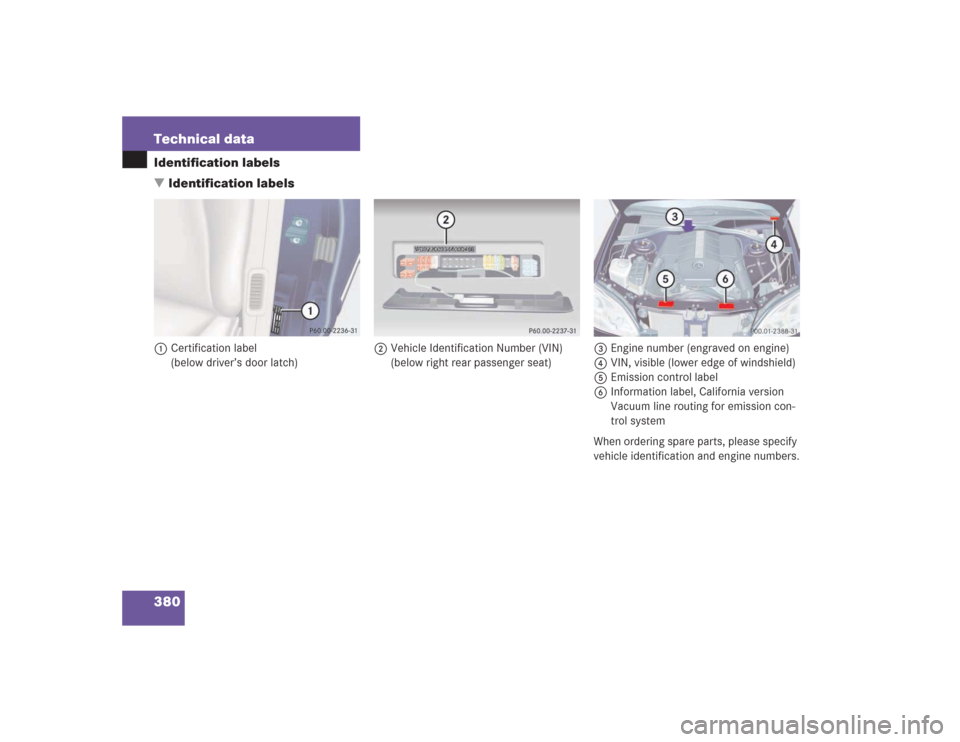
�Identification labels1Certification label
(below driver’s door latch)2Vehicle Identification Number (VIN)
(below right rear passenger seat)3Engine number (engraved on engine)
4VIN, visible (lower edge of windshield)
5Emission control label
6Information label, California version
Vacuum line routing for emission con-
trol system
When ordering spare parts, please specify
vehicle identification and engine numbers.
Page 393 of 435
392 Technical dataFuels, coolants, lubricants, etc.
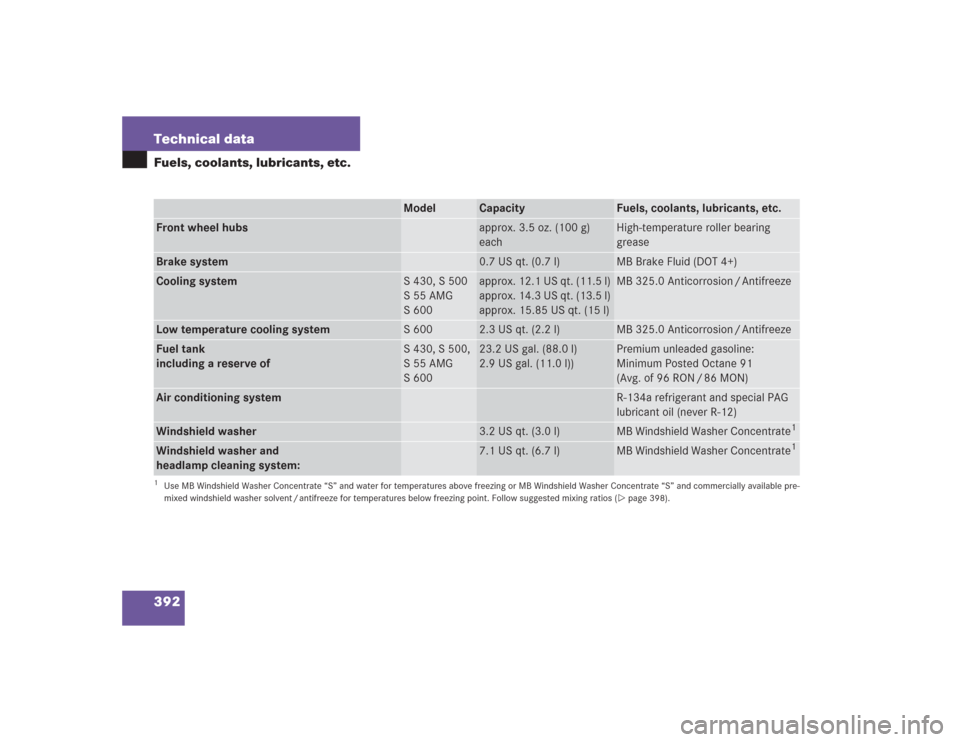
Model
Capacity
Fuels, coolants, lubricants, etc.
Front wheel hubs
approx. 3.5 oz. (100 g)
each
High-temperature roller bearing
grease
Brake system
0.7 US qt. (0.7 l)
MB Brake Fluid (DOT 4+)
Cooling system
S 430, S 500
S 55 AMG
S 600
approx. 12.1 US qt. (11.5 l)
approx. 14.3 US qt. (13.5 l)
approx. 15.85 US qt. (15 l)
MB 325.0 Anticorrosion / Antifreeze
Low temperature cooling system
S 600
2.3 US qt. (2.2 l)
MB 325.0 Anticorrosion / Antifreeze
Fuel tank
including a reserve of
S 430, S 500,
S55AMG
S 600
23.2 US gal. (88.0 l)
2.9 US gal. (11.0 l))
Premium unleaded gasoline:
Minimum Posted Octane 91
(Avg.of96RON/86MON)
Air conditioning system
R-134a refrigerant and special PAG
lubricant oil (never R-12)
Windshield washer
3.2 US qt. (3.0 l)
MB Windshield Washer Concentrate
1
1Use MB Windshield Washer Concentrate “S” and water for temperatures above freezing or MB Windshield Washer Concentrate “S” and commercially available pre-
mixed windshield washer solvent / antifreeze for temperatures below freezing point. Follow suggested mixing ratios (�page 398).Windshield washer and
headlamp cleaning system:
7.1 US qt. (6.7 l)
MB Windshield Washer Concentrate
1
Page 399 of 435
398 Technical dataFuels, coolants, lubricants, etc.Windshield and headlamp washer system
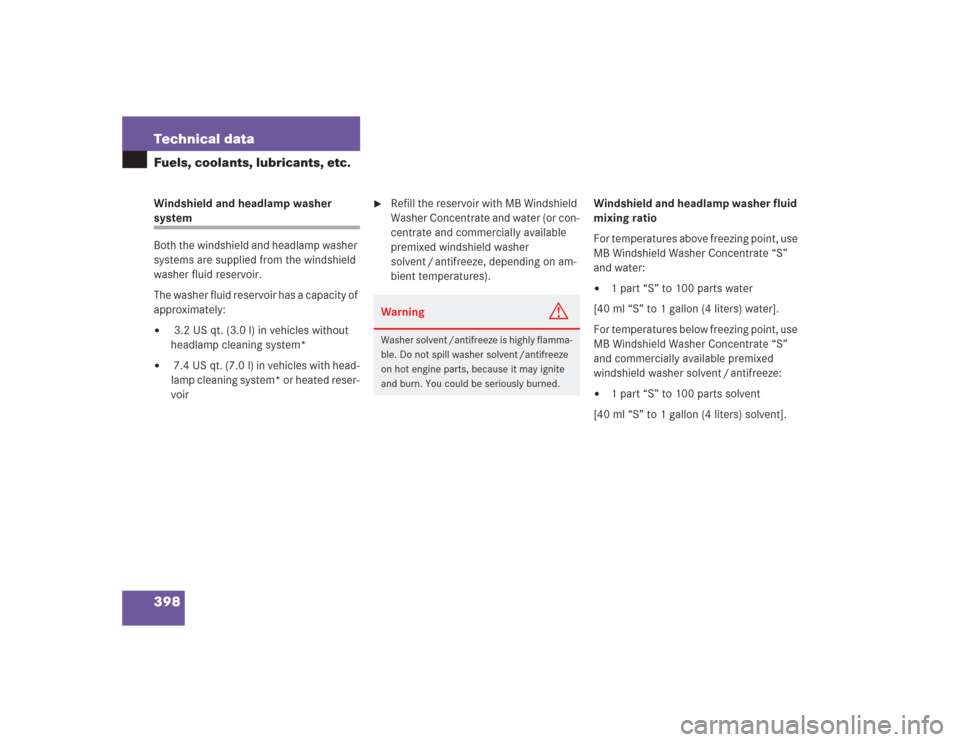
Both the windshield and headlamp washer
systems are supplied from the windshield
washer fluid reservoir.
The washer fluid reservoir has a capacity of
approximately:�
3.2 US qt. (3.0 l) in vehicles without
headlamp cleaning system*
�
7.4 US qt. (7.0 l) in vehicles with head-
lamp cleaning system* or heated reser-
voir
�
Refill the reservoir with MB Windshield
Washer Concentrate and water (or con-
centrate and commercially available
premixed windshield washer
solvent / antifreeze, depending on am-
bient temperatures).Windshield and headlamp washer fluid
mixing ratio
For temperatures above freezing point, use
MB Windshield Washer Concentrate “S”
and water:
�
1 part “S” to 100 parts water
[40 ml “S” to 1 gallon (4 liters) water].
For temperatures below freezing point, use
MB Windshield Washer Concentrate “S”
and commercially available premixed
windshield washer solvent / antifreeze:
�
1 part “S” to 100 parts solvent
[40 ml “S” to 1 gallon (4 liters) solvent].
Warning
G
Washer solvent /antifreeze is highly flamma-
ble. Do not spill washer solvent /antifreeze
on hot engine parts, because it may ignite
and burn. You could be seriously burned.