Page 326 of 442
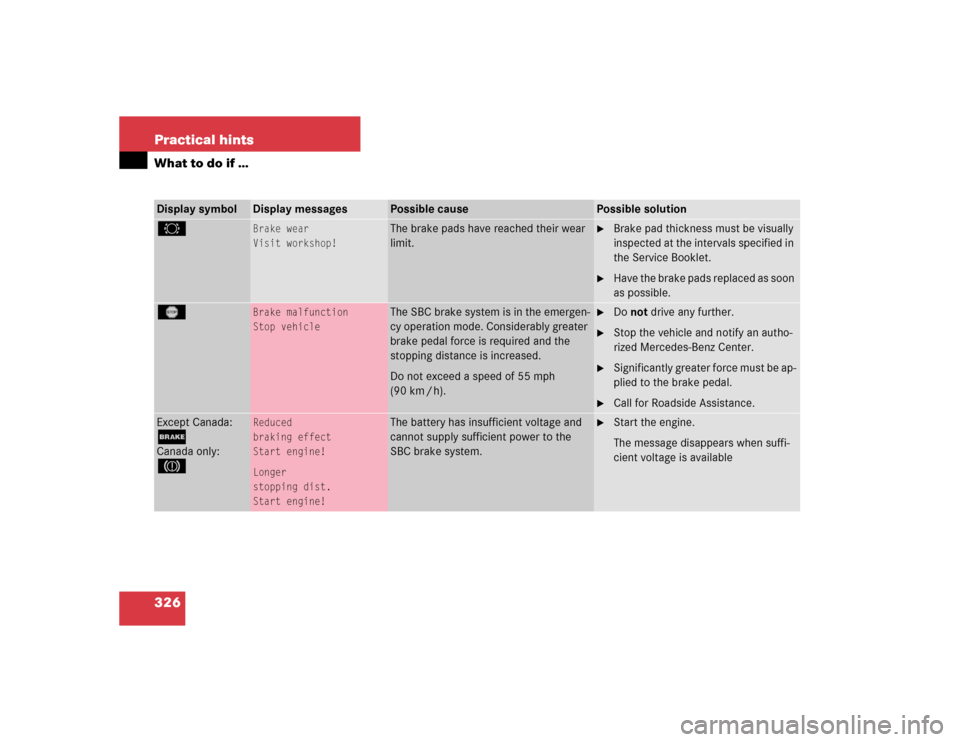
326 Practical hintsWhat to do if …Display symbol
Display messages
Possible cause
Possible solution
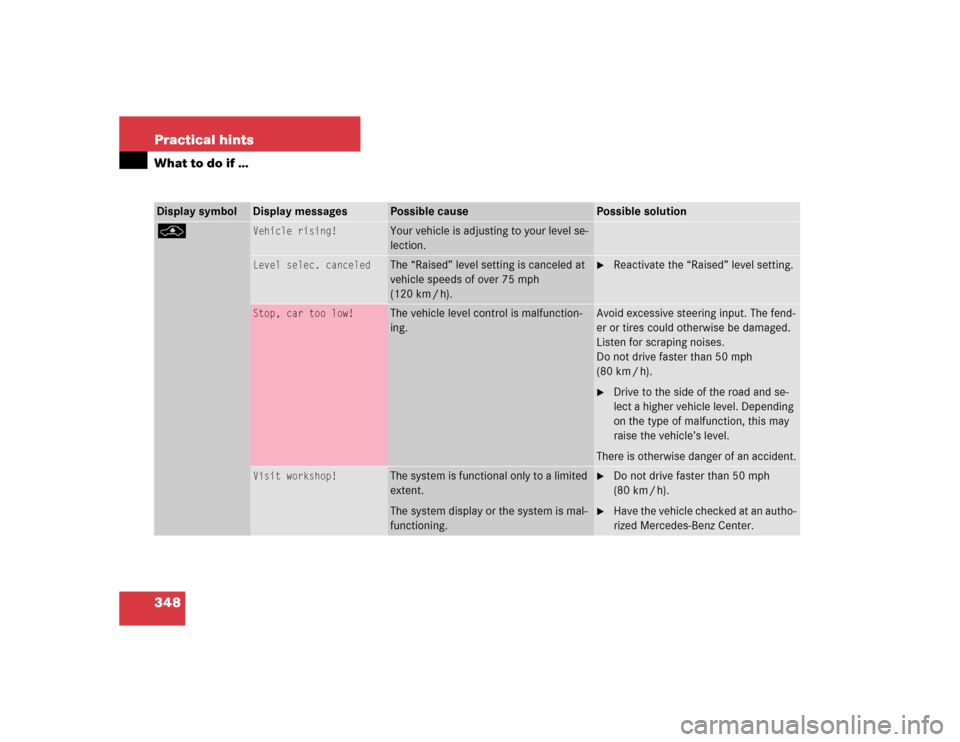
2
Brake wear
Visit workshop!
The brake pads have reached their wear
limit.
�
Brake pad thickness must be visually
inspected at the intervals specified in
the Service Booklet.
�
Have the brake pads replaced as soon
as possible.
T
Brake malfunction
Stop vehicle
The SBC brake system is in the emergen-
cy operation mode. Considerably greater
brake pedal force is required and the
stopping distance is increased.
Do not exceed a speed of 55 mph
(90 km / h).
�
Do not drive any further.
�
Stop the vehicle and notify an autho-
rized Mercedes-Benz Center.
�
Significantly greater force must be ap-
plied to the brake pedal.
�
Call for Roadside Assistance.
Except Canada:;Canada only:3
Reduced
braking effect
Start engine!
Longer
stopping dist.
Start engine!
The battery has insufficient voltage and
cannot supply sufficient power to the
SBC brake system.
�
Start the engine.
The message disappears when suffi-
cient voltage is available
Page 329 of 442
329 Practical hints
What to do if …
Display symbol
Display messages
Possible cause
Possible solution
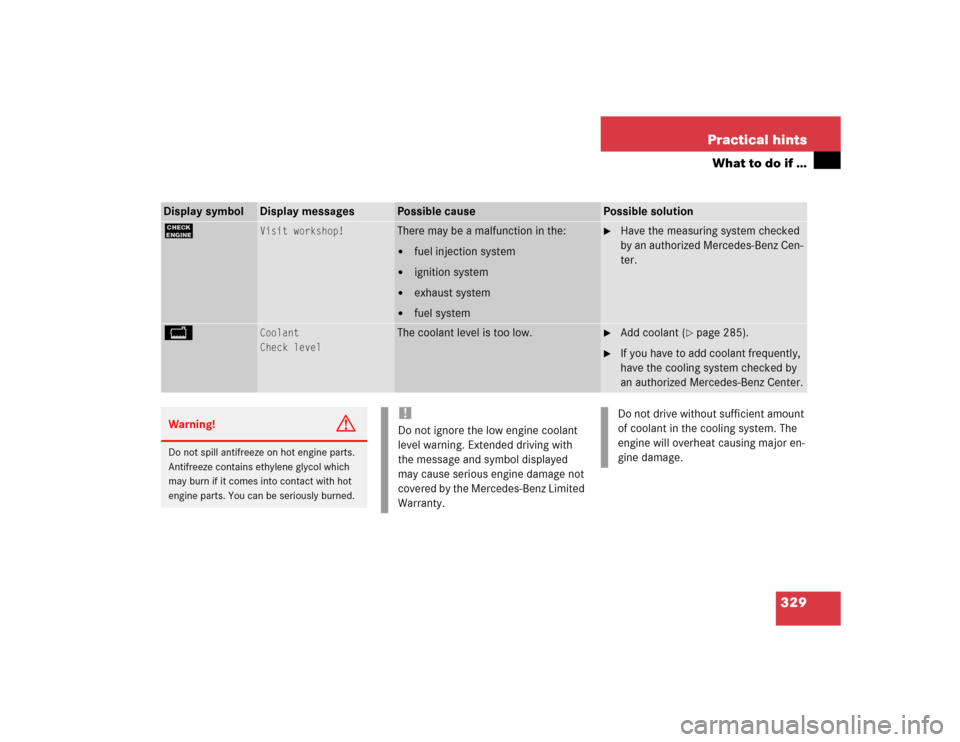
?
Visit workshop!
There may be a malfunction in the:�
fuel injection system
�
ignition system
�
exhaust system
�
fuel system
�
Have the measuring system checked
by an authorized Mercedes-Benz Cen-
ter.
B
Coolant
Check level
The coolant level is too low.
�
Add coolant (
�page 285).
�
If you have to add coolant frequently,
have the cooling system checked by
an authorized Mercedes-Benz Center.
Warning!
G
Do not spill antifreeze on hot engine parts.
Antifreeze contains ethylene glycol which
may burn if it comes into contact with hot
engine parts. You can be seriously burned.
!Do not ignore the low engine coolant
level warning. Extended driving with
the message and symbol displayed
may cause serious engine damage not
covered by the Mercedes-Benz Limited
Warranty.
Do not drive without sufficient amount
of coolant in the cooling system. The
engine will overheat causing major en-
gine damage.
Page 330 of 442
330 Practical hintsWhat to do if …
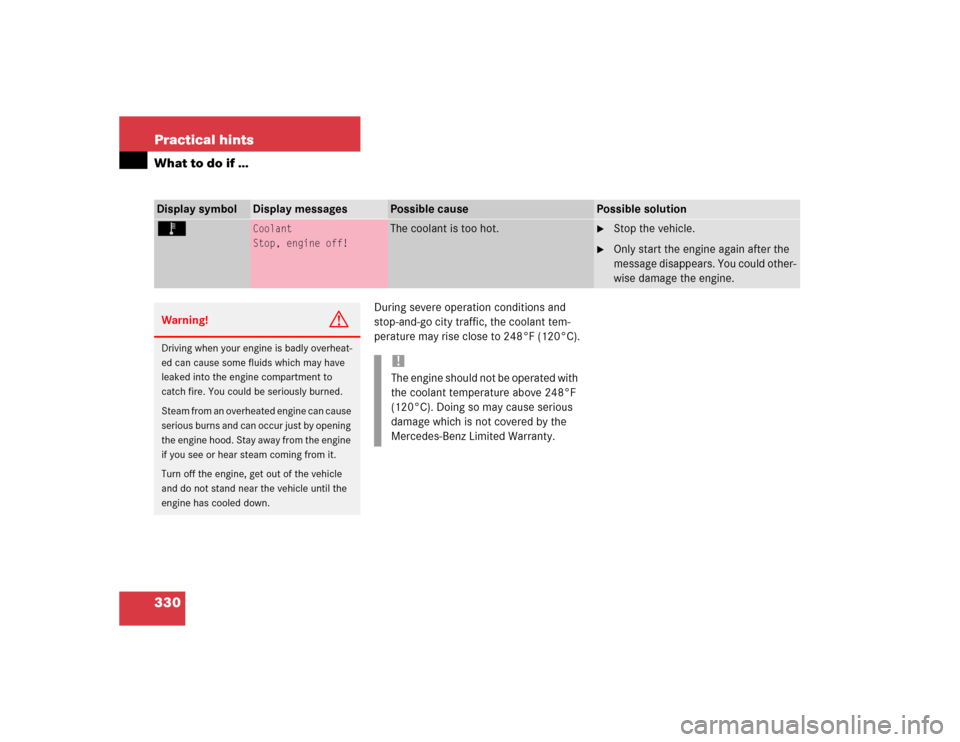
During severe operation conditions and
stop-and-go city traffic, the coolant tem-
perature may rise close to 248°F (120°C).
Display symbol
Display messages
Possible cause
Possible solution
Ï
Coolant
Stop, engine off!
The coolant is too hot.
�
Stop the vehicle.
�
Only start the engine again after the
message disappears. You could other-
wise damage the engine.
Warning!
G
Driving when your engine is badly overheat-
ed can cause some fluids which may have
leaked into the engine compartment to
catch fire. You could be seriously burned.
Steam from an overheated engine can cause
serious burns and can occur just by opening
the engine hood. Stay away from the engine
if you see or hear steam coming from it.
Turn off the engine, get out of the vehicle
and do not stand near the vehicle until the
engine has cooled down.
!The engine should not be operated with
the coolant temperature above 248°F
(120°C). Doing so may cause serious
damage which is not covered by the
Mercedes-Benz Limited Warranty.
Page 334 of 442
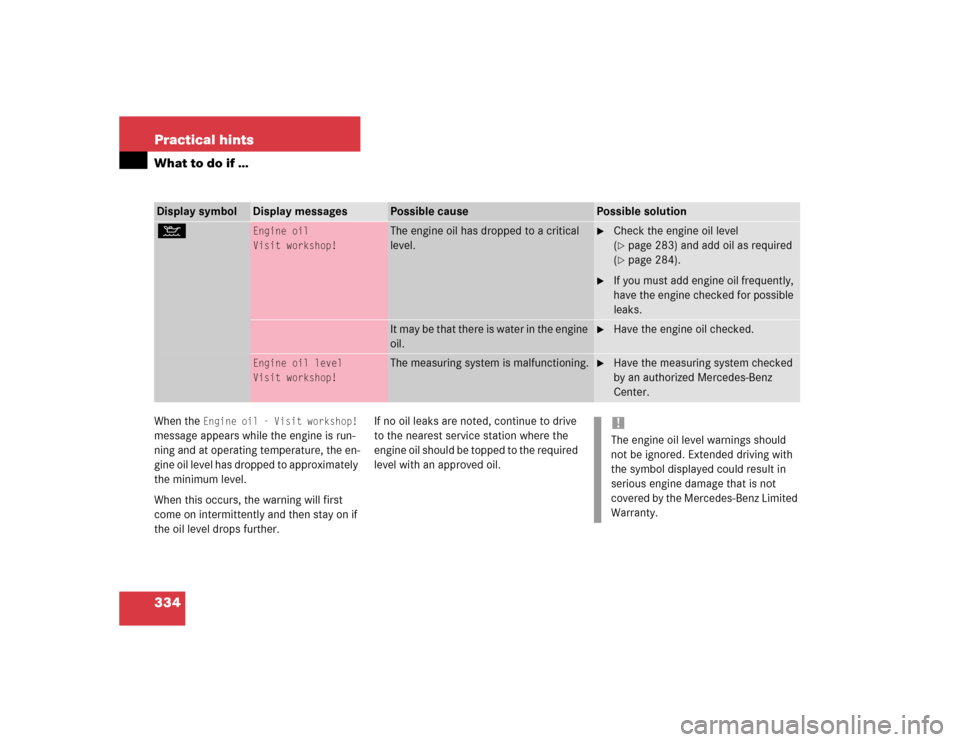
334 Practical hintsWhat to do if …When the
Engine oil - Visit workshop!
message appears while the engine is run-
ning and at operating temperature, the en-
gine oil level has dropped to approximately
the minimum level.
When this occurs, the warning will first
come on intermittently and then stay on if
the oil level drops further.If no oil leaks are noted, continue to drive
to the nearest service station where the
engine oil should be topped to the required
level with an approved oil.
Display symbol
Display messages
Possible cause
Possible solution
:
Engine oil
Visit workshop!
The engine oil has dropped to a critical
level.
�
Check the engine oil level
(�page 283) and add oil as required
(�page 284).
�
If you must add engine oil frequently,
have the engine checked for possible
leaks.
It may be that there is water in the engine
oil.
�
Have the engine oil checked.
Engine oil level
Visit workshop!
The measuring system is malfunctioning.
�
Have the measuring system checked
by an authorized Mercedes-Benz
Center.!The engine oil level warnings should
not be ignored. Extended driving with
the symbol displayed could result in
serious engine damage that is not
covered by the Mercedes-Benz Limited
Warranty.
Page 348 of 442
348 Practical hintsWhat to do if …Display symbol
Display messages
Possible cause
Possible solution
@
Vehicle rising!
Your vehicle is adjusting to your level se-
lection.
Level selec. canceled
The “Raised” level setting is canceled at
vehicle speeds of over 75 mph
(120 km / h).
�
Reactivate the “Raised” level setting.
Stop, car too low!
The vehicle level control is malfunction-
ing.
Avoid excessive steering input. The fend-
er or tires could otherwise be damaged.
Listen for scraping noises.
Do not drive faster than 50 mph
(80 km / h).�
Drive to the side of the road and se-
lect a higher vehicle level. Depending
on the type of malfunction, this may
raise the vehicle’s level.
There is otherwise danger of an accident.
Visit workshop!
The system is functional only to a limited
extent.
The system display or the system is mal-
functioning.
�
Do not drive faster than 50 mph
(80 km / h).
�
Have the vehicle checked at an autho-
rized Mercedes-Benz Center.
Page 367 of 442
367 Practical hints
Flat tire
�
Take the TIREFIT kit out of the trunk
(�page 350).
�
Foreign objects (e.g. screws or nails)
should not be removed from the tire.
�
Attach the sticker where it will be easily
seen by the driver on the instrument
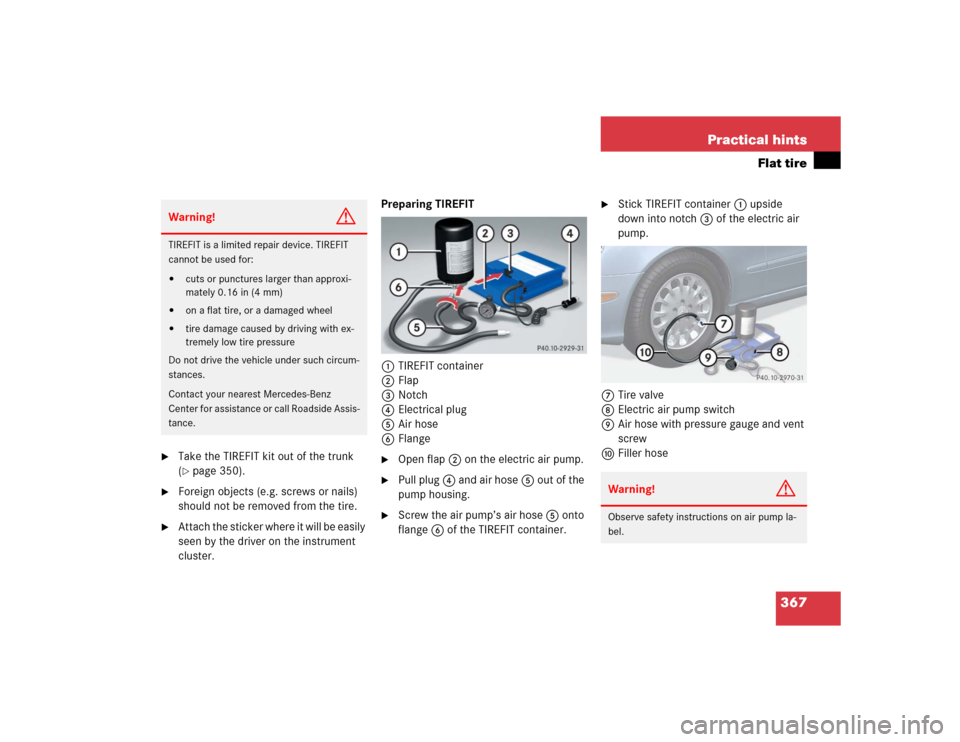
cluster.Preparing TIREFIT
1TIREFIT container
2Flap
3Notch
4Electrical plug
5Air hose
6Flange
�
Open flap2 on the electric air pump.
�
Pull plug4 and air hose5 out of the
pump housing.
�
Screw the air pump’s air hose5 onto
flange6 of the TIREFIT container.
�
Stick TIREFIT container1 upside
down into notch3 of the electric air
pump.
7Tire valve
8Electric air pump switch
9Air hose with pressure gauge and vent
screw
aFiller hose
Warning!
G
TIREFIT is a limited repair device. TIREFIT
cannot be used for:�
cuts or punctures larger than approxi-
mately 0.16 in (4 mm)
�
on a flat tire, or a damaged wheel
�
tire damage caused by driving with ex-
tremely low tire pressure
Do not drive the vehicle under such circum-
stances.
Contact your nearest Mercedes-Benz
Center for assistance or call Roadside Assis-
tance.
Warning!
G
Observe safety instructions on air pump la-
bel.
Page 378 of 442
378 Practical hintsJump starting
�Jump starting
If the battery is discharged, the engine can
be started with jumper cables and the bat-
tery of another vehicle. Observe the follow-
ing:�
Jump starting should only be performed
when the engine and catalytic convert-
er are cold.
�
Do not start the engine if the battery is
frozen. Let the battery thaw out first.
�
Only jump start from batteries with the
same voltage rating (12 V). Jump start-
ing with a more powerful battery could
damage the vehicle’s electrical system,
which will not be covered by the
Mercedes-Benz Limited Warranty.
�
Use only jumper cables with sufficient
cross-section and insulated terminal
clamps.
�
Always make sure the jumper cables
are not on or near pulleys, fans or other
parts that move when the engine is
started or running.
Warning!
G
Failure to follow these directions will cause
damage to the electronic components, and
can lead to a battery explosion and severe
injury or death.
Never lean over batteries while connecting
or jump starting, you might get injured.
Battery fluid contains sulfuric acid. Do not
allow this fluid to come in contact with eyes,
skin or clothing. In case it does, immediately
flush affected area with water, and seek
medical help if necessary.
A battery will also produce hydrogen gas,
which is flammable and very explosive. Keep
flames or sparks away from battery, avoid
improper connection of jumper cables,
smoking, etc.
Attempting to jump start a frozen battery
can result in it exploding, causing personal
injury.
Read all instructions before proceeding.
!Jump starting may only be performed
on the main battery installed in the
trunk.
Avoid repeated and lengthy starting at-
tempts.
Do not attempt to start the engine us-
ing a battery quick charge unit.
If the engine does not run after several
unsuccessful starting attempts, have it
checked at the nearest authorized
Mercedes-Benz Center.
Excessive unburned fuel generated by
repeated failed starting attempts may
damage the catalytic converter.
Make sure the jumper cables do not
have loose or missing insulation.
Make sure the cable clamps do not
touch any other metal part while the
other end is still attached to a battery.
Page 381 of 442
381 Practical hints
Towing the vehicle
�Towing the vehicle
Mercedes-Benz recommends that the vehi-
cle be transported with all wheels off the
ground using flatbed or appropriate wheel
lift/dolly equipment. This method is pref-
erable to other types of towing.When circumstances do not permit the
recommended towing methods, the vehi-
cle may be towed with all wheels on the
ground or front wheels raised (except vehi-
cles with 4MATIC) only so far as necessary
to have the vehicle moved to a safe loca-
tion where the recommended towing
methods can be employed.
!Use flatbed or wheel lift / dolly equip-
ment with SmartKey in starter switch
turned to position0.
Do not tow with sling-type equipment.
Towing with sling-type equipment over
bumpy roads will damage radiator and
supports.
To prevent damage during transport,
do not tie down vehicle by its chassis or
suspension parts.
Switch off the tow-away alarm and the
automatic central locking
Do not tow-start the vehicle.
!Vehicles with 4MATIC:
Do not tow with one axle raised. Doing
so could damage the transfer case,
which is not covered by the Mer-
cedes-Benz Limited Warranty.
All wheels must be on or off the ground.
Observe instructions for towing the ve-
hicle with all wheels on the ground.
!If the vehicle is towed with the front
axle raised (not permissible for vehicles
with 4MATIC), the engine must be shut
off (SmartKey in starter switch
position0 or 1). Otherwise the ESP will
immediately be engaged and will apply
the rear wheel brakes.
When towing the vehicle with all wheels
on the ground, the selector lever must
be in positionN and the SmartKey
must be in starter switch position2.
When towing the vehicle with all wheels
on the ground or the front axle raised,
the vehicle may be towed only for dis-
tances up to 30 miles (50 km) and at a
speed not to exceed 30 mph
(50 km/h).