Page 296 of 442
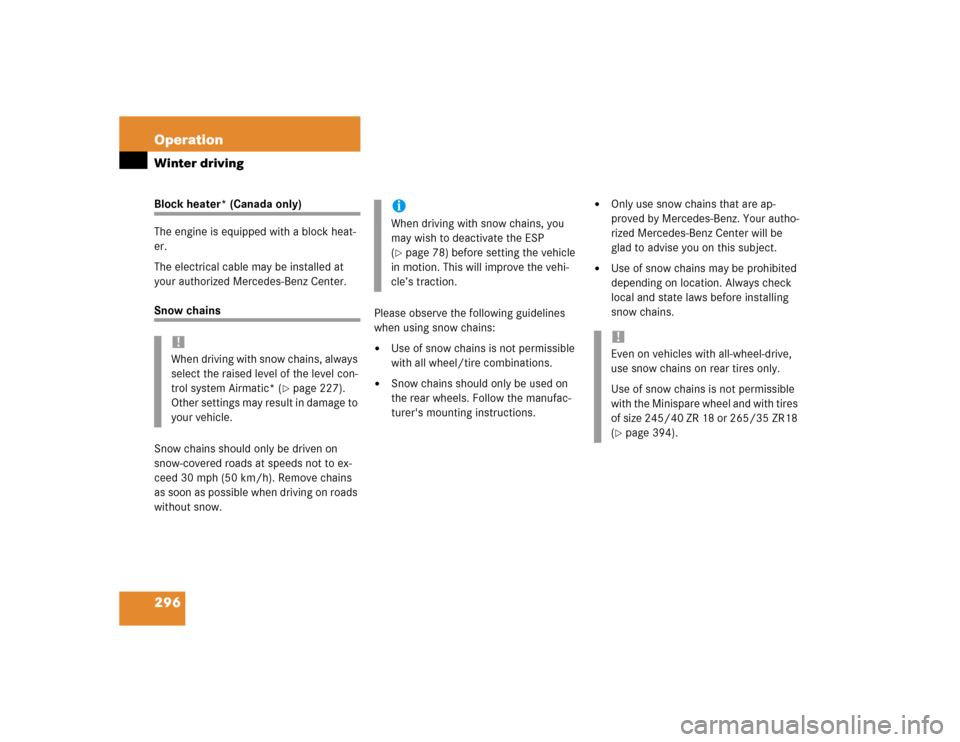
296 OperationWinter drivingBlock heater* (Canada only)
The engine is equipped with a block heat-
er.
The electrical cable may be installed at
your authorized Mercedes-Benz Center.Snow chains
Snow chains should only be driven on
snow-covered roads at speeds not to ex-
ceed 30 mph (50 km/h). Remove chains
as soon as possible when driving on roads
without snow.Please observe the following guidelines
when using snow chains:
�
Use of snow chains is not permissible
with all wheel/tire combinations.
�
Snow chains should only be used on
the rear wheels. Follow the manufac-
turer's mounting instructions.
�
Only use snow chains that are ap-
proved by Mercedes-Benz. Your autho-
rized Mercedes-Benz Center will be
glad to advise you on this subject.
�
Use of snow chains may be prohibited
depending on location. Always check
local and state laws before installing
snow chains.
!When driving with snow chains, always
select the raised level of the level con-
trol system Airmatic* (
�page 227).
Other settings may result in damage to
your vehicle.
iWhen driving with snow chains, you
may wish to deactivate the ESP
(�page 78) before setting the vehicle
in motion. This will improve the vehi-
cle’s traction.
!Even on vehicles with all-wheel-drive,
use snow chains on rear tires only.
Use of snow chains is not permissible
with the Minispare wheel and with tires
of size 245/40 ZR 18 or 265/35 ZR18
(�page 394).
Page 303 of 442
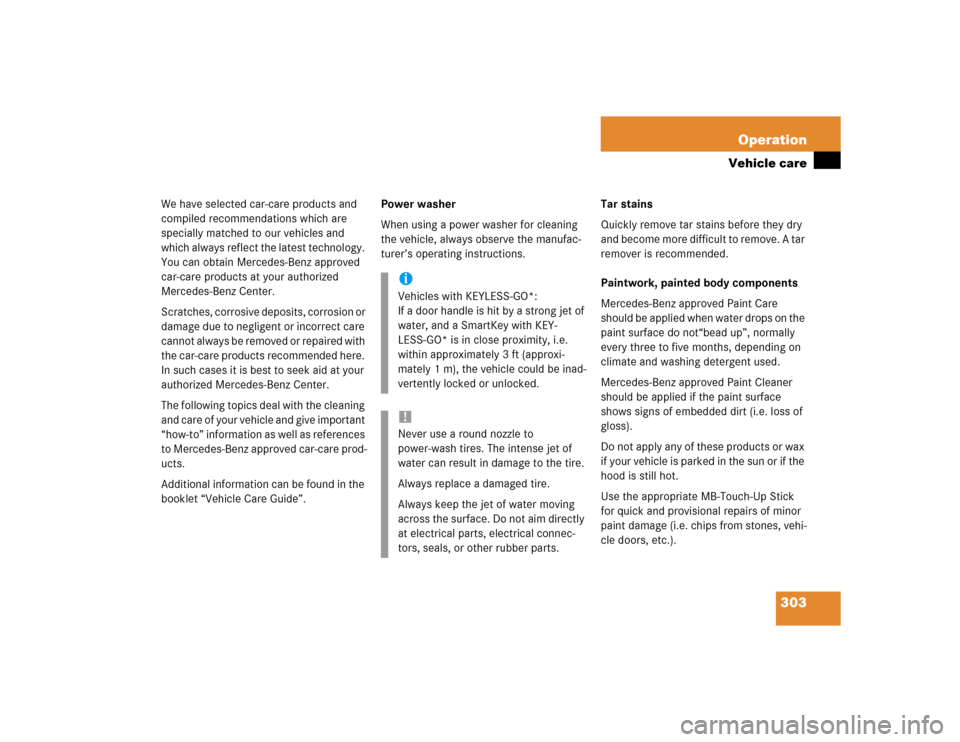
303 Operation
Vehicle care
We have selected car-care products and
compiled recommendations which are
specially matched to our vehicles and
which always reflect the latest technology.
You can obtain Mercedes-Benz approved
car-care products at your authorized
Mercedes-Benz Center.
Scratches, corrosive deposits, corrosion or
damage due to negligent or incorrect care
cannot always be removed or repaired with
the car-care products recommended here.
In such cases it is best to seek aid at your
authorized Mercedes-Benz Center.
The following topics deal with the cleaning
and care of your vehicle and give important
“how-to” information as well as references
to Mercedes-Benz approved car-care prod-
ucts.
Additional information can be found in the
booklet “Vehicle Care Guide”.Power washer
When using a power washer for cleaning
the vehicle, always observe the manufac-
turer’s operating instructions.Tar stains
Quickly remove tar stains before they dry
and become more difficult to remove. A tar
remover is recommended.
Paintwork, painted body components
Mercedes-Benz approved Paint Care
should be applied when water drops on the
paint surface do not“bead up”, normally
every three to five months, depending on
climate and washing detergent used.
Mercedes-Benz approved Paint Cleaner
should be applied if the paint surface
shows signs of embedded dirt (i.e. loss of
gloss).
Do not apply any of these products or wax
if your vehicle is parked in the sun or if the
hood is still hot.
Use the appropriate MB-Touch-Up Stick
for quick and provisional repairs of minor
paint damage (i.e. chips from stones, vehi-
cle doors, etc.).
iVehicles with KEYLESS-GO*:
If a door handle is hit by a strong jet of
water, and a SmartKey with KEY-
LESS-GO* is in close proximity, i.e.
within approximately 3 ft (approxi-
mately 1 m), the vehicle could be inad-
vertently locked or unlocked. !Never use a round nozzle to
power-wash tires. The intense jet of
water can result in damage to the tire.
Always replace a damaged tire.
Always keep the jet of water moving
across the surface. Do not aim directly
at electrical parts, electrical connec-
tors, seals, or other rubber parts.
Page 304 of 442

304 OperationVehicle careEngine cleaning
Prior to cleaning the engine compartment,
make sure to protect electrical compo-
nents and connectors from contact with
water and cleaning agents.
Corrosion protection, such as MB Anticor-
rosion Wax should be applied to the engine
compartment after every engine cleaning.
Before applying, all control linkage bush-
ings and joints should be lubricated. The
poly-V-belt and all pulleys should be pro-
tected from any wax.
Vehicle washing
Do not use hot water or wash your vehicle
in direct sunlight. Use only a mild car wash
detergent, such as Mercedes-Benz ap-
proved Car Shampoo.
Thoroughly spray the vehicle with a dif-
fused jet of water. Direct only a very weak
spray towards the ventilation intake. Use
plenty of water and rinse the sponge and
chamois frequently. Rinse with clear water and thoroughly dry
with a chamois. Do not allow cleaning
agents to dry on the finish.
Due to the width of the vehicle, fold in out-
side mirrors prior to running the vehicle
through an automatic car wash to prevent
damage to the mirrors.
In the winter, thoroughly remove all traces
of road salt as soon as possible.
When washing the undercarriage, do not
forget to clean the inner sides of the
wheels.Ornamental moldings
For regular cleaning and care of very dirty
chrome-plated parts, use a chrome clean-
er.
Headlamps, tail lamps, side markers,
turn signal lenses
Use a mild car wash detergent, such as
Mercedes-Benz approved Car Shampoo,
with plenty of water.
To prevent scratches, never apply strong
force and use only a soft, non-scratchy
cloth when cleaning the lenses. Do not at-
tempt to wipe dirty lenses with a dry cloth
or sponge.
iVehicles with KEYLESS-GO*:
If a door handle is hit by a strong jet of
water, and a SmartKey with KEY-
LESS-GO* is in close proximity, i.e.
within approximately 3 ft (approxi-
mately 1 m), the vehicle could be inad-
vertently locked or unlocked.
Page 309 of 442
309 Practical hints
What to do if …
Where will I find ...?
Unlocking / locking in an emergency
Opening / closing in an emergency
Replacing bulbs
Replacing wiper blades
Flat tire
Batteries
Jump starting
Towing the vehicle
Fuses
Page 310 of 442
310 Practical hintsWhat to do if …
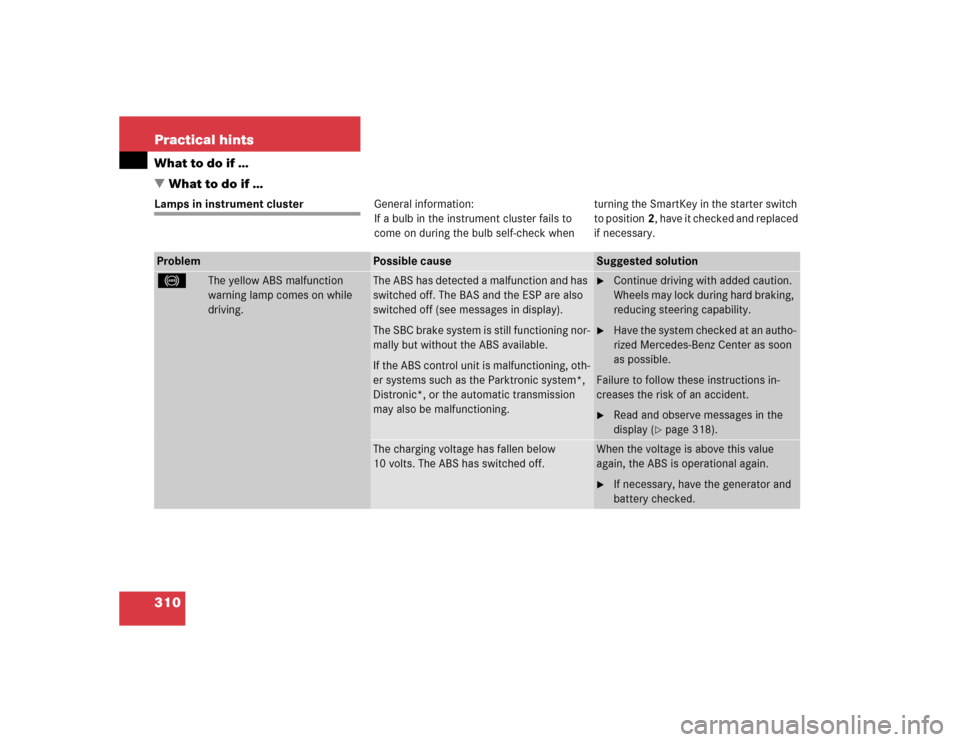
�What to do if …Lamps in instrument clusterGeneral information:
If a bulb in the instrument cluster fails to
come on during the bulb self-check when turning the SmartKey in the starter switch
to position2, have it checked and replaced
if necessary.Problem
Possible cause
Suggested solution
-
The yellow ABS malfunction
warning lamp comes on while
driving.
The ABS has detected a malfunction and has
switched off. The BAS and the ESP are also
switched off (see messages in display).
The SBC brake system is still functioning nor-
mally but without the ABS available.
If the ABS control unit is malfunctioning, oth-
er systems such as the Parktronic system*,
Distronic*, or the automatic transmission
may also be malfunctioning.
�
Continue driving with added caution.
Wheels may lock during hard braking,
reducing steering capability.
�
Have the system checked at an autho-
rized Mercedes-Benz Center as soon
as possible.
Failure to follow these instructions in-
creases the risk of an accident.
�
Read and observe messages in the
display (
�page 318).
The charging voltage has fallen below
10 volts. The ABS has switched off.
When the voltage is above this value
again, the ABS is operational again.�
If necessary, have the generator and
battery checked.
Page 319 of 442
319 Practical hints
What to do if …
Text messagesDisplay
Display message
Possible cause
Possible solution
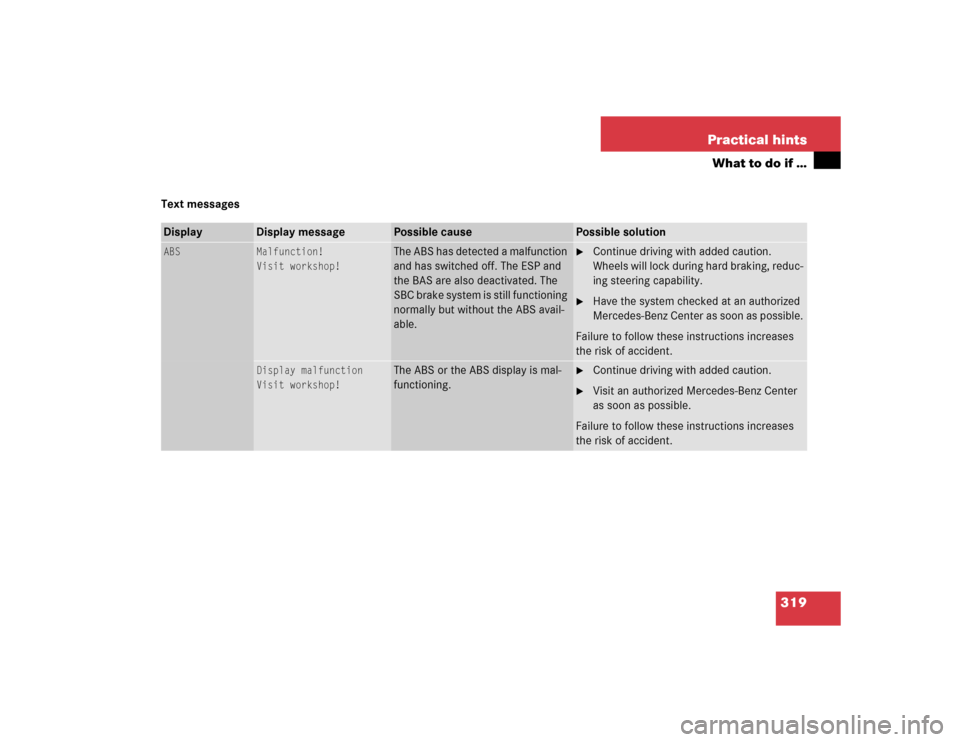
ABS
Malfunction!
Visit workshop!
The ABS has detected a malfunction
and has switched off. The ESP and
the BAS are also deactivated. The
SBC brake system is still functioning
normally but without the ABS avail-
able.
�
Continue driving with added caution.
Wheels will lock during hard braking, reduc-
ing steering capability.
�
Have the system checked at an authorized
Mercedes-Benz Center as soon as possible.
Failure to follow these instructions increases
the risk of accident.
Display malfunction
Visit workshop!
The ABS or the ABS display is mal-
functioning.
�
Continue driving with added caution.
�
Visit an authorized Mercedes-Benz Center
as soon as possible.
Failure to follow these instructions increases
the risk of accident.
Page 325 of 442
325 Practical hints
What to do if …
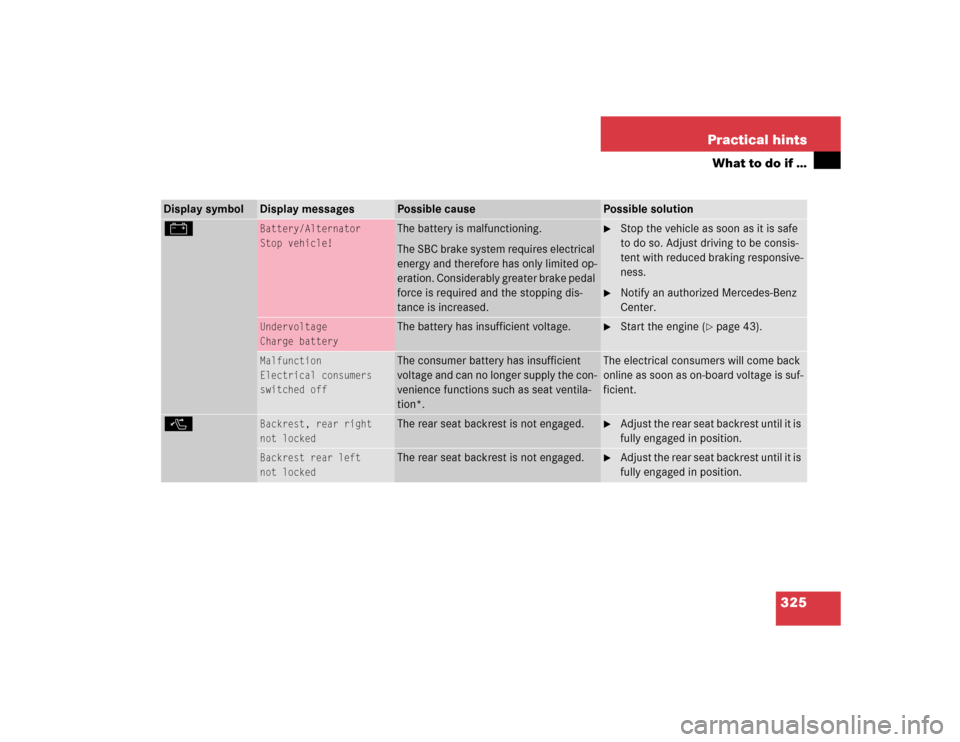
Display symbol
Display messages
Possible cause
Possible solution
#
Battery/Alternator
Stop vehicle!
The battery is malfunctioning.
The SBC brake system requires electrical
energy and therefore has only limited op-
eration. Considerably greater brake pedal
force is required and the stopping dis-
tance is increased.
�
Stop the vehicle as soon as it is safe
to do so. Adjust driving to be consis-
tent with reduced braking responsive-
ness.
�
Notify an authorized Mercedes-Benz
Center.
Undervoltage
Charge battery
The battery has insufficient voltage.
�
Start the engine (
�page 43).
Malfunction
Electrical consumers
switched off
The consumer battery has insufficient
voltage and can no longer supply the con-
venience functions such as seat ventila-
tion*.
The electrical consumers will come back
online as soon as on-board voltage is suf-
ficient.
(
Backrest, rear right
not locked
The rear seat backrest is not engaged.
�
A d j u s t t h e r e a r s e a t b a c k r e s t u n t i l i t i s
fully engaged in position.
Backrest rear left
not locked
The rear seat backrest is not engaged.
�
A d j u s t t h e r e a r s e a t b a c k r e s t u n t i l i t i s
fully engaged in position.
Page 335 of 442
335 Practical hints
What to do if …
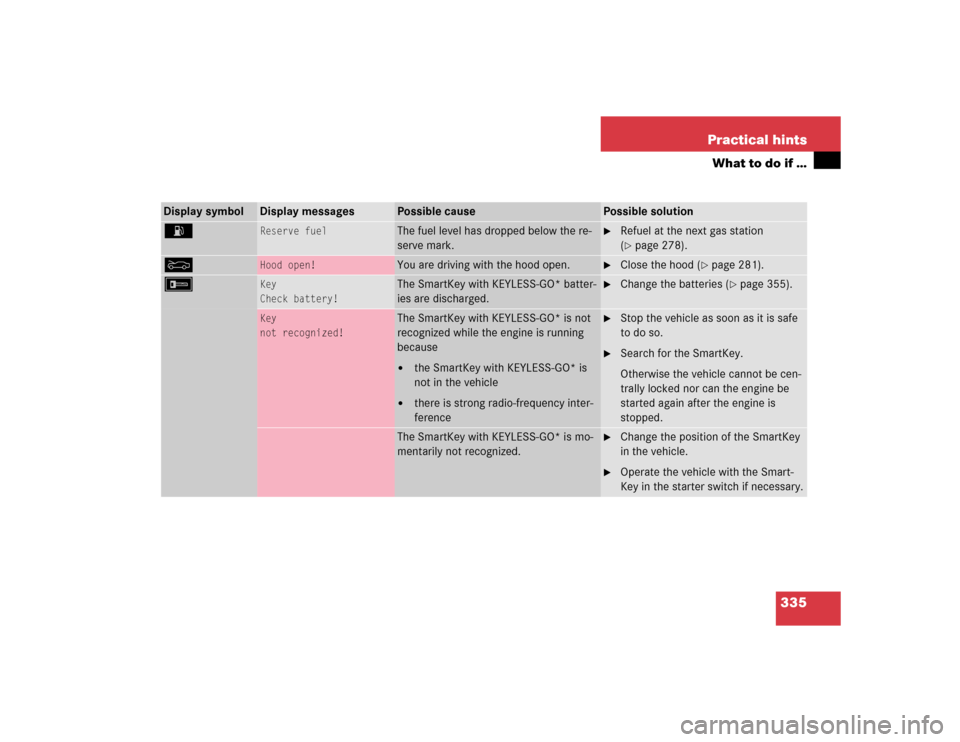
Display symbol
Display messages
Possible cause
Possible solution
A
Reserve fuel
The fuel level has dropped below the re-
serve mark.
�
Refuel at the next gas station
(�page 278).
Y
Hood open!
You are driving with the hood open.
�
Close the hood (
�page 281).
F
Key
Check battery!
The SmartKey with KEYLESS-GO* batter-
ies are discharged.
�
Change the batteries (
�page 355).
Key
not recognized!
The SmartKey with KEYLESS-GO* is not
recognized while the engine is running
because�
the SmartKey with KEYLESS-GO* is
not in the vehicle
�
there is strong radio-frequency inter-
ference
�
Stop the vehicle as soon as it is safe
to do so.
�
Search for the SmartKey.
Otherwise the vehicle cannot be cen-
trally locked nor can the engine be
started again after the engine is
stopped.
The SmartKey with KEYLESS-GO* is mo-
mentarily not recognized.
�
Change the position of the SmartKey
in the vehicle.
�
Operate the vehicle with the Smart-
Key in the starter switch if necessary.