Page 142 of 400
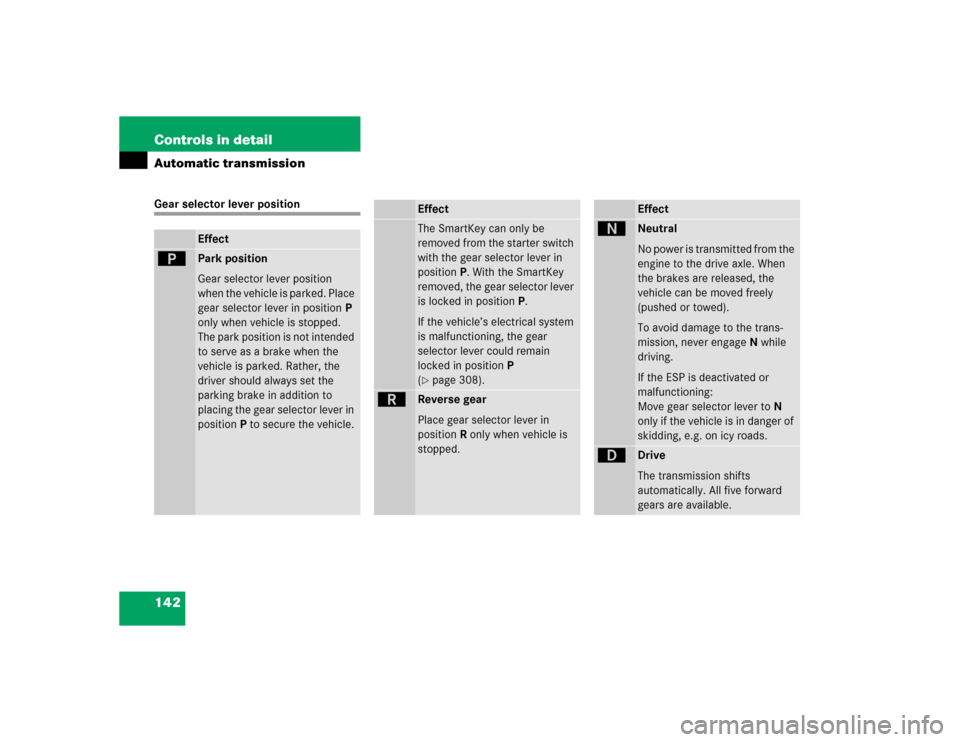
142 Controls in detailAutomatic transmissionGear selector lever position
Effect
ì
Park position
Gear selector lever position
when the vehicle is parked. Place
gear selector lever in positionP
only when vehicle is stopped.
The park position is not intended
to serve as a brake when the
vehicle is parked. Rather, the
driver should always set the
parking brake in addition to
placing the gear selector lever in
positionP to secure the vehicle.
EffectThe SmartKey can only be
removed from the starter switch
with the gear selector lever in
positionP. With the SmartKey
removed, the gear selector lever
is locked in positionP.
If the vehicle’s electrical system
is malfunctioning, the gear
selector lever could remain
locked in positionP
(�page 308).
í
Reverse gear
Place gear selector lever in
positionR only when vehicle is
stopped.
Effect
ë
Neutral
No power is transmitted from the
engine to the drive axle. When
the brakes are released, the
vehicle can be moved freely
(pushed or towed).
To avoid damage to the trans-
mission, never engageN while
driving.
If the ESP is deactivated or
malfunctioning:
Move gear selector lever toN
only if the vehicle is in danger of
skidding, e.g. on icy roads.
ê
Drive
The transmission shifts
automatically. All five forward
gears are available.
Page 144 of 400

144 Controls in detailAutomatic transmission�
Press program mode selector
switch1 repeatedly until the letter of
the desired shift program appears in
the multifunction display (
�page 111).
SelectCfor comfort driving:
�
The vehicle starts out in second
gear (both forward and reverse) for
gentler starts. This does not apply if
full throttle is applied or gear
range1 is selected.
�
Traction and driving stability are
improved on icy roads.
�
Upshifts occur earlier even when
you give more gas. The engine then
operates at lower rpms and the
wheels are less likely to spin.
�
The power transmission ratio for
gear selector lever positionR
changes depending on the program
mode selected (SorC).
Accelerator position
Your driving style influences the
transmission’s shifting behavior:
Less throttle Earlier upshifting
More throttle Later upshifting
Kickdown
Use kickdown when you want maximum
acceleration.�
Press the accelerator past the point of
resistance.
The transmission shifts into a lower
gear.
�
Ease on the accelerator when you have
reached the desired speed.
The transmission shifts up again.Emergency operation (Limp Home
Mode)
If vehicle acceleration worsens or the
transmission no longer shifts, the trans-
mission is most likely operating in limp
home (emergency operation) mode. In this
mode only second gear and reverse gear
can be activated.�
Stop the vehicle.
�
Move gear selector lever toP.
�
Turn off the engine.
�
Wait at least ten seconds before
restarting.
�
Restart the engine.
�
Move gear selector lever to positionD
(for second gear) orR.
�
Have the transmission checked at an
authorized Mercedes-Benz Center as
soon as possible.
Page 145 of 400

145 Controls in detail
Good visibility
�Good visibility
Windshield wipers
More information on the windshield wipers
can be found in the “Getting started”
section (
�page 47).
Intermittent wiping
Windshield wipers with rain sensor*
A rain sensor automatically controls the
windshield wipers depending on how wet
the windshield is.
�
Switch on ignition.
�
Set the wiper switch to positionI
(�page 47).
After the initial wipe, pauses between
wipes are automatically controlled by the
rain sensor.
Headlamp cleaning system*
The switch is located on the left side of the
dashboard.
1Headlamp washer switch�
Switch on ignition.
�
Press switch1.
The headlamps are cleaned with a
high-pressure water jet.
For information on filling up the washer
reservoir, see “Windshield washer system
and headlamp cleaning system*”
(
�page 259).
iIntermittent wiping is interrupted when
the vehicle is at a standstill and a front
door is opened.
!Do not leave windshield wipers in
intermittent setting when the vehicle is
taken to an automatic car wash or
during windshield cleaning. Wipers will
operate in the presence of water
sprayed on the windshield, and wipers
may be damaged as a result.
The switch should not be left in
intermittent setting as the wipers will
wipe the windshield once every time
the engine is started. Dust that
accumulates on the windshield might
scratch the glass and/or damage the
wiper blades when wiping occurs on a
dry windshield.
Page 152 of 400
152 Controls in detailClimate controlThe climate control is operational whenev-
er the engine is running. You can operate
the climate control system in either the au-
tomatic or manual mode. The system cools
or heats the interior depending on the se-
lected interior temperature and the cur-
rent outside temperature.Nearly all dust particles, pollutants and
odors are filtered out before outside air en-
ters the passenger compartment through
the air distribution system.
The air conditioning will not engage (no
cooling) if the modeAC
OFF
is selected
(
�page 156).
Setting the temperature
Use temperature controls2 and3
(�page 151) to separately adjust the air
temperature on each side of the passenger
compartment. You should raise or lower
the temperature setting in small incre-
ments, preferably starting at 72°F (22°C).
Warning!
G
When operating the climate control, the air
that enters the passenger compartment
through the air vents in the footwell can be
very hot or very cold (depending on the set
temperature). This may cause burns or frost-
bite on unprotected skin in the immediate
area of the air vents. Always keep sufficient
distance between unprotected parts of the
body and the footwell air vents. If necessary,
change the air flow using the air distribution
controls to direct the air away from the foot-
well air vents (
�page 153).
Warning!
G
Follow the recommended settings for heat-
ing and cooling given on the following pag-
es. Otherwise the windows could fog up,
impairing visibility and endangering you and
others.
iSevere conditions (e.g. strong air
pollution) may require replacement of
the filter before its scheduled interval.
A clogged filter will reduce the air
volume to the interior.
If the vehicle interior is hot, ventilate
the interior before driving off.
Keep the air intake grille in front of the
windshield free of snow and debris.
Do not obstruct air flow by placing
objects on the air flow-through exhaust
slots below the rear window.
Page 156 of 400

156 Controls in detailClimate controlAir conditioning
The air conditioning is operational while
the engine is running and cools the interior
air to the temperature set by the operator.
Deactivating
It is possible to deactivate the air condi-
tioning (cooling) function of the climate
control system. The air in the vehicle will
then no longer be cooled or dehumidified.�
Press button± (
�page 151).
The indicator lamp on the button
comes on.Activating
Moist air can fog up the windows. You can
dehumidify the air with the air condition-
ing.
�
Press button± (
�page 151).
The indicator lamp on the button goes
out.
The air conditioning uses the
refrigerant R134a. This refrigerant is free
of CFC’s which are harmful to the ozone
layer.
Ventilated storage compartment
The front center console storage compart-
ment has its own air vent that allows for
cooling ventilation when the automatic
climate control system is activated.
1Lever
iCondensation may drip out from under-
neath the vehicle. This is normal and
not an indication of a malfunction.
!If the air conditioning cannot be turned
on again, this indicates that the air
conditioning is losing refrigerant. The
compressor has turned itself off.
Have the air conditioning checked at
the nearest authorized Mercedes-Benz
Center.
iYou should keep this air vent closed
when outside temperatures are low.
Page 160 of 400
160 Controls in detailAutomatic climate control*The automatic climate control is operation-
al whenever the engine is running. You can
operate the climate control system in ei-
ther the automatic or manual mode. The
system cools or heats the interior depend-
ing on the selected interior temperature
and the current outside temperature.Nearly all dust particles, pollutants and
odors are filtered out before outside air en-
ters the passenger compartment through
the air distribution system.
The air conditioning will not engage (no
cooling) if theAC
OFF
mode is selected
(
�page 166).
Warning!
G
When operating the automatic climate
control, the air that enters the passenger
compartment through the air vents in the
footwell can be very hot or very cold
(depending on the set temperature). This
may cause burns or frostbite on unprotected
skin in the immediate area of the air vents.
Always keep sufficient distance between
unprotected parts of the body and the foot-
well air vents. If necessary, change the air
flow using the air distribution controls to
direct the air away from the footwell air
vents (
�page 162).
Warning!
G
Follow the recommended settings for
heating and cooling given on the following
pages. Otherwise the windows could fog up,
impairing visibility and endangering you and
others.
Page 166 of 400
166 Controls in detailAutomatic climate control*Air conditioning
The air conditioning is operational while
the engine is running and cools the interior
air to the temperature set by the operator.Deactivating
It is possible to deactivate the air condi-
tioning (cooling) function of the automatic
climate control system. The air in the
vehicle will then no longer be cooled or
dehumidified.
�
Press button° (
�page 159).
The indicator lamp on the button
comes on.Activating
Moist air can fog up the windows. You can
dehumidify the air with the air condi-
tioning.
�
Press button° (
�page 159).
The indicator lamp on the button goes
out.
The air conditioning uses the
refrigerant R134a. This refrigerant is free
of CFCs which are harmful to the ozone
layer.
iCondensation may drip out from under-
neath the vehicle. This is normal and
not an indication of a malfunction.
!If the air conditioning cannot be turned
on again, this indicates that the air
conditioning is losing refrigerant. The
compressor has turned itself off.
Have the air conditioning checked at
the nearest authorized Mercedes-Benz
Center.
Page 167 of 400
167 Controls in detail
Automatic climate control*
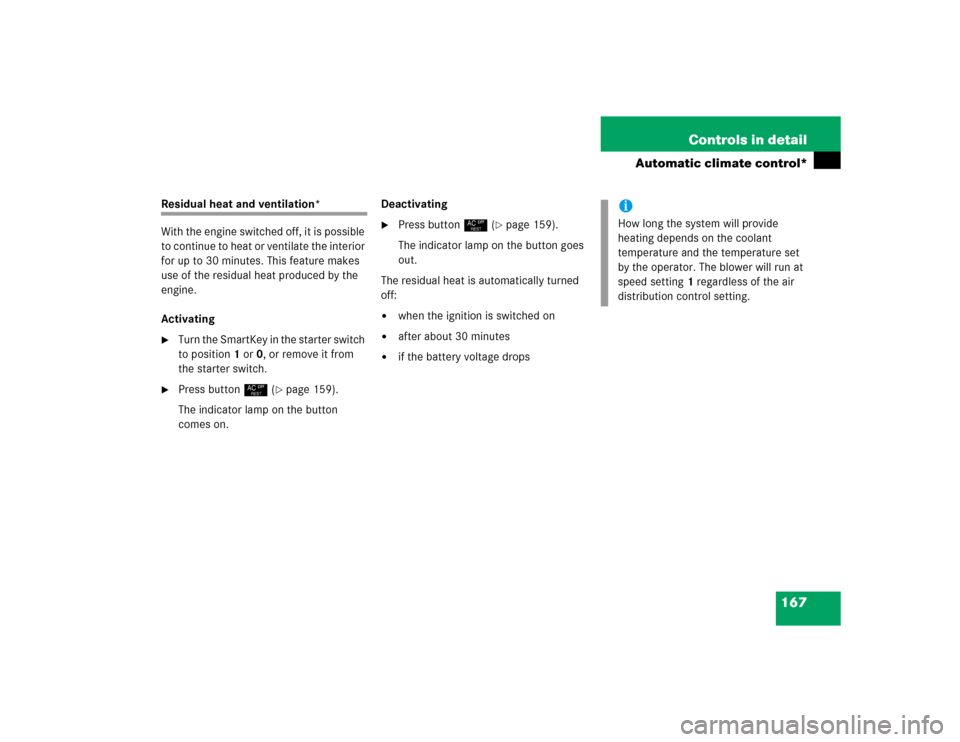
Residual heat and ventilation*
With the engine switched off, it is possible
to continue to heat or ventilate the interior
for up to 30 minutes. This feature makes
use of the residual heat produced by the
engine.
Activating�
Turn the SmartKey in the starter switch
to position1 or0, or remove it from
the starter switch.
�
Press button° (
�page 159).
The indicator lamp on the button
comes on.Deactivating
�
Press button° (
�page 159).
The indicator lamp on the button goes
out.
The residual heat is automatically turned
off:
�
when the ignition is switched on
�
after about 30 minutes
�
if the battery voltage drops
iHow long the system will provide
heating depends on the coolant
temperature and the temperature set
by the operator. The blower will run at
speed setting1 regardless of the air
distribution control setting.