Page 210 of 400
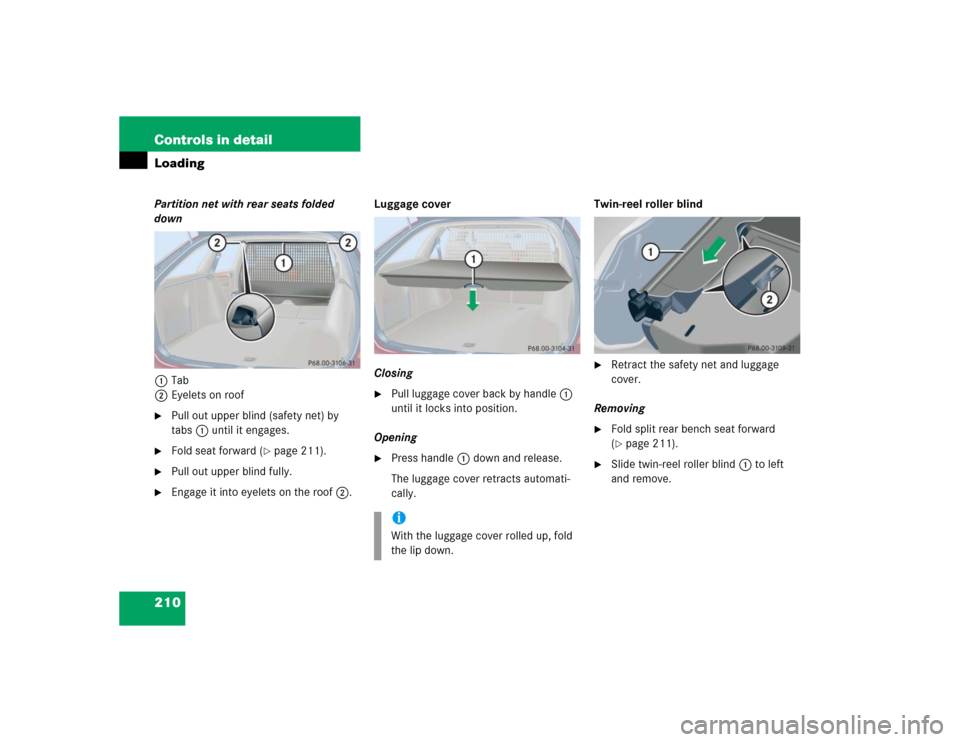
210 Controls in detailLoadingPartition net with rear seats folded
down
1Tab
2Eyelets on roof�
Pull out upper blind (safety net) by
tabs1 until it engages.
�
Fold seat forward (
�page 211).
�
Pull out upper blind fully.
�
Engage it into eyelets on the roof2.Luggage cover
Closing
�
Pull luggage cover back by handle1
until it locks into position.
Opening
�
Press handle1 down and release.
The luggage cover retracts automati-
cally.Twin-reel roller blind
�
Retract the safety net and luggage
cover.
Removing
�
Fold split rear bench seat forward
(�page 211).
�
Slide twin-reel roller blind1 to left
and remove.
iWith the luggage cover rolled up, fold
the lip down.
Page 239 of 400

239 Operation
Driving instructions
�Driving instructions
Drive sensibly – save fuel
Fuel consumption, to a great extent,
depends on driving habits and operating
conditions.
To save fuel you should:�
Keep tires at the recommended infla-
tion pressures.
�
Remove unnecessary loads.
�
Remove roof rack when not in use.
�
Allow engine to warm up under low
load use.
�
Avoid frequent acceleration and decel-
eration.
�
Have all maintenance work performed
at the intervals specified in the Service
Booklet and as required by the FSS.
Contact your authorized
Mercedes-Benz Center.
Fuel consumption is also increased by
driving in cold weather, in stop-and-go
traffic, on short trips and in hilly country.
Drinking and driving
PedalsPower assistance
Warning!
G
Drinking and driving and/or taking drugs
and driving are very dangerous combina-
tions. Even a small amount of alcohol or
drugs can affect your reflexes, perceptions
and judgement.
The possibility of a serious or even fatal
accident are greatly increased when you
drink or take drugs and drive.
Do not drink or take drugs and drive or allow
anyone to drive who has been drinking or
taking drugs.
Warning!
G
Keep driver’s foot area clear at all times.
Objects stored in this area may impair pedal
movement.Warning!
G
With the engine not running, there is no
power assistance for the brake and steering
systems. In this case, it is important to keep
in mind that a considerably higher degree of
effort is necessary to brake and steer the
vehicle.
Page 267 of 400

267 Operation
Vehicle care
�Vehicle care
Cleaning and care of the vehicle
While in operation, even while parked, your
vehicle is subjected to varying external
influences which, if gone unchecked, can
attack the paintwork as well as the under-
body and cause lasting damage.Such damage is caused not only by
extreme and varying climatic conditions,
but also by:
�
Air pollution
�
Road salt
�
Tar
�
Gravel and stone chipping
To avoid paint damage, you should
immediately remove:
�
Grease and oil
�
Fuel
�
Coolant
�
Brake fluid
�
Bird droppings
�
Insects
�
Tree resins, etc.
Frequent washing reduces and/or elimi-
nates the aggressiveness and potency of
the above adverse influences.More frequent washings are necessary to
deal with unfavorable conditions:
�
near the ocean
�
in industrial areas (smoke, exhaust
emissions)
�
during winter operation
You should check your vehicle from time to
time for stone chipping or other damage.
A n y d a m a g e s h o u l d b e r e p a i r e d a s s o o n a s
possible to prevent corrosion.
In doing so, do not neglect the underbody
of the vehicle. A prerequisite for a thor-
ough check is a washing of the underbody
followed by a thorough inspection. Dam-
aged areas need to be re-undercoated.
Your vehicle has been treated at the facto-
ry with a wax-base rustproofing in the body
cavities which will last for the lifetime of
the vehicle. Post-production treatment is
neither necessary nor recommended by
Mercedes-Benz because of the possibility
of incompatibility between materials used
in the production process and others
applied later.
Warning!
G
Many cleaning products can be hazardous.
Some are poisonous, others are flammable.
Always follow the instructions on the partic-
ular container. Always open your vehicle’s
doors or windows when cleaning the inside.
Never use fluids or solvents that are not
designed for cleaning your vehicle.
Page 299 of 400
299 Practical hints
What to do if …
Display symbol
Display message
Possible cause
Possible solution
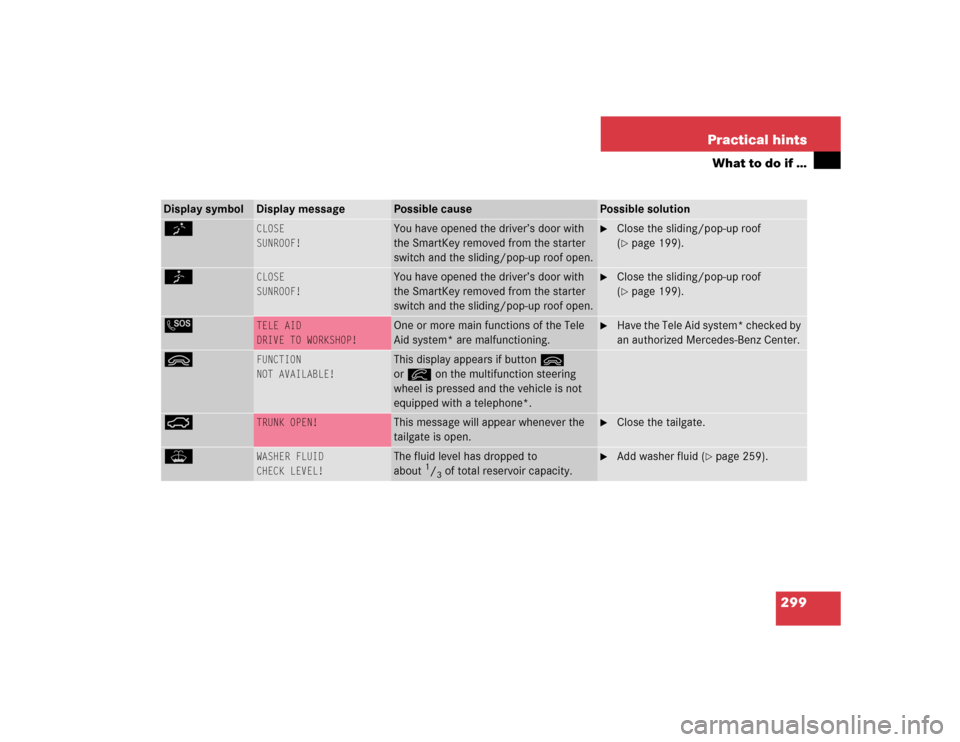
K
CLOSE
SUNROOF!
You have opened the driver’s door with
the SmartKey removed from the starter
switch and the sliding/pop-up roof open.
�
Close the sliding/pop-up roof
(�page 199).
J
CLOSE
SUNROOF!
You have opened the driver’s door with
the SmartKey removed from the starter
switch and the sliding/pop-up roof open.
�
Close the sliding/pop-up roof
(�page 199).
L
TELE AID
DRIVE TO WORKSHOP!
One or more main functions of the Tele
Aid system* are malfunctioning.
�
Have the Tele Aid system* checked by
an authorized Mercedes-Benz Center.
ì
FUNCTION
NOT AVAILABLE!
This display appears if buttonì
orí on the multifunction steering
wheel is pressed and the vehicle is not
equipped with a telephone*.
Ê
TRUNK OPEN!
This message will appear whenever the
tailgate is open.
�
Close the tailgate.
W
WASHER FLUID
CHECK LEVEL!
The fluid level has dropped to
about
1/3of total reservoir capacity.
�
Add washer fluid (
�page 259).
Page 309 of 400
309 Practical hints
Opening/closing in an emergency
�Opening/closing in an emergency
Sliding/pop-up roof*
You can open or close the sliding/pop-up
roof manually should an electrical
malfunction occur.
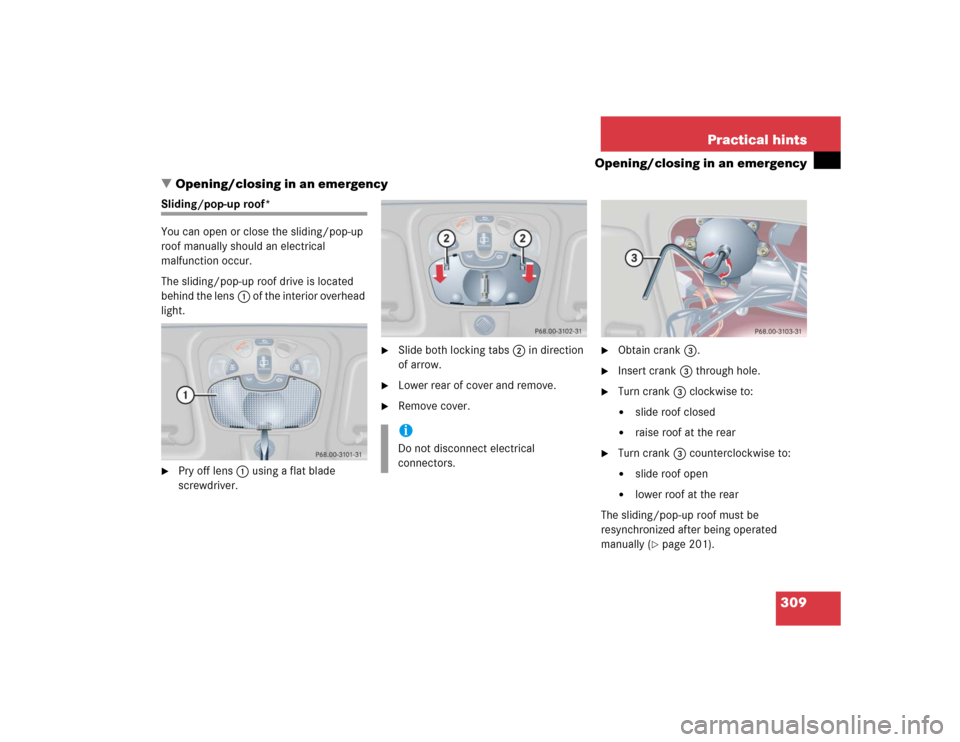
The sliding/pop-up roof drive is located
behind the lens1 of the interior overhead
light.�
Pry off lens1 using a flat blade
screwdriver.
�
Slide both locking tabs2 in direction
of arrow.
�
Lower rear of cover and remove.
�
Remove cover.
�
Obtain crank3.
�
Insert crank3 through hole.
�
Turn crank3 clockwise to:�
slide roof closed
�
raise roof at the rear
�
Turn crank3 counterclockwise to:�
slide roof open
�
lower roof at the rear
The sliding/pop-up roof must be
resynchronized after being operated
manually (
�page 201).
iDo not disconnect electrical
connectors.
Page 324 of 400

324 Practical hintsBattery
�BatteryThe battery is located in the engine
compartment on the right hand side.
Removal of filter box:�
Release the three clamps1.
�
Remove filter box.
Installation of filter box:
�
Insert filter box properly.
�
Secure it with the three clamps1.
Warning!
G
Failure to follow these instructions can
result in severe injury or death.
Never lean over batteries while connecting,
you might get injured.
Battery fluid contains sulfuric acid. Do not
allow this fluid to come in contact with eyes,
skin or clothing. In case it does, immediately
flush affected area with water and seek
medical help if necessary.
A battery will also produce hydrogen gas,
which is flammable and explosive. Keep
flames or sparks away from battery, avoid
improper connection of jumper cables,
smoking, etc.
!Never loosen or detach battery termi-
nal clamps while the engine is running
or the SmartKey is in the starter switch.
Otherwise the alternator and other
electronic components could be se-
verely damaged.
Have the battery checked regularly by
an authorized Mercedes-Benz Center.
Refer to Service Booklet for mainte-
nance intervals or contact your autho-
rized Mercedes-Benz Center for further
information.Warning!
G
Do not place metal objects on the battery as
this could result in a short circuit.
Use leak-proof battery only to avoid the risk
of acid burns in the event of an accident.
Page 326 of 400
326 Practical hintsBatteryReconnecting the battery�
Turn off all electrical consumers.
�
Connect the positive lead and fasten its
cover2.
�
Connect negative lead1.
�
Reinstall the filter box (
�page 324).Batteries contain materials that can harm
the environment if disposed of improperly.
Large 12 volt storage batteries contain
lead. Recycling of batteries is the preferred
method of disposal. Many states require
sellers of batteries to accept old batteries
for recycling.
!NEVER invert the terminal connections.!The battery, its filler caps and the vent
tube must always be securely installed
when the vehicle is in operation.
iThe following procedures must be
carried out following any interruption of
battery power (e.g. due to reconnec-
tion):�
Set the clock (
�page 124).
Vehicles with COMAND*:
See COMAND operator’s manual.
�
Resynchronize the ESP
(�page 282).
�
Resynchronize side windows
(�page 198).
�
Resynchronize sliding/pop-up
roof* (
�page 201).
Page 345 of 400
345 Technical data
Weights
�Weights
Roof load max.
220 lb (100 kg)