Page 225 of 372
7-11
In Case of an Emergency
Flat Tire
Form No. 8S18-EA-03I
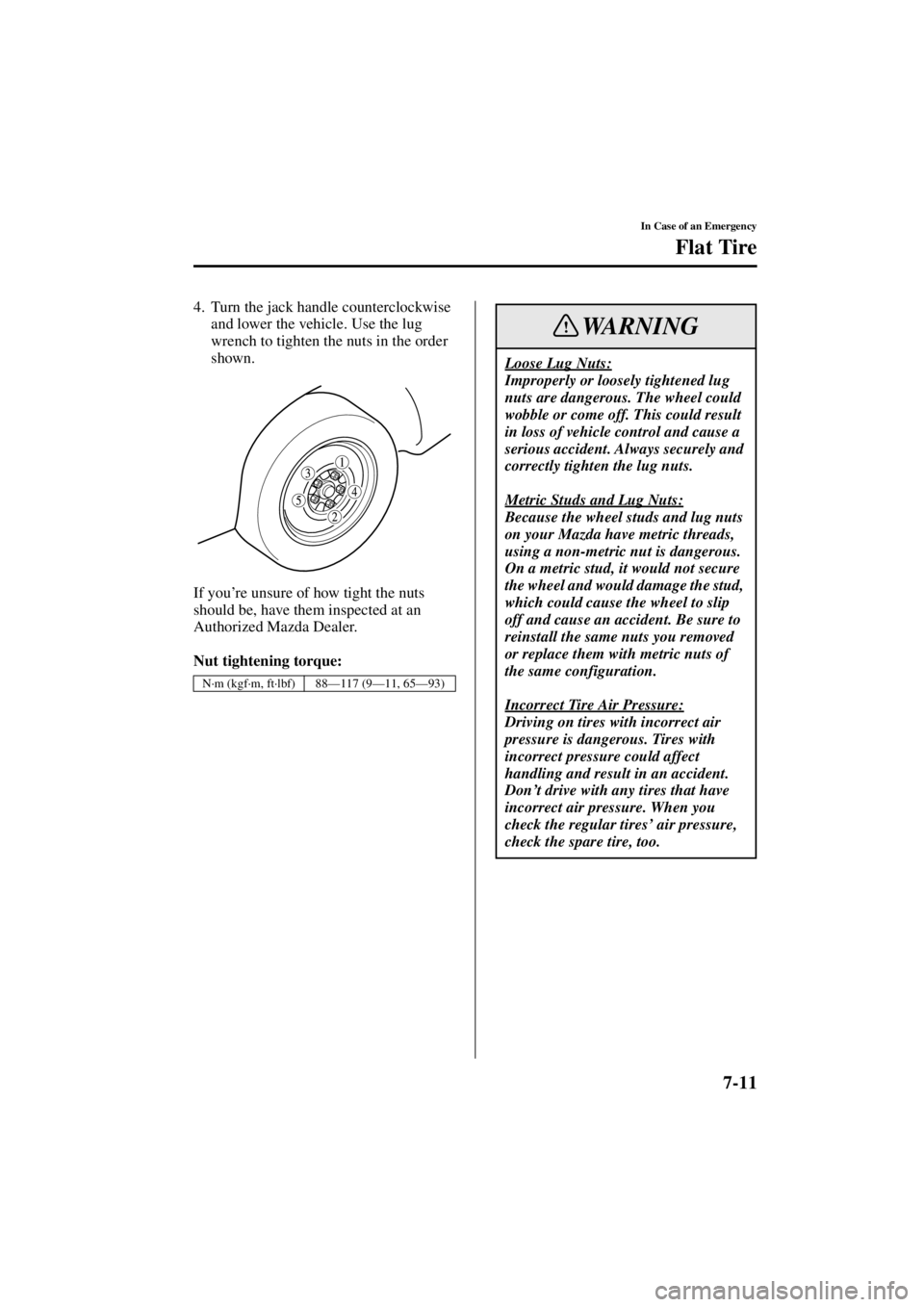
4. Turn the jack handle counterclockwise and lower the vehicle. Use the lug
wrench to tighten the nuts in the order
shown.
If you ’re unsure of how tight the nuts
should be, have them inspected at an
Authorized Mazda Dealer.
Nut tightening torque:
N·m (kgf ·m, ft ·lbf) 88 —117 (9—11, 65 —93)
Loose Lug Nuts:
Improperly or loosely tightened lug
nuts are dangerous. The wheel could
wobble or come off. This could result
in loss of vehicle control and cause a
serious accident. Always securely and
correctly tighten the lug nuts.
Metric Studs and Lug Nuts:
Because the wheel studs and lug nuts
on your Mazda have metric threads,
using a non-metric nut is dangerous.
On a metric stud, it would not secure
the wheel and would damage the stud,
which could cause the wheel to slip
off and cause an accident. Be sure to
reinstall the same nuts you removed
or replace them with metric nuts of
the same configuration.
Incorrect Tire Air Pressure:
Driving on tires with incorrect air
pressure is dangerous. Tires with
incorrect pressure could affect
handling and result in an accident.
Don ’t drive with any tires that have
incorrect air pressure. When you
check the regular tires ’ air pressure,
check the spare tire, too.
WARNING
J48C_8S18-EA-03I_Edition3.book Page 11 Monday, February 9, 2004 8:41 PM
Black process 45.0 ° 240.0 LPI
Page 242 of 372

8-4
Maintenance and Care
Scheduled Maintenance
Form No. 8S18-EA-03I
�Schedule 1
I
: Inspect and repair, clean, adjust, or replace if necessary.
R : Replace
L : Lubricate
ENGINE
COOLING SYSTEM
FUEL SYSTEM
IGNITION SYSTEM
CHASSIS and BODY
*1:According to state / provincial and federal regulations, failure to perform maintenance on these items will not void your emissions warranties. However, Mazda recommends that all maintenance services be performed at
the recommended time or mileage / kilometer period to ensure long-term reliability.
Maintenance Interval
(Number of months or
kilometers (miles), whichever comes first)Months 6 12182430364248
× 1000 km 12 24 36 48 60 72 84 96
× 1000 miles 7.5 15 22.5 30 37.5 45 52.5 60
Engine valve clearance A u d i b l e i n s p e c t e v e r y 1 2 0 , 0 0 0 k m ( 7 5 , 0 0 0 m i l e s ) ,
if noisy, adjust
Drive belts (tension) I
Engine oil RRRRRRRR
Engine oil filter RRRRRRRR
Cooling system II
Engine coolant Replace at first 96,000 km (60,000 miles) or 4 years ;
after that, every 2 years
Air filter R
Fuel lines and hoses
*1II
Hoses and tubes for emission*1I
Spark plugs Replace every 120,000km (75,000miles)
Brake lines, hoses and connections II
Disc brakes IIII
Tire (Rotation) Rotate every 12,000km (7,500miles)
Steering operation and linkages II
Front and rear suspension and ball joints II
Driveshaft dust boots II
Exhaust system and heat shields Inspect every 72,000km (45,000miles) or 60 months
All locks and hinges LLLLLLLL
J48C_8S18-EA-03I_Edition3.book Page 4 Monday, February 9, 2004 8:41 PM
Black process 45.0 ° 240.0 LPI
Page 244 of 372
8-6
Maintenance and Care
Scheduled Maintenance
Form No. 8S18-EA-03I
I: Inspect and repair, clean, adjust, or replace if necessary.
R : Replace
L : Lubricate
CHASSIS and BODY
Maintenance Interval
(Number of months or kilometers (miles),
whichever comes first)Months 4 8 12 16 20 24 28 32 36 40 44 48
× 1000 km 8 16 24 32 40 48 56 64 72 80 88 96
× 1000 miles 5 10 15 20 25 30 35 40 45 50 55 60
Brake lines, hoses and connections II
Brake and clutch fluid level IIIIIIIIIIII
Disc brakes IIII
Tire (rotation) Rotate every 8,000km (5,000miles)
Tire inflation pressure and tire wear IIIIIIIIIIII
Steering operation and linkages II
Power steering fluid level IIIIIIIIIIII
Front and rear suspension and ball
joints II
Driveshaft dust boots II
Exhaust system and heat shields Inspect every 72,000km (45,000miles) or 60 months
All locks and hinges LLLLLLLLLLLL
Washer fluid level IIIIIIIIIIII
J48C_8S18-EA-03I_Edition3.book Page 6 Monday, February 9, 2004 8:41 PM
Black process 45.0 ° 240.0 LPI
Page 250 of 372
8-12
Maintenance and Care
Owner Maintenance
Form No. 8S18-EA-03I
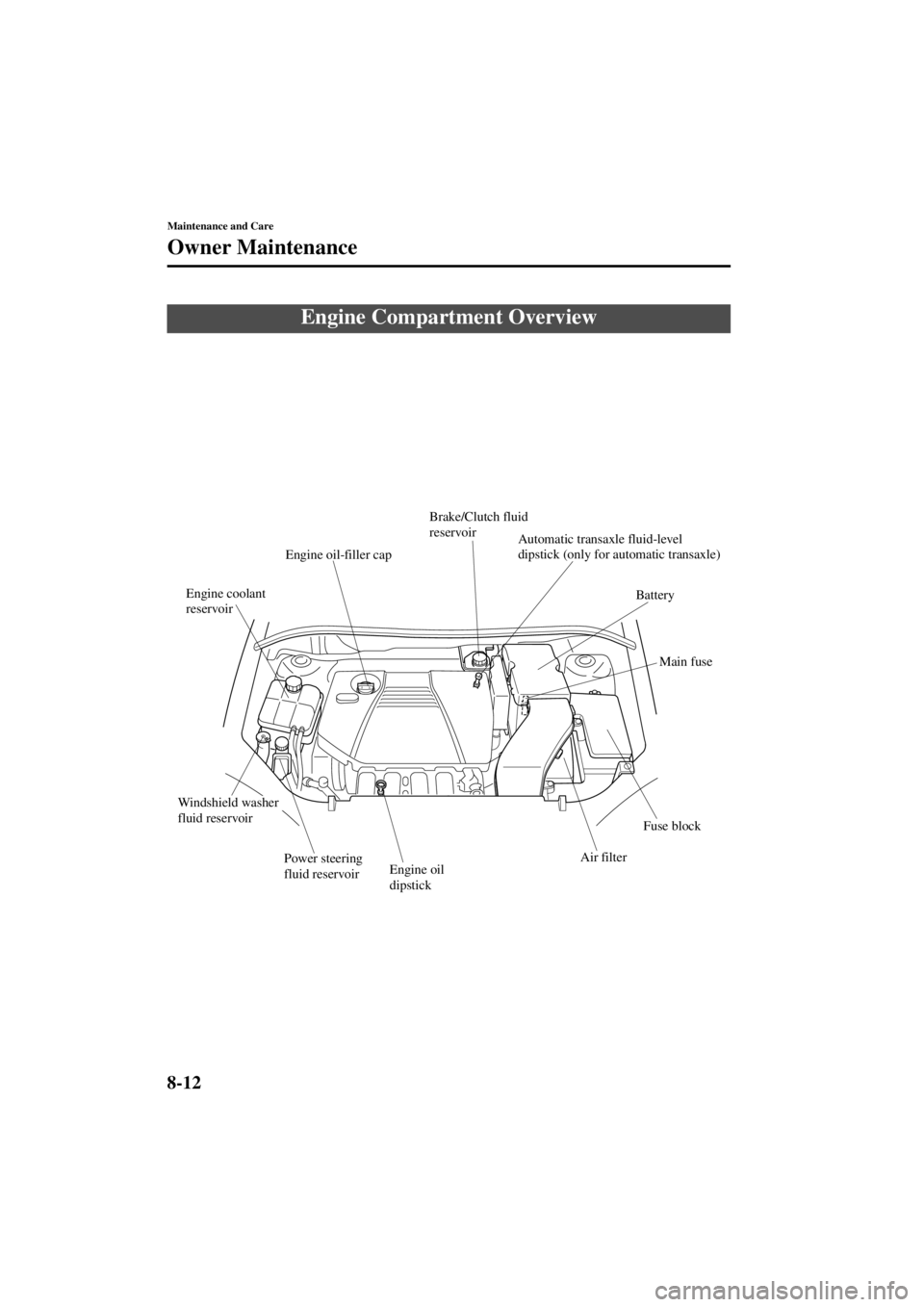
Engine Compartment Overview
Engine oil
dipstick
Fuse block
Air filter
Battery
Brake/Clutch fluid
reservoir
Engine oil-filler cap
Engine coolant
reservoir
Windshield washer
fluid reservoir
Power steering
fluid reservoir
Main fuse
Automatic transaxle fluid-level
dipstick (only for automatic transaxle)
J48C_8S18-EA-03I_Edition3.book Page 12 Monday, February 9, 2004 8:41 PM
Black process 45.0 ° 240.0 LPI
Page 255 of 372

8-17
Maintenance and Care
Owner Maintenance
Form No. 8S18-EA-03I
To change coolant1. Remove the cooling system cap.
2. Only when the engine is cool, remove the radiator drain plug and drain the
coolant into a suitable container.
Properly dispose of the used coolant.
3. Flush out the system with running water.
4. Drain the system completely. Insert and tighten the plug. Add as much
ethylene-glycol-based coolant mixture
and water as necessary to provide
freezing and corrosion protection.
5. In extremely cold climates, add the mixture percentage recommended in
the coolant mixture percentage table.
6. Run the engine at idle with the cooling system cap off. Slowly add additional
coolant if necessary.
7. At this point, wait until the engine reaches normal operating temperature;
then depress the accelerator two or
three times. Add more coolant, if
necessary, until the system is full.
8. Install the cooling system cap. Inspect all connections for leaks. Inspect the
level in the coolant reservoir one more
time.
Removing the Cooling System Cap:
Removing the cooling system cap
while the engine is running or hot is
dangerous. This might lead to cooling
system and engine damage and could
result in serious injury from escaping
hot coolant or steam. Turn off the
engine and wait until it ’s cool. Even
then, be very careful when removing
the cap.
Wrap a thick cloth around the cap
and slowly turn it counterclockwise
about two and a half rotations.
Step back while the pressure escapes.
When you ’re sure all the pressure has
escaped, turn the cap
counterclockwise — still using a cloth
— and remove the cap.
WARNINGLoosen
Loosen
Tighten
Tighten
J48C_8S18-EA-03I_Edition3.book Page 17 Monday, February 9, 2004 8:41 PM
Black process 45.0 ° 240.0 LPI
Page 260 of 372
8-22
Maintenance and Care
Owner Maintenance
Form No. 8S18-EA-03I
Inspect fluid level in the washer fluid
reservoir; add fluid if necessary.
To inspect the washer fluid level in the
front reservoir, pull off the cap. Then,
holding your thumb over the hole in the
center of the cap, lift it straight up. The
fluid level can be seen from the fluid
column in the pipe. Add fluid if necessary.
Use plain water if washer fluid is
unavailable. But use only washer fluid in
cold weather to prevent it from freezing.All moving points of the body, such as
door and hood hinges and locks, should
be lubricated each time the engine oil is
changed. Use a nonfreezing lubricant on
locks during cold weather.
Make sure the hood
’s secondary latch
keeps the hood from opening when the
primary latch is released.
NOTE
Front and rear washer fluid is supplied
from the same reservoir.
Body Lubrication
J48C_8S18-EA-03I_Edition3.book Page 22 Monday, February 9, 2004 8:41 PM
Black process 45.0 ° 240.0 LPI
Page 262 of 372

8-24
Maintenance and Care
Owner Maintenance
Form No. 8S18-EA-03I
Contamination of either the windshield or
the blades with foreign matter can reduce
wiper effectiveness. Common sources are
insects, tree sap, and hot wax treatments
used by some commercial car washes.
If the blades are not wiping properly,
clean the window and blades with a good
cleaner or mild detergent; then rinse
thoroughly with clean water. Repeat if
necessary.
�Replacing Windshield Wiper
Blades
When the wipers no longer clean well, the
blades are probably worn or cracked.
Replace them.
1. Raise the wiper arm and turn the blade
assembly to expose the plastic locking
clip.
Slide the assembly downward; then lift
it off the arm.
Wiper Blades
•Hot waxes applied by automatic car
washers have been known to affect
the wiper ’s ability to clean windows.
• To prevent damage to the wiper
blades, don
’t use gasoline,
kerosene, paint thinner, or other
solvents on or near them.
• When the wiper lever is in the
AUTO position and the ignition
switch is in the ON position, the
wipers may move automatically in
the following cases:
If the windshield above the rain
sensor is touched.
If the windshield above the rain
sensor is wiped with a cloth.
If the windshield is given a
shock.
If the rain sensor is given a shock
from inside the vehicle.
Be careful not to pinch hands or
fingers as it may cause injury, or
damage the wipers. When washing or
servicing your Mazda, make sure the
wiper lever is in the OFF position.
CAUTION
To prevent damage to the wiper arms
and other components, don ’t move the
wipers by hand.
To prevent damage to the windshield,
don’ t let the wiper arm fall on it.
CAUTION
Push
Plastic locking clip
CAUTION
J48C_8S18-EA-03I_Edition3.book Page 24 Monday, February 9, 2004 8:41 PM
Black process 45.0 ° 240.0 LPI
Page 264 of 372
8-26
Maintenance and Care
Owner Maintenance
Form No. 8S18-EA-03I
�Replacing Rear Window Wiper
Blade (5 Door)
When the wiper no longer cleans well, the
blade is probably worn or cracked.
Replace it.
1. Raise the wiper arm and rotate the
wiper blade to the right until it unlocks,
then remove the blade. 2. Pull down the blade rubber and slide it
out of the blade holder.
3. Remove the metal stiffeners from the blade rubber and install them in new
blades.
To prevent damage to the wiper arm
and other components, don
’t move the
wiper by hand.
To prevent damage to the rear window,
don ’t let the wiper arm fall on it.
CAUTION
CAUTION
Don ’t bend or discard the stiffeners.
You need to use them again.
Pull out
Stiffener
CAUTION
J48C_8S18-EA-03I_Edition3.book Page 26 Monday, February 9, 2004 8:41 PM
Black process 45.0 ° 240.0 LPI