Page 271 of 304
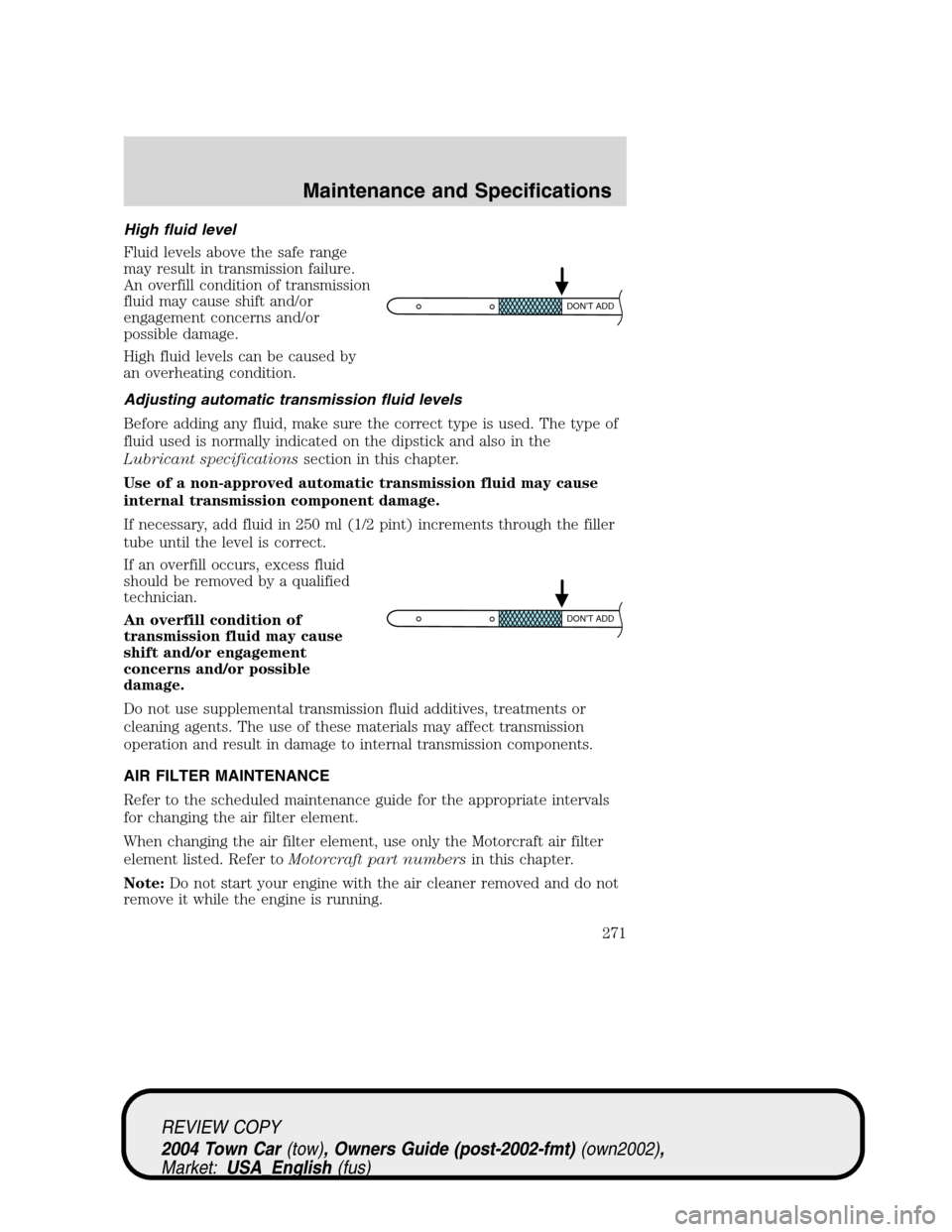
High fluid level
Fluid levels above the safe range
may result in transmission failure.
An overfill condition of transmission
fluid may cause shift and/or
engagement concerns and/or
possible damage.
High fluid levels can be caused by
an overheating condition.
Adjusting automatic transmission fluid levels
Before adding any fluid, make sure the correct type is used. The type of
fluid used is normally indicated on the dipstick and also in the
Lubricant specificationssection in this chapter.
Use of a non-approved automatic transmission fluid may cause
internal transmission component damage.
If necessary, add fluid in 250 ml (1/2 pint) increments through the filler
tube until the level is correct.
If an overfill occurs, excess fluid
should be removed by a qualified
technician.
An overfill condition of
transmission fluid may cause
shift and/or engagement
concerns and/or possible
damage.
Do not use supplemental transmission fluid additives, treatments or
cleaning agents. The use of these materials may affect transmission
operation and result in damage to internal transmission components.
AIR FILTER MAINTENANCE
Refer to the scheduled maintenance guide for the appropriate intervals
for changing the air filter element.
When changing the air filter element, use only the Motorcraft air filter
element listed. Refer toMotorcraft part numbersin this chapter.
Note:Do not start your engine with the air cleaner removed and do not
remove it while the engine is running.
DON’T ADD
DON’T ADD
REVIEW COPY
2004 Town Car(tow), Owners Guide (post-2002-fmt)(own2002),
Market:USA_English(fus)
Maintenance and Specifications
271
Page 281 of 304
5. Repeat this procedure for each tire, including the spare.
Note:Some spare tires require higher inflation pressure than the other
tires. Check the tire label on the B pillar or the edge of the driver’s door
for the recommended spare tire pressure.
6. Visually inspect the tires to make sure there are no nails or other
objects embedded that could poke a hole in the tire and cause an air
leak.
7. Check the sidewalls to make sure there are no gouges, cuts or bulges.
Tire and wheel alignment
A bad jolt from hitting a curb or pothole can cause the front end of your
vehicle to become misaligned or cause damage to your tires. If your
vehicle seems to pull to one side when you’re driving, the wheels may be
out of alignment. Have a qualified technician at a Ford or
Lincoln/Mercury dealer check the wheel alignment periodically.
Wheel misalignment in the front or the rear can cause uneven and rapid
treadwear of your tires and should be corrected by a qualified technician
at a Ford or Lincoln/Mercury dealer. Front wheel drive (FWD) vehicles
and those with an independent rear suspension (if equipped) may
require alignment of all four wheels.
The tires should also be balanced periodically. An unbalanced tire and
wheel assembly may result in irregular tire wear.
Tire rotation
Rotating your tires at the recommended interval (as indicated in the
Scheduled Maintenance Guidethat comes with your vehicle) will help
your tires wear more evenly, providing better tire performance and
longer tire life. Unless otherwise specified, rotate the tires approximately
every 5,000 miles (8,000 km).
REVIEW COPY
2004 Town Car(tow), Owners Guide (post-2002-fmt)(own2002),
Market:USA_English(fus)
Maintenance and Specifications
281
Page 286 of 304
MOTORCRAFT PART NUMBERS
Component 4.6L SOHC V8 engine
Air filter element FA-1668
Fuel filter FG-986B
Battery-standard BXT-65-650
Battery-heavy duty
1BXT-65-750
Oil filter FL-820-S
PCV valve
2
Spark plugs3
1
Included in long wheelbase package.
2The PCV valve is a critical emission component. It is one of the items
listed in theScheduled Maintenance Guideand is essential to the life
and performance of your vehicle and to its emissions system.
For PCV valve replacement, see your dealer or a qualified service
technician. Refer to theScheduled Maintenance Guidefor the
appropriate intervals for changing the PCV valve.
Replace the PCV valve with one that meets Ford material and
design specifications for your vehicle, such as a Motorcraft or
equivalent replacement part. The customer warranty may be void
for any damage to the emissions system if such a PCV valve is not
used.
3For spark plug replacement, see your dealer or a qualified service
technician. Refer to theScheduled Maintenance Guidefor the
appropriate intervals for changing the spark plugs.
Replace the spark plugs with ones that meet Ford material and
design specifications for your vehicle, such as Motorcraft or
equivalent replacement parts. The customer warranty may be
void for any damage to the engine if such spark plugs are not
used.
Refer to Vehicle Emissions Control Information (VECI) decal for spark
plug gap information.
REVIEW COPY
2004 Town Car(tow), Owners Guide (post-2002-fmt)(own2002),
Market:USA_English(fus)
Maintenance and Specifications
286
Page 287 of 304
REFILL CAPACITIES
Fluid Ford Part Name Capacity
Engine oil (includes
filter change)
7Motorcraft SAE 5W-20
Premium Synthetic
Blend Motor Oil (US)
Motorcraft SAE 5W-20
Super Premium Motor
Oil (Canada)5.7L (6.0 quarts)
Brake fluid Motorcraft High
Performance DOT 3
Motor Vehicle Brake
Fluid
1
Fill to line on reservoir
Power steering fluid Motorcraft MERCON�
AT FFill to line on reservoir
Transmission fluid
(4R70/75 E-W)
2Motorcraft
MERCON�VATF13.2L (13.9 quarts)3
Engine coolant4Motorcraft Premium
Gold Engine Coolant
(yellow-colored)18.0L (19.0 quarts)
Fuel tank N/A 71.9L (19.0 gallons)
Rear axle lubricant
5Motorcraft SAE
80W-90 Premium Rear
Axle Lubricant2.4L (5.0 pints)6
Windshield washer
fluidMotorcraft Premium
Windshield Washer
ConcentrateFill to line on reservoir
1Use only brake fluids certified to meet Ford specifications. Refer to
Lubricant Specificationsin this chapter. DOT 3 fluid is recommended.
However, if DOT 3 is not available, DOT 4 fluid can be used.
2Ensure the correct automatic transmission fluid is used. MERCON�and
MERCON�V are not interchangeable. DO NOT MIX MERCON�and
MERCON�V. Refer to theScheduled Maintenance Guideto determine
the correct service interval.
3Indicates only approximate dry-fill capacity. Some applications may vary
based on cooler size and if equipped with an in-tank cooler. The amount
of transmission fluid and fluid level should be set by the indication on
the dipstick’s normal operating range.
REVIEW COPY
2004 Town Car(tow), Owners Guide (post-2002-fmt)(own2002),
Market:USA_English(fus)
Maintenance and Specifications
287
Page 290 of 304
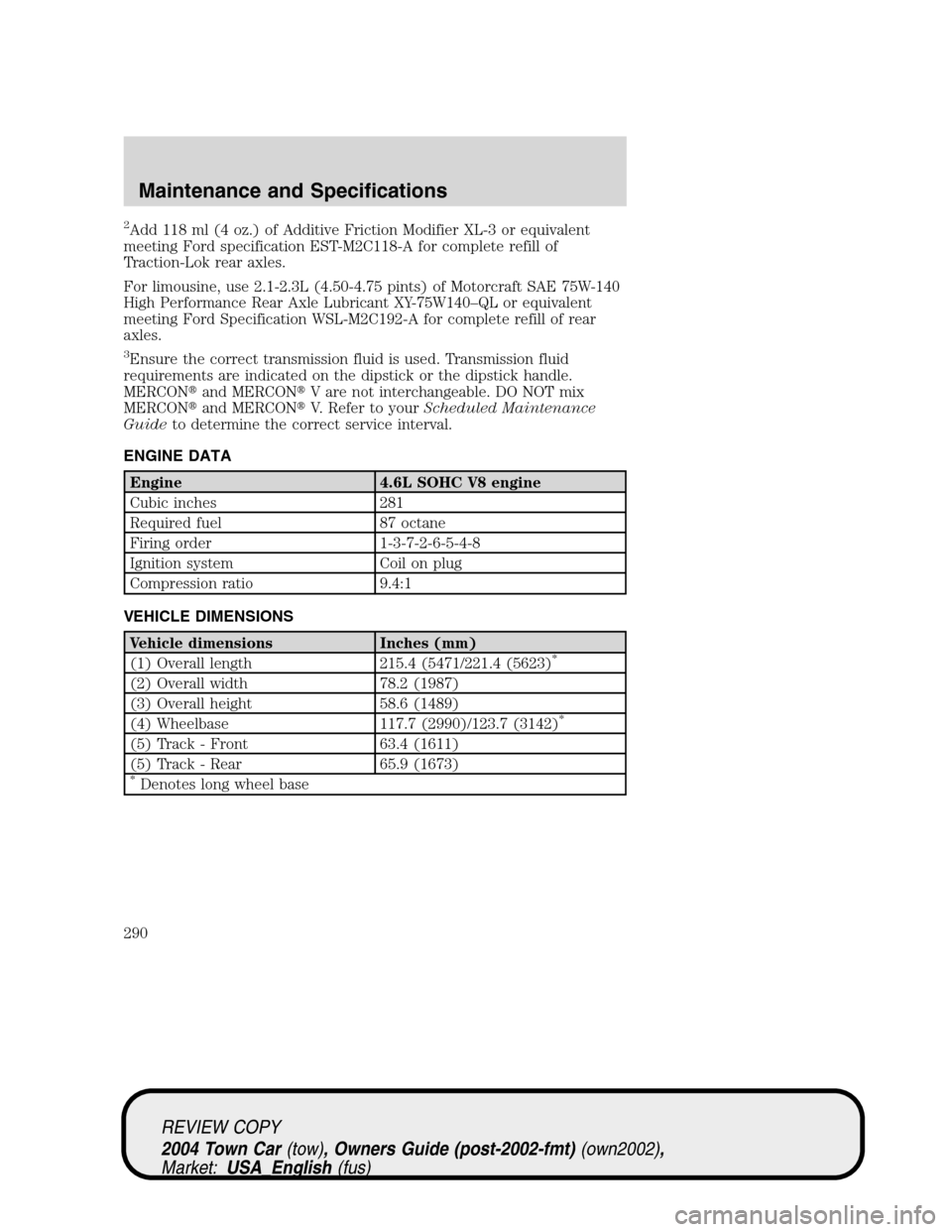
2Add 118 ml (4 oz.) of Additive Friction Modifier XL-3 or equivalent
meeting Ford specification EST-M2C118-A for complete refill of
Traction-Lok rear axles.
For limousine, use 2.1-2.3L (4.50-4.75 pints) of Motorcraft SAE 75W-140
High Performance Rear Axle Lubricant XY-75W140–QL or equivalent
meeting Ford Specification WSL-M2C192-A for complete refill of rear
axles.
3Ensure the correct transmission fluid is used. Transmission fluid
requirements are indicated on the dipstick or the dipstick handle.
MERCON�and MERCON�V are not interchangeable. DO NOT mix
MERCON�and MERCON�V. Refer to yourScheduled Maintenance
Guideto determine the correct service interval.
ENGINE DATA
Engine 4.6L SOHC V8 engine
Cubic inches 281
Required fuel 87 octane
Firing order 1-3-7-2-6-5-4-8
Ignition system Coil on plug
Compression ratio 9.4:1
VEHICLE DIMENSIONS
Vehicle dimensions Inches (mm)
(1) Overall length 215.4 (5471/221.4 (5623)*
(2) Overall width 78.2 (1987)
(3) Overall height 58.6 (1489)
(4) Wheelbase 117.7 (2990)/123.7 (3142)
*
(5) Track - Front 63.4 (1611)
(5) Track - Rear 65.9 (1673)
*Denotes long wheel base
REVIEW COPY
2004 Town Car(tow), Owners Guide (post-2002-fmt)(own2002),
Market:USA_English(fus)
Maintenance and Specifications
290