Page 118 of 296

Driving your vehicle44
1
2
3
4
5
6
7
8
9
1. Make sure the parking brake isapplied.
2. Place the transaxle shift lever in P (Park). Depress the brake pedal
fully.
You can also start the engine when the shift lever is in the N
(Neutral) position.
3. Turn the ignition switch to START and hold it there until the engine
starts (a maximum of 10 seconds),
then release the key. 4. In extremely cold weather (below
-18°C / 0°F) or after the vehicle
has not been operated for several
days, let the engine warm up with-
out depressing the accelerator.
Whether the engine is cold or warm,it should be started withoutdepressing the accelerator.
STARTING THE ENGINE
CAUTION
If the engine stalls while you arein motion, do not attempt tomove the shift lever to the P(Park) position. If traffic androad conditions permit, you mayput the shift lever in the N(Neutral) position while thevehicle is still moving and turnthe ignition switch to the STARTposition in an attempt to restartthe engine.
Opirus-ENG (CAN) 4.qxd 7/8/03 2:19 PM Page 4
Page 124 of 296

Driving your vehicle10
4
1
2
3
4
5
6
7
8
9
Moving up a steep grade from
a standing startTo move up a steep grade from a
standing start, depress the brake
pedal, shift the shift lever to D
(Drive). Select the appropriate gear
depending on load weight and steep-
ness of the grade, and release the
parking brake. Depress the accelera-
tor gradually while releasing the
service brakes.
Shift lock systemFor your safety, the Automatic
Transaxle has a shift lock system
which prevents shifting the transaxle
out of P (Park) unless the brake
pedal is depressed.
To shift the transaxle out of P (Park):
1. Depress and hold the brake pedal.
2. Depress the lock release button
and move the shift lever.
If the brake pedal is repeatedly
depressed and released with the
shift lever in the P (Park) position, a
chattering sound near the shift lever
may be heard. This is a normal con-
dition.
Ignition key inter lock systemThe ignition key cannot be removed
unless the shift lever is in the P
(Park) position. If the ignition switch
is in any other position, the key can-
not be removed.
Opirus-ENG (CAN) 4.qxd 7/8/03 2:19 PM Page 10
Page 128 of 296

Driving your vehicle14
4
1
2
3
4
5
6
7
8
9
Check the brake warning light by
turning the ignition switch ON (do not
start the engine). This light will be
illuminated when the parking brake is
applied with the ignition switch in the
START or ON position.
Before driving, be sure the parking
brake is fully released and the brake
warning light is off. If the brake warning light remains on
after the parking brake is released,
there may be a malfunction in the
brake system. Immediate attention is
necessary.
If at all possible, cease driving the
vehicle immediately. If that is not pos-
sible, use extreme caution while
operating the vehicle and only con-
tinue to drive the vehicle until you
can reach a safe location or repair
shop.
Parking on curbed streets When parking your vehicle on an
uphill grade, park as close to the
curb as possible and turn the front
wheels away from the curb so that
the front wheels will contact the
curb if the vehicle moves back-
ward.
When parking your vehicle on a downhill grade, park as close to the
curb as possible and turn the front
wheels toward the curb so that the
front wheels will contact the curb if
the vehicle moves forward.
W-75
Opirus-ENG (CAN) 4.qxd 7/8/03 2:19 PM Page 14
Page 130 of 296

Driving your vehicle16
4
1
2
3
4
5
6
7
8
9
Even with the anti-lock brake sys-
tem, your vehicle still requires suf-
ficient stopping distance. Always
maintain a safe distance from the
vehicle in front of you.
Always slow down when cornering. The anti-lock brake system cannot
prevent accidents resulting from
excessive speeds.
On loose or uneven road surfaces, operation of the anti-lock brake
system may result in a longer stop-
ping distance than for vehicles
equipped with a conventional
brake system.
✽ ✽ NOTICE• If the ABS warning light is on and
stays on, you may have a problem
with the ABS system. In this case,
however, your regular brakes will
work normally.
• The ABS warning light will stay on for approximately 3 seconds
after the ignition switch is ON.
During that time, the ABS will go
through self-diagnosis and the
light will go off if everything is
normal. If the light stays on, you
may have a problem with your
ABS system. Contact an author-
ized Kia dealer as soon as possible.
✽ ✽ NOTICE• When you drive on a road having
poor traction, such as an icy road,
and operate your brakes continu-
ously, the ABS will be active con-
tinuously and the ABS warning
light may illuminate. Pull your car
over to a safe place and stop the
engine.
• Restart the engine. If the ABS warning light is off, then your
ABS system is normal. Otherwise,
you may have a problem with the
ABS. Contact an authorized Kia
dealer as soon as possible.
ABS
W-78
Opirus-ENG (CAN) 4.qxd 7/8/03 2:19 PM Page 16
Page 137 of 296
423
1
2
3
4
5
6
7
8
9
Driving your vehicle
To turn cruise control off, do
one of the following: Push the CRUISE ON/OFF buttonon the steering wheel (the CRUISE
indicator light in the instrument
cluster will go OFF).
Turn the ignition off.Both of these actions cancel cruise control operation. If you want toresume cruise control operation,repeat the steps provided in “To SetCruise Control Speed” on the previ-ous page.
To increase cruise control set
speed:Follow either of these procedures:
Depress the RES/ACCEL switch and hold it. Your vehicle will acceler-
ate. Release the switch at the speed
you want. Depress the RES/ACCEL switch
and release it immediately. The
cruising speed will increase 1.6
km/h (1mph) by one touch and will
be memorized to the reset speed.
RES
ACCELCOAST
SET
CRUISE
ON/OFF
CANCEL
CRUISE
ON/OFF
CAN CE
L
COAST
SET
RES
ACCEL2GHA2034C2GHA2035C
Type AType B
Opirus-ENG (CAN) 4.qxd 7/8/03 2:19 PM Page 23
Page 140 of 296

Driving your vehicle26
4
1
2
3
4
5
6
7
8
9
The Traction Control System (TCS)
helps the vehicle accelerate on slip-
pery road surfaces by preventing the
drive wheels from spinning exces-
sively. It also provides improved driv-
ing force and steering.
TCS operationTCS ON condition
When the ignition is turned
ON, TCS and TCS OFF
indicator light illuminate for
approximately 3 seconds,
then TCS is turned on.
Press the TCS button to turn TCS off. (TCS OFF
indicator will illuminate). To
turn the TCS on, press the
TCS button (TCS OFF
indicator light will go off).
When starting the engine, you may hear a slight tick-
ing sound. This is the TCS
performing an automatic
system self-check and does
not indicate a problem.
When operating
When the TCS is in opera-
tion, TCS indicator light
blinks.
When the traction control system is operating prop-
erly, you can feel a slight
pulsation in the vehicle.
This is only the effect of
brake control and indi-
cates nothing unusual.
When moving out of mud or driving on a slippery
road, pressing the accel-
erator pedal may not
cause the engine rpm
(revolutions per minute) to
increase.
TRACTION CONTROL SYSTEM (IF EQUIPPED)
1GHA2051D
-
TCS
Opirus-ENG (CAN) 4.qxd 7/8/03 2:19 PM Page 26
Page 141 of 296
427
1
2
3
4
5
6
7
8
9
Driving your vehicle
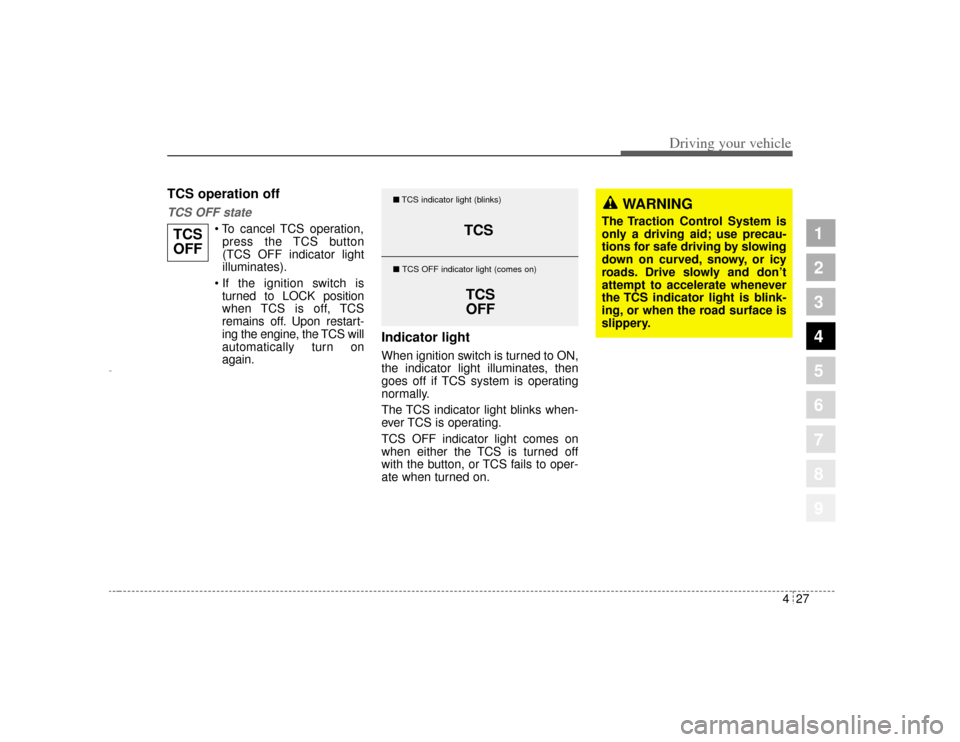
TCS operation offTCS OFF state
To cancel TCS operation,press the TCS button
(TCS OFF indicator light
illuminates).
If the ignition switch is turned to LOCK position
when TCS is off, TCS
remains off. Upon restart-
ing the engine, the TCS will
automatically turn on
again.
Indicator lightWhen ignition switch is turned to ON,
the indicator light illuminates, then
goes off if TCS system is operating
normally.
The TCS indicator light blinks when-
ever TCS is operating.
TCS OFF indicator light comes on
when either the TCS is turned off
with the button, or TCS fails to oper-
ate when turned on.
TCS
OFF
TCS
TCS
OFF
� TCS indicator light (blinks)
� TCS OFF indicator light (comes on)
WARNING
The Traction Control System is
only a driving aid; use precau-
tions for safe driving by slowing
down on curved, snowy, or icy
roads. Drive slowly and don ’t
attempt to accelerate whenever
the TCS indicator light is blink-
ing, or when the road surface is
slippery.
Opirus-ENG (CAN) 4.qxd 7/8/03 2:19 PM Page 27
Page 143 of 296

429
1
2
3
4
5
6
7
8
9
Driving your vehicle
The Electronic Stability Program
(ESP) monitors information from var-
ious vehicle sensors and then com-
pares the driver's commands with
the actual behavior of the vehicle. If
an unstable condition occurs - a sud-
den evasive movement for example -
ESP intervenes within fractions of a
second via the engine computer and
brake system and attempts to stabi-
lize the vehicle.
ESP operationESP ON condition
When the ignition is turnedON, ESP and ESP OFF
indicator lights illuminate
for approximately 3 sec-
onds, then ESP is turned
on.
Press the ESP button to turn ESP off. (ESP OFF
indicator will illuminate). To
turn the ESP on, press the
ESP button (ESP OFF
indicator light will go off).
When starting the engine, you may hear a slight tick-
ing sound. This is the ESP
performing an automatic
system self-check and
does not indicate a prob-
lem.
When operating
When the ESP is in opera-
tion, ESP indicator light
blinks.
When the ElectronicStability Program is oper-
ating properly, you can feel
a slight pulsation in the
vehicle. This is only the
effect of brake control and
indicates nothing unusual.
When moving out of the mud or slippery road,
pressing the accelerator
pedal may not cause the
engine rpm (revolutions
per minute) to increase.
ELECTRONIC STABILITY PROGRAM (IF EQUIPPED)
-
ESP
ESP
2GHN2051D
Opirus-ENG (CAN) 4.qxd 7/8/03 2:19 PM Page 29
