2004 KIA Opirus air condition
[x] Cancel search: air conditionPage 226 of 296

613
In case of an emergency
1
2
3
4
5
6
7
8
9
Driver-side knee bolster
Description Fuse rating Protected component
B/ALARM10A Burglar alarm
A/BAG 15A Airbag
C/LIGHTER 20A Cigar lighter
S/WARMER 10A Seat warmer
P/WDW(RH) 20A Power window (right)
P/HANDLE 15A Power steering wheel
T/SIG LP 15A Turn signal light
HTD GLASS 30A Defroster
TRUNK OPEN 15A Trunk lid opener
CLUSTER 10A Cluster
A/BAG IND 10A Airbag indicator
P/OUTLET 20A Electrical power socket
LAN UNIT 10A Lan unit
CURTAIN(RR) 10A Electric curtain (rear)
FOG LP(RR), PIC 15A Fog light (rear), Personal identifi- cation card
F/LID OPEN 15A Fuel filler lid opener
P/SEAT(RR) 30A Power seat (rear)
B/ALARM 10A Burglar alarm
STOP LP 15A Stop light
TRIP COMPUTER 10A Trip computer
B/UP LP 10A Back-up light
AV 10A Audio
H/LP 10A Headlight
Description Fuse rating Protected component
A/CON10A Air-conditioning system
P/WDW(LH) 20A Power window (left)
TAIL LP(RH) 10A Taillight (right)
BACK WARN’ G10A Back warning
DR LP 10A Door courtesy lamp
MIRROR HTD 10A Outside review mirror defroster
ENG SNSR 10A
Power train control system sensors
T/REDUCER10A Seat belt tension reducer
CLOCK 10A Clock
WIPER(FR) 20A Wiper (front)
EPS 10A Electronic power steering
TAIL LP(LH) 10A Tail light (left)
ROOM LP 10A Room lamp
AV, CLOCK 15A Audio, Clock
LAN UNIT 10A Lan unit
SHUNT CONN - Switch illumination
POWER/CONN - Power connector
Opirus CAN 6-1.qxd 7/8/03 2:22 PM Page 13
Page 238 of 296

1
2
3
4
5
6
7
8
91
2
3
4
5
6
7
8
9
Maintenance services / 7-3
Maintenance schedule / 7-5
Owner maintenance / 7-11
Engine compartment / 7-14
Engine oil and oil filter / 7-15
Engine cooling system / 7-18
Brakes / 7-21
Parking brake / 7-22
Drive belts / 7-23
Power steering / 7-24
Steering wheel / 7-25
Automatic transaxle / 7-25
Lubricants and fluids / 7-28
Air cleaner / 7-29
Air conditioner air filter / 7-30
Wiper blades / 7-32
Battery / 7-34
Tires and wheels / 7-37
Bulb replacement / 7-44
Maintenance
Opirus CAN 7-1.qxd 7/8/03 2:25 PM Page 1
Page 245 of 296

Maintenance87
1
2
3
4
5
6
7
8
9
OWNER MAINTENANCE Owner maintenance schedule The following lists are vehicle checks
and inspections that should be per-
formed by the owner or qualified
service technician at the frequencies
indicated to help ensure safe,
dependable operation of your vehi-
cle.
Any adverse conditions should be
brought to the attention of your deal-
er or qualified service technician or
service advice as soon as possible.
These Owner Maintenance Checks
are generally not covered by war-
ranties and you may be charged for
labor, parts and lubricants used.
When you stop for fuel: Check the engine oil level.
Check coolant level in coolantreservoir.
Check the windshield washer fluid level.
Look for low or under-inflated tires.
While operating your vehicle: Note any changes in the sound of the exhaust or any smell of
exhaust fumes in the vehicle.
Check for vibrations in the steering wheel. Notice any increased steer-
ing effort or looseness in the steer-
ing wheel, or change in its straight-
ahead position.
Notice if your vehicle constantly turns slightly or “pulls” to one side
when traveling on smooth, level
road.
When stopping, listen and check for strange sounds, pulling to one
side, increased brake pedal travel
or “hard-to-push” brake pedal.
If any slipping or changes in the operation of your transaxle occurs,
check the transaxle fluid level.
Check automatic transaxle P (Park) function.
Check parking brake.
Check for fluid leaks under your vehicle (water dripping from the air
conditioning system after use is
normal).
WARNING
Be careful when checking your
engine coolant level when the
engine is hot. Scalding hot
coolant and steam may blow out
under pressure. This could
cause serious injury.
Opirus CAN 7-1.qxd 7/8/03 2:25 PM Page 8
Page 246 of 296

79
Maintenance
1
2
3
4
5
6
7
8
9
At least monthly: Check coolant level in the coolantrecovery reservoir.
Check the operation of all exterior lights, including the stoplights, turn
signals and hazard warning flash-
ers.
Check the inflation pressures of all tires including the spare.
At least twice a year
(i.e., every Spring and Fall) : Check radiator, heater and air con- ditioning hoses for leaks or da-
mage.
Check windshield washer spray and wiper operation. Clean wiper
blades with clean cloth dampened
with washer fluid.
Check headlight alignment.
Check muffler, exhaust pipes, shields and clamps.
Check the lap/shoulder belts for wear and function.
Check for worn tires and loose wheel lug nuts.
At least once a year : Clean body and door drain holes.
Lubricate door hinges and checks,and hood hinges.
Lubricate door and hood locks and latches.
Lubricate door rubber weather- strips.
Check the air conditioning system before the warm weather season.
Check the power steering fluid level.
Inspect and lubricate automatic transaxle linkage and controls.
Clean battery and terminals.
Check the brake fluid level.
Opirus CAN 7-1.qxd 7/8/03 2:25 PM Page 9
Page 257 of 296

Maintenance20
7
1
2
3
4
5
6
7
8
9
DRIVE BELTSDrive belts should be checked peri-
odically for proper tension and
adjusted if necessary. At the same
time, belts should be examined for
cracks, wear, fraying or other evi-
dence of deterioration and replaced
if necessary.
Belt routing should also be checked
to be sure there is no interference
between the belts and other parts of
the engine. After a belt is replaced,
the new belt should be adjusted
again after two or three weeks to
eliminate slack resulting from initial
stretching after use.
Checking the compressor
drive beltWhen the air conditioning is being
used regularly, the compressor drive
belt tension should be checked at
least once a month.
To check the drive belt tension, turn
the engnie off, press down on the
belt halfway between the engine
crankshaft and compressor pulleys.
Pressing with your finger, you should
not be able to deflect this belt any-
more than 8.5 mm. If you have the
instruments to check it, with a force
of 98N (22 lb.), the deflection should
be 8.0 mm (approx. 0.315 inches). If
the belt is too loose, have it adjusted
by an authorized Kia Dealer.
2GHN722
Opirus CAN 7-1.qxd 7/8/03 2:25 PM Page 20
Page 264 of 296
727
Maintenance
1
2
3
4
5
6
7
8
9
Replace the element according to
the Scheduled Maintenance Section.If the vehicle is operated in extreme-ly dusty or sandy areas, replace theelement more often than the usualrecommended intervals. (Refer toMaintenance Schedule in this sec-tion.)
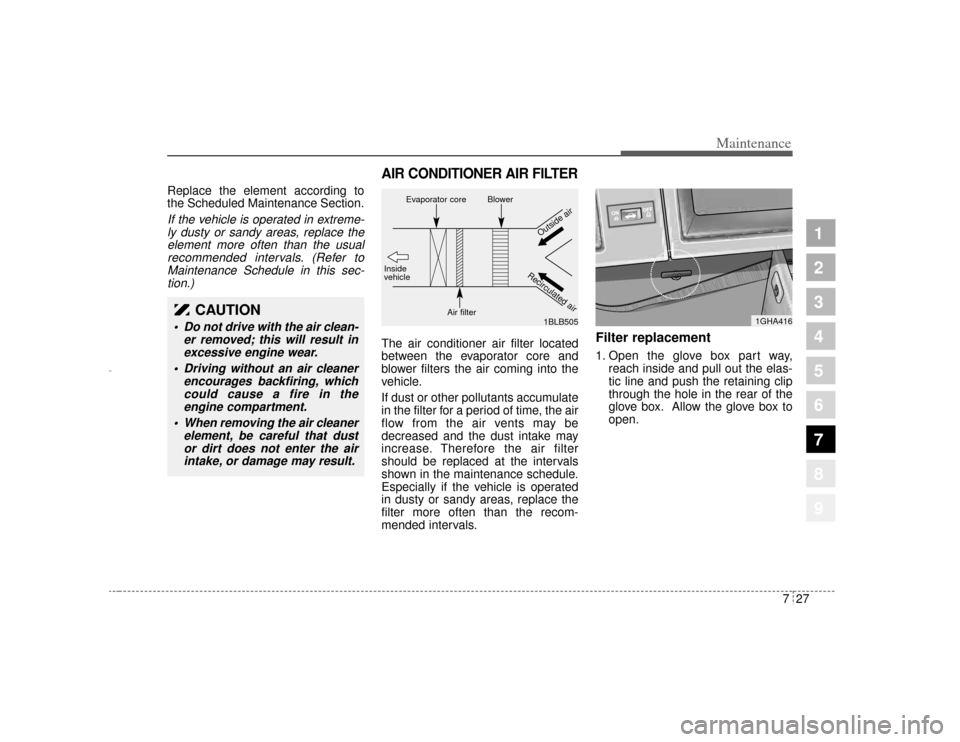
AIR CONDITIONER AIR FILTERThe air conditioner air filter located
between the evaporator core and
blower filters the air coming into the
vehicle.
If dust or other pollutants accumulate
in the filter for a period of time, the air
flow from the air vents may be
decreased and the dust intake may
increase. Therefore the air filter
should be replaced at the intervals
shown in the maintenance schedule.
Especially if the vehicle is operated
in dusty or sandy areas, replace the
filter more often than the recom-
mended intervals.
Filter replacement1. Open the glove box part way, reach inside and pull out the elas-
tic line and push the retaining clip
through the hole in the rear of the
glove box. Allow the glove box to
open.
CAUTION
Do not drive with the air clean-er removed; this will result inexcessive engine wear.
Driving without an air cleaner encourages backfiring, whichcould cause a fire in theengine compartment.
When removing the air cleaner element, be careful that dustor dirt does not enter the airintake, or damage may result.
1GHA416
1BLB505
Evaporator core
BlowerOutside air
Recirculated air
Air filter
Inside
vehicle
Opirus CAN 7-1.qxd 7/8/03 2:25 PM Page 27
Page 265 of 296
Maintenance28
7
1
2
3
4
5
6
7
8
9
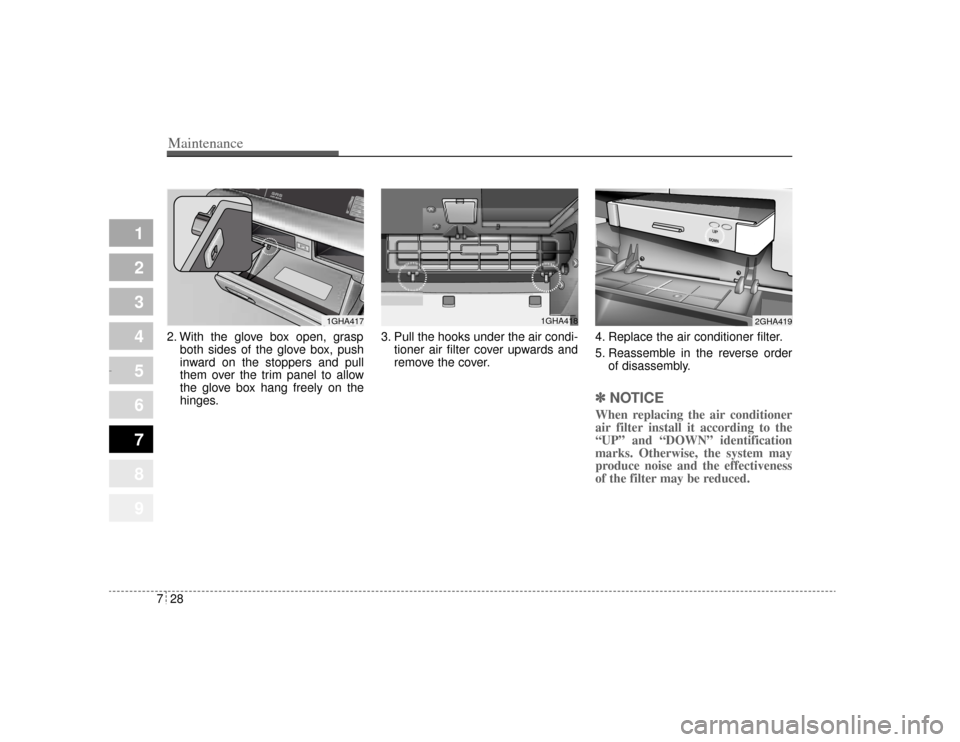
2. With the glove box open, grasp
both sides of the glove box, push
inward on the stoppers and pull
them over the trim panel to allow
the glove box hang freely on the
hinges. 3. Pull the hooks under the air condi-
tioner air filter cover upwards and
remove the cover. 4. Replace the air conditioner filter.
5. Reassemble in the reverse order
of disassembly.
✽ ✽NOTICEWhen replacing the air conditioner
air filter install it according to the
“UP” and “DOWN” identification
marks. Otherwise, the system may
produce noise and the effectiveness
of the filter may be reduced.
1GHA418
UPUPUPUPDOWNDOWNDOWN
DOWN
2GHA419
1GHA417
Opirus CAN 7-1.qxd 7/8/03 2:25 PM Page 28
Page 272 of 296

735
Maintenance
1
2
3
4
5
6
7
8
9
(Continued)
• Overinflation produces a harshride, handling problems, excessive
wear at the center of the tire tread,
and a greater possibility of dam-
age from road hazards.
• Be sure to reinstall the tire infla- tion valve caps. Without the valve
cap, dirt or moisture could get into
the valve core and cause air leak-
age. If the cap have been lost,
install new one as soon as possible.
Tire rotation To equalize tread wear, it is recom-
mended that the tires be rotated
every 12,000 km (7,500 miles) or
sooner if irregular wear develops.
During rotation, check the tires for
correct balance.
When rotating tires, check for uneven
wear and damage. Abnormal wear is
usually caused by incorrect tire pres-
sure, improper wheel alignment, out-
of-balance wheels, severe braking or
severe cornering. Look for bumps or
bulges in the tread or side of tire.
Replace the tire if you find either of
these conditions. Replace the tire
also if you can see fabric or cord.
After rotation, be sure to bring the
front and rear tire pressures to spec-
ification and check lug nut tightness.
Refer to Section 8, Specifications.
WARNING
- Tire Inflation
Overinflation or underinflation
can reduce tire life, adversely
affect vehicle handling, and lead
to sudden tire failure. This could
result in loss of vehicle control.
CBGQ0706CBGQ0707CBGQ0707A
Without a spare tire With a full-size spare tire
Directional tires (if equipped)
Opirus CAN 7-1.qxd 7/8/03 2:26 PM Page 35