Page 181 of 296

467
1
2
3
4
5
6
7
8
9
Driving your vehicle
Use the air conditioning systemevery month if only for a few min-
utes to ensure maximum system
performance.
When using the air conditioning system, you may notice clear water
dripping (or even pudding) on the
ground under the passenger side
of the vehicle. This is a normal sys-
tem operation characteristics.
The air conditioning system includes a function that automati-
cally turns the air conditioning
compressor off if engine coolant
temperature approaches an over
heating level. The air conditioning
compressor operation will resume
once engine coolant temperature
returns to the normal range. Also,
the air conditioning compressor is
automatically turned off for a few
seconds when the accelerator is
fully depressed (wide open throt-
tle). When operating the air condition-
ing system use the outside (fresh)
air position.
Operating the air conditioning sys- tem in the recirculated air position
does provide maximum cooling,
however, continual operation in this
mode may cause the air inside the
vehicle to become stale.
Checking the amount of air
conditioner refrigerant and
compressor lubricantWhen the amount of refrigerant is
low, the performance of the air con-
ditioning is reduced. Overfilling also
has a bad influence on the air condi-
tioning system.
Therefore, if abnormal operation is
found, have the system inspected by
an authorized Kia dealer.
Opirus-ENG (CAN) 4.qxd 7/8/03 2:19 PM Page 67
Page 182 of 296
Driving your vehicle68
4
1
2
3
4
5
6
7
8
9
✽ ✽
NOTICEWhen the performance of the air
conditioning system is reduced it is
important that the correct type and
amount of oil and refrigerant is
used. Otherwise, damage to the
compressor and abnormal system
operation may occur.
Item TypeAmount
Refrigerant R-134a625 ~ 675 g
Compressor lubricant PAG(FD46XG)140 ~ 160 cc
CAUTION
The air conditioning system
should be serviced by anauthorized Kia dealer. Improperservice may cause seriousinjury.Air conditioner refrigerant and compressor lubricantThe system complies with SAE J-639.
Opirus-ENG (CAN) 4.qxd 7/8/03 2:19 PM Page 68
Page 185 of 296
471
1
2
3
4
5
6
7
8
9
Driving your vehicle
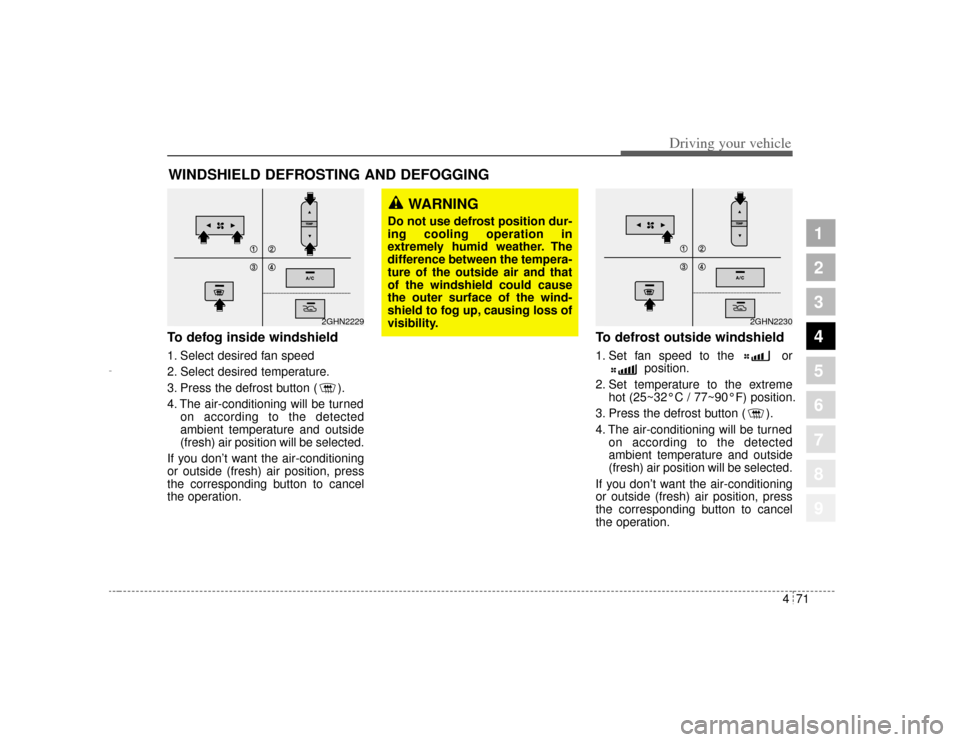
To defog inside windshield 1. Select desired fan speed
2. Select desired temperature.
3. Press the defrost button ( ).
4. The air-conditioning will be turnedon according to the detected
ambient temperature and outside
(fresh) air position will be selected.
If you don’t want the air-conditioning
or outside (fresh) air position, press
the corresponding button to cancel
the operation.
To defrost outside windshield 1. Set fan speed to the or position.
2. Set temperature to the extreme hot (25~32°C / 77~90°F) position.
3. Press the defrost button ( ).
4. The air-conditioning will be turned on according to the detected
ambient temperature and outside
(fresh) air position will be selected.
If you don’t want the air-conditioning
or outside (fresh) air position, press
the corresponding button to cancel
the operation.
WINDSHIELD DEFROSTING AND DEFOGGING
2GHN2229
2GHN2230
WARNING
Do not use defrost position dur-
ing cooling operation in
extremely humid weather. The
difference between the tempera-
ture of the outside air and that
of the windshield could cause
the outer surface of the wind-
shield to fog up, causing loss of
visibility.
Opirus-ENG (CAN) 4.qxd 7/8/03 2:19 PM Page 71
Page 192 of 296

Driving tips65SUGGESTIONS FOR ECONOMICAL OPERATIONYour vehicle's fuel economy depends
mainly on your style of driving, where
you drive and when you drive.
Each of these factors affects how
many kilometers (miles) you can get
from a liter (gallon) of fuel. To operate
your vehicle as economically as pos-
sible, use the following driving sug-
gestions to help save money in both
fuel and repairs:
Avoid lengthy warm-up idling.Once the engine is running
smoothly, begin driving.
Remember, engine warm-up may
take a little longer on cold days.
Save fuel by accelerating slowly after stopping.
Keep the engine in tune and follow the recommended periodic mainte-
nance schedule. This will increase
the life of all parts and lower your
operating costs. Do not use the air conditioner
unnecessarily.
Slow down when driving on rough roads.
For longer tire life and better fuel economy, always keep the tires
inflated to the recommended pres-
sures.
Maintain a safe distance from other vehicles to avoid sudden stops.
This will reduce wear on brake lin-
ings and pads. Driving in such a
way will also save fuel because
extra fuel is required to accelerate
back to driving speed.
Do not carry unnecessary weight in the vehicle.
Do not rest your foot on the brake pedal while driving. This can cause
needless wear, possible damage
to the brakes, and poor fuel econo-
my.
Improper wheel alignment results in faster tire wear and lower fuel
economy. Open windows at high speeds can
reduce fuel economy.
Fuel economy is less in crosswinds and headwinds. To help offset
some of this loss, slow down when
driving in these conditions.
Keeping a vehicle in good operating
condition is important both for econ-
omy and safety. Therefore, have an
authorized Kia dealer perform
scheduled inspections and mainte-
nance.
1
2
3
4
5
6
7
8
9
WARNING
- Engine off
during motion
Never turn the engine off to
coast down hills or anytime the
vehicle is in motion. The power
steering and power brakes will
not function without the engine
running. Instead, downshift to
an appropriate gear for engine
braking effect.
Opirus CAN 5-1.qxd 7/8/03 2:21 PM Page 6
Page 197 of 296

511
Driving tips
1
2
3
4
5
6
7
8
9
HLA (Hydraulic Lash Adjuster)
noiseThe engine HLA's keep the gap
between the valve and cam at zero
regardless of the valve expansion.
Occasionally, you may hear a tempo-
rary or continuous sound (clatter)
from the engine when starting or
idling. This noise will usually go away
by following a few simple steps:If the temporary sound occurs when
starting a cold engine:
This is a normal condition. This
sound will disappear after the engine
oil has reached normal operating
pressure.
If the sound occurs when starting the
engine after the engine has not been
operated for more than 48 hours; or
engine has been cranked excessively:
This condition may be caused by oil
draining from the HLA's. This allows
air to enter the HLA causing insuffi-
cient lubricating oil in the HLA. This
will usually disappear within 15 min-
utes with the engine running at
2000~3000 rpm. If the sound does
not disappear, have the engine oil
pressure, engine lubrication system
and HLA's inspected by an
Authorized Kia Dealer.
CAUTION
Do not run the engine at more
than 3000 rpm until the noisegoes away. Damage to theHLA's could occur.
Opirus CAN 5-1.qxd 7/8/03 2:21 PM Page 11
Page 216 of 296

63
In case of an emergency
OVERHEATING If your temperature gauge indicates
overheating, if you experience a loss
of power, or if you hear a loud knock-
ing or pinging noise, the engine has
probably overheated. Should any of
these symptoms occur, use the fol-
lowing procedure:
1. Turn on the hazard warning flash-er, then drive to the nearest safe
location and stop your vehicle; set
the automatic transaxle in P (Park)
and apply the parking brake.
2. Make sure the air conditioner is off.
3. If coolant or steam is boiling out of the radiator, stop the engine and
call an Authorized Kia Dealer for
assistance. If coolant is not boiling out, allow
the engine to idle and open the
hood to permit the engine to cool
gradually.
If the temperature does not go
down with the engine idling, stop
the engine and allow sufficient
time for it to cool.
4. The coolant level should then be checked. If the level in the reser-
voir is low, look for leaks at the
radiator hoses and connections,
heater hoses and connections,
radiator, and water pump. If you
find a major leak or another prob-
lem that may have caused the
engine to overheat, do not operate
the engine until it has been cor-
rected. Call an Authorized Kia
Dealer for assistance. If you do not
find a leak or other problem, care-
fully add coolant to the reservoir.
If the engine frequently overheats,have the cooling system checkedand repaired by an Authorized KiaDealer.
1
2
3
4
5
6
7
8
9
WARNING
- Removing
radiator cap
Do not remove the radiator cap
when the engine and radiator
are hot. Scalding hot coolant
and steam may blow out under
pressure. This could cause seri-
ous injury.
Opirus CAN 6-1.qxd 7/8/03 2:22 PM Page 3
Page 223 of 296
In case of an emergency10
6
1
2
3
4
5
6
7
8
9
Relay panel description
ETS
H/LAMP
(LO-RH)
DRL*
(TAIL)
DRL*
(RESISTOR)
H/LP
WASHER*
Passenger-side panel
Engine compartment
2GHN601/2GHN602
Relay name Relay description
Passenger - side panel
BLOWER (HI) Air conditioner blower relay (high)
Engine compartment
H/LP WASHER* Head lamp washer relay
ETS Electronic throttle system relay
DRL (RESISTOR)* Daytime running light (Resistor) relay
DRL (TAIL)* Daytime running light (Taillight) relay
H/LAMP (LO-RH) Headlight relay (low beam-right)
Opirus CAN 6-1.qxd 7/8/03 2:22 PM Page 10
Page 225 of 296

In case of an emergency12
6
1
2
3
4
5
6
7
8
9
Description Fuse rating Protected component
1 FUEL PUMP 20A Fuel pump
2 H/LP (LO-LH) 15A Headlight (low-left)
3 ABS 10A Anti-lock brake system
4 INJECTOR 10A Injector
5 A/CON COMP 10A Air-conditioner compressor
6 ATM RLY 20A Automatic transaxle control relay
7 ECU RLY 20A Engine control unit relay
8 IGN COIL 20A Ignition coil
9 O2 SNSR 15A Oxygen sensor
10 ENG SNSR 15A
Power train control system sensors
11 HORN 15A Horn
12 TAIL LP 20A Tail light
13 H/LP WASHER 20A Headlight washer
14 ETS 20A Electronic throttle system
15 FOG LP (FR) 15A Fog light (front)
16 H/LP (HI) 15A Headlight (high)
17 SPARE 30A spare fuse
18 SPARE 20A spare fuse
19 SPARE 15A spare fuse
20 SPARE 10A spare fuse
21 BLOWER MTR 30A Blower motor
22 S/WARMER 30A Seat warmer
23 AMP 20A Radio amplifier
24 DRL* 15A Daytime running light
Description Fuse rating Protected component
25 H/LP (LO-RH) 15A Headlight (low beam-right)
26 P/FUSE-1 30A All electrical system
27 ECU 10A Engine control unit
28 ECS 15A Electronic control suspension
! NOT USED Not used
C/FAN 20A Condenser fan
P/SEAT (FR) 30A Power seat (front)
IGN SW-1 30A Ignition switch
ABS 2 30A Anti-lock brake system
ABS 1 30A Anti-lock brake system
IGN SW-2 30A Ignition switch
R/FAN 30A Radiator fan
H/LP (LO-LH) - Headlight relay (low beam-left)
FUEL PUMP - Fuel pump relay
HORN - Horn relay
START - Start motor relay
A/CON - Air conditioner relay
A/CON FAN-1 - Air conditioner fan relay
H/LP (HI) - Headlight relay (high beam)
R/FAN - Radiator fan relay
FOG LP (FR) - Fog light relay (front)
TAIL LP - Taillight relay
WIPER (LO) - Wiper relay (low)
A/CON FAN-2 - Air conditioner fan relay
Engine compartment
Opirus CAN 6-1.qxd 7/8/03 2:22 PM Page 12

