Page 309 of 374
Inspect all hose clamps and couplings to make sure they
are secure and no leaks are present.
NOTE:Often fluids such as oil, power steering fluid,
and brake fluid are used during assembly plant opera-
tions to ease the assembly of hoses to couplings. There-
fore, oil wetness at the hose-coupling area is not neces-
sarily an indication of leakage. Actual dripping of hot
fluid when systems are under pressure (during vehicle
operation) should be noted before hose is replaced based
on leakage.NOTE:Inspection of brake hoses should be done when-
ever the brake system is serviced and every engine oil
change.
WARNING!
Worn brake hoses can burst and cause brake failure.
You could have an accident. If you see any signs of
cracking, scuffing, or worn spots, have the brake
hoses replaced immediately.
MAINTAINING YOUR VEHICLE 309
7
Page 310 of 374
Brake Master Cylinder
The fluid level in the master cylinder should be checked
when performing under hood services, or immediately if
the ªBrake Warning Lightº shows system failure.Be sure to clean the top of the master cylinder area before
removing the cap. If necessary, add fluid to bring the
fluid level up to the requirements described on the brake
fluid reservoir. With disc brakes, fluid level can be
expected to fall as the brake pads wear. However, low
fluid level may be caused by a leak and a checkup may be
needed.
Use only manufacturer's recommended brake fluid, refer
to Recommended Fluids, Lubricants, and Genuine Parts
for correct fluid type.
WARNING!
Use of a brake fluid that may have a lower initial
boiling point or unidentified as to specification, may
result in sudden brake failure during hard pro-
longed braking. You could have an accident.
310 MAINTAINING YOUR VEHICLE
Page 319 of 374
Seat Belt Maintenance
Do not bleach, dye or clean the belts with chemical
solvents or abrasive cleaners. This will weaken the fabric.
Sun damage will also weaken the fabric.
If the belts need cleaning, use a mild soap solution or
lukewarm water. Do not remove the belts from the
vehicle to wash them.
Replace the belts if they appear frayed or worn or if the
buckles do not work properly.
Maintenance After Off-Pavement Driving
After extended operation in mud, sand or water, or
similar dirty conditions, have your brake drums, brake
linings, and axle joints inspected and cleaned as soon as
possible. This will prevent any abrasive material from
causing excessive wear or unpredictable braking action.
Following off-pavement usage, completely inspect the
underbody of your vehicle. Check tires, body structure,steering, suspension and exhaust system for damage.
Check threaded fasteners for looseness, particularly on
the chassis, drivetrain components, steering and suspen-
sion. Retighten, if required, to torque values specified in
the Service Manual. Also check for accumulations of
vegetation or brush that could become a fire hazard, or
conceal damage to fuel lines, brake hoses, axle pinion
seals, and propeller shafts.
CAUTION!
Under frequent heavy-duty driving conditions,
change all lubricants and lubricate body compo-
nents, all driveline joints and steering linkage more
often than in normal service to prevent excessive
wear.
MAINTAINING YOUR VEHICLE 319
7
Page 324 of 374

VEHICLE STORAGE
If you are leaving your vehicle dormant for more than 21
days you may want to take steps to protect your battery.
You may:
²Remove Cartridge fuse #15 in the Power Distribution
Center labeled Ignition-Off Draw (IOD).
²Store the removed IOD fuse in the Power Distribution
Center location #11 labeled ªIOD Storage.º
²Or, disconnect the negative cable from the battery.
²Anytime you store your vehicle, or keep it out of
service (i.e. vacation) for two weeks or more, run the
air conditioning system at idle for about five minutes
in the fresh air and high blower setting. This will
insure adequate system lubrication to minimize the
possibility of compressor damage when the system is
started again.
REPLACEMENT BULBS
Interior Lights Bulb Type
A/C Heater.................... NotServiceable
Ashtray Receiver Light.................... 161
Climate Control (Manual A/C)................ 74
Front Reading........................... 192
Rear Cargo Light.......................214±2
Lighted Vanity Mirror *.............. P/N6501966
Underpanel Courtesy Lights................. 906
Instrument Cluster (General Illumination)....... 103
Telltale/Hazard Light...................... 74
* Available only from authorized dealers.
324 MAINTAINING YOUR VEHICLE
Page 330 of 374
EMISSION CONTROL SYSTEM MAINTENANCE
The ªScheduledº maintenance services, listed inbold
typemust be done at the times or mileages specified to
assure the continued proper functioning of the emission
control system. These, and all other maintenance services
included in this manual, should be done to provide best
vehicle performance and reliability. More frequent main-
tenance may be needed for vehicles in severe operating
conditions such as dusty areas and very short trip
driving.
Inspection and service also should be done any time a
malfunction is suspected.
NOTE:Maintenance, replacement, or repair of the emis-
sion control devices and systems on your vehicle may be
performed by any automotive repair establishment or
individual using any automotive part which has been
certified pursuant to U.S. EPA or, in the State of Califor-
nia, California Air Resources Board regulations.
MAINTENANCE SCHEDULES
There are two maintenance schedules that show the
requiredservice for your vehicle.
First is Schedule(B(. It is for vehicles that are operated
under the conditions that are listed below and at the
beginning of the schedule.
²Day or night temperatures are below 32ÉF (0ÉC).
²Stop and go driving.
²Extensive engine idling.
²Driving in dusty conditions.
²Short trips of less than 10 miles (16.2 km).
²More than 50% of your driving is at sustained high
speeds during hot weather, above 90ÉF (32ÉC).
²Trailer towing.
²Taxi, police, or delivery service (commercial service).
330 MAINTENANCE SCHEDULES
8
M
A
I
N
T
E
N
A
N
C
E
S
C
H
E
D
U
L
E
S
Page 333 of 374
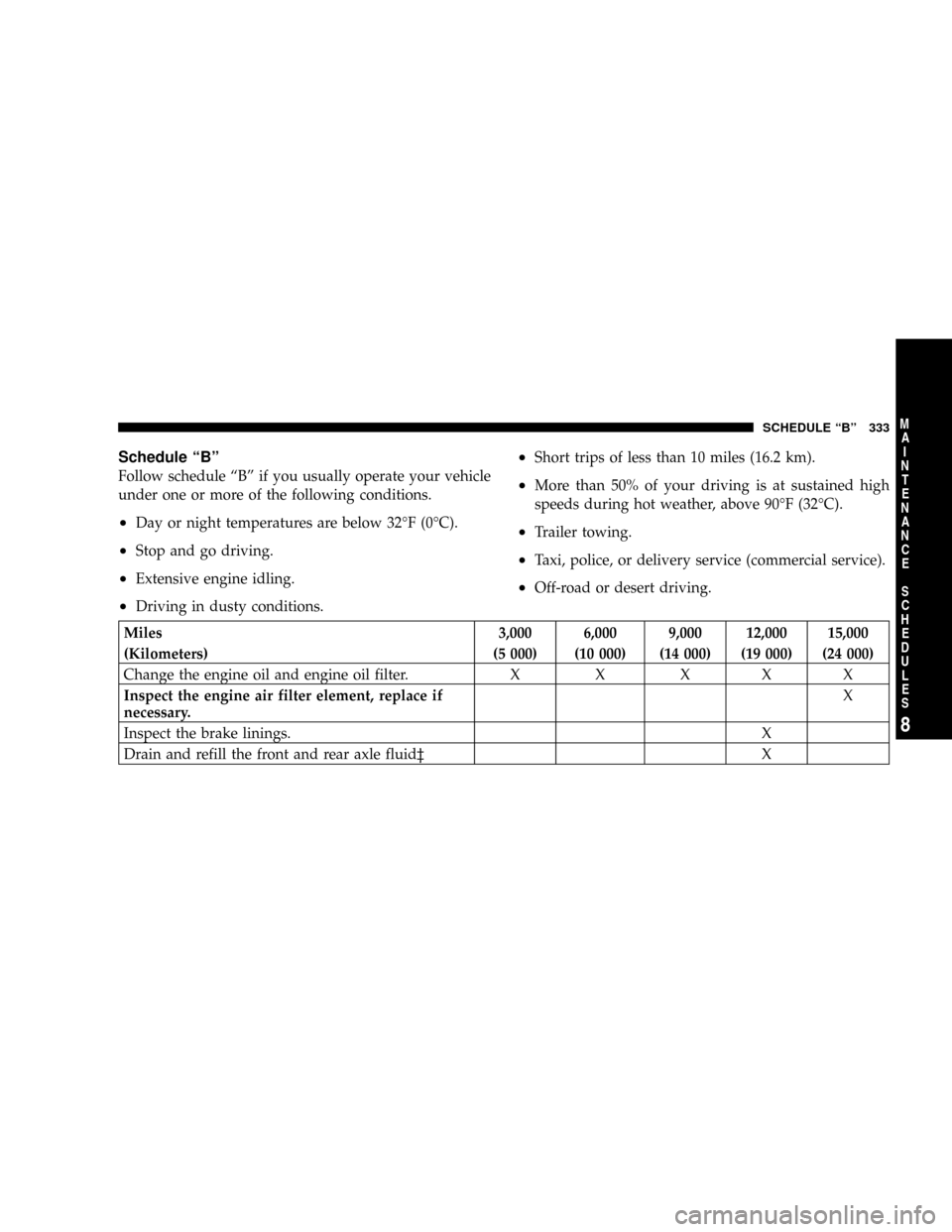
Schedule ªBº
Follow schedule ªBº if you usually operate your vehicle
under one or more of the following conditions.
²Day or night temperatures are below 32ÉF (0ÉC).
²Stop and go driving.
²Extensive engine idling.
²Driving in dusty conditions.
²Short trips of less than 10 miles (16.2 km).
²More than 50% of your driving is at sustained high
speeds during hot weather, above 90ÉF (32ÉC).
²Trailer towing.
²Taxi, police, or delivery service (commercial service).
²Off-road or desert driving.
Miles 3,000 6,000 9,000 12,000 15,000
(Kilometers) (5 000) (10 000) (14 000) (19 000) (24 000)
Change the engine oil and engine oil filter. X X X X X
Inspect the engine air filter element, replace if
necessary.X
Inspect the brake linings. X
Drain and refill the front and rear axle fluid³ X
SCHEDULE ªBº 333
8
M
A
I
N
T
E
N
A
N
C
E
S
C
H
E
D
U
L
E
S
Page 341 of 374
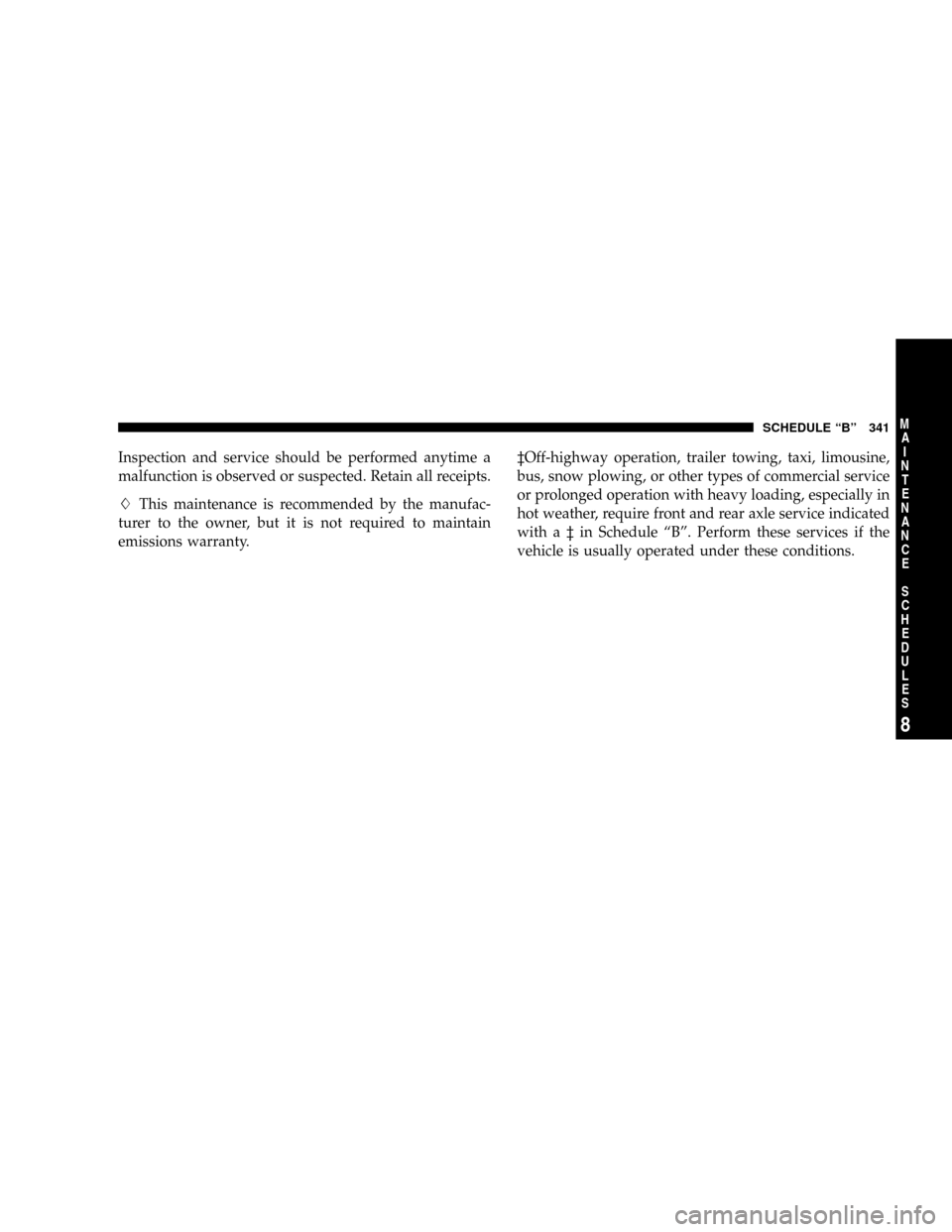
Inspection and service should be performed anytime a
malfunction is observed or suspected. Retain all receipts.
LThis maintenance is recommended by the manufac-
turer to the owner, but it is not required to maintain
emissions warranty.³Off-highway operation, trailer towing, taxi, limousine,
bus, snow plowing, or other types of commercial service
or prolonged operation with heavy loading, especially in
hot weather, require front and rear axle service indicated
witha³inSchedule ªBº. Perform these services if the
vehicle is usually operated under these conditions.
SCHEDULE ªBº 341
8
M
A
I
N
T
E
N
A
N
C
E
S
C
H
E
D
U
L
E
S
Page 346 of 374
Miles 108,000 114,000 120,000
(Kilometers) (173 000) (182 000) (192 000)
[Months] [108] [114] [120]
Change the engine oil and engine oil filter. X X X
Inspect the brake linings. X
Inspect the engine air filter element, and replace if necessary.X
Replace the spark plugs.X
Inspect and replace the PCV valve, if necessary.LX
Inspect the ignition cables, and replace if necessary (2.4L Only).X
Inspect the drive belt and replace as needed. Not required if pre-
viously replaced.XX
Flush and replace the engine coolant if not done at 163 000 km
(102,000 miles).X
Replace the timing belt (2.4L Only). X
Drain and refill the transfer case fluid. X
Inspection and service should be performed anytime a
malfunction is observed or suspected. Retain all receipts.LThis maintenance is recommended by the manufac-
turer to the owner, but it is not required to maintain
emissions warranty.
346 SCHEDULE ªAº
8
M
A
I
N
T
E
N
A
N
C
E
S
C
H
E
D
U
L
E
S
![JEEP LIBERTY 2004 KJ / 1.G Owners Manual Miles 108,000 114,000 120,000
(Kilometers) (173 000) (182 000) (192 000)
[Months] [108] [114] [120]
Change the engine oil and engine oil filter. X X X
Inspect the brake linings. X
Inspect the engine a](/manual-img/16/7118/w960_7118-345.png "JEEP LIBERTY 2004 KJ / 1.G Owners Manual Miles 108,000 114,000 120,000
(Kilometers) (173 000) (182 000) (192 000)
[Months] [108] [114] [120]
Change the engine oil and engine oil filter. X X X
Inspect the brake linings. X
Inspect the engine a")