Page 36 of 374
WARNING!
²Wearing a seat belt incorrectly is dangerous. Seat
belts are designed to go around the large bones of
your body. These are the strongest parts of your
body and can take the forces of a collision the
best. Wearing your belt in the wrong place could
make your injuries in a collision much worse. You
might suffer internal injuries, or you could even
slide out of part of the belt. Follow these instruc-
tions to wear your seat belt safely and to keep
your passengers safe, too.
²Two people should never be belted into a single
seat belt. People belted together can crash into one
another in an accident, hurting one another badly.
Never use a lap/shoulder belt or a lap belt for
more than one person, no matter what their size.
Lap/Shoulder Belt Operating Instructions
1. Enter the vehicle and close the door. Sit back and
adjust the seat.
2. The seat belt latch plate is above the back of your seat.
Grasp the latch plate and pull out the belt. Slide the latch
plate up the webbing as far as necessary to make the belt
go around your lap.
36 THINGS TO KNOW BEFORE STARTING YOUR VEHICLE
Page 38 of 374
WARNING!
A belt that is buckled into the wrong buckle will not
protect you properly. The lap portion could ride too
high on your body, possibly causing internal injuries.
Always buckle your belt into the buckle nearest you.
A belt that is too loose will not protect you as well. In a
sudden stop you could move too far forward, increasing
the possibility of injury. Wear your seat belt snugly.
A belt that is worn under your arm is very dangerous.
Your body could strike the inside surfaces of the vehicle
in a collision, increasing head and neck injury. A belt
worn under the arm can cause internal injuries. Ribs
aren't as strong as shoulder bones. Wear the belt over
your shoulder so that your strongest bones will take the
force in a collision.
A shoulder belt placed behind will not protect you from
injury during a collision. You are more likely to hit your
head in a collision if you do not wear your shoulder
belt. The lap and shoulder belt are meant to be used
together.
4. Position the lap belt across your thighs, below your
abdomen. To remove slack in the lap portion, pull up a
bit on the shoulder belt. To loosen the lap belt if it is too
tight, tilt the latch plate and pull on the lap belt. A snug
belt reduces the risk of sliding under the belt in a
collision.
NOTE:The ªSeat Belt Indicator Lightº will remain on
until the driver's seat belt is buckled.
38 THINGS TO KNOW BEFORE STARTING YOUR VEHICLE
Page 39 of 374
WARNING!
A lap belt worn too high can increase the risk of
injury in a collision. The belt forces won't be at the
strong hip and pelvic bones, but across your abdo-
men. Always wear the lap part of your seat belt as
low as possible and keep it snug.
A twisted belt cannot do its job as well. In a collision
it could even cut into you. Be sure the belt is straight.
If you cannot straighten a belt in your vehicle, take it
to your authorized dealer and have it fixed.
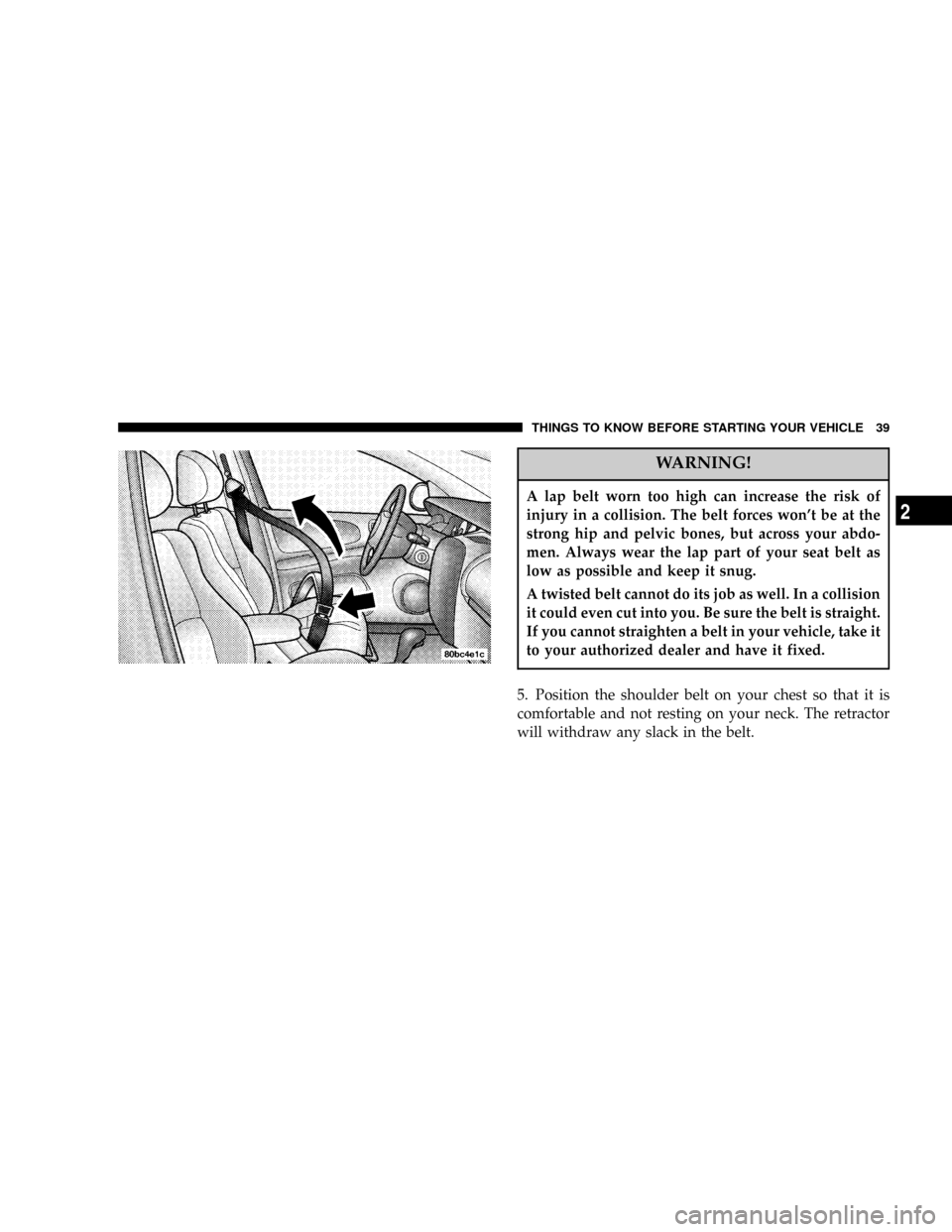
5. Position the shoulder belt on your chest so that it is
comfortable and not resting on your neck. The retractor
will withdraw any slack in the belt.
THINGS TO KNOW BEFORE STARTING YOUR VEHICLE 39
2
Page 40 of 374
6. To release the belt, push the red button marked PRESS
on the buckle. The belt will automatically retract to its
stowed position. If necessary, slide the latch plate down
the webbing to allow it to retract fully.
WARNING!
A frayed or torn belt could rip apart in a collision
and leave you with no protection. Inspect the belt
system periodically, checking for cuts, frays, or loose
parts. Damaged parts must be replaced immediately.
Do not disassemble or modify the system. Seat belt
assemblies must be replaced after an accident if they
have been damaged (bent retractor, torn webbing,
pretensioner, etc.).
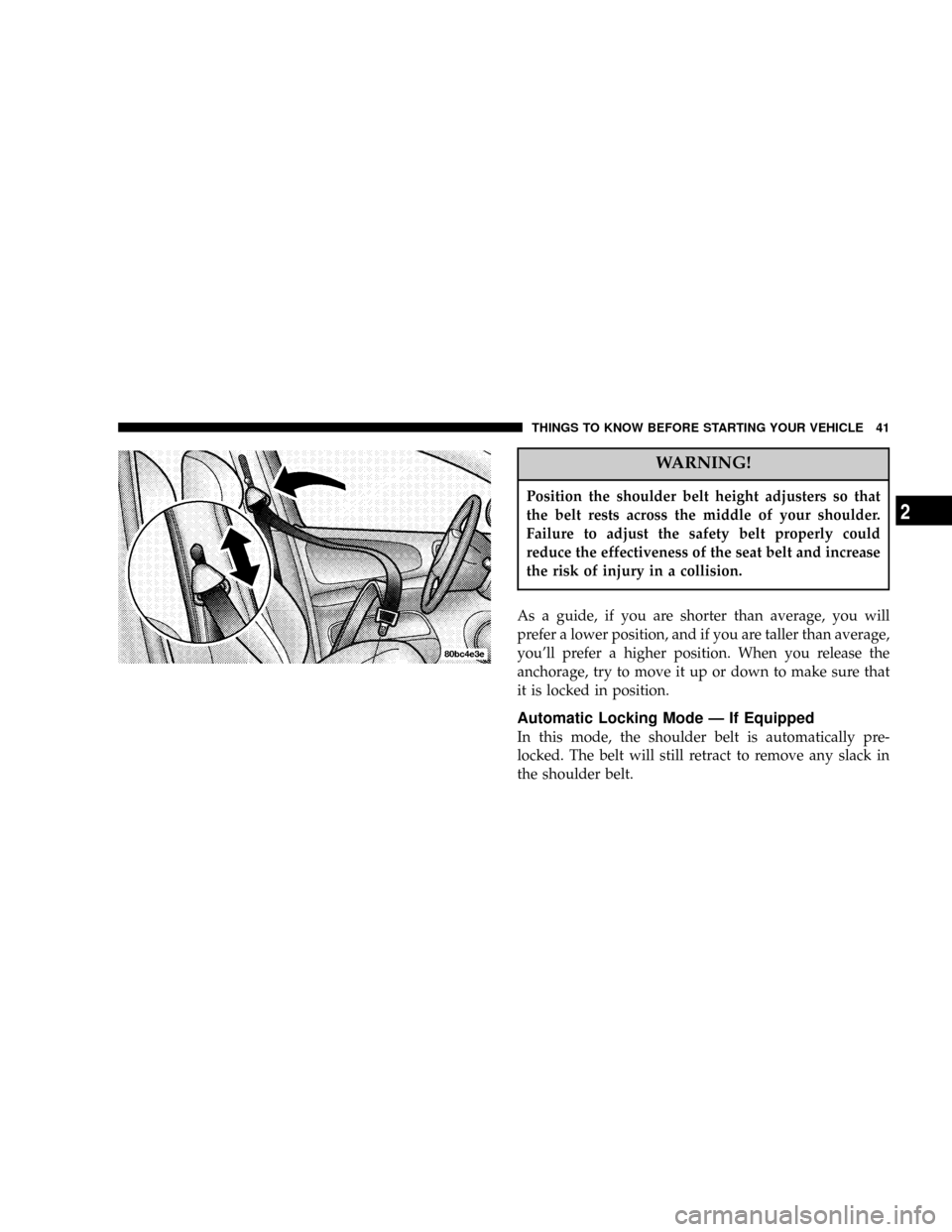
Adjustable Upper Shoulder Belt Anchorage
In the front seat positions, the shoulder belt can be
adjusted upward or downward to position the belt away
from your neck. To lower the shoulder belt height, push
the button and slide the height adjuster down. To raise
the height of the shoulder belt, slide the height adjuster
up. Pull down on the height adjuster to make sure it is
locked in place.
40 THINGS TO KNOW BEFORE STARTING YOUR VEHICLE
Page 41 of 374
WARNING!
Position the shoulder belt height adjusters so that
the belt rests across the middle of your shoulder.
Failure to adjust the safety belt properly could
reduce the effectiveness of the seat belt and increase
the risk of injury in a collision.
As a guide, if you are shorter than average, you will
prefer a lower position, and if you are taller than average,
you'll prefer a higher position. When you release the
anchorage, try to move it up or down to make sure that
it is locked in position.
Automatic Locking Mode Ð If Equipped
In this mode, the shoulder belt is automatically pre-
locked. The belt will still retract to remove any slack in
the shoulder belt.
THINGS TO KNOW BEFORE STARTING YOUR VEHICLE 41
2
Page 43 of 374
WARNING!
²After a vehicle collision, the driver and front
passenger outboard seat belt system must be
checked by a qualified technician to verify that
the ªautomatic locking retractorº feature for child
seats is still functioning properly. In addition, all
seat belts should be checked for proper function.
²The belt and retractor assembly must be replaced
if the seat belt assembly ªautomatic locking re-
tractorº feature or any other seat belt function is
not working properly when checked according to
the procedures in the Service Manual.
²Failure to replace the belt and retractor assembly
could increase the risk of injury in collisions.
Seat Belt Pretensioners
The driver and front passenger seat belts are equipped
with a pretensioning device that is designed to remove
any slack from the seat belt systems in the event of a
collision. This device improves the performance of the
seat belt by assuring that the belt is tight around the
occupant early in a collision. Pretensioners work for all
size occupants, including those in child restraints.
NOTE:These devices are not a substitute for proper seat
belt placement by the occupant. The seat belt must still be
worn snugly and positioned properly.
The pretensioners are triggered by the front Airbag
Control Module. Like the front airbags, the pretensioners
are a single use item. After a collision that is severe
enough to deploy the airbags and pretensioners, they
must be replaced.
THINGS TO KNOW BEFORE STARTING YOUR VEHICLE 43
2
Page 44 of 374

Enhanced Driver Seat Belt Use Reminder System
(BeltAlert)
If the driver's seat belt has not been buckled within 60
seconds of starting the vehicle and if the vehicle speed is
greater than 5 mph (8 km/h), the Enhanced Warning
System (BeltAlert) will alert the driver to buckle their seat
belt. The driver should also instruct all other occupants to
buckle their seat belts. Once the warning is triggered, the
Enhanced Warning System (BeltAlert) will continue to
chime and flash the Seat Belt Warning Light for 96
seconds or until the driver's seat belt is buckled.
The Enhanced Warning System (BeltAlert) will be reacti-
vated if the driver's seat belt is unbuckled for more than
10 seconds and the vehicle speed is greater than 5 mph (8
km/h).
The Enhanced Warning System (BeltAlert) can be en-
abled or disabled by your authorized dealer or by
following these steps:NOTE:The following steps must occur within the first
60 seconds of the ignition switch being turned to the ON
or START position. The manufacturer does not recom-
mend deactivating the Enhanced Warning System
(BeltAlert).
1. Turn the ignition switch to the OFF position, and
buckle the driver's seat belt.
2. Turn the ignition key to the ACCESSORY/RUN posi-
tion (engine does not need to be running), and wait for
the Seat Belt Warning Light to turn off.
3. Within 60 seconds of starting the vehicle, unbuckle
and then re-buckle the driver's seat belt at least three
times within 10 seconds, ending with the seat belt
buckled.
4. Turn the ignition key to the OFF position. A single
chime will sound to signify that you have successfully
completed the programming.
44 THINGS TO KNOW BEFORE STARTING YOUR VEHICLE
Page 45 of 374
The Enhanced Warning System (BeltAlert) can be reacti-
vated by repeating this procedure.
NOTE:Although the Enhanced Warning System (BeltA-
lert) has been deactivated, the Seat Belt Warning Light
will continue to illuminate while the driver's seat belt
remains unfastened.
Seat Belts and Pregnant Women
We recommend that pregnant women use the seat belts
throughout their pregnancy. Keeping the mother safe is
the best way to keep the baby safe.
Pregnant women should wear the lap part of the belt
across the thighs and as snug across the hips as possible.
Keep the belt low so that it does not come across the
abdomen. That way the strong bones of the hips will take
the force if there is a collision.
Seat Belt Extender
If a seat belt is too short, even when fully extended and
when the adjustable upper shoulder belt anchorage (if
equipped) is in its lowest position, your authorized
dealer can provide you with a seat belt extender. This
extender should be used only if the existing belt is not
long enough. When it is not required, remove the ex-
tender and store it.
WARNING!
Using a seat belt extender when not needed can
increase the risk of injury in a collision. Only use
when the lap belt is not long enough when it is worn
low and snug, and in the recommended seating
positions. Remove and store the extender when not
needed.
THINGS TO KNOW BEFORE STARTING YOUR VEHICLE 45
2