Page 291 of 374
The best time to check the engine oil level is about 5
minutes after a fully warmed engine has been shut off, or
before starting the engine after it has sat overnight.
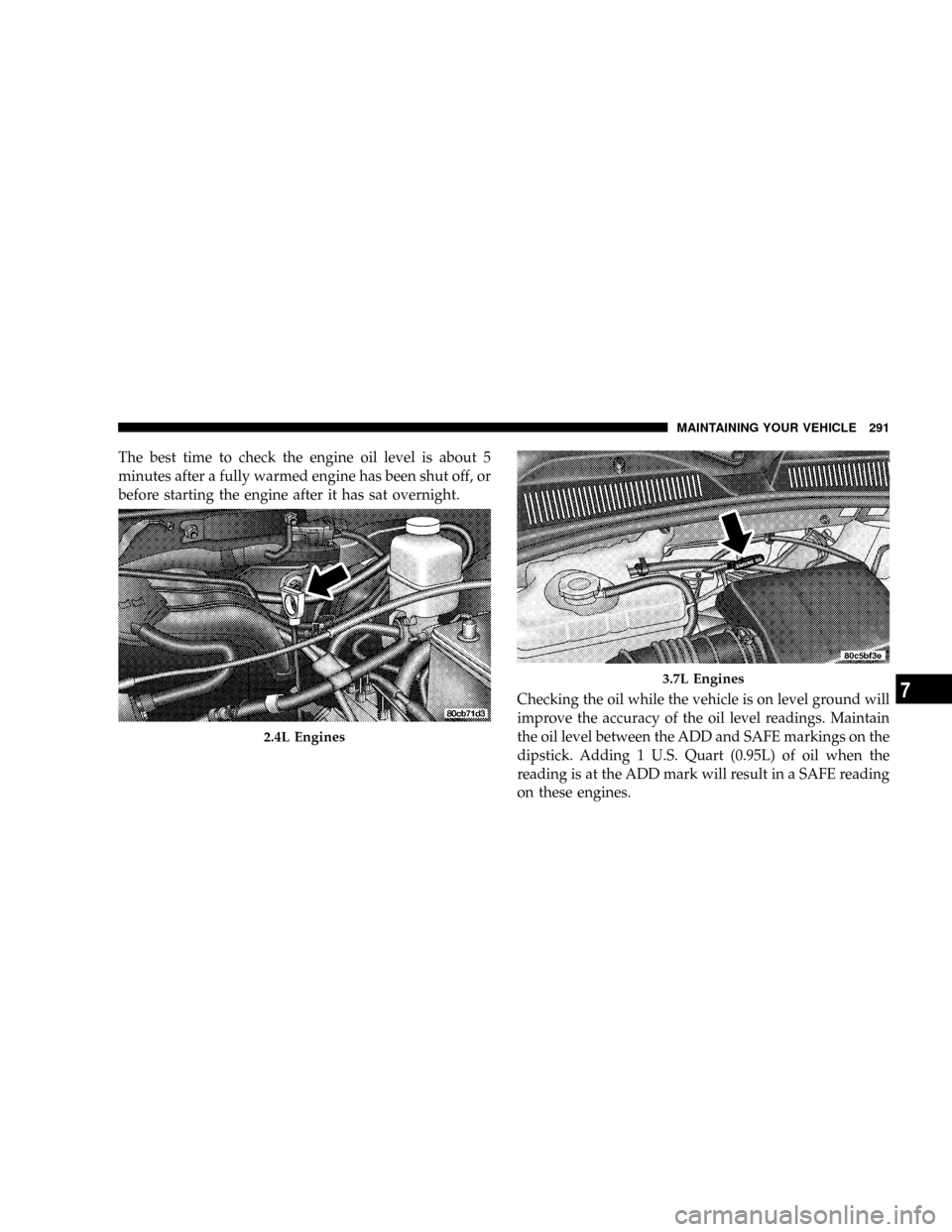
Checking the oil while the vehicle is on level ground will
improve the accuracy of the oil level readings. Maintain
the oil level between the ADD and SAFE markings on the
dipstick. Adding 1 U.S. Quart (0.95L) of oil when the
reading is at the ADD mark will result in a SAFE reading
on these engines.
2.4L Engines
3.7L Engines
MAINTAINING YOUR VEHICLE 291
7
Page 292 of 374
CAUTION!
Overfilling or underfilling the crankcase will cause
aeration or loss of oil pressure. This could damage
your engine.
Change Engine Oil
Road conditions as well as your kind of driving affect the
interval at which your oil should be changed. Check the
following to determine if any apply to you:
²Day or night temperatures are below 32ÉF (0ÉC)
²Stop and go driving
²Extensive engine idling
²Driving in dusty conditions
²Short trip driving of less than 10 miles (16.2 km)
²More than 50% of your driving is at sustained high
speeds during hot weather, above 90ÉF (32ÉC)
²Taxi, Police, or delivery service (commercial service)
²Trailer towing
²Off-road or desert driving
IfANYof these apply to you, then change your engine oil
at every interval shown in schedule ªBº of the ªMainte-
nance Schedulesº section of this manual.
If none of these apply to you, then change your engine oil
at every interval shown on schedule ªAº of the ªMain-
tenance Schedulesº section of this manual
NOTE:Under no circumstances should oil change in-
tervals exceed 6,000 miles (10 000 km) or 6 months
whichever comes first.
292 MAINTAINING YOUR VEHICLE
Page 293 of 374
Engine Oil Selection
For best performance and maximum protection for all
engines under all types of operating conditions, the
manufacturer recommends engine oils that are API Cer-
tified and meet the requirements of DaimlerChrysler
Material Standard MS-6395.
American Petroleum Institute (API) Engine Oil
Identification Symbol
This symbol means that the oil has
been certified by the American
Petroleum Institute (API). The
manufacturer only recommends
API Certified engine oils.
Engine Oil Viscosity Chart
The proper SAE viscosity grade of engine oil should be
selected based on the following recommendation and be
within the operating temperature shown in the engine oil
viscosity chart.
MAINTAINING YOUR VEHICLE 293
7
Page 294 of 374
Materials Added To Engine Oils
The manufacturerstrongly recommendsagainst the ad-
dition of any additives (other than leak detection dyes) to
engine oil. Engine oil is an engineered product and it's
performance may be impaired by supplemental addi-
tives.
Disposing of Used Engine Oil
Care should be taken in disposing of used engine oil from
your vehicle. Used oil and oil filters, indiscriminately
discarded, can present a problem to the environment.
Contact your authorized dealer, service station, or gov-
ernmental agency for advice on how and where used oil
can be safely discarded in your area.
Engine Oil Filter
The engine oil filter should be replaced at every engine
oil change.
Engine Oil Filter Selection
All of the manufacturer's engines have a full-flow type
disposable oil filter. Use a filter of this type for replace-
ment. The quality of replacement filters varies consider-
ably. Only high quality filters should be used to assure
most efficient service. Mopartengine oil filters are high
quality oil filters and are recommended.
Drive Belts Ð Check Condition and Tension
At the mileage shown in the appropriate ªMaintenance
Schedule,º check all drive belts for condition and proper
tension. Improper belt tension can cause belt slippage
and failure.
Inspect the drive belt for evidence of cuts, cracks, or
glazing and replace them if there is any sign of damage
which could result in belt failure. If adjustment is re-
quired, adjust the belts according to the specifications
and procedures shown in the Service Manual.
294 MAINTAINING YOUR VEHICLE
Page 300 of 374
Refrigerant Recovery and Recycling
R-134a Air Conditioning Refrigerant is a hydrofluorocar-
bon (HFC) that is endorsed by the Environmental Pro-
tection Agency and is an ozone-saving product. How-
ever, the manufacturer recommends that air conditioning
service be performed by dealers or other service facilities
using recovery and recycling equipment.
NOTE:Air Conditioning systems found to be contami-
nated with A/C System Sealers, Stop Leak Products, Seal
Conditioners, Compressor Oil, or Refrigerants not ap-
proved by the manufacturer, voids the warranty for the
Air Conditioning system.
Power Steering Fluid Check
Checking the power steering fluid level at a defined
service interval is not required. The fluid should only be
checked if a leak is suspected, abnormal noises areapparent, and/or the system is not functioning as antici-
pated. Coordinate inspection efforts through a certified
ªDaimlerChrysler Dealership.º
WARNING!
Fluid level should be checked on a level surface with
the engine off to prevent injury from moving parts,
and to insure accurate fluid level reading. Do not
overfill. Use only the manufacturer's recommended
fluid.
If necessary, add fluid to restore to the proper indicated
level. With a clean cloth, wipe any spilled fluid from all
surfaces. Refer to Recommended Fluids, Lubricants, and
Genuine Parts for correct fluid type.
300 MAINTAINING YOUR VEHICLE
Page 301 of 374
Driveline And Steering Component Lubrication
U-joints (cardan joints) are sealed and do not require
lubrication. Prop shafts, yokes, ball joints and other
driveline and steering components may be provided with
grease fittings for lubrication. Lubrication of these com-
ponents at the intervals specified in the appropriate
ªMaintenance Scheduleº in Section 8 is very important,
particularly if your vehicle is subjected to off-road or
other heavy-duty use. See your authorized dealer for
complete service information.
Body Lubrication
Locks and all body pivot points, including such items as
seat tracks, doors, swing gate and hood hinges, should be
lubricated periodically to assure quiet, easy operation
and to protect against rust and wear. Prior to the appli-
cation of any lubricant, the parts concerned should be
wiped clean to remove dust and grit; after lubricating
excess oil and grease should be removed. Particularattention should also be given to hood latching compo-
nents to insure proper function. When performing other
underhood services, the hood latch, release mechanism
and safety catch should be cleaned and lubricated.
The external lock cylinders should be lubricated twice a
year, preferably in the fall and spring. Apply a small
amount of a high quality lubricant such as MopartLock
Cylinder Lubricant directly into the lock cylinder.
Windshield Wiper Blades
Clean the rubber edges of the wiper blades and the
windshield periodically with a sponge or soft cloth and a
mild non-abrasive cleaner. This will remove accumula-
tions of salt or road film.
Operation of the wipers on dry glass for long periods
may cause deterioration of the wiper blades. Always use
washer fluid when using the wipers to remove salt or dirt
from a dry windshield. Avoid using the wiper blades to
MAINTAINING YOUR VEHICLE 301
7
Page 302 of 374
remove frost or ice from the windshield. Keep the blade
rubber out of contact with petroleum products such as
engine oil, gasoline, etc.
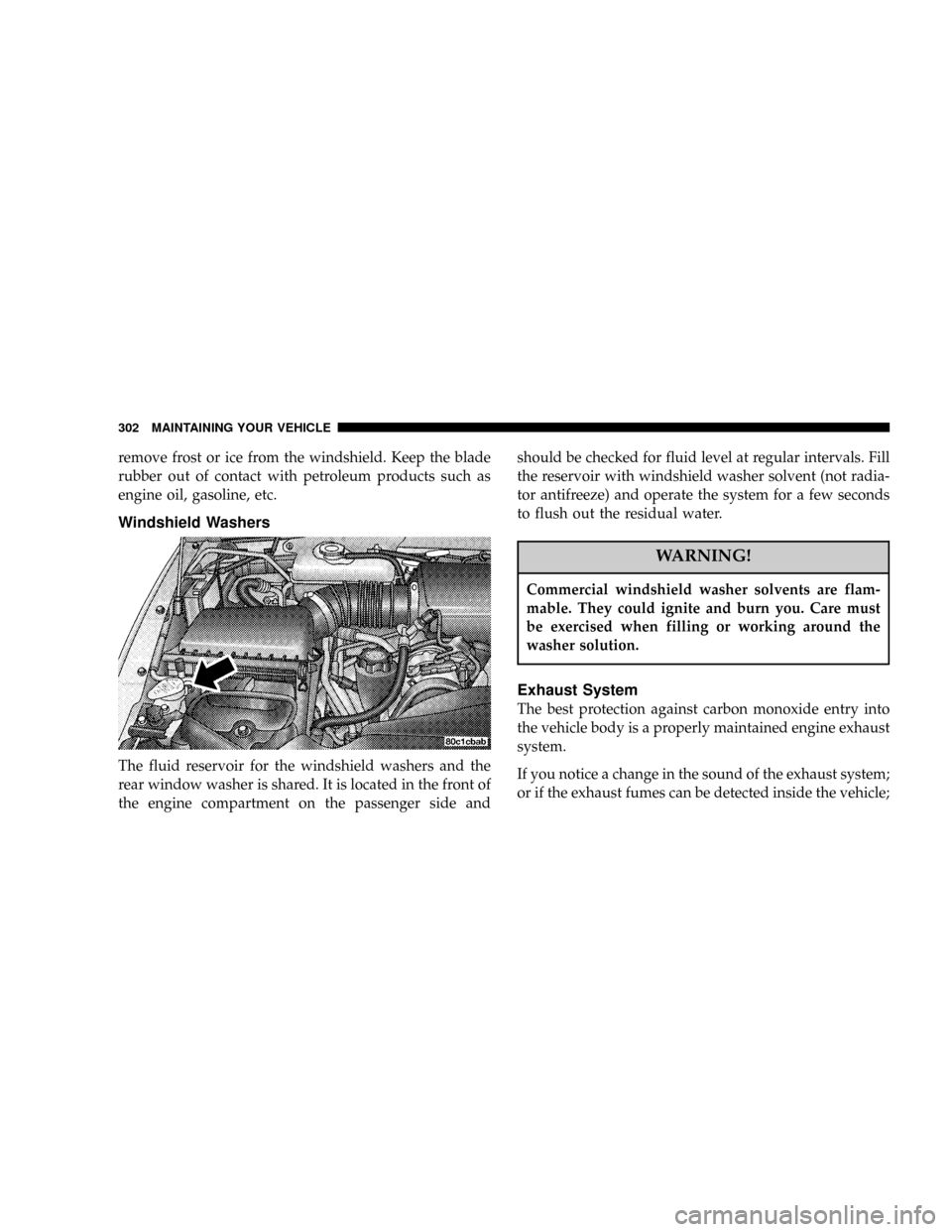
Windshield Washers
The fluid reservoir for the windshield washers and the
rear window washer is shared. It is located in the front of
the engine compartment on the passenger side andshould be checked for fluid level at regular intervals. Fill
the reservoir with windshield washer solvent (not radia-
tor antifreeze) and operate the system for a few seconds
to flush out the residual water.
WARNING!
Commercial windshield washer solvents are flam-
mable. They could ignite and burn you. Care must
be exercised when filling or working around the
washer solution.
Exhaust System
The best protection against carbon monoxide entry into
the vehicle body is a properly maintained engine exhaust
system.
If you notice a change in the sound of the exhaust system;
or if the exhaust fumes can be detected inside the vehicle;
302 MAINTAINING YOUR VEHICLE
Page 303 of 374
or when the underside or rear of the vehicle is damaged;
have an authorized technician inspect the complete ex-
haust system and adjacent body areas for broken, dam-
aged, deteriorated, or mispositioned parts. Open seams
or loose connections could permit exhaust fumes to seep
into the passenger compartment. In addition, inspect the
exhaust system each time the vehicle is raised for lubri-
cation or oil change. Replace as required.
Cooling System
WARNING!
You or others can be badly burned by hot coolant or
steam from your radiator. If you see or hear steam
coming from under the hood, don't open the hood
until the radiator has had time to cool. Never try to
open a cooling system pressure cap when the radia-
tor or coolant bottle is hot.
Coolant Checks
Check coolant protection every 12 months (before the
onset of freezing weather, where applicable). If coolant is
dirty or rusty in appearance, the system should be
drained, flushed and refilled with fresh coolant.
Check the front of the radiator for any accumulation of
bugs, leaves, etc. Clean the radiator by gently spraying
water from a garden hose at the back of the core.
Check the engine cooling system hoses for condition and
tightness of connection. Inspect the entire system for
leaks. Any hoses that show cuts or severe abrasion must
be replaced.
Cooling System Ð Drain, Flush, And Refill
At the intervals shown in the appropriate ªMaintenance
Schedule,º the system should be drained, flushed, and
refilled.
MAINTAINING YOUR VEHICLE 303
7