Page 306 of 374
Coolant Level
The coolant recovery bottle provides a quick visual
method for determining that the coolant level is ad-
equate. The coolant level must be at or above the COLD
FULL level on the bottle. The radiator normally remains
completely full, so there is no need to remove the radiator
cap unless checking for coolant freeze point or replacing
coolant. Advise your service attendant of this. As long as
the engine operating temperature is satisfactory, the
coolant bottle need only be checked once a month.
When additional coolant is needed to maintain the
proper level, it should be added to the coolant recovery
bottle. Do not overfill.
Points To Remember
NOTE:When the vehicle is stopped after a few miles of
operation, you may observe vapor coming from the front
of the engine compartment. This is normally a result of
306 MAINTAINING YOUR VEHICLE
Page 307 of 374

moisture from rain, snow, or high humidity accumulat-
ing on the radiator and being vaporized when the
thermostat opens, allowing hot water to enter the radia-
tor.
If an examination of your engine compartment shows no
evidence of radiator or hose leaks, the vehicle may be
safely driven. The vapor will soon dissipate.
²Do not overfill the coolant bottle.
²Check coolant freeze point in the system.
²If frequent coolant additions are required, or if the
level in the recovery bottle does not drop when the
engine cools, the cooling system should be pressure
tested for leaks.
²Maintain coolant concentration to 50% ethylene glycol
antifreeze (minimum) in water for proper corrosion
protection of your engine that contains aluminum
components.
²Make sure that the radiator and coolant bottle hoses
are not kinked or obstructed.
²Do not change the thermostat for summer or winter
operation. If replacement is ever necessary, install
ONLY the correct type thermostat. Other designs may
result in unsatisfactory cooling performance, poor gas
mileage, and increased emissions.
Hoses and Vacuum/Vapor Harnesses
Inspect surfaces of hoses and nylon tubing for evidence
of heat and mechanical damage. Hard or soft spots,
brittle rubber, cracking, tears, cuts, abrasions, and exces-
sive swelling indicate deterioration of the rubber.
Pay particular attention to the hoses nearest to high heat
sources such as the exhaust manifold. Inspect hose rout-
ing to be sure hoses do not touch any heat source or
moving component that may cause heat damage or
mechanical wear.
MAINTAINING YOUR VEHICLE 307
7
Page 326 of 374
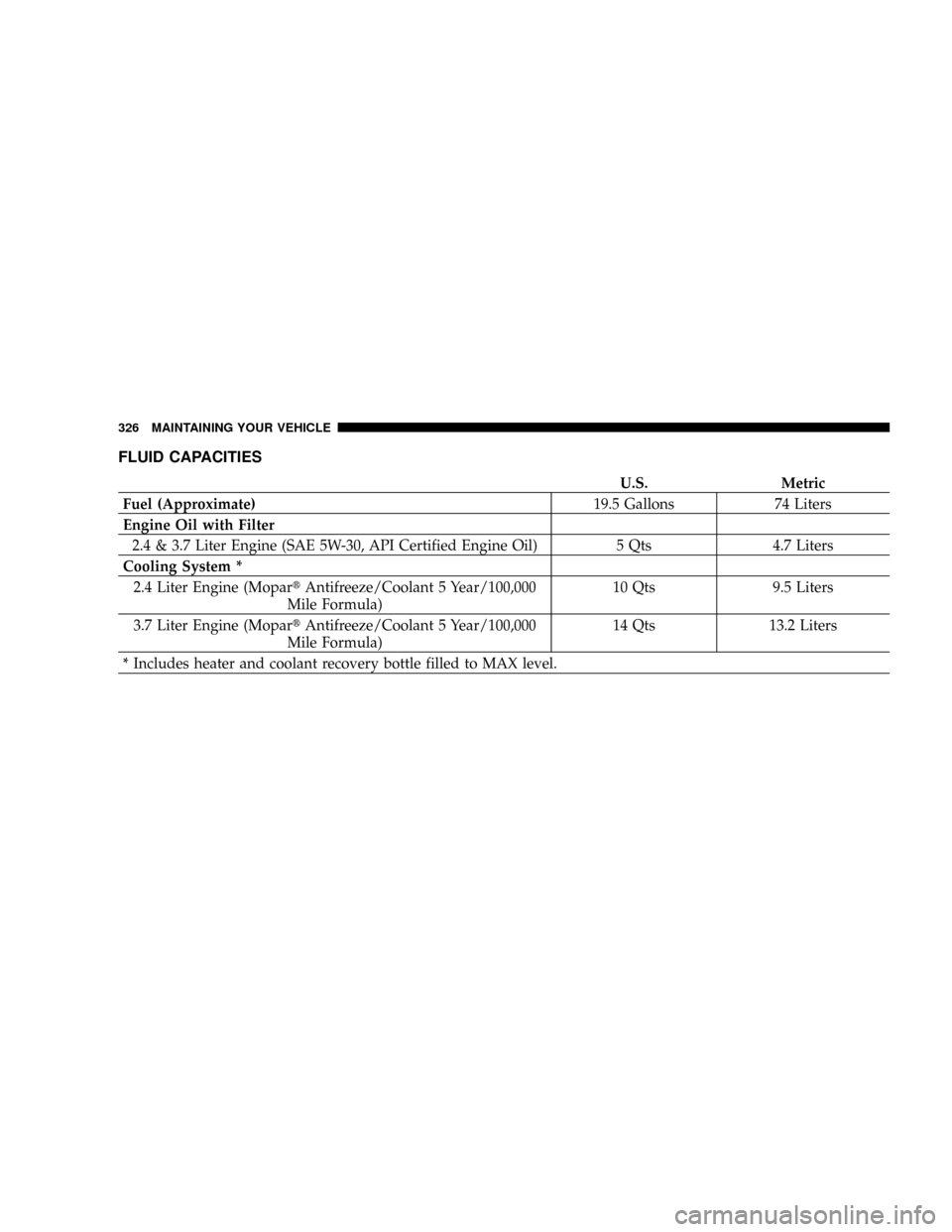
FLUID CAPACITIES
U.S. Metric
Fuel (Approximate)19.5 Gallons 74 Liters
Engine Oil with Filter
2.4 & 3.7 Liter Engine (SAE 5W-30, API Certified Engine Oil) 5 Qts 4.7 Liters
Cooling System *
2.4 Liter Engine (MopartAntifreeze/Coolant 5 Year/100,000
Mile Formula)10 Qts 9.5 Liters
3.7 Liter Engine (MopartAntifreeze/Coolant 5 Year/100,000
Mile Formula)14 Qts 13.2 Liters
* Includes heater and coolant recovery bottle filled to MAX level.
326 MAINTAINING YOUR VEHICLE
Page 327 of 374
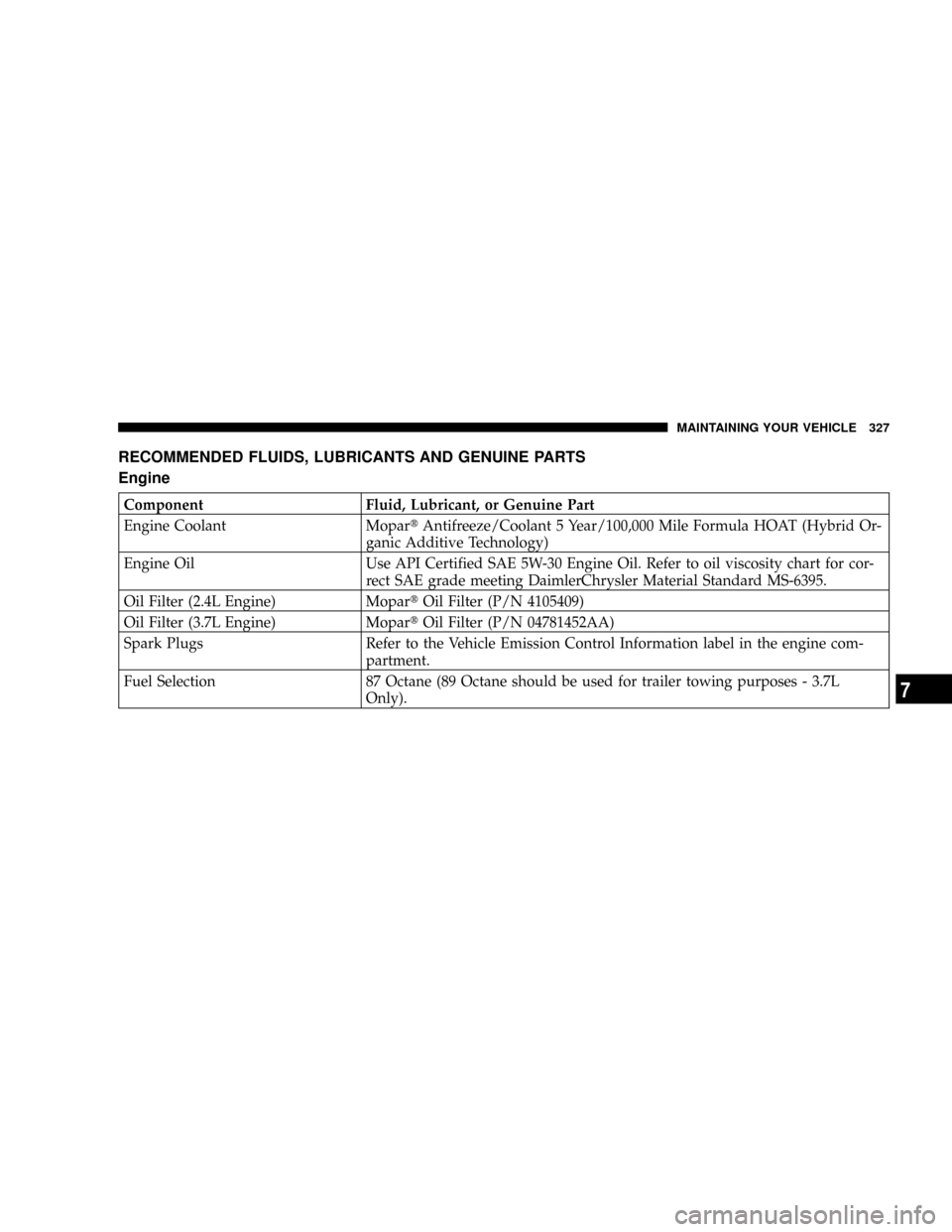
RECOMMENDED FLUIDS, LUBRICANTS AND GENUINE PARTS
Engine
Component Fluid, Lubricant, or Genuine Part
Engine Coolant MopartAntifreeze/Coolant 5 Year/100,000 Mile Formula HOAT (Hybrid Or-
ganic Additive Technology)
Engine Oil Use API Certified SAE 5W-30 Engine Oil. Refer to oil viscosity chart for cor-
rect SAE grade meeting DaimlerChrysler Material Standard MS-6395.
Oil Filter (2.4L Engine) MopartOil Filter (P/N 4105409)
Oil Filter (3.7L Engine) MopartOil Filter (P/N 04781452AA)
Spark Plugs Refer to the Vehicle Emission Control Information label in the engine com-
partment.
Fuel Selection 87 Octane (89 Octane should be used for trailer towing purposes - 3.7L
Only).
MAINTAINING YOUR VEHICLE 327
7
Page 331 of 374
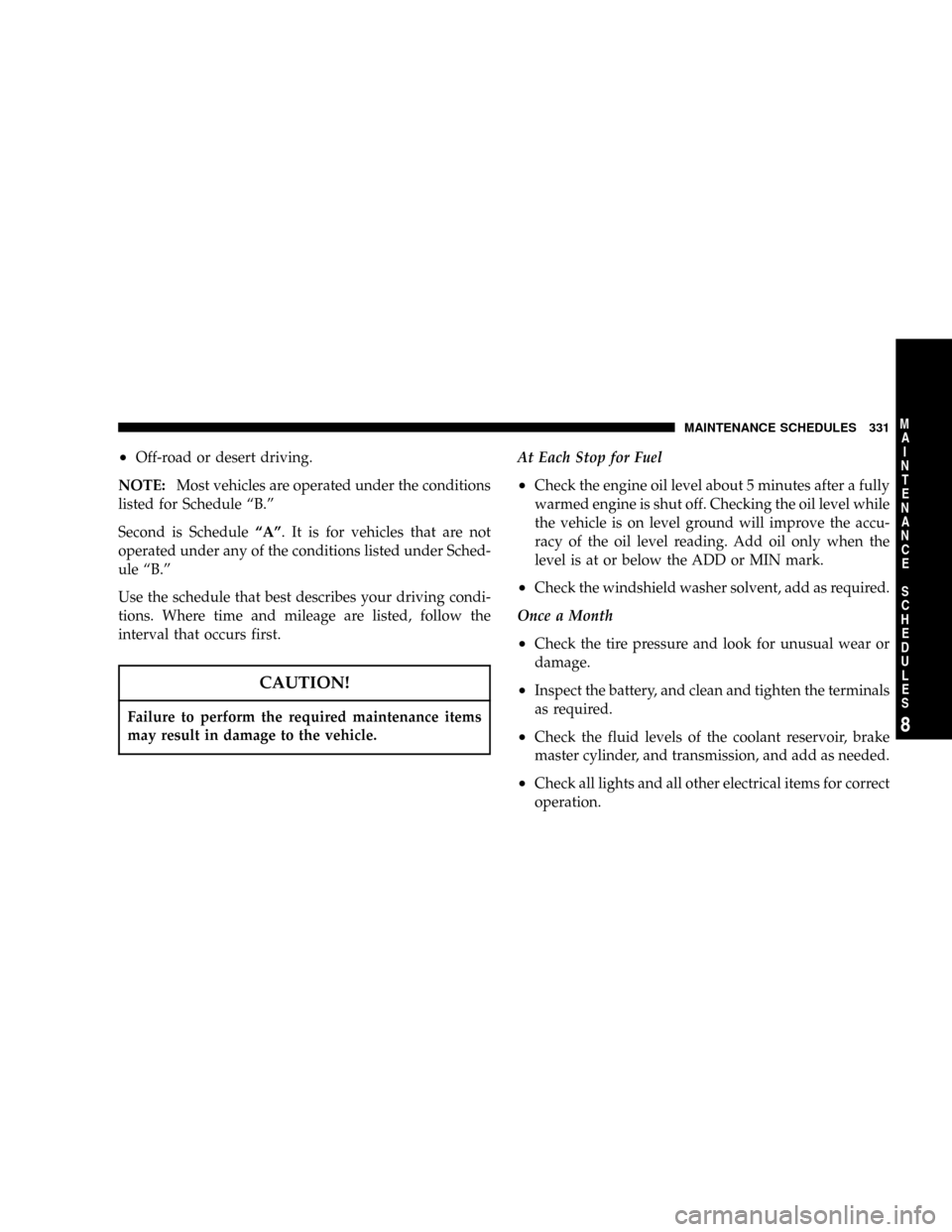
²Off-road or desert driving.
NOTE:Most vehicles are operated under the conditions
listed for Schedule ªB.º
Second is ScheduleªAº. It is for vehicles that are not
operated under any of the conditions listed under Sched-
ule ªB.º
Use the schedule that best describes your driving condi-
tions. Where time and mileage are listed, follow the
interval that occurs first.
CAUTION!
Failure to perform the required maintenance items
may result in damage to the vehicle.
At Each Stop for Fuel
²Check the engine oil level about 5 minutes after a fully
warmed engine is shut off. Checking the oil level while
the vehicle is on level ground will improve the accu-
racy of the oil level reading. Add oil only when the
level is at or below the ADD or MIN mark.
²Check the windshield washer solvent, add as required.
Once a Month
²Check the tire pressure and look for unusual wear or
damage.
²Inspect the battery, and clean and tighten the terminals
as required.
²Check the fluid levels of the coolant reservoir, brake
master cylinder, and transmission, and add as needed.
²Check all lights and all other electrical items for correct
operation.
MAINTENANCE SCHEDULES 331
8
M
A
I
N
T
E
N
A
N
C
E
S
C
H
E
D
U
L
E
S
Page 332 of 374
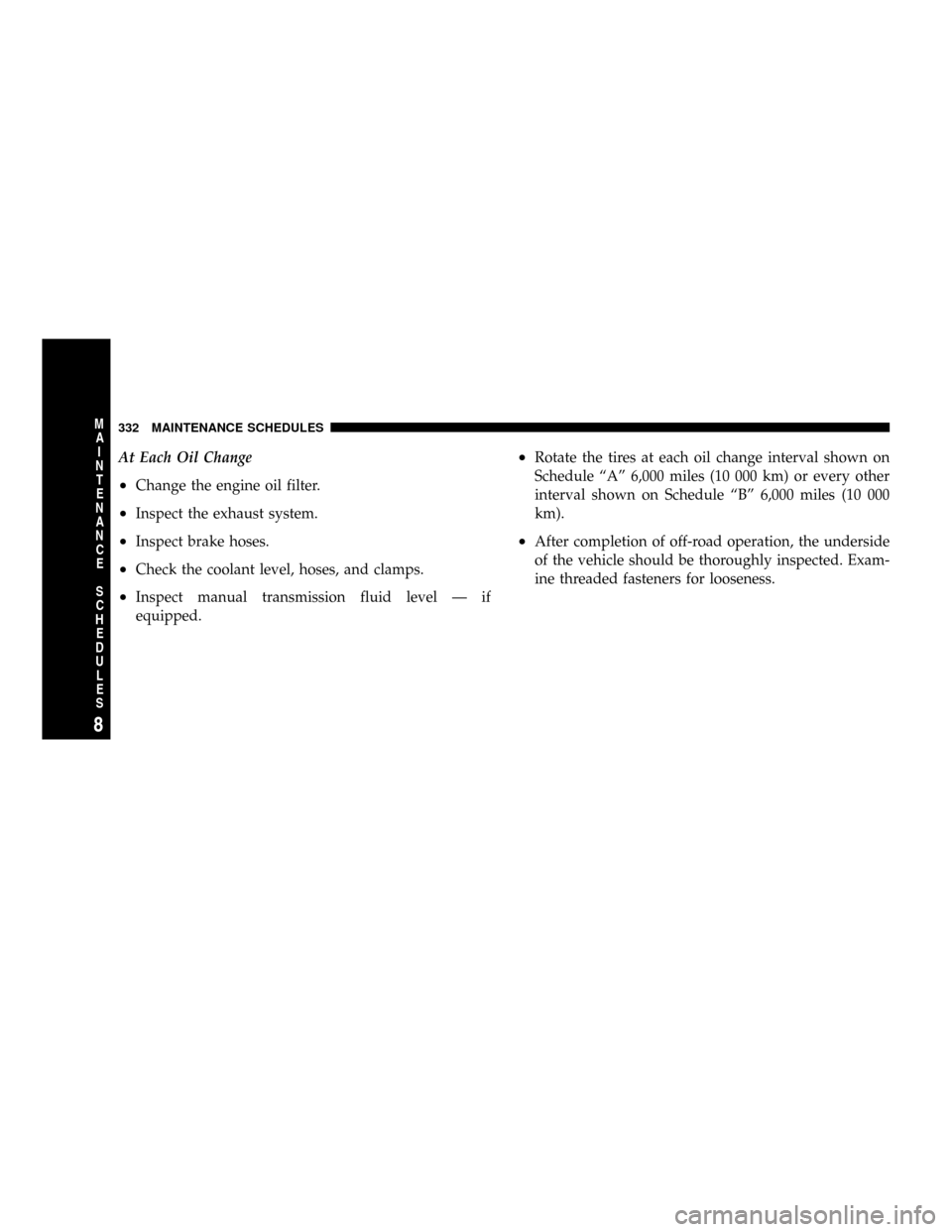
At Each Oil Change
²Change the engine oil filter.
²Inspect the exhaust system.
²Inspect brake hoses.
²Check the coolant level, hoses, and clamps.
²Inspect manual transmission fluid level Ð if
equipped.
²Rotate the tires at each oil change interval shown on
Schedule ªAº 6,000 miles (10 000 km) or every other
interval shown on Schedule ªBº 6,000 miles (10 000
km).
²After completion of off-road operation, the underside
of the vehicle should be thoroughly inspected. Exam-
ine threaded fasteners for looseness.
332 MAINTENANCE SCHEDULES
8
M
A
I
N
T
E
N
A
N
C
E
S
C
H
E
D
U
L
E
S
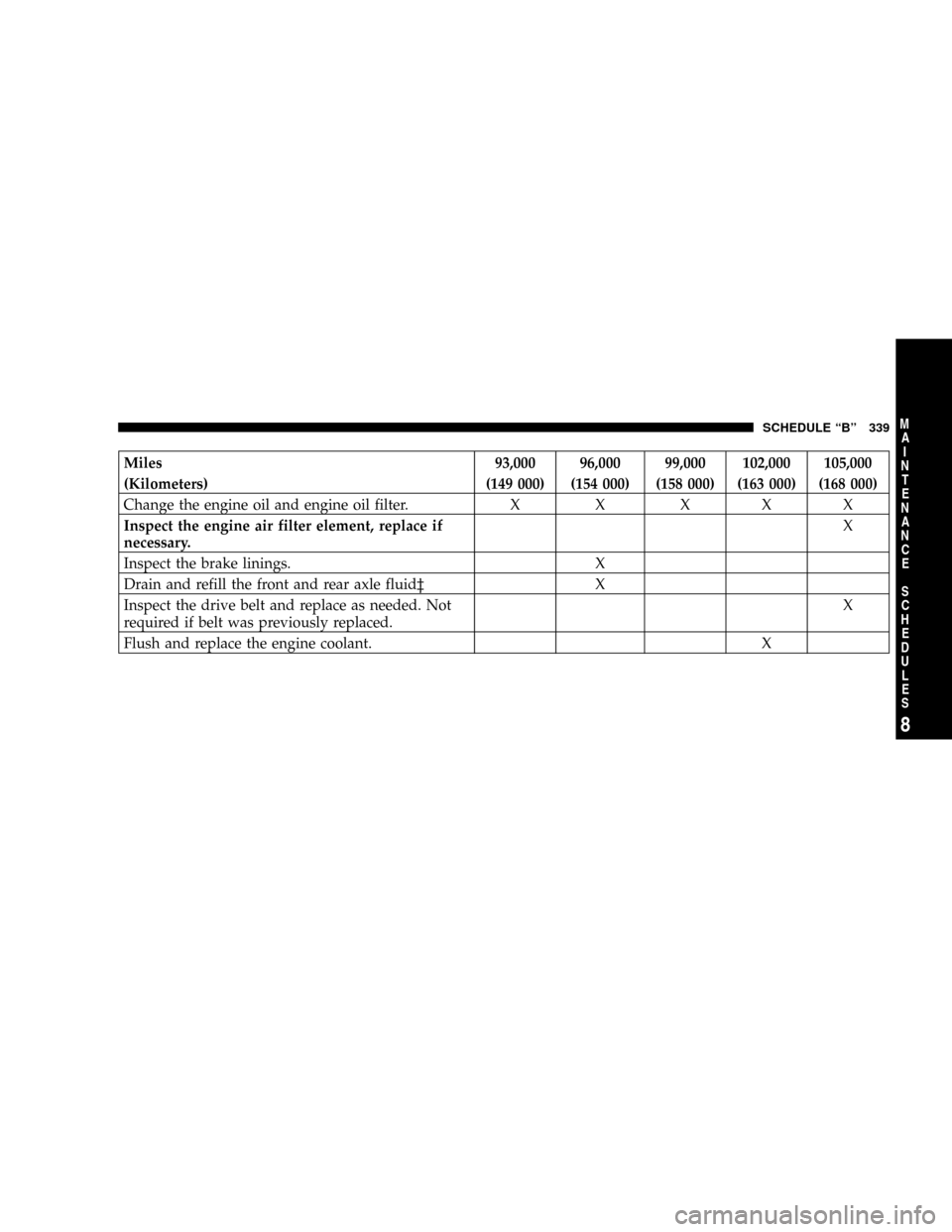
Page 339 of 374
Miles 93,000 96,000 99,000 102,000 105,000
(Kilometers) (149 000) (154 000) (158 000) (163 000) (168 000)
Change the engine oil and engine oil filter. X X X X X
Inspect the engine air filter element, replace if
necessary.X
Inspect the brake linings. X
Drain and refill the front and rear axle fluid³ X
Inspect the drive belt and replace as needed. Not
required if belt was previously replaced.X
Flush and replace the engine coolant. X
SCHEDULE ªBº 339
8
M
A
I
N
T
E
N
A
N
C
E
S
C
H
E
D
U
L
E
S
Page 344 of 374
Miles 60,000 66,000 72,000 78,000
(Kilometers) (96 000) (106 000) (115 000) (125 000)
[Months] [60] [66] [72] [78]
Change the engine oil and engine oil filter. X X X X
Inspect the brake linings. X
Inspect the engine air filter element, and replace if nec-
essary.X
Replace the spark plugs.X
Inspect the ignition cables, and replace if necessary
(2.4L Only).X
Inspect and replace the PCV valve, if necessary.LX
Inspect the drive belt and replace, if needed. X
Inspect the drive belt and replace as needed. Not re-
quired if previously replaced.X
Flush and replace the engine coolant at 60 months, re-
gardless of mileage.X
Inspect the transfer case fluid. X
344 SCHEDULE ªAº
8
M
A
I
N
T
E
N
A
N
C
E
S
C
H
E
D
U
L
E
S

![JEEP LIBERTY 2004 KJ / 1.G Owners Manual Miles 60,000 66,000 72,000 78,000
(Kilometers) (96 000) (106 000) (115 000) (125 000)
[Months] [60] [66] [72] [78]
Change the engine oil and engine oil filter. X X X X
Inspect the brake linings. X
Ins](/manual-img/16/7118/w960_7118-343.png "JEEP LIBERTY 2004 KJ / 1.G Owners Manual Miles 60,000 66,000 72,000 78,000
(Kilometers) (96 000) (106 000) (115 000) (125 000)
[Months] [60] [66] [72] [78]
Change the engine oil and engine oil filter. X X X X
Inspect the brake linings. X
Ins")