2004 Hyundai Tiburon lock
[x] Cancel search: lockPage 23 of 224
1FEATURES OF YOUR HYUNDAI
10
!WARNING:To minimize risk of severe injury in the
event of a collision or a sudden stop, both
the driver's and passenger's seatbacks
should always be in an upright position
while the vehicle is in motion. The protec-
tion provided by the seat belts and airbags
in a frontal collision may be reduced signifi-
cantly when the seatbacks are reclined.
There is greater risk that the driver and
passenger will slide under the seatbelt which
may result in serious injury if a crash occurs
when the seatbacks are reclined. The seat
belt cannot provide full protection to an
occupant if the seat back is reclined.
B080D02A-AAT
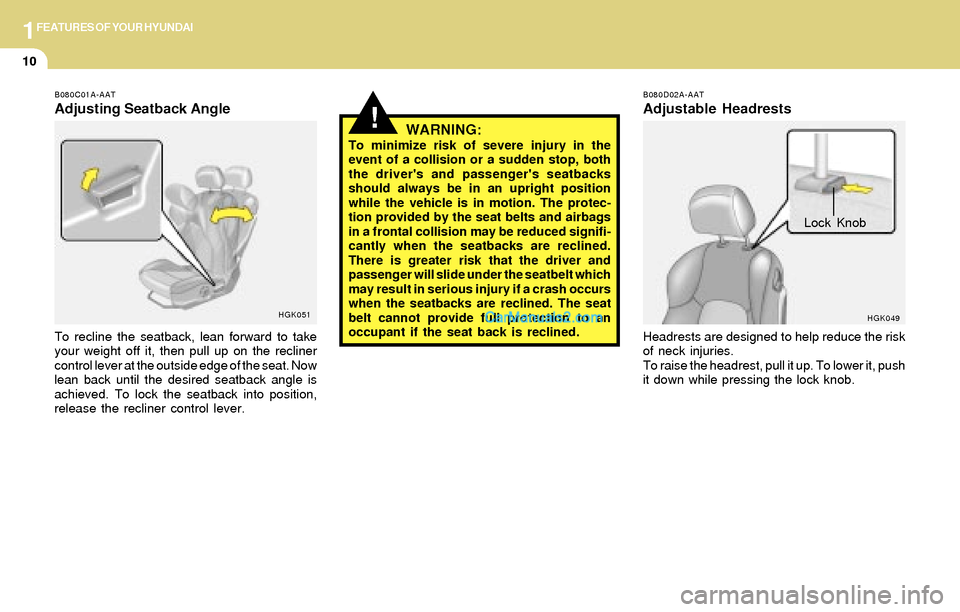
Adjustable Headrests
Headrests are designed to help reduce the risk
of neck injuries.
To raise the headrest, pull it up. To lower it, push
it down while pressing the lock knob.Lock Knob
HGK049
B080C01A-AAT
Adjusting Seatback Angle
To recline the seatback, lean forward to take
your weight off it, then pull up on the recliner
control lever at the outside edge of the seat. Now
lean back until the desired seatback angle is
achieved. To lock the seatback into position,
release the recliner control lever.
HGK051
Page 25 of 224

1FEATURES OF YOUR HYUNDAI
12
!
B130A01GK-AAT
REAR SEAT ENTRY (Walk in device)
The driver and front passenger's seatbacks
should be tilted to enter the rear seat.
By pulling up the walk in device lever (1) at the
left-upper side of the driver side seatback, the
seatback will tilt forward. Then pull the lock
release lever (2) up to move the seat forward.
HGK053
By pulling up the walk in device lever (1) at the
right-upper side of the passenger side seatback,
the seatback will tilt forward. Then push the seat
forward to allow the occupants to enter.
Recliner Memory
By pulling up the walk in device lever (1) the
seatback is reclined and returned to the original
position.
WARNING:Don't drive with the passenger side seatback
reclined. It is dangerous to move it while
driving. Be sure the seatback is caterred
firmly before driving.
HGK240
(1)
(2)(1)
!
B129A01F-AAT
REAR SEAT POSITIONS
WARNING:
This vehicle contains two rear seating po-
sitions only and a seat belt for each seating
position. Thus, never permit more than two
occupants to ride in the rear seat because
an unrestrained occupant could be seri-
ously injured or killed in the event of a
vehicle crash.
B129A01GK
Page 26 of 224
1FEATURES OF YOUR HYUNDAI
13
!
B099A01F-AAT
BEFORE FOLDING THE REAR SEATS
In order to prevent the shoulder belt from being
damaged while folding the rear seat, the shoul-
der belt must be passed through the hanger to
keep it out of the way.
CAUTION:Seat belts must be removed from the hanger
when in use.
!
B099A01GKB110A02S-AAT
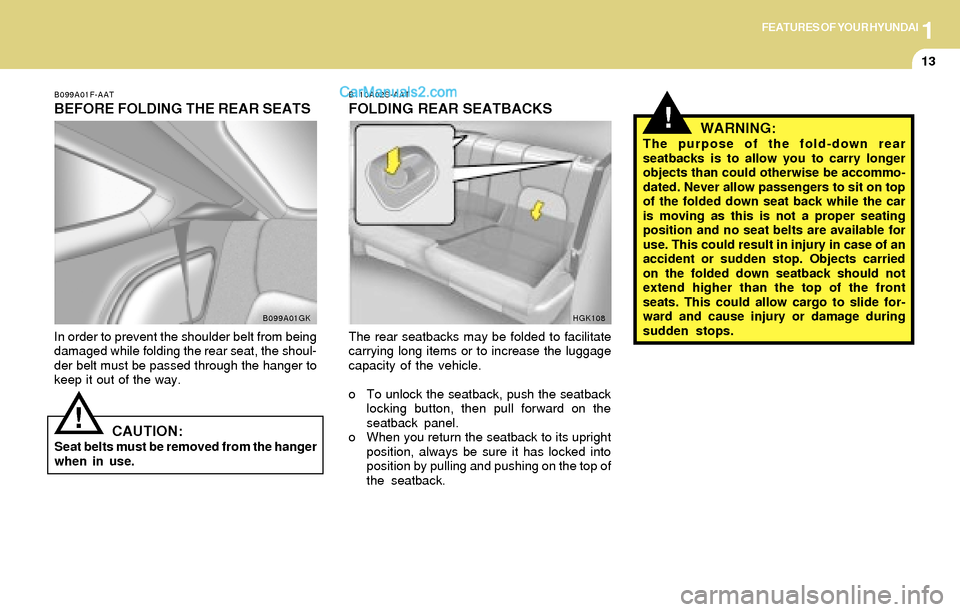
FOLDING REAR SEATBACKS
The rear seatbacks may be folded to facilitate
carrying long items or to increase the luggage
capacity of the vehicle.
o To unlock the seatback, push the seatback
locking button, then pull forward on the
seatback panel.
o When you return the seatback to its upright
position, always be sure it has locked into
position by pulling and pushing on the top of
the seatback.
HGK108
WARNING:The purpose of the fold-down rear
seatbacks is to allow you to carry longer
objects than could otherwise be accommo-
dated. Never allow passengers to sit on top
of the folded down seat back while the car
is moving as this is not a proper seating
position and no seat belts are available for
use. This could result in injury in case of an
accident or sudden stop. Objects carried
on the folded down seatback should not
extend higher than the top of the front
seats. This could allow cargo to slide for-
ward and cause injury or damage during
sudden stops.
Page 30 of 224

1FEATURES OF YOUR HYUNDAI
17
!
Release the button to lock the anchor into
position. Try sliding the height adjuster to make
sure that it has locked into the position.
WARNING:o The height adjuster must be in the locked
position when the vehicle is moving.
o The misadjustment of height of the
shoulder belt could reduce the effective-
ness of the seat belt in a crash.
B180A01A-AAT
SEAT BELT-Driver's 3-Point System with
Emergency Locking Retractor
To Fasten Your Belt
To fasten your seat belt, pull it out of the retractor
and insert the metal tab into the buckle. There
will be an audible "click" when the tab locks into
the buckle.
The seat belt automatically adjusts to the proper
length only after the lap belt portion is adjusted
manually so that it fits snugly around your hips.
If you lean forward in a slow, easy motion, the
belt will extend and let you move around. If there
is a sudden stop or impact, however, the belt will
lock into position. It will also lock if you try to lean
forward too quickly.
B180A01L
NOTE:If the driver's seat belt is not fastened when
the ignition key is in the "ON" position, the
seat belt warning light will flash and the
warning chime will sound for approximately
six seconds.
Page 31 of 224
1FEATURES OF YOUR HYUNDAI
18
!
o Avoid wearing twisted seat belts. A
twisted belt can't do its job as well. In a
collision, it could even cut into you. Be
sure the belt webbing is straight and not
twisted.
o Be careful not to damage the belt web-
bing or hardware. If the belt webbing or
hardware is damaged, replace it.
!
NOTE:Although the combination retractor pro-
vides the same level of protection for seated
passengers in either emergency or auto-
matic locking modes, it is recommended
that seated passengers use the emergency
locking feature for improved convenience.
The automatic locking function is intended
to facilitate child restraint installation. To
convert from the automatic locking feature
to the emergency locking operation mode,
allow the unbuckled seat belt to fully re-
tract.
WARNING:o For maximum restraint system protec-
tion, seat belts must always be used
whenever the car is moving.
o Seat belts are most effective when
seatbacks are in the upright position.
o Children must always be seatbelted in
the rear seats. Never allow children to
ride in the front passenger seat.
o The shoulder belt should be positioned
midway over the shoulder nearest the
door for the most effective protection.
Never wear the seat belt under the arm
nearest the door. Wearing the belt under
the arm nearest the door could cause
serious or fatal injuries in an accident.
WARNING:
B190A01Y-AAT
SEAT BELTS -Front Passenger and Rear
Seat 3-Point System with Combination
Locking Retractor
To Fasten Your Belt
Combination retractor type seat belts are in-
stalled in the rear seat positions to help accom-
modate the installation of child restraint sys-
tems. Hyundai strongly recommends that chil-
dren always be seated in the rear seat. NEVER
place any infant restraint system in the front
seat of the vehicle.
This type of seat belt combines the features of
both an emergency locking retractor seat belt
and an automatic locking retractor seat belt. To
fasten your seat belt, pull it out of the retractor
and insert the metal tab into the buckle. There
will be an audible "click" when the tab locks into
the buckle. When not securing a child restraint,
the seat belt operates in the same way as the
driver's seat belt (Emergency Locking Retrac-
tor Type). It automatically adjusts to the proper
length only after the lap belt portion of the seat
belt is adjusted manually so that it fits snugly
around your hips. When the seat belt is fully
extended from the retractor to allow the instal-
lation of a child restraint system, the seat belt
operation changes to allow the belt to retract, but
not to extend. (Automatic Locking Retractor
Type) see page 1-23.
Page 32 of 224
1FEATURES OF YOUR HYUNDAI
19CHILD RESTRAINT SYSTEM
!
B200A01A-AAT
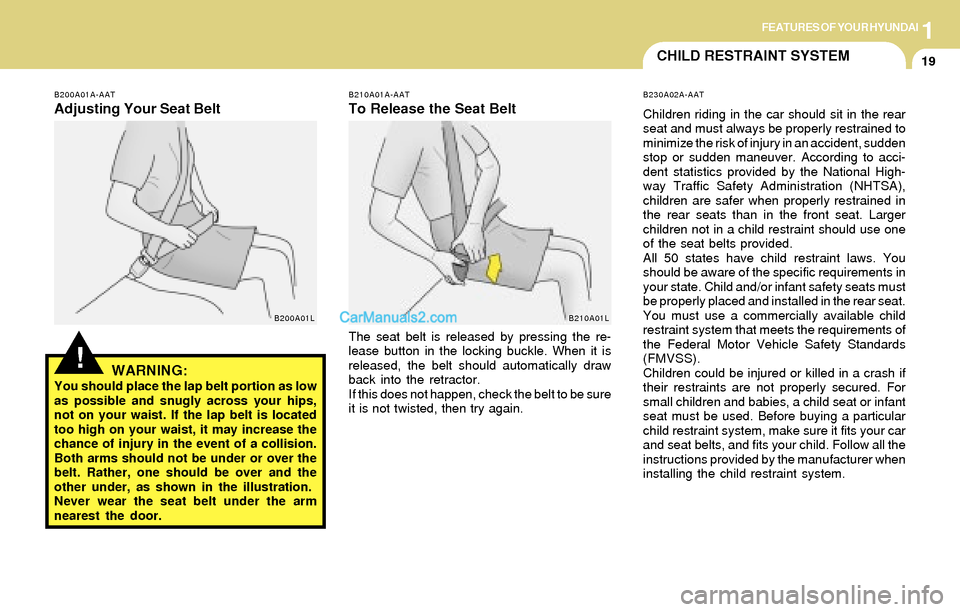
Adjusting Your Seat Belt
WARNING:
You should place the lap belt portion as low
as possible and snugly across your hips,
not on your waist. If the lap belt is located
too high on your waist, it may increase the
chance of injury in the event of a collision.
Both arms should not be under or over the
belt. Rather, one should be over and the
other under, as shown in the illustration.
Never wear the seat belt under the arm
nearest the door.
B200A01LB210A01A-AAT
To Release the Seat Belt
The seat belt is released by pressing the re-
lease button in the locking buckle. When it is
released, the belt should automatically draw
back into the retractor.
If this does not happen, check the belt to be sure
it is not twisted, then try again.
B210A01LB230A02A-AAT
Children riding in the car should sit in the rear
seat and must always be properly restrained to
minimize the risk of injury in an accident, sudden
stop or sudden maneuver. According to acci-
dent statistics provided by the National High-
way Traffic Safety Administration (NHTSA),
children are safer when properly restrained in
the rear seats than in the front seat. Larger
children not in a child restraint should use one
of the seat belts provided.
All 50 states have child restraint laws. You
should be aware of the specific requirements in
your state. Child and/or infant safety seats must
be properly placed and installed in the rear seat.
You must use a commercially available child
restraint system that meets the requirements of
the Federal Motor Vehicle Safety Standards
(FMVSS).
Children could be injured or killed in a crash if
their restraints are not properly secured. For
small children and babies, a child seat or infant
seat must be used. Before buying a particular
child restraint system, make sure it fits your car
and seat belts, and fits your child. Follow all the
instructions provided by the manufacturer when
installing the child restraint system.
Page 36 of 224
1FEATURES OF YOUR HYUNDAI
23
B230G01A-AAT
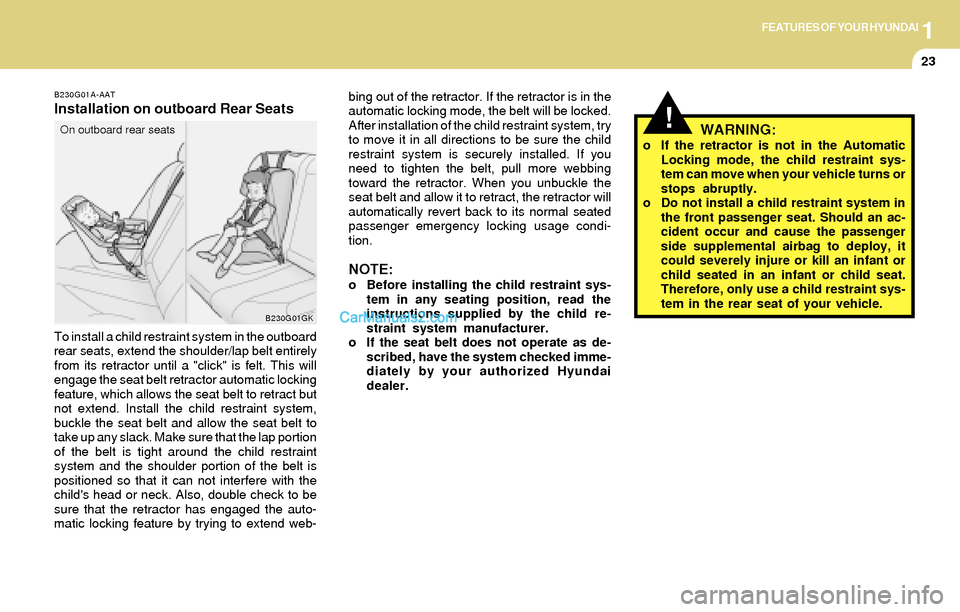
Installation on outboard Rear Seats
To install a child restraint system in the outboard
rear seats, extend the shoulder/lap belt entirely
from its retractor until a "click" is felt. This will
engage the seat belt retractor automatic locking
feature, which allows the seat belt to retract but
not extend. Install the child restraint system,
buckle the seat belt and allow the seat belt to
take up any slack. Make sure that the lap portion
of the belt is tight around the child restraint
system and the shoulder portion of the belt is
positioned so that it can not interfere with the
child's head or neck. Also, double check to be
sure that the retractor has engaged the auto-
matic locking feature by trying to extend web-bing out of the retractor. If the retractor is in the
automatic locking mode, the belt will be locked.
After installation of the child restraint system, try
to move it in all directions to be sure the child
restraint system is securely installed. If you
need to tighten the belt, pull more webbing
toward the retractor. When you unbuckle the
seat belt and allow it to retract, the retractor will
automatically revert back to its normal seated
passenger emergency locking usage condi-
tion.
NOTE:o Before installing the child restraint sys-
tem in any seating position, read the
instructions supplied by the child re-
straint system manufacturer.
o If the seat belt does not operate as de-
scribed, have the system checked imme-
diately by your authorized Hyundai
dealer.
On outboard rear seats!WARNING:o If the retractor is not in the Automatic
Locking mode, the child restraint sys-
tem can move when your vehicle turns or
stops abruptly.
o Do not install a child restraint system in
the front passenger seat. Should an ac-
cident occur and cause the passenger
side supplemental airbag to deploy, it
could severely injure or kill an infant or
child seated in an infant or child seat.
Therefore, only use a child restraint sys-
tem in the rear seat of your vehicle.
B230G01GK
Page 37 of 224
1FEATURES OF YOUR HYUNDAI
24
NOTE:o Both the driver's and front passenger's
pre-tensioner seat belts will be activated
in certain frontal collisions. The pre-
tensioner seat belts can be activated
alone or, where the frontal collision is
severe enough, together with the
airbags.
o When the pre-tensioner seat belts are
activated, a loud noise may be heard and
fine dust, which may appear to be smoke,
may be visible in the passenger com-
partment. These are normal operating
conditions and are not hazardous.
o Although it is harmless, the fine dust
may cause skin irritation and should not
be breathed for prolonged periods. Wash
your hands and face thoroughly after an
accident in which the pre-tensioner seat
belts were activated.
!WARNING:To obtain maximum benefit from a pre-
tensioner seat belt:
1. The seat belt must be worn correctly.
2. The seat belt must be adjusted to the
correct position.
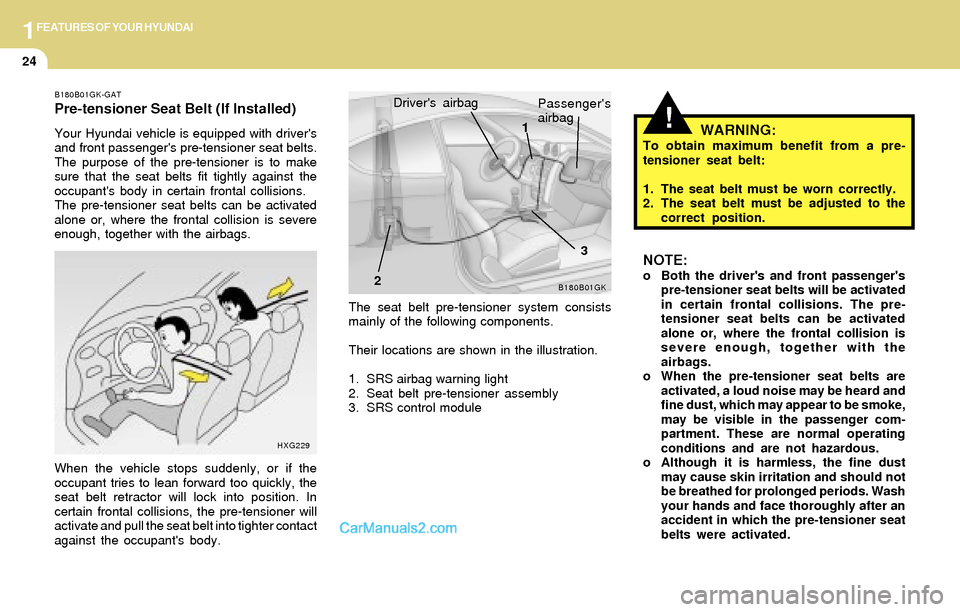
The seat belt pre-tensioner system consists
mainly of the following components.
Their locations are shown in the illustration.
1. SRS airbag warning light
2. Seat belt pre-tensioner assembly
3. SRS control moduleDriver's airbag
B180B01GK23 Passenger's
airbag
1
B180B01GK-GAT
Pre-tensioner Seat Belt (If Installed)
Your Hyundai vehicle is equipped with driver's
and front passenger's pre-tensioner seat belts.
The purpose of the pre-tensioner is to make
sure that the seat belts fit tightly against the
occupant's body in certain frontal collisions.
The pre-tensioner seat belts can be activated
alone or, where the frontal collision is severe
enough, together with the airbags.
When the vehicle stops suddenly, or if the
occupant tries to lean forward too quickly, the
seat belt retractor will lock into position. In
certain frontal collisions, the pre-tensioner will
activate and pull the seat belt into tighter contact
against the occupant's body.
HXG229