2004 Hyundai Matrix hazard
[x] Cancel search: hazardPage 105 of 317

DRIVING YOUR HYUNDAI 2- 7
C090I02A-AAT CAUTION:
o Shift into "R" and "P" position only when
the vehicle has completely stopped.
o Do not accelerate the engine in reverse or
any of the forward positions with the brakes applied.
o Always apply the footbrake when shifting from "P" or "N", to "R", "D", "2" or "L" position.
o Do not use the "P" (Park) position in place
of the parking brake. Always set the park- ing brake, shift the transaxle into "P" (Park) position and turn off the ignition when you leave the vehicle, even momentarily. Never leave the vehicle unattended while the engine is running.
o Check the automatic transaxle fluid level regularly, and add fluid as necessary. See the maintenance schedule for the proper fluid recommendation.
C090N02A-AAT Good Driving Practices
o Never move the gear selector lever from "P" or "N" to any other position with the acceler- ator pedal depressed.
o Never move the gear selector lever into "P"
when the vehicle is in motion.
o Be sure the car is completely stopped before
you attempt to shift into "R".
o Never take the car out of gear and coast down
a hill. This may be extremely hazardous. Always leave the car in gear when moving. o Do not "ride" the brakes. This can cause them
to overheat and malfunction. Instead, whenyou are driving down a long hill, slow down and shift to a lower gear. When you do this, engine braking will help slow the car.
o Slow down before shifting to a lower gear. Otherwise, the lower gear may not be en- gaged.
o Always use the parking brake. Do not depend
on placing the transaxle in "P" to keep the car from moving.
o Exercise extreme caution when driving on a slippery surface. Be especially careful when braking, accelerating or shifting gears. On a slippery surface, an abrupt change in vehicle speed can cause the drive wheels to lose traction and the vehicle to go out of control.
o Turn the overdrive switch on for good fuel economy and smooth driving. If engine brak- ing is needed in the "D" range or if repeated upshifting and downshifting between 3rd and 4th gear is needed when climbing a gentle slope, it is recommended that the overdrive switch be turned off. Turn the overdrive switch back on immediately afterward.
WARNING:
o The risk of rollover is greatly increased if you lose control of your vehicle at high-way speeds.
o Loss of control often occurs if two or more
wheels drop off the roadway and the driv- er oversteers to reenter the roadway. C090P01A-GAT Overdrive Switch
HFC3023
When the overdrive switch is turned on, the transaxle will automatically upshift to the second, third and overdrive gears. When the overdrive switch is turned off, the transaxle will not upshift to the overdrive gear. For normal driving, the selector lever should be left in the "D" position and the overdrive switch turned on. If you need to accelerate rapidly, press the accel- erator pedal all the way to the floor. The transaxle will automatically shift to a lower gear, depending on the vehicle speed and load.
o In the event your vehicle leaves the road- way, do not steer sharply. Instead, slow down before pulling back into the travel lanes.
o In a collision crash, an unbelted person is
significantly more likely to die than a per- son wearing a seatbelt.
Page 106 of 317

DRIVING YOUR HYUNDAI
2- 8 o Do not hold the vehicle on the upgrade with
the accelerator pedal. This can cause the transmission to overheat. Always use the brake pedal or parking brake.
C120A02A-AAT ANTI-LOCK BRAKE SYSTEM (If Installed) The Anti-Lock Brake System (ABS) is designed to prevent wheel lock-up during sudden braking or on hazardous road surfaces. The ABS control module monitors the wheel speed and controls the pressure applied to each brake. Thus, in emergency situations or on slick roads, ABS will increase vehicle control during braking. NOTE: During ABS operation, a slight pulsation may be felt in the brake pedal when the brakes are applied. Also, a noise may be heard in the engine compartment while braking. These conditions are normal and indicate that the anti-lock brake system is functioning proper- ly. WARNING: ABS will not prevent accidents due to im- proper or dangerous driving maneuvers. Even though vehicle control is improved during emergency braking, always maintain a safe distance between you and objects ahead. Vehicle speeds should always be reduced during extreme road conditions. The braking distance for cars equipped with
also increases the wear of the brake compo-nents.
o If a tire goes flat while you are driving, apply
the brakes gently and keep the car pointed straight ahead while you slow down. When
you are moving slowly enough for it to be safe to do so, pull off the road and stop in a safe place.
o If your car is equipped with an automatic
transaxle, don't let your car creep forward. To avoid creeping forward, keep your foot on the brake pedal when the car is stopped.
o Use caution when parking on a hill. Engage
the parking brake and place the gear selector lever in "P" (automatic transaxle) or in first or
reverse gear (manual transaxle). If your car is
facing downhill, turn the front wheels into the curb to help keep the car from rolling. If your car is facing uphill, turn the front wheels away from the curb to help keep the car from rolling. If there is no curb or if it is required by other conditions to keep the car from rolling, block the wheels.
o Under some conditions your parking brake can freeze in the engaged position. This is most likely to happen when there is an accu- mulation of snow or ice around or near the rear brakes or if the brakes are wet. If there is a risk that the parking brake may freeze, apply it only temporarily while you put the gear selector lever in "P" (automatic) or in first or reverse gear (manual transaxle) and block the rear wheels so the car cannot roll. Then release the parking brake.
C130A01A-AAT GOOD BRAKING PRACTICES WARNING: Nothing should be carried on top of the shelf panel behind the rear seat. If there were an accident or a sudden stop, such objects could move forward and cause damage to the ve- hicle or injure the occupants.
o After being parked, check to be sure the
parking brake is not engaged and that the parking brake indicator light is out before driving away.
o Driving through water may get the brakes
wet. They can also get wet when the car is washed. Wet brakes can be dangerous! Your
car will not stop as quickly if the brakes are wet. Wet brakes may cause the car to pull to one side. To dry the brakes, apply the brakes lightly until the braking action returns to nor-
mal, taking care to keep the car under control at all times. If the braking action does not return to normal, stop as soon as it is safe to do so and call your Hyundai dealer for assis- tance.
o Don't coast down hills with the car out of gear.
This is extremely hazardous. Keep the car in gear at all times, use the brakes to slow down, then shift to a lower gear so that engine braking will help you maintain a safe speed.
o Don't "ride" the brake pedal. Resting your foot on the brake pedal while driving can be dan- gerous because it can result in the brakes overheating and losing their effectiveness. It
Page 108 of 317

DRIVING YOUR HYUNDAI
2- 10 C150A01A-AAT
SMOOTH CORNERING
Avoid braking or gear changing in corners, espe- cially when roads are wet. Ideally, corners should always be taken under gentle acceleration. If you follow these suggestions, tire wear will be held to a minimum.
curbs or driving too fast over irregular surfac- es. Poor alignment causes faster tire wear and may also result in other problems as well as greater fuel consumption.
o Keep your car in good condition. For better
fuel economy and reduced maintenance costs, maintain your car in accordance with the maintenance schedule in Section 5. If you drive your car in severe conditions, more frequent maintenance is required (see Sec- tion 5 for details).
o Keep your car clean. For maximum service, your Hyundai should be kept clean and free of corrosive materials. It is especially important that mud, dirt, ice, etc. not be allowed to accumulate on the underside of the car. This extra weight can result in increased fuel con- sumption and also contribute to corrosion.
o Travel lightly. Don't carry unnecessary weight
in your car. Weight reduces fuel economy.
o Don't let the engine idle longer than neces-
sary. If you are waiting (and not in traffic), turn off your engine and restart only when you're ready to go.
o Remember, your Hyundai does not require
extended warm-up. As soon as the engine is running smoothly, you can drive away. In very cold weather, however, give your engine a slightly longer warm-up period.
o Don't "lug" or "over-rev" the engine. Lugging is driving too slowly in too high a gear result- ing in the engine bucking. If this happens, shift to a lower gear. Over-revving is racing the engine beyond its safe limit. This can be C160A01A-AAT WINTER DRIVING The more severe weather conditions of winter result in greater wear and other problems. To minimize the problems of winter driving, you should follow these suggestions: C160B01A-GAT Snowy or Icy ConditionsTo drive your vehicle in deep snow, it may be necessary to use snow tires or to install tire chains on your tires. If snow tires are needed, it is necessary to select tires equivalent in size and type to the original equipment tires. Failure to do so may adversely affect the safety and handling of your car. Speeding, rapid acceleration, sud- den brake applications, and sharp turns are potentially very hazardous practices. During
C140A01A-GAT DRIVING FOR ECONOMY You can save fuel and get more kilometers from your car if you follow these suggestions:
o Drive smoothly. Accelerate at a moderate
rate. Don't make "jack-rabbit" starts or full- throttle shifts and maintain a steady cruising speed. Don't race between stoplights. Try to adjust your speed to that of the other traffic so you don't have to change speeds unneces- sarily. Avoid heavy traffic whenever possible. Always maintain a safe distance from other vehicles so you can avoid unnecessary brak- ing. This also reduces brake wear.
o Drive at a moderate speed. The faster you drive, the more fuel your car uses. Driving at a moderate speed, especially on the high- way, is one of the most effective ways to reduce fuel consumption.
o Don't "ride" the brake or clutch pedal. This
can increase fuel consumption and also in- crease wear on these components. In addi- tion, driving with your foot resting on the brake pedal may cause the brakes to overheat, which reduces their effectiveness and may lead to more serious consequences.
o Take care of your tires. Keep them inflated to the recommended pressure. Incorrect infla- tion, either too much or too little, results in unnecessary tire wear. Check the tire pres- sures at least once a month.
o Be sure that the wheels are aligned correctly.
Improper alignment can result from hitting avoided by shifting at the recommendedspeeds.
o Use your air conditioning sparingly. The air
conditioning system is operated by engine power so your fuel economy is reduced when you use it.
Page 113 of 317

WHAT TO DO IN AN EMERGENCY 3-1
3. WHAT TO DO IN ANEMERGENCY
D010A01A-AAT IF THE ENGINE WILL NOT START WARNING If the engine will not start, do not push or pull the car to start it. This could result in a collision or cause other damage. In addition, push or pull starting may cause the catalytic converter to be overloaded and create a fire hazard. D010B02A-AAT If Engine Doesn’t Turn Over or Turns Over Slowly
D010B01FC
1. If your car has an automatic transaxle, be sure the gear selector lever is in "N" or "P" and the emergency brake is set. 2. Check the battery connections to be sure
they are clean and tight.
3. Turn on the interior light. If the light dims or
goes out when you operate the starter, the battery is discharged.
4. Check the starter connections to be sure they are securely tightened.
5. Do not push or pull the vehicle to start it. See instructions for "Jump Starting".
SSA3020C
D010C01A-AAT If Engine Turns Over Normally but Does Not Start
1 Check fuel level.
2 Check all connectors at ignition, coil and
spark plugs. Reconnect any that may bedisconnected or loose.
3 Check the fuel line in the engine room.
4 If engine still refuses to start, call a Hyundai dealer or seek other qualified assistance. D010D01A-AAT If the Engine Stalls While Driving
1. Reduce your speed gradually, keeping a
straight line. Move cautiously off the road to a safe place.
2. Turn on your emergency flashers.
3. Try to start the engine again. If your vehicle will not start, contact a Hyundai dealer or seekother qualified assistance.
D020A03A-AAT JUMP STARTING
HFC4002
WARNING: The gas produced by the battery during the jump-start operation is highly explosive. If these instructions are not followed exactly, serious personal injury and damage to the vehicle may occur! If you are not sure how to follow this procedure, seek qualified assis- tance. Automobile batteries contain sulfuric acid. This is poisonous and highly corrosive.
Booster battery Discharged battery
3
Page 116 of 317

WHAT TO DO IN AN EMERGENCY
3-4 D060A01A-AAT CHANGING A FLAT TIRE The procedure described on the following pages can be used to rotate tires as well as to change a flat tire. When preparing to change a flat tire, check to be sure the gear selector lever is in "P" (automatic transaxle) or reverse gear (manual transaxle) and that the parking brake is set, then:
D060A01FC
2. When the car is stopped, turn on your emer-
gency hazard flashers, set the parking brake and put the transaxle in "P" (automatic) or reverse (manual transaxle).
3. Have all passengers get out of the car. Be
sure they all get out on the side of the car that is away from traffic.
4. Change the tire following the instructions pro- vided on the following pages.
D040B01A-AAT Handling the Spare Tire
HFC4014
Remove the installation bolt to remove the spare tire. To replace the spare tire in its storage compartment, tighten the bolt firmly with your fingers until there is no more play in the spare tire.
D050A01A-AAT IF YOU HAVE A FLAT TIRE If a tire goes flat while you are driving:
1. Take your foot off the accelerator pedal and let the car slow down while driving straight ahead. Do not apply the brakes immediately or attempt to pull off the road as this may cause a loss of control. When the car has slowed to such a speed that it is safe to do so, brake carefully and pull off the road. Drive off the road as far as possible and park on firm, level ground. If you are on a divided highway, do not park in the median area between the two traffic lanes.
D040B01FC-GAT FULL SIZE SPARE TIRE (If Installed) The following instructions for the FULL SIZE spare tire should be observed: Check inflation pressure as soon as practical after installing the spare tire, and adjust to the specified pressure. The tire pressure should be periodically checked and maintained at the spec- ified pressure while the tire is stored.
Inflation Pressure
Tire Size
Full Size 210 kPa (30 psi)
Spare Tire Pressure
Page 153 of 317
DO-IT-YOURSELF MAINTENANCE 6-19
G190A01A-GAT
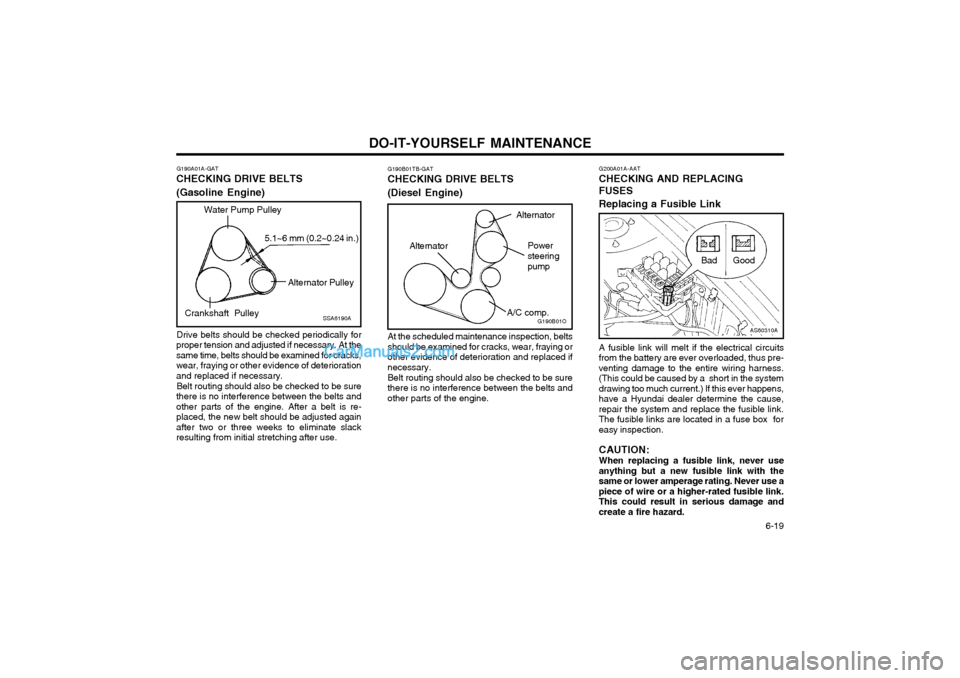
CHECKING DRIVE BELTS (Gasoline Engine)
Drive belts should be checked periodically for
proper tension and adjusted if necessary. At the same time, belts should be examined for cracks,wear, fraying or other evidence of deteriorationand replaced if necessary.
Belt routing should also be checked to be sure
there is no interference between the belts andother parts of the engine. After a belt is re-placed, the new belt should be adjusted againafter two or three weeks to eliminate slackresulting from initial stretching after use.
SSA6190A
Water Pump Pulley
Alternator Pulley
Crankshaft Pulley 5.1~6 mm (0.2~0.24 in.)
G200A01A-AAT
CHECKING AND REPLACING FUSES Replacing a Fusible Link
A fusible link will melt if the electrical circuits
from the battery are ever overloaded, thus pre- venting damage to the entire wiring harness.(This could be caused by a short in the systemdrawing too much current.) If this ever happens,have a Hyundai dealer determine the cause,repair the system and replace the fusible link.The fusible links are located in a fuse box foreasy inspection.
CAUTION: When replacing a fusible link, never use
anything but a new fusible link with the same or lower amperage rating. Never use apiece of wire or a higher-rated fusible link.This could result in serious damage andcreate a fire hazard.
AS60310A
Bad Good
G190B01TB-GAT
CHECKING DRIVE BELTS (Diesel Engine)
At the scheduled maintenance inspection, belts should be examined for cracks, wear, fraying orother evidence of deterioration and replaced ifnecessary. Belt routing should also be checked to be sure there is no interference between the belts andother parts of the engine.G190B01O
Power steeringpump
A/C comp.
Alternator
Alternator
Page 154 of 317

DO-IT-YOURSELF MAINTENANCE
6-20 CAUTION: A burned-out fuse indicates that there is aproblem in the electrical circuit. If you re-place a fuse and it blows as soon as theaccessory is turned on, the problem is seri-ous and should be referred to a Hyundaidealer for diagnosis and repair. Never re-place a fuse with anything except a fusewith the same or a lower amperage rating. Ahigher capacity fuse could cause damageand create a fire hazard.
Burned out
G200B03YGood
4. Replace the blown fuse by pressing a new fuse of the same rating into place. The fuse should be a snug fit. If it is not, have the fuseclip repaired or replaced by a Hyundai dealer.If you do not have a spare fuse, you may beable to borrow a fuse of the same or lowerrating from an accessory you can tempo-rarily get along without (the radio or cigarettelighter, for example). Always remember toreplace the borrowed fuse.
AXA6201B
G200B01E-AAT
Replacing Accessory Fuse The fuse box for the lights and other electrical accessories will be found in the backside of multibox located in the left side of driver. Inside the boxyou will find a list showing the circuits protectedby each fuse. If any of your car’s lights or other electrical
accessories stop working, a blown fuse couldbe the reason. If the fuse has burned out, youwill see that the metal strip inside the fuse hasburned through. If you suspect a blown fuse,follow this procedure:
HFC4010
NOTE: See page 6-26 for the fuse panel descrip-
tions. 1. Turn off the ignition and all other switches.
2. Open the fuse box and examine each fuse.
Remove each fuse by pulling it toward you (a small "fuse puller" tool is contained in thefuse box to simplify this operation).
3. Be sure to check all other fuses even if you find one that appears to have burned out.
Page 160 of 317

DO-IT-YOURSELF MAINTENANCE
6-26
G200C02FC-GAT
FUSE PANEL DESCRIPTION Engine Compartment (GASOLINE)
HFC4004
PROTECTED COMPONENTS Generator (A/CON, RR HTD, STOP, D/LOCK, HAZARD) Fuse Generator, Engine control relay, ECM Radiator fan relay Start relay, Ignition switch Blower relay Power window relay Condenser fan relay #1 ABS control module, ABS bleeding connector ABS control module, ABS bleeding connector Fuel pump relay Injector, lgnition coilMAP sensor, Oxygen sensor, CP sensor, Knock sensor, Throttle position sensor Audio, Room lamp, Overhead console lamp, lnstrument cluster DRL control module Horn relay A/C relay Front fog lamp relay ECM, TCM Tail lamp relay Left rear combi lamp, Left position lamp, Left License lamp Right rear combi lamp, Right position lamp, Right License lamp Left head lamp Right head lamp, (H/LP IND) Fuse
FUSE RATING
120A40A30A 20A 40A 40A 30A 20A 30A 30A 10A 15A 10A 10A 15A 10A 10A 15A 10A 20A 10A 10A 15A 15A
DESCRIPTION
ALTB+
ECU RAD IGN
BLR
P/WINCOND ABSABS
F/PUMP INJ
SNSR
ROOM LP DRL
HORN
A/CON
FR FOG ECU
LP
TAIL LH
TAIL RH H/LP LH
H/LP RH
NOTE:
Not all fuse panel descriptions in this manual may be applicable
to your vehicle. It is accurate at the time of printing. When you inspect the fuse box on your vehicle, refer to the fuse box label.