2004 Hyundai Matrix lock
[x] Cancel search: lockPage 256 of 317

DRIVING YOUR HYUNDAI
2- 12 NOTE: Never allow undiluted screen washer fluidadditive to spill upon the paintwork or use engine coolant anti-freeze since damage to the paintwork may result.
o When driving in extreme conditions, the
windscreen wiper blades may fail to clear the screen properly due to the formation of ice upon the blade edge. It will therefore be necessary to periodically remove such ice to restore their efficiency.
o If the power operated door mirrors become frozen, attempts to adjust these may dam-age the mechanism.
o The formation of snow or ice built up inside the wheel arches may interfere with theroad wheels or steering mechanism. In such instances, unusual noises or an in- crease in steering effort may result. There- fore, ensure that the wheel arches are checked periodically and any accumulated snow or ice removed.
o It is advisable to carry emergency equip- ment including, torch, shovel, tow rope,blankets etc., if a journey is to be under- taken into areas of severe road conditions.
ZC170D1-E Door LocksShould the door lock mechanism become frozen, a proprietary lock de-icer should be used. Alternatively, warming the door key may thaw the door lock. However, the key should be handled carefully to avoid burning the fingers. Never attempt to thaw a frozen door lock using hot water, since the water will eventu- ally freeze and compound the problem. NOTE: The proper temperature for using the immobiliser key is from -40°F to 176°F (- 40°C to 80°C). If you heat the immobiliser key over 176°F (80°C) to open the frozen lock, it may cause damage to the tran- sponder in its head.
SC170E1-E Windscreen Washers and Wipers The windscreen washer bottle should be filled with a solution of water and a proprietary winter screen wash additive. The windscreen wipers should not be used if the blades are frozen to the windscreen or if they are cov- ered with snow, before this is removed.
ZC170B1-E Electrical SystemWinter conditions impose severe demands upon vehicle electrical systems, particularly the charging circuit. The battery condition and performance along with the alternator perfor- mance and drive belt condition should be checked prior to the onset of winter. ZC170C1-E Anti-freeze/Corrosion inhibitorThe cooling system must always contain an Ethylene-Glycol based anti-freeze solution. The system is filled during manufacture with solution of the correct strength which should be checked before the onset of winter and adjusted or changed as required. NOTE: The anti-freeze solution contains a corro- sion inhibitor to prevent degradation of the aluminum castings contained within the engine. Therefore, never, drain the system and refill with water only. In addition, anti-freeze solution must ALWAYS be used in vehicles fitted with air conditioning, to prevent the heater matrix from freezing and subsequently bursting with the refrigeration system in use.
fcuk-2.p65
3/6/2007, 9:59 AM
12
Page 263 of 317

IN CASE OF EMERGENCY
3-4
SD070A1-E
CHANGING A FLAT TYRE
It is of the utmost importance that care is
exercised when changing road wheels. En- sure that the parking brake is set and that the gear shift lever is in reverse (P, if the vehicle has automatic transaxle).
D060A01FC-D
SD050A2-E SPARE WHEEL (Not all models) The spare wheel is stored under the luggage compartment floor and is accessed from within the luggage compartment by lifting the carpet and the floor panel.To remove the spare wheel, unscrew the retainer, rotating this in an anti clockwise direction and lift out the wheel. To replace the wheel, screw the retainer by hand until tight having located the wheel in the luggage com- partment floor well. The inflation pressure of the spare wheel should be checked at least monthly and whenever the wheel is fitted to the vehicle. Spare Tyre Pressure
CAUTION:
o Do not use snow chains with your
temporary spare tyre.
o Do not use more than one temporary
spare tyre at a time. SD060A1-E
IN THE EVENT OF A PUNCTURE If a puncture occurs whilst driving the vehicle:
1. Bring the car to rest as soon as it is safe to do so and with the minimum amount of braking required which will assist in main- taining the maximum amount of control. The vehicle should be parked wherever possible upon firm level ground to facilitate wheel changing.
2. If the vehicle is creating a hazard and the road conditions do not permit the wheel tobe changed safely, assistance should be sought.
3. Passengers must not be allowed to remain inside the vehicle during wheel changing.If a puncture occurs whilst the vehicle is on a motorway, the passengers should take refuge on the motorway embankment to avoid the possibility of injury occurring should the vehicle be struck by other motorway traffic.
4. Wheel changing should be performed ac- cording to the following instructions.
Type
Inflation Pressure Full Size
210 kPa (30 psi)
fcuk-3.p65
3/6/2007, 9:59 AM
4
Page 264 of 317

3-5
IN CASE OF EMERGENCY
D060K01FC-EAT Wheel Cap (Not all models)
HFC4024
1. Wrap a piece of cloth around the tip of the
screwdriver to avoid scratching.
2. Insert a screwdriver into the groove of the wheel cap and pry gently to remove the wheel cap.
3. Change the flat tyre. HFC4023
Groove
BossGroove
Remove the spare wheel and take out the jack and tool bag from the luggage room. NOTE: The jack is equipped on the underside ofthe luggage mat in the vehicle.
D060B01FC-EAT 1. Obtain Spare Tyre and Tool
4. Reinstall the wheel cap by fitting the boss of
the wheel cap in the groove of the wheel,
hitting the centre of the wheel cap with hand.
D060B01FC Block the wheel that is diagonally opposite from the flat tyre to prevent the vehicle from rolling when the car is raised on the jack.
SD070D1-E 2. Block the Wheel
Flat tyre
HFC4005
fcuk-3.p65 3/6/2007, 9:59 AM
5
Page 265 of 317

IN CASE OF EMERGENCY
3-6 SD070G1-E
5. Raising the Car
After inserting a wrench bar into the wheel nut
wrench, install the wrench bar into the jack as shown in the drawing. To raise the vehicle, turn the wheel nut wrench clockwise. As the jack begins to raise the vehicle, double check that it is properly positioned and will not slip. If the jack is on soft ground or sand, it may be necessary to place a stout piece of timber under the base of the jack to prevent it from sinking.
Raise the car high enough so that the fully
inflated spare wheel can be installed.
WARNING: Do not get under the car when it is support-
ed by the jack! The jack is solely designedfor wheel changing and is not intended to support the vehicle for other purposes. The use of purpose designed supports is neces- sary whilst the vehicle is raised and the operator is required to get underneath.
HFC4022
Wrench bar
Wheel nut wrench
SD070E1-E 3. Loosen Wheel Nuts The wheel nuts should be loosened slightly before raising the car. To loosen the nuts, turn the wheel brace counterclockwise. Ensure that the wheel brace socket is seated properly on the nut and that it cannot slip. Do not remove the nuts at this stage. SD070F1-F
4. Put the Jack in Place
The base of the jack should be placed on firm,level ground. The jack should be positioned as shown in the drawing.
D060D01FC-DHFC4006
fcuk-3.p65 3/6/2007, 9:59 AM
6
Page 266 of 317
3-7
IN CASE OF EMERGENCY
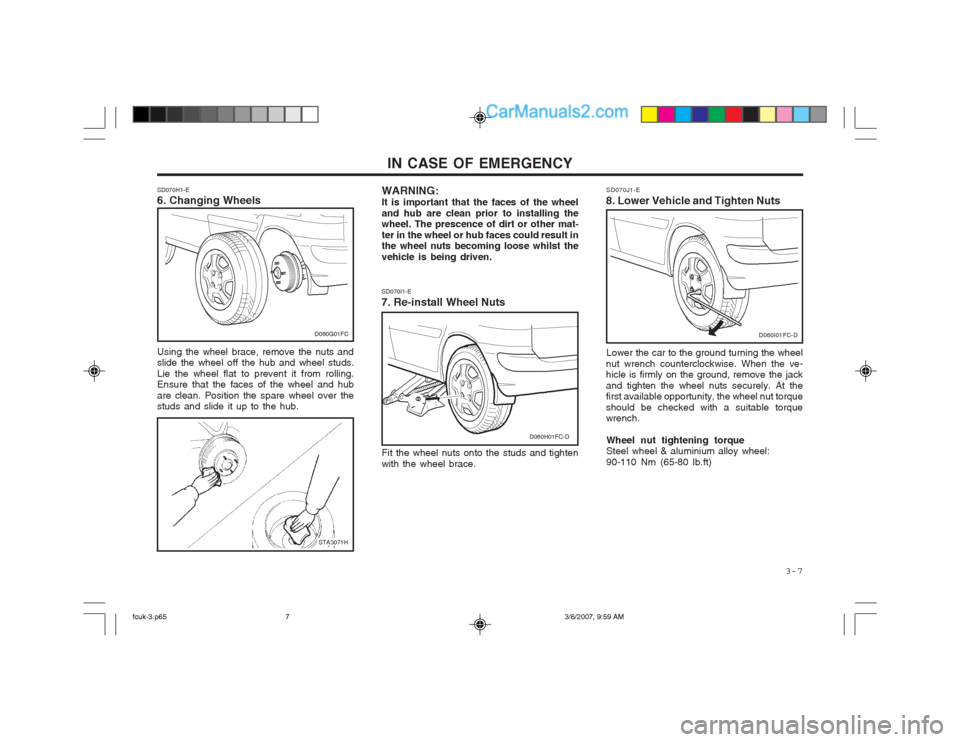
WARNING: It is important that the faces of the wheeland hub are clean prior to installing the wheel. The prescence of dirt or other mat- ter in the wheel or hub faces could result in the wheel nuts becoming loose whilst the vehicle is being driven. SD070I1-E
7. Re-install Wheel Nuts
Fit the wheel nuts onto the studs and tighten with the wheel brace.
SD070H1-E 6. Changing Wheels Using the wheel brace, remove the nuts and slide the wheel off the hub and wheel studs. Lie the wheel flat to prevent it from rolling. Ensure that the faces of the wheel and hub are clean. Position the spare wheel over the studs and slide it up to the hub.
STA3071H
D060H01FC-D
D060G01FC
SD070J1-E
8. Lower Vehicle and Tighten Nuts
Lower the car to the ground turning the wheel
nut wrench counterclockwise. When the ve- hicle is firmly on the ground, remove the jack and tighten the wheel nuts securely. At the first available opportunity, the wheel nut torque should be checked with a suitable torque wrench.
Wheel nut tightening torqueSteel wheel & aluminium alloy wheel: 90-110 Nm (65-80 lb.ft)
D060I01FC-D
fcuk-3.p65 3/6/2007, 9:59 AM
7
Page 267 of 317

IN CASE OF EMERGENCY
3-8 The vehicle may be towed by the conven- tional method using the towing eye at the front of the vehicle as an attachment point. In addition, a suspended tow with or without an towing dolly may be used with either the front or the rear wheels being suspended, provided the above caution is observed. In addition, the following points must be noted:
o If towing by conventional means, the
ignition key must be at the "ACC" posi- tion, otherwise the steering lock will be activated.
o Because the brake system and steering system power assistance is derived fromthe engine, the amount of effort re- quired to stop or steer the vehicle will be greater than normal.
SD090A1-E
Manual Transaxle Vehicle
o OK FOR AUTOMATIC OR MANUAL TRANSAXLE EQUIPPED VEHICLE WITH NO DAMAGE D080B01FC
SD070K1-E AFTER CHANGING WHEELS
SD080A1-EVEHICLE TOWING OR RECOVERY
The pressure of the spare tyre should be checked at the first available opportunity. If any doubt exists as to the tyre pressure, the vehicle should be driven slowly to the nearest service station and the tyre pressure checked and adjusted as required. If the valve cap is lost from any of the valves, a replacement should be obtained and fitted at the first available opportunity. The valve cap prevents the ingress of dirt which may cause the valve to stick and therefore leak and is part of the valve sealing function. Ensure that the spare wheel, jack and wheel nut wrench as well tools are correctly located in the boot of the vehicle to prevent damage and noise. CAUTION: An incorrect tow or recovery could result in serious damage to the vehicle. If any damage to the suspension, steering or transaxle is apparent or suspected, a tow- ing towing dolly must be used.
D060B01FC
o OK FOR AUTOMATIC OR MANUAL
TRANSAXLE EQUIPPED VEHICLE D080A01FC
fcuk-3.p65
3/6/2007, 9:59 AM
8
Page 268 of 317

3-9
IN CASE OF EMERGENCY
o If a suspended tow is being given to the rear, the ignition key must be at the "ACC" position since the steering lock is not designed to withstand the force required to hold the front wheels straight during the tow.
o The vehicle must not be towed with the front wheels on the ground for morethan thirty miles.
o OK FOR AUTOMATIC OR MANUAL
TRANSAXLE EQUIPPED VEHICLE
SD100A2-E Automatic Transaxle Vehicle
o NOT OK FOR AUTOMATIC TRANSAXLE
EQUIPPED VEHICLE
o OK FOR MANUAL TRANSAXLE
The vehicle may be towed by the conven- tional method using the towing eye at the front of the vehicle as an attachment point.In addition, a suspended tow may be given to the front of the vehicle without an towing dolly. In the event of a suspended tow being given to the rear of the vehicle, the use of an towing dolly is imperative. D120A01A-EAT IF YOU LOSE YOUR KEYS Information about the key of immobiliser sys- tem will be found on page 1-2.
CAUTION:The following restriction must be ob-served in order to avoid serious damage to the transaxle . The vehicle must never be towed from therear with the front wheels on the ground. The vehicle must not be towed until transaxle fluid has been added to bring the level up to the "HOT" marking on the dipstick. (The level will need to be reduced again after towing). The vehicle must not be towed at speedsfaster than 25 mph. or distances greater than fifty miles. The general points regard- ing the steering lock etc. described in the preceding section (Manual transaxle ve- hicle) should be observed.
D080C01FC
D080C02FC
fcuk-3.p65
3/6/2007, 9:59 AM
9
Page 274 of 317

VEHICLE MAINTENANCE REQUIREMENTS
5- 4 F030C01E-EAT
R : REPLACE I : INSPECT AND, AFTER INSPECTION, CLEAN, ADJUST, REPAIR OR REPLACE IF NECESSARY
GENERAL MAINTENANCE COOLING SYSTEMCOOLANT GASOLINE ENGINEDIESEL ENGINE
ENGINE COOLANT SPECIFIC GRAVITYMANUAL TRANSAXLE OILAUTOMATIC TRANSAXLE FLUIDBRAKE PIPES, HOSES, AND CONNECTIONSBRAKE FLUIDCLUTCH FLUIDREAR BRAKE LININGS AND CYLINDERSBRAKE PADSSUSPENSION AND STEERING SYSTEMFRONT SUSPENSION BALL JOINTSPOLLEN FILTER (IN FRONT OF BLOWER UNIT)REAR WHEEL BEARINGSTYRE CONDITION AND PRESSURE (incl. Spare)LUBRICATE LOCKS AND HINGESCHECK ALL ELECTRICAL SYSTEMSROAD TESTCHECK ALL SYSTEMS WITH HI-SCAN
60 72
50 60
4048
I
R R
I I
R I
R R I I II
R
IIIII I
I I IIII I I I I
R I III I I
I
R IIII
R R I I I I
R I III I I
30 36
2024
I
R
I IIII I I II
R IIIIII
I
R IIII
R R I I I I
R I III I I
10 12
I I IIII I I I I
R I III I I
MILES X 1,000 MONTHS
NO. DESCRIPTION
1 2 3 456789
10111213141516171819
fcuk-5.p65 3/6/2007, 10:01 AM
4