2004 Hyundai Grandeur stop start
[x] Cancel search: stop startPage 82 of 235
FEATURES OF YOUR HYUNDAI 1- 69
HXGS255
WARNING:
o Gasoline vapors are dangerous. Before refueling, always stop the engine and never allow sparks or open flames near the filler area. If you need to replace the filler cap,use a genuine Hyundai replace- ment part.
o If you open the fuel filler cap during high ambient tempera-tures, a slight "pressure sound" may be heard. This is normal andnot a cause for concern.
o Whenever you open the fuel filler
cap, turn it slowly.
HXGS207
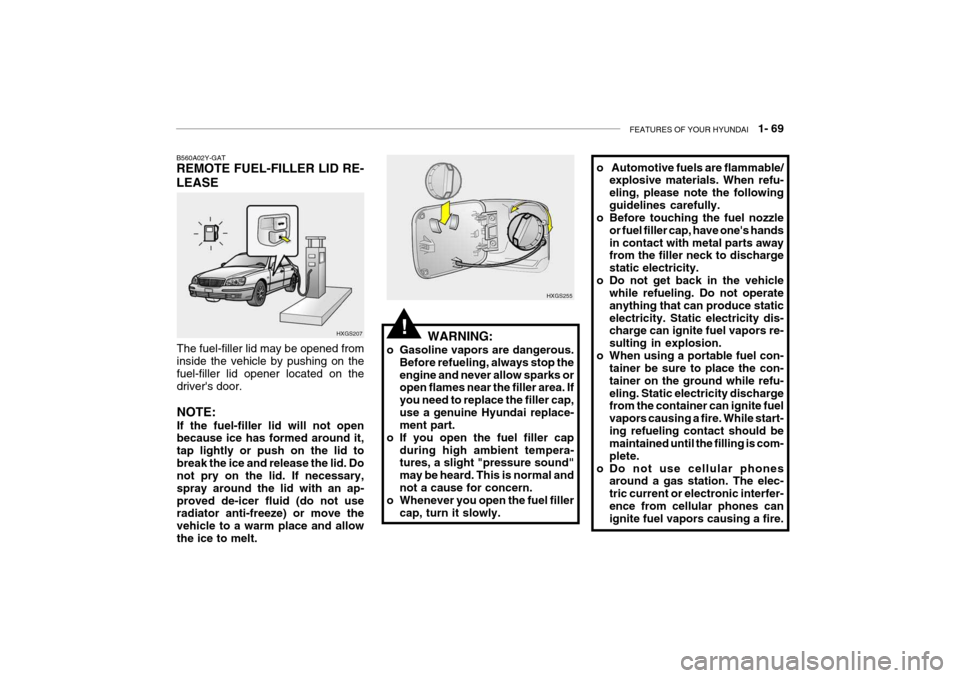
B560A02Y-GAT REMOTE FUEL-FILLER LID RE- LEASE
The fuel-filler lid may be opened from inside the vehicle by pushing on the fuel-filler lid opener located on the driver's door. NOTE: If the fuel-filler lid will not open because ice has formed around it, tap lightly or push on the lid tobreak the ice and release the lid. Do not pry on the lid. If necessary, spray around the lid with an ap-proved de-icer fluid (do not use radiator anti-freeze) or move the vehicle to a warm place and allowthe ice to melt.
!
o Automotive fuels are flammable/ explosive materials. When refu- eling, please note the followingguidelines carefully.
o Before touching the fuel nozzle
or fuel filler cap, have one's handsin contact with metal parts away from the filler neck to discharge static electricity.
o Do not get back in the vehicle while refueling. Do not operateanything that can produce staticelectricity. Static electricity dis- charge can ignite fuel vapors re- sulting in explosion.
o When using a portable fuel con- tainer be sure to place the con-tainer on the ground while refu-eling. Static electricity discharge from the container can ignite fuel vapors causing a fire. While start-ing refueling contact should be maintained until the filling is com- plete.
o Do not use cellular phones around a gas station. The elec-tric current or electronic interfer-ence from cellular phones can ignite fuel vapors causing a fire.
Page 114 of 235

FEATURES OF YOUR HYUNDAI 1- 101
B940D01L-GAT
1. FF/REW Button
o Fast forward tape winding starts
when the FF button is pressed during PLAY or REW mode.
o PLAY starts when the FF button is
pressed again during FF mode.
o Tape rewinding starts when the REW button is pressed during PLAYor FF mode.
o PLAY starts when the REW button pressed again during REW mode.
2. AUTO MUSIC SELECT Button Press the button to find the starting point of each song in a prerecorded music tape. The quiet space betweensongs (must have at least a 4 sec. gap) can be identified by the AUTO MUSIC SELECT button.
o Pressing the will play the begin- ning of the next music segment.
o Pressing the will start replay at the beginning of the music just lis- tened to.
o To stop FF or REW action, press the button again. 3. TAPE PROGRAM Button This allows you to play the reverse side of the tape by merely pressing theprogram button. An arrow will appear in the display to show tape direction.
4. EJECT button
o When the EJECT button is pressed
with a cassette loaded, the cassette will eject.
o When the EJECT button is pressed during FF/REW mode, the cassettewill eject.
5. EQ Button Press the EQ button to select the CLASSIC, JAZZ, ROCK and DEFEATMODE for the desired tone quality. Each press of the button changes the display as follows; 6. DOLBY Button If you get background noise during tape PLAY, you can reduce this consider-ably by merely pressing the DOLBY button. If you want to cancel the DOLBY feature, press the button again.
CLASSIC JAZZ ROCK DEFEAT
!
CAUTION:
o Do not insert anything like coins into the player slot as damage to the unit may occur.
o Do not place beverages close to the audio system. The playbackmechanism may be damaged if you spill them.
o Do not impact on the audio sys- tem, or the playback mechanismcould be damaged.
Page 122 of 235

FEATURES OF YOUR HYUNDAI 1- 109
B940J01L-GAT
1. FF/REW Button
o Fast forward tape winding starts
when the FF button is pressed during PLAY or REW mode.
o PLAY starts when the FF button is
pressed again during FF mode.
o Tape rewinding starts when REW button is pressed during PLAY or FFmode.
o PLAY starts when REW button pressed again during REW mode.
2. AUTO MUSIC SELECT Button Press the button to find the starting point of each song in a prerecorded music tape. The quiet space betweensongs (must have at least a 4 sec. gap) can be identified by the AUTO MUSIC SELECT button.
o Pressing the will play the begin- ning of the next music segment.
o Pressing the will start replay at the beginning of the music just lis- tened to.
o To stop FF or REW action, press the button again. 3. TAPE PROGRAM Button This allows you to play the reverse side of the tape by merely pressing theprogram button. An arrow will appear in the display to show tape direction.
4. EJECT button
o When the EJECT button is pressed
with a cassette loaded, the cassette will eject.
o When the EJECT button is pressed during FF/REW mode, the cassettewill eject.
5. EQ Button Press the EQ button to select the CLASSIC, JAZZ, ROCK and DEFEAT MODE for the desired tone quality. Each press of the button changes thedisplay as follows; 6. DOLBY Button If you get background noise during tape PLAY, you can reduce this consider-ably by merely pressing the DOLBY button. If you want to cancel the DOLBY feature, press the button again.
CLASSIC JAZZ ROCK DEFEAT
!
CAUTION:
o Do not insert anything like coins into the player slot as damage to the unit may occur.
o Do not place beverages close to
the audio system. The playback mechanism may be damaged if you spill them.
o Do not impact on the audio sys- tem, or the playback mechanismcould be damaged.
Page 138 of 235
DRIVING YOUR HYUNDAI 2- 5
C050B01A-GAT Normal Conditions: The Starting Procedure:
1. Insert key, and fasten the seat belt.
2. Depress the clutch pedal fully and
place the gearshift lever (manual transaxle) in neutral or the selector lever (automatic transaxle) in "P" (park) position.
3. After turning the ignition key to the "ON" position, make certain all warn-ing lights and gauges are function-ing properly before starting the en- gine.
WARNING:
Be sure that the clutch is fully de- pressed when starting a manualtransaxle vehicle. Otherwise, there is the potential to cause damage to the vehicle or injury to someoneinside or outside the vehicle as a result of the forward or backward movement of the vehicle that willoccur if the clutch is not depressed when the vehicle is started. 4. Turn the ignition key to the "Start"
position and release it when the engine starts.
C070A02A-AAT OPERATING THE MANUAL TRANSAXLE
HFC3029
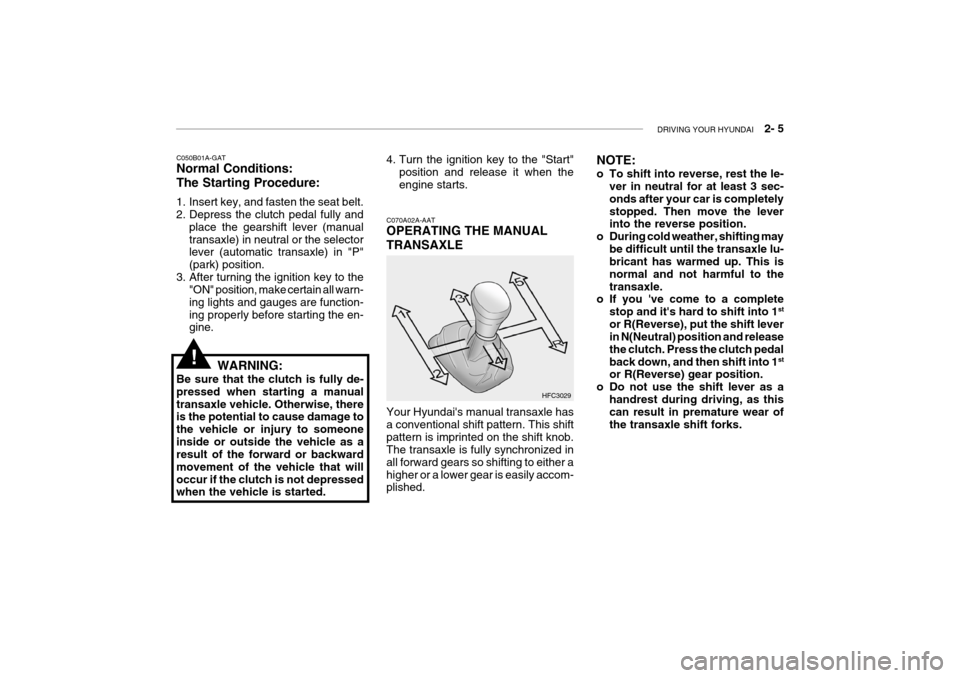
Your Hyundai's manual transaxle has a conventional shift pattern. This shiftpattern is imprinted on the shift knob. The transaxle is fully synchronized in all forward gears so shifting to either ahigher or a lower gear is easily accom- plished. NOTE:
o To shift into reverse, rest the le-
ver in neutral for at least 3 sec- onds after your car is completelystopped. Then move the lever into the reverse position.
o During cold weather, shifting may
be difficult until the transaxle lu-bricant has warmed up. This is normal and not harmful to thetransaxle.
o If you 've come to a complete
stop and it's hard to shift into 1 st
or R(Reverse), put the shift lever in N(Neutral) position and release the clutch. Press the clutch pedalback down, and then shift into 1 st
or R(Reverse) gear position.
o Do not use the shift lever as a
handrest during driving, as this can result in premature wear of the transaxle shift forks.
!
Page 141 of 235
2- 8 DRIVING YOUR HYUNDAI
C090C01A-AAT o R(Reverse): Use for backing up the vehicle. Bring the car to a complete stop before shift- ing the selector lever to "R" position. C090D02A-AAT o N (Neutral): In the "N" position, the transaxle is in neutral, which means that no gearsare engaged. The engine can be started with the shift lever in "N" position, although this is not recommended ex-cept if the engine stalls while the car is moving. C090E01L-GAT o D (Drive): Use for normal driving. This position is used for most city and highway driving, for starting from a full stop to maximumspeed. The transaxle will automati- cally shift through a four/five gear sequency, giving best economy andpower.
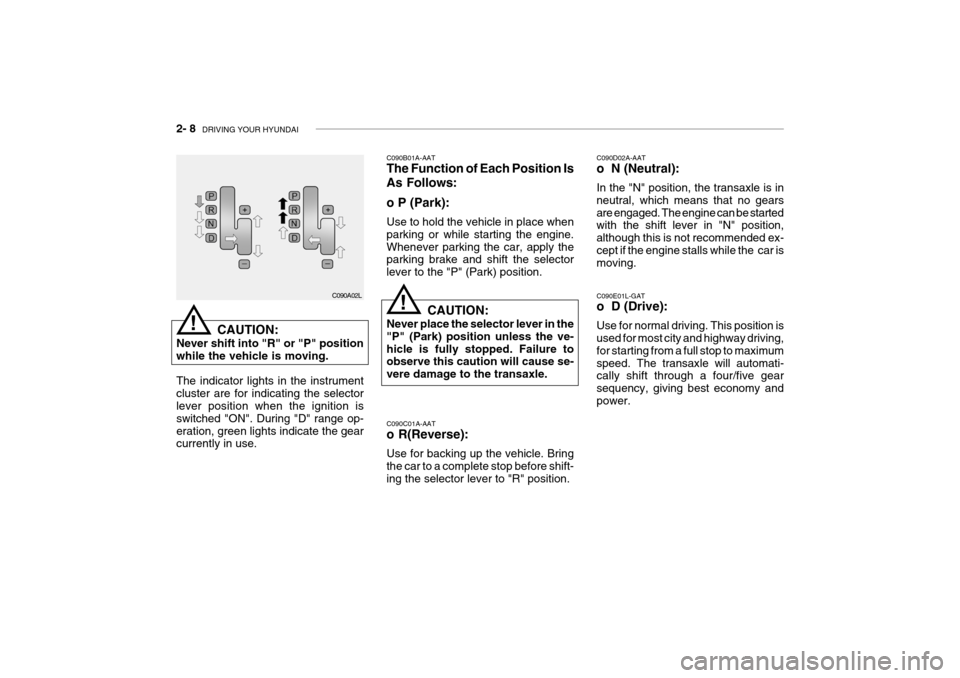
C090B01A-AAT The Function of Each Position Is As Follows: o P (Park): Use to hold the vehicle in place when parking or while starting the engine.Whenever parking the car, apply the parking brake and shift the selector lever to the "P" (Park) position.
CAUTION:
Never place the selector lever in the"P" (Park) position unless the ve-hicle is fully stopped. Failure to observe this caution will cause se- vere damage to the transaxle.
C090A02L
CAUTION:
Never shift into "R" or "P" positionwhile the vehicle is moving. The indicator lights in the instrument cluster are for indicating the selector lever position when the ignition is switched "ON". During "D" range op-eration, green lights indicate the gear currently in use.
!
!
Page 146 of 235

DRIVING YOUR HYUNDAI 2- 13
If the indicator does not go out after three seconds after the engine has been started, have your car checkedby an authorized Hyundai dealer. NOTE:
1) When the TCS indicator illumi-
nates, traction control is auto- matically deactivated for safety.
2) This warning function is not pro-
vided when in the TCS-OFF mode.
3) When the engine starts, a click is
heard from the engine compart- ment; however, this is only thesound of traction control being checked.
4) When moving out of the mud or fresh snow, pressing the accel-erator pedal may not cause the engine speed to increase due toTCS operation.
C300D02L-GAT Indicator and Warning The TCS indicator should illuminate when the ignition key is turned to ON or START but should go out after three seconds.If the indicator does not illuminate or go out after three seconds, have it checked by an authorized dealer. Should there be any unusual condi- tions in the device, TCS illuminates asa warning. If TCS illuminates, pull your car to a safe place and stop the engine.Then, start the engine again to check if the TCS indicator goes out. C130A01A-AAT GOOD BRAKING PRACTICES
WARNING:
Nothing should be carried on top of the cargo area cover behind therear seat. If there were an accident or a sudden stop, such objects could move forward and cause dam-age to the vehicle or injure the oc- cupants.
C300B01L-GAT TCS ON/OFF Mode In the TCS ON mode, the indicator in the instrument cluster will not be illumi-nated. To switch the TCS OFF mode, press the TCS switch . The SLIP control willbe deactivated and the TCS indicator in the instrument cluster will be illumi- nated. NOTE:
1) The TCS mode will automatically
be turned ON after the engine is turned off and restarted.
2) When the traction control is op-
erating properly, you can feel aslight pulsation in the vehicle. This is only the effect of brake control and indicates nothingunusual. WARNING:
Traction control is a driving aid; all normal precautions for driving in inclement weather and on slipperydriving surfaces should be ob- served.
!
!
Page 148 of 235

DRIVING YOUR HYUNDAI 2- 15
o Don't "ride" the brake or clutch pedal.
This can increase fuel consumption and also increase wear on thesecomponents. In addition, driving with your foot resting on the brake pedal may cause the brakes to overheat,which reduces their effectiveness and may lead to more serious con- sequences.
o Take care of your tires. Keep them inflated to the recommended pres-sure. Incorrect inflation, either toomuch or too little, results in unnec- essary tire wear. Check the tire pres- sures at least once a month.
o Be sure that the wheels are aligned correctly. Improper alignment canresult from hitting curbs or drivingtoo fast over irregular surfaces. Poor alignment causes faster tire wear and may also result in other prob-lems as well as greater fuel con- sumption.
o Keep your car in good condition. For better fuel economy and reducedmaintenance costs, maintain your car in accordance with the mainte-nance schedule in Section 5. If you drive your car in severe conditions, more frequent maintenance is re-quired (see Section 5 for details). o Keep your car clean. For maximum
service, your Hyundai should bekept clean and free of corrosivematerials. It is especially important that mud, dirt, ice, etc. not be al- lowed to accumulate on the under-side of the car. This extra weight can result in increased fuel con- sumption and also contribute to cor-rosion.
o Travel lightly. Don't carry unneces-
sary weight in your car. Weight re-duces fuel economy.
o Don't let the engine idle longer than
necessary. If you are waiting (andnot in traffic), turn off your engine and restart only when you're ready to go.
o Remember, your Hyundai does not require extended warm-up. As soonas the engine is running smoothly,you can drive away. In very cold weather, however, give your engine a slightly longer warm-up period.
C140A01A-AAT DRIVING FOR ECONOMY You can save fuel and get more miles from your car if you follow these sug-gestions:
o Drive smoothly. Accelerate at a
moderate rate. Don't make "jack- rabbit" starts or full-throttle shifts and maintain a steady cruisingspeed. Don't race between stop- lights. Try to adjust your speed to that of the other traffic so you don'thave to change speeds unneces- sarily. Avoid heavy traffic whenever possible. Always maintain a safedistance from other vehicles so you can avoid unnecessary braking. This also reduces brake wear.
o Drive at a moderate speed. The faster you drive, the more fuel yourcar uses. Driving at a moderatespeed, especially on the highway, is one of the most effective ways to reduce fuel consumption.
Page 155 of 235

2- 22 DRIVING YOUR HYUNDAI
NOTE: When towing, check transaxle fluid more frequently.
CAUTION:
If overheating should occur whentowing, (temperature gauge reads near red zone), taking the followingaction may reduce or eliminate the problem.
1. Turn off the air conditioner.
2. Reduce highway speed.
3. Select a lower gear when going uphill.
4. While in stop and go traffic, place
the gear selector in park or neu-tral and idle the engine at a higher speed.
!
10.During your trip, check occasion-
ally to be sure that the load is secure, and that the lights and anytrailer brakes are still working.
11.Avoid jerky starts, sudden accel-
eration or sudden stops.
12.Avoid sharp turns and rapid lane changes.
13.Avoid holding the brake pedal down too long or too frequently. This could cause the brakes to overheat, re- sulting in reduced braking efficien-cy.
14.When going down a hill, shift into a
lower gear and use the engine brak-ing effect. When ascending a long grade, downshift the transaxle to a lowergear and reduce speed to reduce chances of engine overloading and/ or overheating.
15.If you have to stop while going uphill, do not hold the vehicle inplace by pressing on the accelera-tor. This can cause the automatic transaxle to overheat. Use the park- ing brake or footbrake.