2004 Hyundai Getz warning
[x] Cancel search: warningPage 401 of 445

6- 10 DO-IT-YOURSELF MAINTENANCE
!
!
HTB170
Petrol engine SG050A1-E
ENGINE COOLANT CHECKING
AND REPLACING
SG050B1-E
Coolant recommendations WARNING:
Do not remove the radiator cap when
the engine is hot, since the system is
pressurized and coolant may be
ejected from the radiator resulting in
scalding.
3. Prepare a suitable receptacle to col-
lect the displaced oil and remove the
drain plug from the sump.
4. When the oil has drained from the sump, replace the drain plug using a
new washer ensuring that the plug is
not over tightened.
Tightening torque is: 3.5 ~ 4.5 kgf.m
5. Remove the oil filter by rotating coun- terclockwise, using a proprietary oil
filter removal tool if necessary. Note
that the oil filter will contain approxi-
mately 0.5 litres of oil and this should
be collected in a suitable receptacle.
6. Install a new oil filter having smeared the sealing ring with clean oil and
rotating clockwise until the filter con-
tacts the mounting and then a further
one half turn. Do not over-tighten CAUTION:
The oil being drained from the en-
gine will be hot. Care should be
exercised to prevent scalding.
! Tightening torque:
Petrol -
1.2 ~ 1.6 kgf.m
Diesel(RHD) - 2.3 ~ 2.5 kgf.m
7. Pour the specified quantity of the recommended oil into the engine and
replace the filler cap. Start the en-
gine and ensure that no oil leaks
exist. Turn off the engine and after a
couple minutes, recheck the oil level.
WARNING:
Prolonged and repeated contact with
used engine oils may result in seri-
ous skin disorders including derma-
titis and cancer. Avoid contact with
skin as far as possible and always
wash thoroughly after any contact.
Keep used oils out of reach of chil-
dren. It is illegal to pollute drains,
water courses and soil. Use only
authorized waste collection facili-
ties including civic amenity sites
and garages for the disposal of used
oil and oil filters. If in doubt, contact
the local authority for disposal in-
structions.
tbuk-6.p65 3/23/04, 4:26 PM
10
Page 403 of 445

6- 12 DO-IT-YOURSELF MAINTENANCE
!
HTB172
HTB171
1. Park the vehicle on level ground and
ensure that the parking brake is firmly
applied, and the engine allowed to
cool.
Do not attempt this operation whilst
the engine is hot since burning or
scalding may result.
2. Prepare a suitable receptacle to col-
lect the displaced coolant and posi-
tion this under the radiator drain tap.
3. With the heater temperature control
set to the "HOT" position, remove
the radiator cap and open the radiator
drain tap. 5. Prepare a suitable quantity of new
engine coolant (refer to section 9)
and pour this into the radiator.
6. Start the engine with the radiator cap
still removed and continue to add
coolant as the level decreases as air
is expelled from the system. When
the level remains constant, replace
the radiator cap and replenish the
coolant reservoir.
7. When the engine is hot, check to ensure that no coolant leaks are
present.
4. When the engine coolant has drained completely, close the drain tap en-
suring that this is not over tightened. WARNING:
The cooling fan is controlled by en-
gine coolant temperature and may
sometimes operate even when the
engine is not running. Use extreme
caution when working near the
blades of the cooling fan so that you
are not injured by a rotating fan
blade. As the engine coolant tem-
perature decreases, the fan will auto-
matically shut off. This is a normal
condition.
tbuk-6.p65 3/23/04, 4:26 PM
12
Page 406 of 445
DO-IT-YOURSELF MAINTENANCE 6- 15
!
SG100A1-E
MANUAL TRANSAXLE
LUBRICANT
SG090A2-E
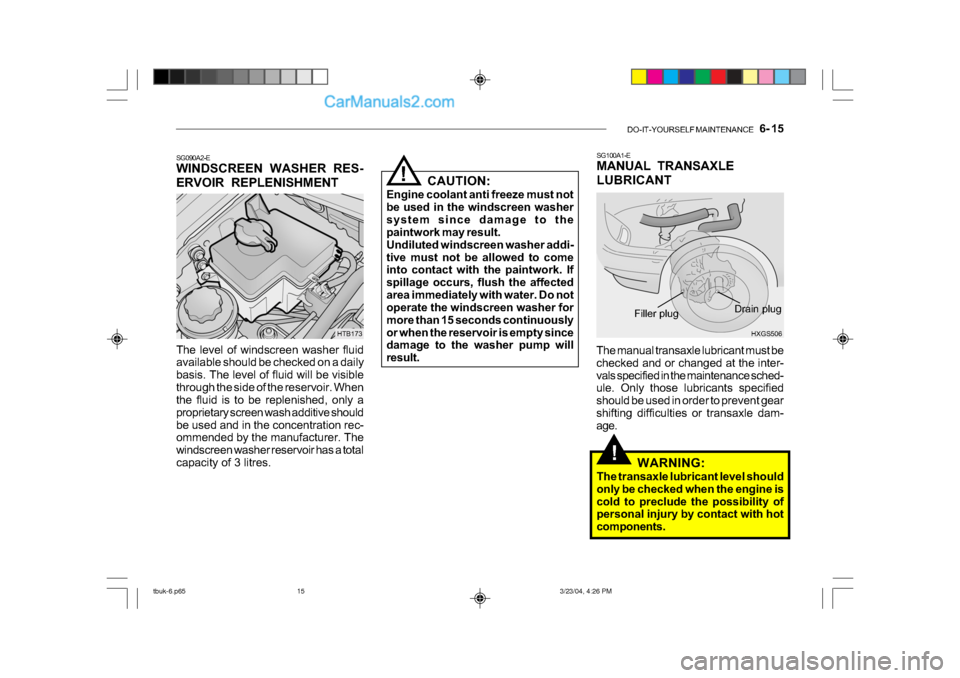
WINDSCREEN WASHER RES-
ERVOIR REPLENISHMENT
The level of windscreen washer fluid
available should be checked on a daily
basis. The level of fluid will be visible
through the side of the reservoir. When
the fluid is to be replenished, only a
proprietary screen wash additive should
be used and in the concentration rec-
ommended by the manufacturer. The
windscreen washer reservoir has a total
capacity of 3 litres. CAUTION:
Engine coolant anti freeze must not
be used in the windscreen washer
system since damage to the
paintwork may result.
Undiluted windscreen washer addi-
tive must not be allowed to come
into contact with the paintwork. If
spillage occurs, flush the affected
area immediately with water. Do not
operate the windscreen washer for
more than 15 seconds continuously
or when the reservoir is empty since
damage to the washer pump will
result.
!
HTB173
HXGS506
Drain plug
Filler plug
The manual transaxle lubricant must be
checked and or changed at the inter-
vals specified in the maintenance sched-
ule. Only those lubricants specified
should be used in order to prevent gear
shifting difficulties or transaxle dam-
age.
WARNING:
The transaxle lubricant level should
only be checked when the engine is
cold to preclude the possibility of
personal injury by contact with hot
components.
tbuk-6.p65 3/23/04, 4:26 PM
15
Page 408 of 445

DO-IT-YOURSELF MAINTENANCE 6- 17
!
!
With the engine idling and the footbrake
applied, the transaxle selector should
be moved from the "P" or "N" position
through to the "L" position and back to
the "N" or "P" position.
Open the bonnet and remove the
transaxle dipstick, remembering that
care must be exercised to prevent in-
jury occurring through contact with hot
or rotating parts of the engine.
C090A03FC
Fluid level should be within
"HOT" range
HTB164 Wipe the dipstick, replace it fully and
promptly remove it again. The fluid
level should be between the upper and
lower marks. Fluid need only be added
if the level is at or below the lower mark
and must never be increased above the
higher mark. If additional fluid is re-
quired, this should be poured into the
transmission through the dipstick tube
with the aid of a suitable funnel. WARNING:
The cooling fan is controlled by en-
gine coolant temperature and may
sometimes operate even when the
engine is not running. Use extreme
caution when working near the
blades of the cooling fan so that you
are not injured by a rotating fan
blade. As the engine coolant tem-
perature decreases, the fan will auto-
matically shut off. This is a normal
condition.
WARNING (Diesel only):
Never work on injection system with
engine running or within 30 seconds
after shutting off engine. High pres-
sure pump, rail, injectors and high
pressure pipes are subject to high
pressure even after the engine
stopped. The fuel jet produced by
fuel leaks may cause serious injury,
if it touch the body. People using
pacemakers should not move than
30cm closer to the ECU or wiring
harness within the engine room while
engine is running, since the high
tbuk-6.p65 3/23/04, 4:26 PM
17
Page 410 of 445
DO-IT-YOURSELF MAINTENANCE 6- 19
!WARNING:
Brake fluid is hygroscopic and
should never be stored in an un-
sealed container. The presence of
water in the braking system will cause
vapour locks and increase the possi-
bility of brake fade along with pro-
moting corrosion within the braking
system. The brake fluid must be
changed at the specified time or mile-
age interval to ensure continued safe
operation of the system. Brake fluid
will cause rapid and serious damage
to paintwork. If accidental spillage
occurs, the affected area must be
rinsed with water immediately. Do
not allow brake fluid to come into SG140A1-E
AIR CONDITIONING SYSTEM
MAINTENANCE
Condenser
Ensure that the condenser is periodi-
cally inspected and that accumulations
of dirt, dead insects and leaves etc, are
removed to ensure that the efficiency of
the system is not impaired. Care must
be exercised to ensure that the con-
denser fins are not damaged during
cleaning.
G140D01TB-EAT
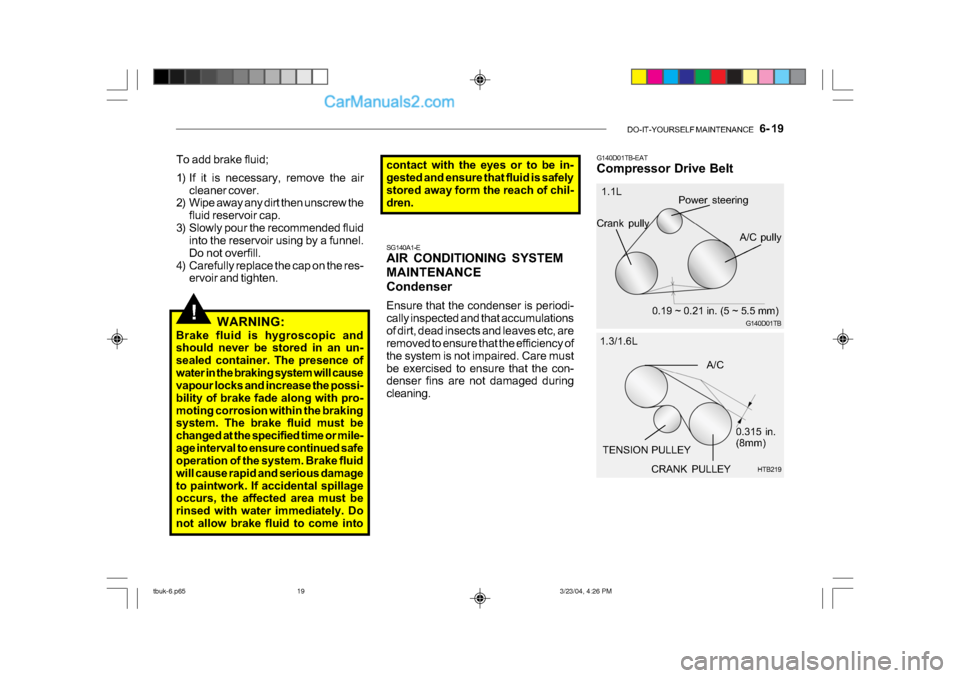
Compressor Drive BeltG140D01TB
Power steering
Crank pully
A/C pully
0.19 ~ 0.21 in. (5 ~ 5.5 mm)
1.1L
To add brake fluid;
1) If it is necessary, remove the air
cleaner cover.
2) Wipe away any dirt then unscrew the
fluid reservoir cap.
3) Slowly pour the recommended fluid into the reservoir using by a funnel.
Do not overfill.
4) Carefully replace the cap on the res- ervoir and tighten. contact with the eyes or to be in-
gested and ensure that fluid is safely
stored away form the reach of chil-
dren.
CRANK PULLEY
HTB219
A/C
TENSION PULLEY 0.315 in.
(8mm)
1.3/1.6L
tbuk-6.p65
3/23/04, 4:26 PM
19
Page 415 of 445

6- 24 DO-IT-YOURSELF MAINTENANCE
!
!
SG200A1-E
FUSIBLE LINKS
The fusible link prevents damage to the
wiring harness in the event of an elec-
trical system malfunction. Failure of a
fusiblelink is indicative of a serious
overload condition having occurred and
therefore the electrical system should
be checked by a Hyundai dealer before
a replacement link is fitted.
WARNING:
Under no circumstances should a
fusible link be replaced with any-
thing other than a new link of the
same rating. The use of higher rated
links or other means of connecting
the circuit will create a potential fire
hazard.G200B01E-EAT
INDIVIDUAL CIRCUIT FUSES
The fuse box containing the individual
circuit fuses will be found in the back-
side of multi box located in the right side
of driver. The multi box is removed by
pulling lightly and then releasing the lid.
A fuse rating grid will be found on the
reverse side of the cover. In the event
of fuse failure, the fuse should be re-
placed with one of equivalent rating. A
fuse removal tool is provided within the
fuse box to facilitate replacement.
In the event of a replacement fuse
failing shortly after installation a mal-
function within the circuit protected by
that fuse is indicated. The circuit should
be checked by a Hyundai dealer at the
first available opportunity. HTB180-D
HTB223
WARNING:
The use of replacement fuses having
a higher rating than specified or other
means of connecting the circuit will
create a potential fire hazard.
tbuk-6.p65 3/23/04, 4:27 PM
24
Page 416 of 445
DO-IT-YOURSELF MAINTENANCE 6- 25
!
!
o If battery electrolyte is spilled onto
skin or into eyes, the effected area
must be flushed with copious
amounts of water and medical assis-
tance sought.
o If battery electrolyte is ingested, copious amounts of water or milk
followed by an ant-acid (raw egg or
milk of magnesia) must be drunk.
Vomiting should not be induced and
medical assistance must be sought.
o Batteries must only be charged in well venti-lated areas from which
naked lights or sources of sparks are
excluded.
o Ensure that children, pets or other unauthorized persons are kept away
from batteries.
o Do not allow anything to bridge the positive (+) and negative (-) termi-
nals of the battery.
o Never invert the battery.
The battery fitted during production is of
the "Maintenance Free" type.
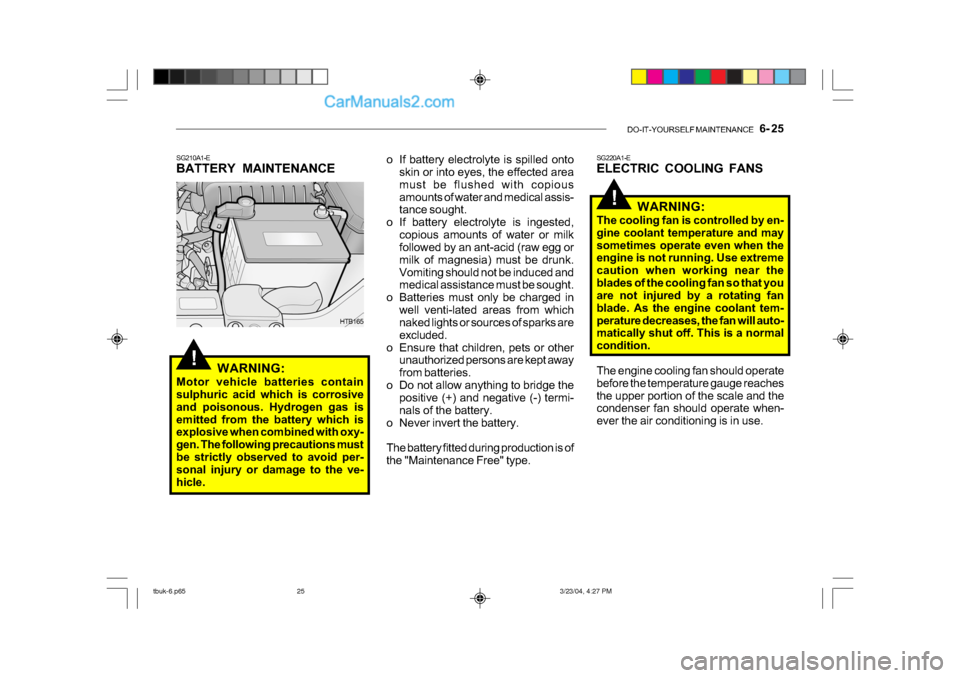
SG210A1-E
BATTERY MAINTENANCE
WARNING:
Motor vehicle batteries contain
sulphuric acid which is corrosive
and poisonous. Hydrogen gas is
emitted from the battery which is
explosive when combined with oxy-
gen. The following precautions must
be strictly observed to avoid per-
sonal injury or damage to the ve-
hicle.
HTB165 SG220A1-E
ELECTRIC COOLING FANS
WARNING:
The cooling fan is controlled by en-
gine coolant temperature and may
sometimes operate even when the
engine is not running. Use extreme
caution when working near the
blades of the cooling fan so that you
are not injured by a rotating fan
blade. As the engine coolant tem-
perature decreases, the fan will auto-
matically shut off. This is a normal
condition.
The engine cooling fan should operate
before the temperature gauge reaches
the upper portion of the scale and the
condenser fan should operate when-
ever the air conditioning is in use.
tbuk-6.p65 3/23/04, 4:27 PM
25
Page 418 of 445

DO-IT-YOURSELF MAINTENANCE 6- 27
!
5. Open the bonnet.
6. Draw the vertical line (through the
center of each headlight beam pat-
tern) and the horizontal line (through
the center of each headlight beam
pattern) on the aiming screen.
And then, draw the horizontal paral-
lel line at 1.18 in. (30 mm ) under the
horizontal line.
7. Adjust each cut-off line of the low beam to the parallel line with a phillips
screwdriver - VERTICAL AIMING.
8. Adjust each cut-off line of the low
beam to each vertical line with a
phillips screwdriver - HORIZONTAL
AIMING. HTB269
Horizontal Aiming
Vertical
Aiming
G290A01FC-EAT
HEADLIGHT AIMING ADJUST-
MENT
Before performing aiming adjustment,
make sure of the following.
1. Keep all tires inflated to the correct pressure.
2. Place the vehicle on level ground
and press the front bumper and rear
bumper down several times. Place
the vehicle at a distance of 118 in.
(3,000 mm) from the test wall.
3. See that the vehicle is unloaded (except for full levels of coolant,
engine oil and fuel, and spare tire,
jack, and tools).
4. Clean the head lights lens and turn
on the headlight (low beam). WARNING:
Be sure to carefully wipe away any
water drained out in this manner,
because the fuel mixed in the water
might be ignited and result in a fire.
1. Remove the engine cover.
2. Disconnect the air intake hose from air cleaner cover.
3. Loosen the drain plug at the bottom
of the fuel filter.
4. Tighten the drain plug when water no longer comes out.
5. Check to be sure that the warning lamp illuminates when the ignition
key is turned to "ON", and that it
goes off when the engine is started.
If in doubt, consult your nearest au-
thorized HYUNDAI dealer.
G300B01FC
tbuk-6.p65 3/23/04, 4:27 PM
27