2004 Hyundai Getz trailer
[x] Cancel search: trailerPage 183 of 445

VEHICLE MAINTENANCE REQUIREMENTS 5- 7
SEVERE DRIVING CONDITIONS
A - Repeated short distance driving
B - Extensive idling
C - Driving in dusty, rough roads
D - Driving in areas using salt or other corrosive
materials or in very cold weather
E - Driving in sandy areas F - More than 50% driving in heavy city traffic during hot weather
above 32°C (90°F)
G - Driving in mountainous areas
H - Towing a trailer
I - Driving for patrol car, taxi, commercial car or vehicle towing
J - Driving over 170 Km/h (100 MPH) R R RR
I I I I
RR R
European community Only Except European community
ENGINE OIL AND FILTER AIR CLEANER FILTER SPARK PLUGSTIMING BELT BRAKE PADS, CALIPERS AND ROTORS REAR BRAKE DRUMS/LININGS/PADS,PARKING BRAKE STEERING GEAR BOX, LINKAGE & BOOTS/LOWER ARM BALL JOINTDRIVESHAFTS AND BOOTS MANUAL TRANSAXLE OIL AUTOMATIC TRANSAXLEFLUID
AIR CONDITIONER FILTER (For Evaporator and Blower unit)
F040A06A-GAT
MAINTENANCE UNDER SEVERE USAGE CONDITIONS
The following items must be serviced more frequently on cars normally used under severe driving conditions. Refer to the chart below for the appropriate maintenance intervals. R : Replace I : Inspect and, after inspection, clean, adjust, repair or replace if necessary
MAINTENANCE ITEM
EVERY 7,500 KM OR 6 MONTHS MORE FREQUENTLY MORE FREQUENTLYEVERY 60,000 KM OR 48 MONTHS MORE FREQUENTLY MORE FREQUENTLY MORE FREQUENTLY EVERY 15,000 KM OR 12 MONTHS EVERY 100,000 KM EVERY 45,000 KMEVERY 40,000 KM MORE FREQUENTLY A, B, C, F, HC, E B, HD, E, F, G C, D, G, H C, D, G, H C, D, E, F C, D, E, F A, C, D, E, F, G, H, I, J A, C, E, F, G, H, I C, E
MAINTENANCE
INTERVALS DRIVING
CONDITION
MAINTENANCE
OPERATION
Page 246 of 445

INDEX 10- 5
P Parking Brake ........................................................... 1-67
Power Steering Fluid Level ............................. ..........6-30
Power Windows ........................................................ 1-12
R Rear Seat .................................................................. 1-15
Rear Window Defroster Switch ................................ 1-56
SSeat Front ....................................................................... 1-13
Seatback Holder ....................................................... 1-70
Seat Pocket .............................................................. 1-70
Seat Warmer ............................................................. 1-19
Seat Belts
3-Point system ....................................................... 1-22
Adjustable height .................................................... 1-22
Adjusting your seat be lt .........................................1-23
Care of seat belts .................................................. 1-21
Precautions ............................................................ 1-20
Spark Plugs ............................................................... 6-15
Spectacle Case ......................................................... 1-63
Speedometer ............................................................. 1-49
Starting ........................................................................ 2-5
Steering Wheel Freeplay .................. ........................ 6-24
Steering Wheel Tilt Lever .............. ...........................1-74
Stereo Radio Operation (K210/K220, K240, H280, HMP280)
................................................. 1-86, 1-91, 1-96, 1-105Stereo Sound System
............................................... 1-84
Sun Visor .................................................................. 1-73
Sunroof ...................................................................... 1-60
T Tachometer ............................................................... 1-49
Tail gate .................................................................... 1-69
Theft-Alarm system ..................................................... 1-9
Tires Balancing .................................................................. 8-5
Chains ...................................................................... 8-4
If you have a flat tire ............................................... 3-6
Information ............................................................... 8-3
Pressure ................................................................... 8-3
Replacement ............................................................ 8-7
Rotation .................................................................... 8-5
Snow tires ................................................................ 8-4
Spare tire ................................................................. 3-5
Traction .................................................................... 8-5
Towing
A trailer (or vehicle) ............................................... 2-18
Emergency ............................................................. 3-13
If your car must be towed .....................................3-11
Trailer or Vehicle towing ........................................... 2-18
Transaxle Automatic ................................................................. 2-9
Automatic transaxle fluid checking ........................6-19
Manual ..................................................................... 2-7
Manual transaxle Oil checking............................... 6-18
Trip Computer ........................................................... 1-51
Trip Odometer ........................................................... 1-50
Page 261 of 445

FEATURES OF YOUR HYUNDAI 1- 3
B020A01FC-EAT
RUNNING IN YOUR NEW
HYUNDAI (Petrol Engine)
The longevity and performance of the
vehicle are greatly affected by the care
exercised during the first 1,000 miles of
motoring. Because of modern manu-
facturing techniques, rigid guidelines
regarding maximum road speeds have
become unnecessary. However, cer-
tain precautions should be observed in
order to obtain the best possible perfor-
mance and useful life from the vehicle.
1) Do not race the engine without a load
(i.e revving the engine in neutral).
2) During the first 500 miles the maxi-
mum engine speed should be re-
stricted to 3,000 rpm and gradually
increased thereafter.
3) Avoid prolonged constant speed op- eration. The internal components of
the engine will become more quickly
run in if the operation speed is varied
during the running-in period.
4) Never allow the engine to labour. Use
the gearbox freely and avoid large
throttle openings when the engine
speed is below 1,500 rpm.
5) Avoid rapid acceleration and maxi- mum throttle openings.
6) Avoid harsh braking during the first
100 miles of urban motoring or 1,000
miles of motorway driving to allow
the friction facings of the brake pads
and shoes to bed against the discs
and drums properly.
7) No trailer towing should be under-
taken during the running-in period.
B020B01FC-EAT
(Diesel Engine)
The longevity and performance of the
vehicle are greatly affected by the care
exercised during the first 1,000 miles of
motoring. Because of modern manu-
facturing techniques, rigid guidelines
regarding maximum road speeds have
become unnecessary. However, cer-
tain precautions should be observed in
order to obtain the best possible perfor-
mance and useful life from the vehicle. 1) Do not race the engine without a load
(i.e revving the engine in neutral).
2) During the first 600 miles the maxi- mum engine speed should be re-
stricted to 3,000 rpm and gradually
increased thereafter. And while driv-
ing, keep under three quarters of
maximum vehicle speed.
3) Avoid prolonged constant speed op- eration. The internal components of
the engine will become more quickly
run in if the operation speed is varied
during the running in period.
4) Never allow the engine to labour. Use
the gearbox freely and avoid large
throttle openings when the engine
speed is below 1,500 rpm.
5) Avoid rapid acceleration and maxi- mum throttle openings.
6) Avoid harsh braking during the first
100 miles of urban motoring or 1,000
miles of motorway driving to allow
the friction facings of the brake pads
and shoes to bed against the discs
and drums properly.
7) No trailer towing should be under
taken during the running in period.
tbuk-1a.p65 3/23/04, 2:21 PM
3
Page 313 of 445

FEATURES OF YOUR HYUNDAI 1- 55
!
B460A01Y-AAT
SUNROOF (Not all models)
Sun Shade
Your HYUNDAI is equipped with a
sliding sunshade which you can manu-
ally adjust to let in light with the sunroof
closed, or to block sunlight.
Loading condition Switch
position
Driver only
Driver + front passenger
Full passengers
(including driver)
Full passengers
(including driver) + full trunk
loading (or light trailer loading)
Driver + full trunk loading
(or maximum trailer loading) 0
1
2
3 0
B470A01FC
WARNING:
Never adjust the sunshade while
driving.
B340G01S-EAT
HEADLIGHT LEVELING DEVICE
SYSTEM
To adjust the headlight beam level ac-
cording to the number of the passen-
gers and the loading weight in the lug-
gage area, turn the beam leveling switch.
The higher the number of the switch
position, the lower the headlight beam
level. Always keep the headlight beam
at the proper leveling position, or head-
lights may dazzle other road users.
Listed below are the examples of rec-
ommended switch settings. For loading
conditions other than those listed be-
low, adjust the switch position so that
the beam level may be the nearest as
the condition obtained according to the
list.
HTB181-D
tbuk-1a.p65
3/23/04, 2:22 PM
55
Page 344 of 445
2. DRIVING YOUR HYUNDAIBefore starting the engine .............................................................. 2-3
Key position .................................................................................... 2-4Starting ............................................................................................ 2-5
Operating the manual transaxle ..................................................... 2-8
Automatic transaxle ........................................................................ 2-9
Effective Braking ........................................................................... 2-13
Anti-Lock brake system (ABS) ...................................................... 2-13
Driving for economy ...................................................................... 2-14
Winter Driving ............................................................................... 2-15
Trailer and Caravan Towing ......................................................... 2-17
2
tbuk-2.p65 3/23/04, 4:55 PM
1
Page 356 of 445

DRIVING YOUR HYUNDAI 2- 13
SC140B1-E ANTI-LOCK BRAKE SYSTEM (Not all models) The Anti-Lock Brake System (ABS) is designed to prevent wheel lock-upduring sudden braking or on hazard-ous road surfaces. The ABS controlmodule monitors the wheel speed and controls the pressure applied to each brake. Thus, in emergency situationsor on slick roads, ABS will increasevehicle control during braking. NOTE: During ABS operation, a slight pul- sation may be felt in the brake pedal when the brakes are applied. Also, a noise may be heard in the enginecompartment whilst braking. Theseconditions are normal and indicatethat the anti-lock brake system isfunctioning properly.
located in the instrument cluster will beilluminated. When the overdrive switchis turned "ON", the transaxle functionsas a fully automatic four speed unitwith the maximum fuel economy po- tential of the vehicle being realized. SC140A1-E EFFECTIVE BRAKING Braking system performance and fric- tion material life are greatly affected by the driving style adopted. The follow-ing suggestions are made to assist inachieving the best results from thebraking system.
o Anticipate the road and conditions
ahead in order that heavy braking may be avoided.
o When descending long gradients,
use the engine to assist in retardingthe vehicle to minimize the possibil- ity of brake fade occurring.
o When trailer towing, ensure that the
trailer brakes function correctly and use engine braking to assist thevehicle braking system. o Use only genuine Hyundai replace-
ment brake pads and shoes to en-sure consistent friction characteris-tics and wear rates.
o After driving through deep water (e.g. fording), the brakes may be-come wet and performance reduced.Always check brake efficiency afteremerging from the water and dry thebrakes by lightly depressing thebrake pedal several times whilst driving slowly.
o Apply the parking brake only when the vehicle is at rest.
o Since the power assistance pro- vided by the brake servo is derived from the engine, coasting with the engine turned off or towing of the vehicle with the engine turned offwill result in greatly increased pedalpressures being required to stop thevehicle.
o Do not hold the vehicle on the up- grade with the accelerator pedal.This can cause the transmission tooverheat. Always use the brakepedal or parking brake.
tbuk-2.p65 3/23/04, 4:55 PM
13
Page 360 of 445

DRIVING YOUR HYUNDAI 2- 17
!
o The formation of snow or ice built up
inside the wheel arches may inter- fere with the road wheels or steeringmechanism. In such instances, un-usual noises or an increase in steer- ing effort may result. Therefore, ensure that the wheel arches arechecked periodically and any accu-mulated snow or ice removed.
o It is advisable to carry emergency equipment including, torch, shovel, tow rope, blankets etc., if a journey is to be undertaken into areas ofsevere road conditions.
Nose weight Total trailer weight
C190E01L C195F02TB-EAT TOWING ATTACHMENTS It is strongly recommended that only an Hyundai Approved towing attach-ment is used to ensure that the loadsplaced upon the body structure arecorrectly distributed. The use of a non approved attachment will result in the invalidation of the vehicle warranty.Hyundai towing attachments are de-signed and constructed to ensuremaximum towing performance andease of fitment. A range of accesso- ries including electrical kits are avail- able through the Hyundai dealer net-work. It is of the utmost importance that those areas of the vehicle which are subjected to greater stress during tow- ing are maintained in accordance withthe recommendations given at the endof this book. In addition, the daily oper-ating checks relating to engine oil,transmission oil and tyres must be performed at each refuelling to ensure maximum reliability and safety.
C190E02TB-EAT TRAILER AND CARAVAN TOW- ING
WARNING:
It is not recommended that the ve- hicle be used for towing until thefirst 1,000 miles of Running In hasbeen completed. All Hyundai MA- TRIX models are suited to towing trailers and caravans up to the lim-its indicated on page 2-19. Thismodels fitted with automatictransaxle have a transaxle oil coolerand further transaxle cooling should not be required.
tbuk-2.p65 3/23/04, 4:55 PM
17
Page 361 of 445
2- 18 DRIVING YOUR HYUNDAI
C190E02L
Gross Axle Weight
Gross Vehicle
Weight
The use of a proprietary stabiliser will assist in achieving an inherently stableoutfit but whilst the use of such equip-ment will improve the characteristicsof a balanced outfit, it will not compen- sate for a badly loaded and therefore unstable outfit. The tyres and braking equipment fitted to the trailer or caravan must be main-tained in accordance with the recom- mendations of the manufacturer. Spe- cial attention should be paid to tyreswhich deteriorate through time andexposure rather than as a result of thedistances towed. The inside walls ofthe tyres should be inspected along with the outside walls for cracking and damage. The trailer wheel nut torquemust be checked on a regular basis,preferably before each towing ses-sion. The trailer hitch and the safety catch mechanism must be maintained in goodworking order. The trailer break awaycable or chain should be inspected fordamage and should be attached to thevehicle towing attachment each and every time the trailer is hitched to the vehicle. Whilst towing, the performance of thevehicle will be reduced in terms ofacceleration, braking and handling dueto the increased loads placed upon thevehicle. The driver should anticipate the change in characteristics and ad- just the driving style in keeping withthese changes. Care should be exer-cised when cornering and braking toprevent the outfit becoming uncontrol-lable by reducing cornering speeds and allowing increased braking dis- tances. The driver should exercise care to ensure that when pulling away fromrest particularly on uphill gradients the clutch unit is not subjected to exces- sive slippage which will reduce theuseful life of this component. Use ofthe "Overdrive Off" "2" and "L" posi-tions when driving vehicles with auto-matic transmission will assist with brak- ing performance when long down hill gradients are encountered. Improvedacceleration performance will be avail-able by selecting "Overdrive Off","2",or "1" depending upon road speed if itis found that the transmission unit makes an undesirable upshift whilst hill climbing or overtaking. The trans- mission unit should be operated in "D"with the Overdrive "On" under normalcircumstances to enhance fueleconomy and reduce noise and en-gine wear.
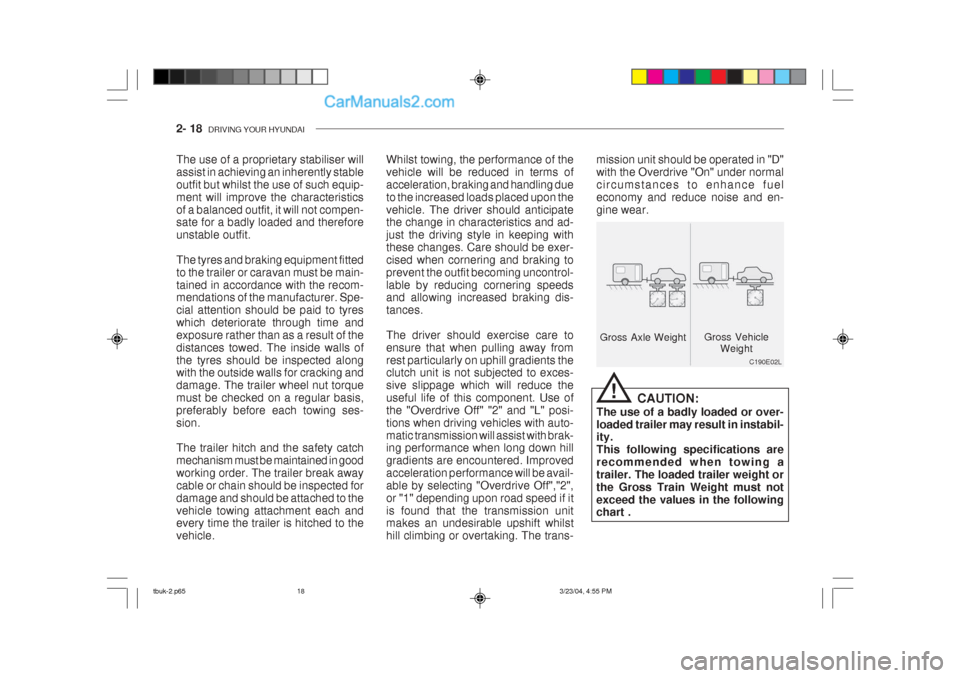
CAUTION:
The use of a badly loaded or over-loaded trailer may result in instabil- ity. This following specifications arerecommended when towing atrailer. The loaded trailer weight orthe Gross Train Weight must notexceed the values in the following chart .
!
tbuk-2.p65 3/23/04, 4:55 PM
18