2004 Hyundai Getz air
[x] Cancel search: airPage 333 of 445
FEATURES OF YOUR HYUNDAI 1- 75
B670E01A-AAT
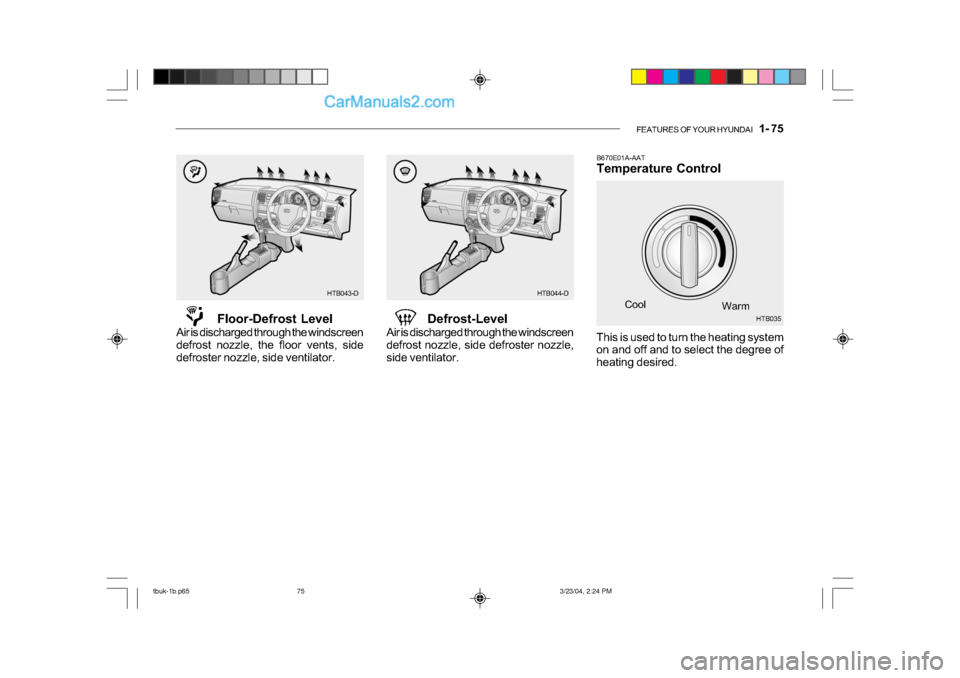
Temperature Control
Cool Warm
Floor-Defrost Level
Air is discharged through the windscreen
defrost nozzle, the floor vents, side
defroster nozzle, side ventilator. Defrost-Level
Air is discharged through the windscreen
defrost nozzle, side defroster nozzle,
side ventilator.
HTB043-D HTB044-D
This is used to turn the heating system
on and off and to select the degree of
heating desired. HTB035
tbuk-1b.p65
3/23/04, 2:24 PM
75
Page 334 of 445

1- 76 FEATURES OF YOUR HYUNDAI
B670B01A-AAT
BI-LEVEL HEATING
Your Hyundai is equipped with bi-level
heating controls. This makes it pos-
sible to have cooler air from the dash-
board vents and warmer air from the
floor outlets at the same time. To use
this feature:
o Set the air intake control to the fresh
air ( ) position.
o Set the air flow control at the bi-level ( ) position.
o Set the temperature control between "Cool" and "Warm".
B690A01A-AAT
HEATING CONTROLS
For normal heating operation, set the
air intake control to the fresh air ( )
position and the air flow control to the
floor ( ) position.
For faster heating, the air intake con-
trol should be set in the recirculate
( ) position.
If the windows fog up, set the air flow
control to the defrost ( ) position and
the air intake control to the fresh air
( ) position.
For maximum heat, move the tem-
perature control to "Warm". B720A01TB-EAT
DEFROSTING/DEFOGGING
HTB045-D
Use the heating/ventilation system to
defrost or defog the windscreen:
To remove interior fog on the
windscreen:
o Set the air intake control to the fresh air ( ) position.
o Set the air flow control to the defrost
( ) position.
o For more rapid action, turn on the air conditioning.
o Set the temperature control to the
desired position.
o Set the fan speed control between
"1" and "4" position.
tbuk-1b.p65 3/23/04, 2:24 PM
76
Page 335 of 445

FEATURES OF YOUR HYUNDAI 1- 77
B740A01A-AAT
AIR CONDITIONING SWITCH
(Not all models)
B730A01FC-EAT
Operation Tips
o To keep dust or unpleasant fumes
from entering the car through the
ventilation system, temporarily set
the air intake control at "Recircula-
tion". Be sure to return the control to
"Fresh" when the irritation has
passed to keep fresh air in the ve-
hicle. This will help keep the driver
alert and comfortable.
o Air for the heating/cooling system is
drawn in through the grilles just
ahead of the windscreen. Care should
be taken that these are not blocked
by leaves, snow, ice or other ob-
structions.
o To prevent interior fog on the
windscreen, set the air intake control
to the fresh air ( ) position and
fan speed to the desired position.
To remove the frost or exterior
fog on the windscreen:
o Set the air intake control to the fresh
( ) position.
o Set the air flow control to the defrost ( ) position
o Set the temperature control to warm.
o Set the fan speed control to position
"3" or "4".
NOTE:
When the A/C is operated continu-
ously on the floor-defrost level ( )
or defrost level ( ), it may cause
fog to form on the exterior
windscreen. If this occurs, set the air
flow control to the face level posi-
tion ( ) and fan speed control to
the low position. The air conditioning is turned on by
pushing the A/C button on the heating/
air conditioning control panel.
HTB037-D
tbuk-1b.p65
3/23/04, 2:24 PM
77
Page 336 of 445

1- 78 FEATURES OF YOUR HYUNDAI
B740B02A-AAT
AIR CONDITIONING OPERA-
TION (Cooling)
B740C01A-AAT
De-Humidified Heating
To use the air conditioning to cool the
interior:
o Turn on the fan control switch (2).
o Turn on the air conditioning switch(4) by pushing in on the switch.
The air conditioning indicator light
should come on at the same time.
o Set the air intake control to the
position (5).
o Set the temperature control (1) to "Cool". ("Cool" provides maximum
cooling. The temperature may be
moderated by moving the control
toward "Warm".) HTB046-D
o Adjust the fan control (2) to the
desired speed. For greater cooling,
turn the fan control to one of the
higher speeds or temporarily select
the position on the air intake
control. For dehumidified heating:
o Turn on the fan control switch (2).
o Turn on the air conditioning switch
(4). The air conditioning indicator
light should come on at the same
time.
o Set the air intake control (5) to the fresh air ( ) position.
o Set the air flow control (3) to the face ( ) position.
o Adjust the fan control (2) to the
desired speed.
o For more rapid action, set the fan at one of the higher speeds.
o Adjust the temperature control (1)
to provide the desired amount of
warmth.
(1)
(2)
(3)
(4) (5)
HTB046-D
(1)
(2)
(3)
(4) (5)
tbuk-1b.p65 3/23/04, 2:24 PM
78
Page 337 of 445
FEATURES OF YOUR HYUNDAI 1- 79
!
B760A01Y
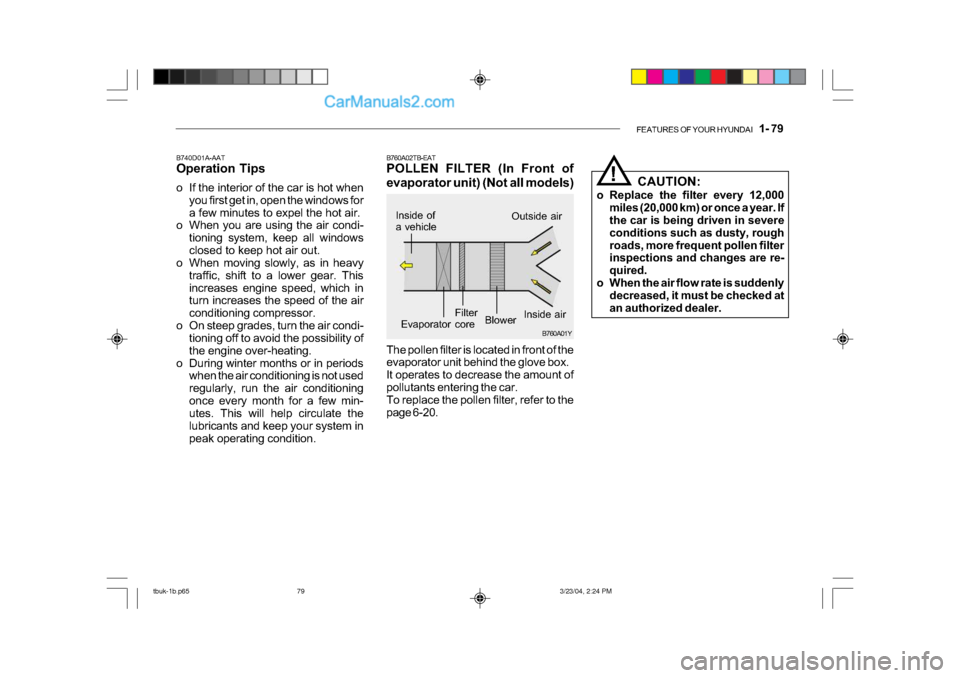
The pollen filter is located in front of the
evaporator unit behind the glove box.
It operates to decrease the amount of
pollutants entering the car.
To replace the pollen filter, refer to the
page 6-20.
B760A02TB-EAT
POLLEN FILTER (In Front of
evaporator unit) (Not all models)
B740D01A-AAT
Operation Tips
o If the interior of the car is hot when
you first get in, open the windows for
a few minutes to expel the hot air.
o When you are using the air condi-
tioning system, keep all windows
closed to keep hot air out.
o When moving slowly, as in heavy
traffic, shift to a lower gear. This
increases engine speed, which in
turn increases the speed of the air
conditioning compressor.
o On steep grades, turn the air condi- tioning off to avoid the possibility of
the engine over-heating.
o During winter months or in periods when the air conditioning is not used
regularly, run the air conditioning
once every month for a few min-
utes. This will help circulate the
lubricants and keep your system in
peak operating condition. Inside of
a vehicle
Evaporator core
Filter
BlowerOutside air
Inside air CAUTION:
o Replace the filter every 12,000 miles (20,000 km) or once a year. If
the car is being driven in severe
conditions such as dusty, rough
roads, more frequent pollen filter
inspections and changes are re-
quired.
o When the air flow rate is suddenly decreased, it must be checked at
an authorized dealer.
tbuk-1b.p65 3/23/04, 2:24 PM
79
Page 345 of 445

2- 2 DRIVING YOUR HYUNDAI
!
SC020A1-E
WARNING: ENGINE EXHAUST CAN BE DANGEROUS!
Engine exhaust gases are potentially lethal. If at any time engine exhaust gas is detected within the passenger compartment, move the vehicle to an open area and open all windows. o Never inhale exhaust gas. Exhaust gases contain Carbon Monoxide which is colourless and odourless. Carbon Monoxide is poisonous and can cause unconsciousness and death by asphyxiation. o Exhaust System Maintenance. Ensure that the exhaust system is maintained in good condition and is free from excessive corrosion and damage which may result in leakage. If the vehicle is driven over an object which strikes the exhaust system,ensure that the exhaust system is inspected at the first available opportunity to ensure that no leakage exists. o Confined Areas. Do not run the engine in confined spaces, allowing the engine to idle in a garage, even when the doors are open is dangerous practice. Only start the engine immediately prior to moving the vehicle out of the garage. o Prolonged Idling. If it is necessary to allow the vehicle to idle for prolonged periods, ensure that the heating system air intake control is set to the "Fresh" position, the blower is set to high speed operation and that the vehicle is standing in an open area. o Load Carrying. If it is necessary to carry long objects which do not permit the boot lid to be fully closed, the side windows must remain closed and the heating air intake control set to the "Fresh" position with the blower running at the highest speed setting. To ensure correct operation of the heater system, the air intake grilles at the base of the windscreen must not be obstructed by snow leaves etc..
tbuk-2.p65 3/23/04, 4:55 PM
2
Page 351 of 445

2- 8 DRIVING YOUR HYUNDAI
HTB206 CAUTION:
o Do not attempt to engage reverse gear when the car is in motion.
o To avoid damaging the selector mechanism, do not use the gear shift lever as a hand rest. Releasethe lever immediately the shift iscompleted.
o To avoid premature clutch wear,
do not use the clutch pedal as afoot rest, and do not hold thevehicle on a gradient using theclutch.
o Ensure that the engine is not over-revved by upshifting beforethe tachometer needle enters thered zone.
o Do not coast with the shift lever at the neutral position.
o When descending long gradi- ents, make use of the engine brak-ing to assist the footbrake toavoid brake fade or over-heating.
o When slippery conditions are en- countered, increased cautionshould be exercised when gear changing, braking or accelerat-
SC090A03-EMANUAL TRANSAXLE The five speed fully synchronized transaxle is controlled by a floor mounted shift lever upon which theshift pattern is indicated. It is importantthat when changing gear, the clutchpedal is fully depressed to avoidtransaxle damage. ing. Abrupt changes in speedmay cause a loss of traction orcontrol of the vehicle.
o During cold weather, shifting may be difficult until the transaxle lu-bricant has warmed up. This isnormal and not harmful to thetransaxle.
o If you 've come to a complete
stop and it's hard to shift into 1st or R(Reverse), put the shift lever in N(Neutral) position and releasethe clutch. Press the clutch pedalback down, and then shift into1st or R(Reverse) gear position.
o Do not use the shift lever as a handrest during driving, as thiscan result in premature wear ofthe transaxle shift forks.
o Always ensure that the periodic
maintenance services are performedby a Hyundai dealer at the time and/or mileage intervals specified.
o Use the air conditioning only when necessary.
!
tbuk-2.p65 3/23/04, 4:55 PM
8
Page 358 of 445

DRIVING YOUR HYUNDAI 2- 15
o Keep your car in good condition. For
better fuel economy and reduced maintenance costs, maintain yourcar in accordance with the mainte-nance schedule in Section 5. If you drive your car in severe conditions, more frequent maintenance is re-quired (see Section 5 for details).
o Keep your car clean. For maximum service, your car should be keptclean and free of corrosive materi- als. It is especially important that mud, dirt, ice, etc. not be allowed toaccumulate on the underside of thecar. This extra weight can result inincreased fuel consumption and alsocontribute to corrosion.
o Travel lightly. Don't carry unneces-
sary weight in your car. Weight is anenemy of good fuel economy.
o Don't let the engine idle longer than necessary. If you are waiting (andnot in traffic), turn off your engine and restart only when you're ready to go.
o Remember, your car does not re-
quire extended warm-up. As soonas the engine is running smoothly,you can drive away. In very cold weather, however, give your engine a slightly longer warm-up period. o Don't "lug" or "over-rev" the engine.
Lugging is driving too slowly in toohigh a gear resulting in the enginebucking. If this happens to you, shiftto a lower gear. Over-revving is racing the engine beyond its safe limit. This can beavoided by shifting at the recom-mended speeds.
o Use your air conditioning sparingly.
The air conditioning system is oper- ated by the engine power so your fuel economy is reduced when youuse it.
SC160A1-F SMOOTH CORNERING Avoid braking or gear changing in cor- ners, especially when roads are wet.Ideally, corners should always be takenunder gentle acceleration. If you followthese suggestions, tyre wear will beheld to a minimum. SC170A1-E WINTER MOTORING The onset of winter conditions subject motor vehicles to greater operatingdemands. Therefore, the followingsuggestions will assist in maintainingpeak performance and reliability dur- ing these periods: ZC170B1-E Electrical System Winter conditions impose severe de- mands upon vehicle electrical systems, particularly the charging circuit. The battery condition and performancealong with the alternator performanceand drive belt condition should bechecked prior to the onset of winter.
tbuk-2.p65
3/23/04, 4:55 PM
15