2004 Hyundai Getz ignition
[x] Cancel search: ignitionPage 350 of 445

DRIVING YOUR HYUNDAI 2- 7
!
!
C055B01B-GAT STARTING AND STOPPING THE ENGINE FOR TURBO CHARGER INTERCOOLER (DIESEL EN-GINE)
(1) Do not race the engine or sudden
accelerate the engine immediately after start it. If the engine is cold,allow the engine to idle for severalseconds before it is driven to en-sure sufficient lubrication of the turbo charger unit.
(2) After high speed or extended driv- ing, requiring a heavy engine load, the engine should be allowed to idleabout 1 minute before turning it off.This idle time will allow the turbo charger to cool prior to shutting the engine off.
WARNING:
Do not turn the engine off immedi-ately after it has been subjected to a heavy load. Doing so may cause severe damage to the engine orturbo charger unit.
WARNING:
Be sure that the clutch is fully de-pressed when starting a manualtransaxle vehicle. Otherwise thereis the potential to cause damage tothe vehicle or injury to someone inside or outside the vehicle as a result of the forward or backwardmovement of the vehicle that willoccur if the clutch is not depressedwhen the vehicle is started. SC060B1-E FUEL ECONOMY The following suggestions are made to assist in achieving the greatest degreeof fuel economy.
o Maintaining a constant check on
fuel consumption will enable the most economical use pattern anddriving style to be adopted.
o Avoid using the vehicle for very short journeys if possible, particu-larly when a cold start is involved.
o Ensure that tyre pressures are main-
tained at the correct level.
o Use only the recommended grade
of fuel.
o Avoid carrying unnecessary weight,
and if a roof rack is in use, remove it as soon as possible after use.
o Anticipate the road and conditions ahead to enable adjustments in speed to be made smoothly. Avoidheavy acceleration and sharp brak-ing.
o Avoid cruising at unnecessary high
speeds.
5. Turn the ignition key to the "Start"
position and release it when theengine starts.
tbuk-2.p65 3/23/04, 4:55 PM
7
Page 354 of 445

DRIVING YOUR HYUNDAI 2- 11
C090H01A-EAT NOTE:
o The brake pedal should be de-
pressed when shifting from NEU- TRAL to a forward or reversegear.
o The brake pedal fully depressed
in order to move the shift lever from the "P" (Park) position to any of the other positions.
o It is always possible to shift from "R", "N", "D", "2", "L" position.
!
C090I02A-EAT
CAUTION:
o Shift into "R" and "P" only when the vehicle has completely stopped.
o Do not accelerate the engine in reverse or any of the forward positions with the brakes applied.
o Always apply the footbrake when shifting from "P" or "N", to "R", "D", "2" or "L" position.
o Do not use the "P" (Park) posi- tion in place of the parking brake. Always set the parking brake,shift the transaxle into "P" (Park)and turn off the ignition when you leave the vehicle, even mo- mentarily. Never leave the vehicleunattended whilst the engine isrunning.
o Check the automatic transaxle fluid level regularly, and add fluid as necessary. See the maintenance schedulefor the proper fluid recommen-dation. FC120D1-E General Operating Instructions
o The button in the selector handle
must be depressed before the se- lector can be moved.
o The engine may only be started
when the selector is at position "P" or "N".
o Ensure that the footbrake is firmly applied when shifting from "P" or "N" to "D", "2", "L" or "R" and viceversa.
o Always engage the parking brake when the vehicle is unattended,never use the "P" position in place ofthe parking brake.
o Under normal circumstances, the selector should be placed in the "D"position and the transaxle allowed to select the most ideal ratio for the circumstances. In this position maxi-mum fuel economy will be achieved.
o When descending steep gradients where engine braking is required,the selector should be placed at the "2" or "L" position depending upon the vehicle speed.
tbuk-2.p65 3/23/04, 4:55 PM
11
Page 365 of 445

3- 2 WHAT TO DO IN AN EMERGENCY
HTB165
SD020B1-E
IF THE ENGINE CANNOT BE
CRANKED
1. If the vehicle is fitted with manual
transaxle, ensure that the clutch
pedal is depressed whilst cranking
the engine. If the vehicle is fitted
with automatic transaxle, ensure
that the transaxle selector is at the
"P" or"N" position.
2. Check the battery terminals and
connections to ensure that these
are clean and also tight.
3. If the ignition warning lights dim
when the engine is cranked and the
battery terminals have been
checked, a discharged battery is
indicated. SD020C1-F
If Engine Turns Over Normally
but Does Not Start
SD020A1-E
IF THE ENGINE WILL NOT START
Seek assistance from the nearest
Hyundai dealer with regard to the
method of ignition and fuel system
diagnosis.
!
HTB221
CAUTION:
If the engine refuses to start, no
attempt should be made to push or
tow start the vehicle. Vehicles with
automatic transaxle or fuel injec-
tion will not be able to be started in
this manner since no drive is trans-
mitted through the automatic
transaxle whilst the engine is not
running, and in the case of fuel
injected derivatives, the fuel pump
will not operate under tow start
conditions. In addition, if the ve-
hicle is equipped with an exhaust
catalyst, damage to the catalyst may
result if the vehicle is tow started. 4. Do not attempt to push or tow start
the vehicle, refer to "Jump Starting"
for information regarding engine
starting when the battery is dis-
charged.
1. Check fuel Level
2. Check all connectors at ignition coil and spark plugs.
Replace any that may be discon-
nected or loose.
3. Check fuel line in the engine com- partment.
4. If engine still refuses to start, call a
Hyundai dealer or seek other quali-
fied assistance.
tbuk-3.p65 3/23/04, 4:24 PM
2
Page 375 of 445
3- 12 WHAT TO DO IN AN EMERGENCY
!
CAUTION:
The following restriction must be
observed in order to avoid serious
damage to the transaxle .
The vehicle must never be towed
from the rear with the front wheels
on the ground.
The vehicle must not be towed until
transaxle fluid has been added to
bring the level up to the "HOT"
marking on the dipstick. (The level
will need to be reduced again after
towing).
The vehicle must not be towed at
speeds faster than 25 mph. or dis-
tances greater than fifty miles. The
general points regarding the steer-
ing lock etc. described in the pre-
ceding section (Manual transaxle
vehicle) should be observed.
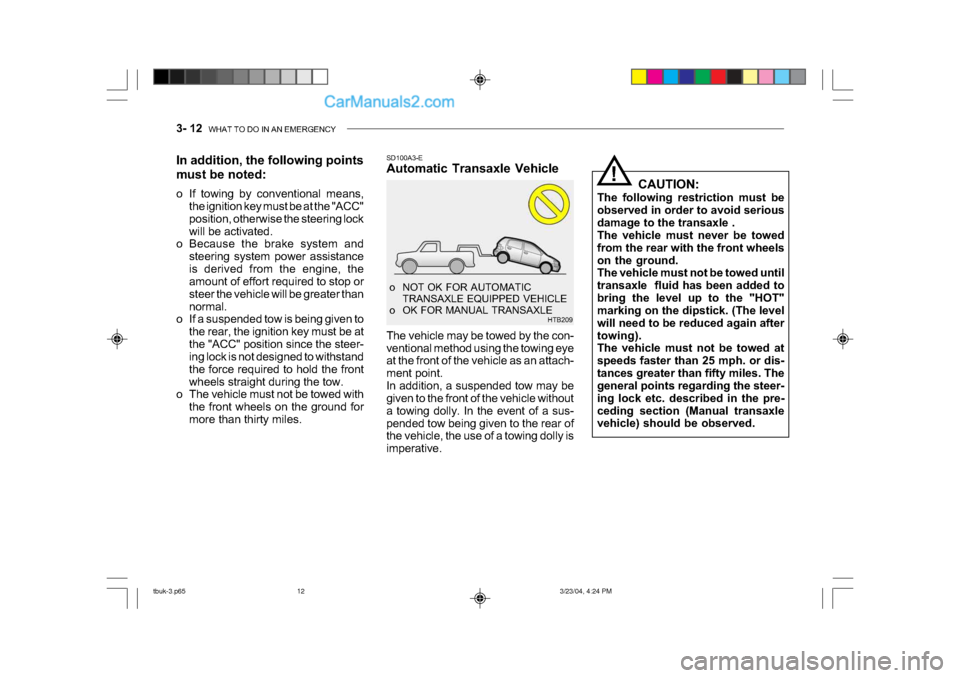
SD100A3-E
Automatic Transaxle Vehicle
The vehicle may be towed by the con-
ventional method using the towing eye
at the front of the vehicle as an attach-
ment point.
In addition, a suspended tow may be
given to the front of the vehicle without
a towing dolly. In the event of a sus-
pended tow being given to the rear of
the vehicle, the use of a towing dolly is
imperative.
o NOT OK FOR AUTOMATIC
TRANSAXLE EQUIPPED VEHICLE
o OK FOR MANUAL TRANSAXLE HTB209
In addition, the following points
must be noted:
o If towing by conventional means,
the ignition key must be at the "ACC"
position, otherwise the steering lock
will be activated.
o Because the brake system and
steering system power assistance
is derived from the engine, the
amount of effort required to stop or
steer the vehicle will be greater than
normal.
o If a suspended tow is being given to
the rear, the ignition key must be at
the "ACC" position since the steer-
ing lock is not designed to withstand
the force required to hold the front
wheels straight during the tow.
o The vehicle must not be towed with
the front wheels on the ground for
more than thirty miles.
tbuk-3.p65 3/23/04, 4:24 PM
12
Page 418 of 445

DO-IT-YOURSELF MAINTENANCE 6- 27
!
5. Open the bonnet.
6. Draw the vertical line (through the
center of each headlight beam pat-
tern) and the horizontal line (through
the center of each headlight beam
pattern) on the aiming screen.
And then, draw the horizontal paral-
lel line at 1.18 in. (30 mm ) under the
horizontal line.
7. Adjust each cut-off line of the low beam to the parallel line with a phillips
screwdriver - VERTICAL AIMING.
8. Adjust each cut-off line of the low
beam to each vertical line with a
phillips screwdriver - HORIZONTAL
AIMING. HTB269
Horizontal Aiming
Vertical
Aiming
G290A01FC-EAT
HEADLIGHT AIMING ADJUST-
MENT
Before performing aiming adjustment,
make sure of the following.
1. Keep all tires inflated to the correct pressure.
2. Place the vehicle on level ground
and press the front bumper and rear
bumper down several times. Place
the vehicle at a distance of 118 in.
(3,000 mm) from the test wall.
3. See that the vehicle is unloaded (except for full levels of coolant,
engine oil and fuel, and spare tire,
jack, and tools).
4. Clean the head lights lens and turn
on the headlight (low beam). WARNING:
Be sure to carefully wipe away any
water drained out in this manner,
because the fuel mixed in the water
might be ignited and result in a fire.
1. Remove the engine cover.
2. Disconnect the air intake hose from air cleaner cover.
3. Loosen the drain plug at the bottom
of the fuel filter.
4. Tighten the drain plug when water no longer comes out.
5. Check to be sure that the warning lamp illuminates when the ignition
key is turned to "ON", and that it
goes off when the engine is started.
If in doubt, consult your nearest au-
thorized HYUNDAI dealer.
G300B01FC
tbuk-6.p65 3/23/04, 4:27 PM
27
Page 425 of 445

6- 34 DO-IT-YOURSELF MAINTENANCE
G200C01TB-GAT
FUSE PANEL DESCRIPTION
Engine Compartment
HTB261-EPROTECTED COMPONENTS
Ignition Switch
Ignition Switch, Start Relay
Fuel pump, Alternator, ECM
Auto Fuel Cut Switch
Radiator Fan
Headlight, Defogger Relay
ABS
ECM
A/CON, Fuel Pump
Injector
A/Conditioner
Horn
ABS
ABS
Blower, Blower Motor
Power Window
Electronic power steering
Alternator
Spare Fuse
Spare Fuse
Spare Fuse
FUSE RATING
30A
30A
30A
20A
30A
50A
10A
10A
10A
15A
10A
10A
20A
40A
30A
30A
50A
15A
10A
10A
DESCRIPTION
IGN 2
IGN 1ECU
F/PUMP RAD
BATT ABS
ECU
SNSR INJ
A/CON HORN ABS1
ABS2 BLW
P/WDW EPS
BATT( ) SPARE
SPARE
SPARE
NOTE:
Not all fuse panel descriptions in this manual may be applicable to your vehicle. It is accurate at the time of printing.
When you inspect the fuse box on your vehicle, refe r to the fuse box label.
1.1L
1.3/1.6L100A
120A
tbuk-6.p65
3/23/04, 4:27 PM
34
Page 426 of 445

DO-IT-YOURSELF MAINTENANCE 6- 35
G200E01TB-GAT
Inner Panel
HTB260-DFUSE RATING10A
10A
10A
10A
10A
10A
10A
15A
10A
10A
20A
15A
10A
20A
10A
15A
15A
15A
20A
10A
10A
10A
30A
15A
10A
15A
15APROTECTED COMPONENTS
Air conditioner
Stop/Tail Light (LH)
A/Bag Indicator
Audio, Electronic Outside Mirror
Turn signal Light, Back-up Light
Stop/Tail Light (RH)
Cluster
Cigarette Lighter
PCM, ABS control
Air Bag
Door Lock System, Sunroof
Rear Wiper Motor
Start Relay, 9oTheft alarm system
Seat Warmer
Rear window Defroster
ECM
Stop Light, Power Window
Hazard Warning Light, ETACM
Front Wiper Motor
Rear Fog Light
Fog light, ETACM, Power Window, Headlight leveling Device
Blower, Sunroof
Rear window Defroster
Headlight (RH)
Front Fog Light
High Beam Light Indicator, Headlight (LH)
Room Lamp, Audio, Cluster
DESCRIPTION
A/C SW
TAIL LH
A/BAG IND
AUDIO
T/SIG
TAIL RH
CLUSTER C/LIGHT ECU 1
A/BAG
D/LOCK
RR/WPR STARTS/HTD
HTD MIR ECU2
STOP
HAZARD
FRT WPR R/FOG
IGNITION BLOWER PR/HTD
H/LP RH F/FOG
H/LP LH
POWER CONN & R/LP
tbuk-6.p65 3/23/04, 4:27 PM
35
Page 429 of 445

EMISSION CONTROL SYSTEMS 7- 3
H020A01TB-EAT
CATALYTIC CONVERTOR OP- ERATION PRECAUTIONS ; For a Petrol engine
Hyundai Getz models are fitted with
catalytic convertors which require special operating considerations. Thecatalytic convertor serves to oxidize certain noxious elements of the ex- haust gases leaving the engine toreduce the level of pollutants emitted from the vehicle and, provided that care is exercised to prevent damage,the catalyst will operate efficiently for the life of the vehicle.
It is of the utmost importance that the
following information is read and un-derstood by the vehicle operator in
HTB178Catalytic Converter order to prevent operational problems arising from damage to the catalyst.
Damage to the catalyst will result if
contamination occurs through the use of leaded fuel. Whilst the vehicle isfitted with a reduced diameter filler neck to prevent charging of the fuel tank with a leaded fuel pump nozzle,it is possible that the use of funnels or jerry cans will permit leaded fuel to be introduced into the fuel tank.
The catalyst is intolerant of unburnt
fuel and therefore if an engine misfirecondition exists, damage to the cata-lyst will occur. It is imperative that if a misfire condition develops, the ve- hicle is immediately presented to aHyundai dealer for rectification. Simi- larly, the practice of certain ignition system diagnosis procedures whichinvolve inducing a misfire (cylinder power balance tests for example) may result in catalyst damage.
For these reasons, it is advisable that
the exhaust gas emission be testedat each routine service with a gas analyzer having a Hydrocarbon mea- suring facility to ensure continuedreliability of the catalyst. Push or tow starting of the vehicle is to be avoided since unburnt fuel may be enter the catalyst and result indamage. (Note, it is impossible to push or tow start a Hyundai model equipped with fuel injection since thefuel pump safety interlock will prevent the pump from operating under these conditions).Operation of the catalyst involvesextremely high temperatures beingattained within the catalytic conver- tor, and although the convertor is fitted with heat shields, it is importantthat the vehicle is not parked over combustible or volatile material which may result in fire. If the above precautions are not ad- hered to and the catalyst becomes inoperative, the resultant increase incore temperature will result in a "melt down" where the catalyst core will melt and subsequently may block theexhaust system.Due to the fragile nature of the cata-lyst element, it is important that dam- age does not occur when the vehicle is raised by means of a garage jack.Care must also be exercised to avoid driving over road hazards or debris which may cause damage to the cata-lyst element.
tbuk-7.p65
7/3/2008, 4:10 PM
3