2004 Hyundai Coupe fuel
[x] Cancel search: fuelPage 126 of 389

VEHICLE MAINTENANCE REQUIREMENTS 5-1
F010C01A-GAT
Specified Scheduled Procedures
These are the procedures such as inspections,
adjustments and replacements that are listed in the maintenance charts starting on page 5-2.These procedures must be performed at theintervals shown in the maintenance schedule toassure that your warranty remains in effect.Although it is strongly recommended that theybe performed by the factory-trained or distribu-tor-trained technicians at your Hyundai dealer,these procedures may be performed at anyqualified service facility.
It is suggested that genuine Hyundai service
parts be used for any required repairs or re-placements. Other parts of equivalent qualitysuch as engine oil, engine coolant, manual orauto transaxle oil, brake fluid and so on which
are not supplied by Hyundai Motor Company or
its distributor may be used without affectingyour warranty coverage but you should alwaysbe sure these are equivalent to the quality of theoriginal Hyundai parts. Your Service Passportprovides further information about your warran-ty coverage.
5. VEHICLE
MAINTENANCE REQUIREMENTS F010E01A-AAT
Do-It-Yourself Maintenance If you are mechanically inclined, own a few tools that are required and want to take the time to do so, you can inspect and service a number of items. For more information about doing it your-self, see Section 6.
F010D01A-AAT
General Checks These are the regular checks you should per-
form when you drive your Hyundai or you fill the fuel tank. A list of these items will be found onpage 6-4.
F010A01A-GAT
MAINTENANCE INTERVALS Service Requirements To assure that you receive the greatest number
of kilometers of satisfying operation from your Hyundai, certain maintenance procedures mustbe performed. Although careful design and en-gineering have reduced these to a minimum,those that are required are of the utmost impor-tance.
It is your responsibility to have these mainte-
nance procedures performed to comply with theterms of the warranties covering your newHyundai. The Service Passport supplied withyour new vehicle provides further informationabout these warranties.
F010B01A-AAT
Maintenance Requirements The maintenance required for your Hyundai can be divided into three main areas: o Specified scheduled procedures o General checkso Do-it-yourself maintenance F010F01A-AAT
A Few Tips
o Whenever you have your Hyundai serviced, keep copies of the service records in your glovebox. This will help ensure that you candocument that the required procedures havebeen performed to keep your warranties ineffect. This is especially important when service is not performed by an authorized Hyundai dealer.
o If you choose to do your own maintenance and repairs, you may find it helpful to havean official Hyundai Shop Manual. A copy of this publication may be purchased at your Hyundai dealer's parts department.
F020A02A-GAT
SCHEDULED MAINTENANCE RE- QUIREMENTS Inspection should be performed any time a
malfunction is experienced or suspected. Re- ceipts for all emission control system servicesshould be retained to demonstrate compliance with conditions of the emissions system war- ranty.
For severe usage maintenance requirements,
see page 5-4 of this section.
5
Page 127 of 389

VEHICLE MAINTENANCE REQUIREMENTS
5- 2 1 2 3 4 5 6 7 8 9
10 ENGINE CONTROL SYSTEM MAINTENANCE ENGINE OIL & FILTER (SG OR ABOVE) See Note (1) DRIVE BELT FUEL FILTER (MPI) FUEL LINES, FUEL HOSES & CONNECTIONS TIMING BELT VAPOR HOSE & FUEL FILLER CAP VACUUM CRANKCASE VENTILATION HOSES AIR CLEANER FILTER SPARK PLUGS SPARK PLUGS (PLATINUM COATED) VALVE CLEARENCE (2.0L)
F030A01GK-GAT
SCHEDULED MAINTENANCE The following maintenance services must be performed to assure good vehicle control and performance. Keep receipts for all vehi cle services to protect
your warranty. Where both mileage and time are shown, the frequency of service is determined by whichever occurs first.
F030B03GK-GAT R :Replace I : Inspect and, after Inspection, clean, adjust, repair or replace if necessary.
NO. DESCRIPTION105 84
R
I I 120
96
R I I I I I
R
90 72
R II I
R I I
R R
75 60
R
I I
60 48
R I I I I I I
R
45 36
R I I I
30 24
R I I I I
R
15 12
R
I I
KILOMETERS X 1000 MONTHS
Note : (1) SF OR LOWER: EVERY 10,000 KM OR 6 MONTHS : "R"
FOR 2.0 DOHC CVVT : SH (API), GF-1 (ILSAC) OR ABOVE
(2) FOR EVERY 40,000 KM: "R"
(3) FOR EVERY 96,000 KM OR 48 MONTHS, WHICHEVER OCCURS FIRST : "I"
See Note (2)
1.6 DOHC/2.0 DOHC CVVT (ALT, W/PUMP, P/STR'G) 2.7 V6 (AUTO-TENSIONER, ALT, P/STR'G, A/CON)
See Note (3)
Page 130 of 389

VEHICLE MAINTENANCE REQUIREMENTS 5-5
F060A01A-AAT
EXPLANATION OF SCHEDULED MAIN- TENANCE ITEMS
F060M01A-AAT
o Engine Oil and Filter The engine oil and filter should be changed at
the intervals specified in the maintenance sched- ule. If the car is being driven in severe condi-tions, more frequent oil and filter changes arerequired.
F060B02A-AAT
o Drive Belts Inspect all drive belts for evidence of cuts,
cracks, excessive wear or oil saturation andreplace if necessary. Drive belts should bechecked periodically for proper tension andadjusted as necessary.
F060C01A-AAT
o Fuel Filter
A clogged filter can limit the speed at which the
vehicle may be driven, damage the emissionsystem and cause hard starting. If an exces-sive amount of foreign matter accumulates inthe fuel tank, the filter may require replacementmore frequently.
After installing a new filter, run the engine for
several minutes, and check for leaks at theconnections. Fuel filters should be installed bytrained technicians. F060D01A-AAT
o Fuel Lines, Fuel Hoses and Connec-
tions
Check the fuel lines, fuel hoses and connec-
tions for leakage and damage. Have a trainedtechnician replace any damaged or leaking partsimmediately.
F060E01A-AAT
o Timing Belt Inspect all parts related to the timing belt for
damage and deformation. Replace any dam-aged parts immediately.
F060G01A-AAT
o Vapor Hose and Fuel Filler cap The vapor hose and fuel filler cap should be
inspected at those intervals specified in themaintenance schedule. Make sure that a newvapor hose or fuel filler cap is correctly re-placed.
F060F01A-AAT
o Vacuum, Crankcase
Ventilation Hoses
Inspect the surface of hoses for evidence of
heat and/or mechanical damage. Hard and brit-tle rubber, cracking, tears, cuts, abrasions, andexcessive swelling indicate deterioration. Par-ticular attention should be paid to examiningthose hose surfaces nearest to high heat sourc-es, such as the exhaust manifold. Inspect the hose routing to assure that the
hoses do not come in contact with any heatsource, sharp edges or moving componentwhich might cause heat damage or mechanicalwear. Inspect all hose connections, such asclamps and couplings, to make sure they aresecure, and that no leaks are present. Hosesshould be replaced immediately if there is anyevidence of deterioration or damage.
F060H01A-AAT
o Air Cleaner Filter
A Genuine Hyundai air cleaner filter is recom-
mended when the filter is replaced.
F060J01A-AAT
o Spark Plugs Make sure to install new spark plugs of the
correct heat range.
F070B01A-GAT
o Cooling System
Check the cooling system part, such as radia-
tor, coolant reservoir, hoses and connectionsfor leakage and damage. Replace any dam-aged parts. F060N02E-AAT
o Valve Clearance Inspect excessive valve noise and/or engine
vibration and adjust if necessary. A qualifiedtechnician should perform the operation.
Page 136 of 389

DO-IT-YOURSELF MAINTENANCE
6-4 G020A01A-AAT
GENERAL CHECKS Engine Compartment
The following should be checked regularly:
o Engine oil level and condition
o Transaxle fluid level and condition
o Brake fluid level
o Clutch fluid level
o Engine coolant level
o Windshield washer fluid level
o Accessory drive belt condition
o Engine Coolant hose condition
o Fluid leaks (on or below components)
o Power steering fluid level
o Battery condition
o Air conditioner filter condition
G020B01A-AAT
Vehicle Exterior The following should be checked monthly:
o Overall appearance and condition
o Wheel condition and wheel nut torque
o Exhaust system condition
o Light condition and operation
o Windshield glass condition
o Wiper blade condition
o Paint condition and body corrosion
o Fluid leaks
o Door and hood lock condition
o Tire pressure and condition (including spare tire) G020C01A-AAT
Vehicle Interior
The following should be checked each time when the vehicle is driven:
o Lights operation
o Windshield wiper operation
o Horn operation
o Defroster, heating system operation (and air conditioning, if installed)
o Steering operation and condition
o Mirror condition and operation
o Turn signal operation
o Accelerator pedal operation
o Brake operation, including parking brake
o Manual transaxle operation, including clutch operation
o Automatic transaxle operation, including "Park" mechanism operation
o Seat control condition and operation
o Seat belt condition and operation
o Sunvisor operation
If you notice anything that does not operate correctly or appears to be functioning incorrect-ly, inspect it carefully and seek assistance fromyour Hyundai dealer if service is needed. G030A01A-AAT
CHECKING THE ENGINE OIL
Engine oil is essential to the performance andservice of the engine. It is suggested that youcheck the oil level at least once a week innormal use and more often if you are on a tripor driving in severe conditions. G030B02GK-GAT
Recommended Oil SH, SG or SG/CD (API) multi-grade and fuel efficient oil is recommended.
SSA6030B°C °F -25-13 20W-40 20W-50
15W-40 15W-50
10W-30
10W-40 10W-50
5W-40
5W-30
5W-2040
104
20 68
1050
032
-15 5 -10-14
1.6L (DOHC), 2.7 L (V6)
Page 141 of 389

DO-IT-YOURSELF MAINTENANCE 6-9
G060A02Y-GAT
SPARK PLUGS
YN60100A
V6
Your engine was originally equipped with plati- num-tipped spark plugs. (For 2.7L only). Platinum-tipped spark plugs will last longer than conventional type spark plugs and can be iden-tified by blue lines on the ceramic shell. NOTE: Do not clean or regap platinum-tipped spark plugs. G060B01GK-GAT
Replacing the Spark Plugs
The spark plugs should be changed at the
intervals specified in the vehicle maintenanceschedule in Section 5 or whenever engine per-formance indicates they should be changed.Symptoms that suggest poor spark plug perfor-mance include engine misfiring under load, lossof fuel economy, poor acceleration, etc. Whenspark plugs are replaced, always use sparkplugs recommended by Hyundai. The use ofother spark plugs can result in loss of perfor-mance, radio interference or engine damage.
NOTE: When replacing the spark plugs, genuine
Hyundai replacement parts are recom- mended. Recommended Spark Plugs:
Type
RC10YC4(CHAMPION) BKR5ES-11(NGK) RC10PYPB4(CHAMPION) PFR5N-11(NGK) RC10YC(CHAMPION) BKR5ES(NGK) RC10YC(CHAMPION) BKR5ES(NGK) Remark
Unleaded
Leaded
1.6/2.0L 2.7L*
2.7L
1.6/2.0L
1.0~1.1 mm (0.039 ~ 0.043 in.)*0.7~0.8 mm (0.028 ~ 0.032 in.)*: leaded one DOHC1.0~1.1 mm (0.039 ~ 0.043 in.)
*0.7~0.8 mm (0.028 ~ 0.032 in.)
* Platinum coated. G060C02GK-GAT
Changing the Spark Plugs
You will find it easier to change spark plugs if
the engine is cold. Always change one spark plug at a time. This helps avoid getting the wiresmixed up.
1. Remove the engine rocker cover.
NOTE: It is recommended that the spark plugs for
2.7L Engines should be changed by an au- thorized Hyundai dealer.
2. Using a clean cloth, remove any dirt that has accumulated around the base of the spark plug so it cannot fall into the cylinder whenthe spark plug is removed.
3. To remove the spark plug cable, pull straight up on the insulated connector, not the cable.Pulling on the cable may damage the carboncore conductor.
HGK256
Page 153 of 389
DO-IT-YOURSELF MAINTENANCE 6-21
G290A02GK-GAT
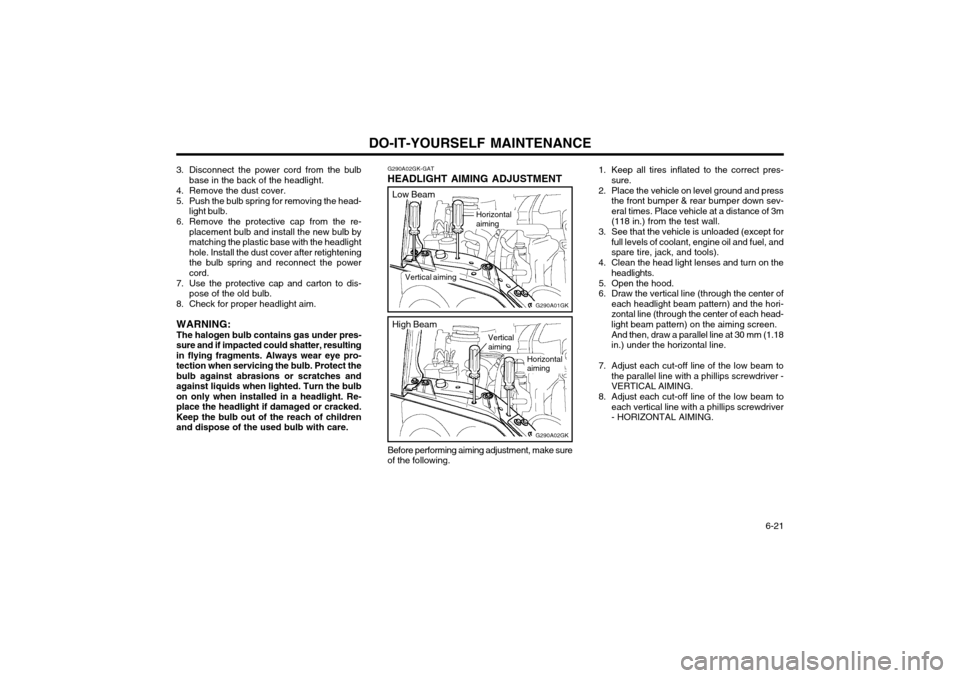
HEADLIGHT AIMING ADJUSTMENT
Horizontal aiming
G290A01GK
Vertical aiming
3. Disconnect the power cord from the bulb
base in the back of the headlight.
4. Remove the dust cover.
5. Push the bulb spring for removing the head- light bulb.
6. Remove the protective cap from the re- placement bulb and install the new bulb by matching the plastic base with the headlighthole. Install the dust cover after retighteningthe bulb spring and reconnect the powercord.
7. Use the protective cap and carton to dis- pose of the old bulb.
8. Check for proper headlight aim.
WARNING: The halogen bulb contains gas under pres-
sure and if impacted could shatter, resulting in flying fragments. Always wear eye pro-tection when servicing the bulb. Protect thebulb against abrasions or scratches andagainst liquids when lighted. Turn the bulbon only when installed in a headlight. Re-place the headlight if damaged or cracked.Keep the bulb out of the reach of childrenand dispose of the used bulb with care.
Before performing aiming adjustment, make sure
of the following.
Low Beam
G290A02GK
Vertical aiming
High Beam
Horizontal aiming1. Keep all tires inflated to the correct pres-
sure.
2. Place the vehicle on level ground and press the front bumper & rear bumper down sev- eral times. Place vehicle at a distance of 3m(118 in.) from the test wall.
3. See that the vehicle is unloaded (except for full levels of coolant, engine oil and fuel, andspare tire, jack, and tools).
4. Clean the head light lenses and turn on the headlights.
5. Open the hood.
6. Draw the vertical line (through the center of each headlight beam pattern) and the hori-zontal line (through the center of each head-light beam pattern) on the aiming screen. And then, draw a parallel line at 30 mm (1.18 in.) under the horizontal line.
7. Adjust each cut-off line of the low beam to the parallel line with a phillips screwdriver -VERTICAL AIMING.
8. Adjust each cut-off line of the low beam to each vertical line with a phillips screwdriver- HORIZONTAL AIMING.
Page 158 of 389

EMISSION CONTROL SYSTEMS 7-1
7. EMISSION
CONTROL SYSTEMS
H010B01F-GAT
1. Crankcase Emission Control Sys-
tem
The positive crankcase ventilation system is
employed to prevent air pollution caused by H010A01A-GAT
EMISSION CONTROL SYSTEMS (If Installed)
Your Hyundai is equipped with an emission
control system to meet all requirements of the Emission prohibition rules of your province.
There are three emission control systems which
are as follows.
(1) Crankcase emission control system (2) Evaporative emission control system(3) Exhaust emission control system In order to assure the proper function of the
emission control systems, it is recommended that you have your car inspected and main-tained by an authorized Hyundai dealer in ac-cordance with the maintenance schedule in thismanual. H010C01F-GAT
2. Evaporative Emission Control Sys-
tem (If Installed)
The evaporative emission control system is
designed to prevent fuel vapors from escapinginto the atmosphere. Canister
While the engine is inoperative, fuel vapors
generated inside the fuel tank are absorbed and stored in the canister. When the engine is
running, the fuel vapors absorbed in the canis-ter are drawn into the induction system throughthe purge control solenoid valve. Purge Control Solenoid Valve
The purge control solenoid valve is controlled
by the ECM; when the engine coolant tempera- ture is low, and during idling, it closes, so that
evaporated fuel is not taken into the engine.After engine warm-up, during ordinary driving, itopens so as to introduce evaporated fuel to theengine. H010D01A-AAT
3. Exhaust Emission Control System
The exhaust emission control system is a high-
ly effective system which controls exhaust emis-sions while maintaining good vehicleperformace.
H020A01A-GAT
CATALYTIC CONVERTER (If Installed)
Catalytic Converter
SSA7020A
The catalytic converter is part of the exhaust
emission control system. Its purpose is to re- move certain engine emission products fromthe engine's exhaust. It looks something like amuffler and is located underneath the car in theexhaust system.
blow-by gases being emitted from the crank-
case. This system supplies fresh air to the
crankcase through the air cleaner. Inside thecrankcase, the fresh air mixes with blow-bygases, then passes through the PCV valve intothe induction system.
7
Page 159 of 389

7-2EMISSION CONTROL SYSTEMS
H020B01A-GAT
About the Catalytic Converter
Exhaust gases passing through the catalytic
converter cause it to operate at very high tem- peratures. As a result, the introduction of largeamounts of unburned gasoline may cause it tooverheat and create a fire hazard. This can beavoided by observing the following:
o Use unleaded fuel only.
o Maintain your engine in good condition. Ex- tremely high converter temperatures can result from improper operation of the electri-cal, ignition or fuel injection systems.
o If your engine stalls, pings, knocks, or is hard to start, take your car to your Hyundaidealer as soon as possible and have thedifficulty corrected.
o Avoid driving with a very low fuel level. If your run out of gasoline, it could cause theengine to misfire and result in excessiveloading of the catalytic converter.
o Avoid idling the engine for periods longer than 10 minutes.
o Your Hyundai should not be either pushed or pulled to get it started. This can cause thecatalytic converter to overload.
o Take care not to stop your Hyundai over any combustible material such as grass, paper,leaves or rags. As these materials couldcome in contact with the catalytic converterand could cause a fire. o Do not touch the catalytic converter or any
other part of the exhaust system while theengine is running as it is very hot and couldresult in burns.
o Remember that your Hyundai dealer is your best source of assistance.