Page 29 of 296
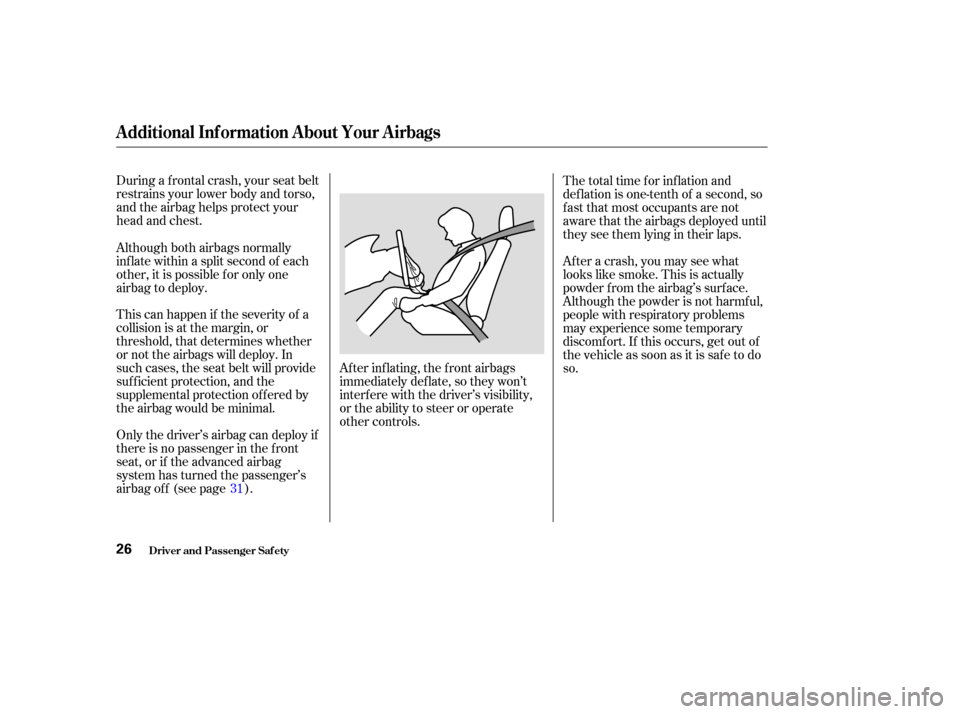
During a f rontal crash, your seat belt
restrains your lower body and torso,
and the airbag helps protect your
head and chest.
This can happen if the severity of a
collision is at the margin, or
threshold, that determines whether
or not the airbags will deploy. In
such cases, the seat belt will provide
suf f icient protection, and the
supplemental protection of f ered by
the airbag would be minimal.Af ter inf lating, the f ront airbags
immediately def late, so they won’t
interf ere with the driver’s visibility,
or the ability to steer or operate
other controls.The total time for inflation and
def lation is one-tenth of a second, so
f ast that most occupants are not
aware that the airbags deployed until
they see them lying in their laps.
After a crash, you may see what
looks like smoke. This is actually
powder f rom the airbag’s surf ace.
Although the powder is not harmf ul,
people with respiratory problems
mayexperiencesometemporary
discomf ort. If this occurs, get out of
the vehicle as soon as it is saf e to do
so.
Only the driver’s airbag can deploy if
there is no passenger in the f ront
seat, or if the advanced airbag
system has turned the passenger’s
airbag off (see page ). Although both airbags normally
inf late within a split second of each
other, it is possible f or only one
airbag to deploy.
31
Additional Inf ormation About Your Airbags
Driver and Passenger Saf ety26
Page 30 of 296

CONT INUED
Your f ront airbags are dual-stage
airbags. This means they have two
inf lation stages that can be ignited
sequentially or simultaneously,
depending on crash severity.
In acrash, both stages
will ignite simultaneously to provide
the quickest and greatest protection.
In a crash, one stage will
ignite first, then the second stage
will ignite a split second later. This
provides longer airbag inf lation time
with a little less force. Your f ront airbags are also dual-
threshold airbags. Airbags with this
f eature have two deployment
thresholds that depend on whether
or not the occupant is wearing a seat
belt.
If the occupant’s belt is
,
the airbag will deploy at the same
threshold as a conventional airbag,
because the occupant would need
extra protection.
It the occupant’s belt is , the
airbag will inf late at a slightly higher
threshold, when the airbag would be
needed to supplement the protection
provided by the seat belt. Your f ront airbags are also advanced
airbags. The main purpose of this
feature is to prevent airbag-caused
injuries to short drivers and children
who ride in f ront.
In addition, do not spill any liquids,
cover the sensors, or put any cargo
or metal objects under the f ront
seats. Ask second row passengers to
not put their f eet under the f ront
seats. Any of these actions could
damage the sensors or prevent them
f rom working properly. For the advanced airbags to work
properly, occupants must sit upright
and wear their seat belts properly. If
a child seat is installed in the f ront, it
must be properly secured.
Additional Inf ormation About Your Airbags
Driver and Passenger Saf ety
Dual-Stage A irbags
more severeless severe Dual-T hreshold A irbags
not lat chedlatchedAdvanced Airbags
27
Page 31 of 296

If there is a problem with the seat
position sensor, the SRS indicator
will come on in the instrument panel.
In this case, the driver’s airbag will
inf late in the normal manner during
a crash regardless of the driver’s
seating position. The driver’s advanced front airbag
system includes a seat position
sensor under the seat. If the seat is
positioned too f ar f orward, the
airbag will inf late sequentially,
regardless of the severity of the
impact.The passenger’s advanced f ront
airbag system has weight sensors
under the seat. If the sensors detect
a total weight on the seat of about 65
lbs (30 kg) or less, the system will
automatically turn the passenger’s
front airbag off.
When the airbag is turned of f , an
indicator in the center of the
dashboard will come on indicating
‘‘Passenger Airbag Of f ’’ (see page). If there is no passenger in the f ront
seat, the
but the
indicator .
To ensure that the passenger’s
advanced front airbag system will
work properly,
This includes: A rear passenger pushing or
pulling on the back of the
passenger’s seat.
Moving the f ront seat f orcibly
back against cargo on the seat or
f loor behind it.
Hanging heavy items on the f ront
passenger seat, or placing heavy
items in the seat-back pocket.
32
Additional Inf ormation About Your Airbags
Driver and Passenger Saf ety
airbag will be of f will not come on
do not do anyt hing
t hat would increase or decrease t he weight on t he f ront passenger’s seat .
28
DRIVER’S
SEAT
POSITION
SENSOR PASSENGER’S
SEAT WEIGHT
SENSOR
Page 33 of 296

The SRS indicator alerts
you to a potential problem
with your airbags or seat belt
tensioners (see page ).
When you turn the ignition to ON
(II), this indicator will come on
brief ly then go out. This tells you the
system is working properly.
If you see any of these indications,
the airbags and seat belt tensioners
may not work properly when you
need them. If the indicator comes on at any
other time, or does not come on at all,
you should have the system checked
by your dealer. For example:If the indicator stays on after the
engine starts.
If the indicator comes on or
flashesonandoff whileyoudrive. If the SRS indicator does not come
on after you turn the ignition
switch to ON (II).
22
How the SRS Indicator Works
Driver and Passenger Saf ety
Additional Inf ormation About Your Airbags
30
Ignoring the SRS indicator can
result in serious injury or death
if the airbag systems or
tensioners do not work properly.
Have your vehicle checked by a
dealer as soon as possible if
the SRS indicator alerts you to
a possible problem.
Page 34 of 296
A f ront seat passenger should not
use a cushion or other object as a
backrest. It may prevent the cutof f
system f rom working properly.
When you turn the ignition switch to
ON (II), the indicator should come
on brief ly and go out (see page ).
If it doesn’t light, stays on, or comes
on while driving without a passenger
in the front seat, have the system
checked.
This indicator alerts you
that the passenger’s side
airbag has been automatically shut
of f . It does mean there is a
problem with your side airbags.
To reduce the risk of injury f rom an
inf lating side airbag, your vehicle has
an automatic cutoff system for the
passenger’s side airbag.
Although Honda does not encourage
children to ride in f ront, this system
is designed to shut of f the side
airbag if a child leans sideways and
the child’s head is in the side airbag
deployment path. 61
Additional Inf ormation About Your Airbags
Driver and Passenger Saf ety
How the Side Airbag Of f
Indicator Works
not
31
Page 35 of 296

This indicator alerts you that the
passenger’s f ront airbag has been
shut of f . It does not mean there is a
problem with the airbag.To reduce the chance of airbag-
caused injuries, the system shuts of f
the passenger’s f ront airbag when
the total weight on the f ront
passenger’s seat is about 65 lbs
(30 kg) or less.
If no one is riding in the f ront
passenger’s seat, the airbag will be
automatically shut off, but the
indicator will not come on.
However, if the indicator comes on
with no passenger in the f ront, or
with an adult in the seat, there may
be a problem with the advanced
airbag system. Have the vehicle
checked by the dealer as soon as
possible.
The Passenger Airbag Of f indicator
may also come on and of f repeatedly
if total weight on the seat is near the
airbag cutof f threshold (65 lbs or 30
kg).If this happens, have the passenger
ride properly restrained in a back
seat. If the passenger must ride in
front, move the seat as far to the
rear as possible, have the passenger
sit upright and wear the seat belt
properly.
This indicator may come on and of f
repeatedly if objects are placed on
the front passenger’s seat, or if the
interior temperature of the vehicle
changes suddenly when a door is
opened.
See page f or more inf ormation
about the passenger’s advanced
f ront airbag.
27
Additional Inf ormation About Your Airbags
Driver and Passenger Saf ety
How the Passenger Airbag Of f
Indicator Works
32
PASSENGER AIRBAG OFF
INDICATOR
Page 36 of 296
Your airbag systems are virtually
maintenance-f ree, and there are no
parts you can saf ely service.
However, you must have your
vehicle serviced if:Any airbag
that has deployed must be
replaced along with the control
unit and other related parts. If a
f ront airbag inf lates the seat belt
tensioners must also be replaced.
Do not try to remove or replace
anyairbagbyyourself.Thismust
be done by a Honda dealer or a
knowledgeable body shop.
Take your vehicle to an
authorized Honda dealer as soon
as possible. If you ignore this
indication, your airbags may not
operate properly. your dealer
should inspect the driver’s seat
position sensor and the f ront
passenger’s weight sensors to
make sure they are operating
properly.
Additional Inf ormation About Your Airbags
Driver and Passenger Saf ety
Airbag Service
An airbag ever inf lates.
T he SRS indicat or alert s you t o aproblem. If your vehicle has a moderat e t o
severe impact , and even if yourairbags do not inf late,
33
Page 38 of 296
�µ
�µ�µ
Each year, many children are injured
or killed in vehicle crashes because
they are either unrestrained or not
properly restrained. In f act, vehicle
accidents are the number one cause
of death of children ages 12 and
under.
To reduce the number of child
deaths and injuries, every state and
Canadian province requires that
inf ants and children be properly
restrained when they ride in a
vehicle.
(see pages ).(see pages ).
If you have children, or if you ever
need to drive with a child in your
vehicle, be sure to read this section.
It begins with important general
guidelines, then presents special
inf ormation f or inf ants, small
children, and larger children.
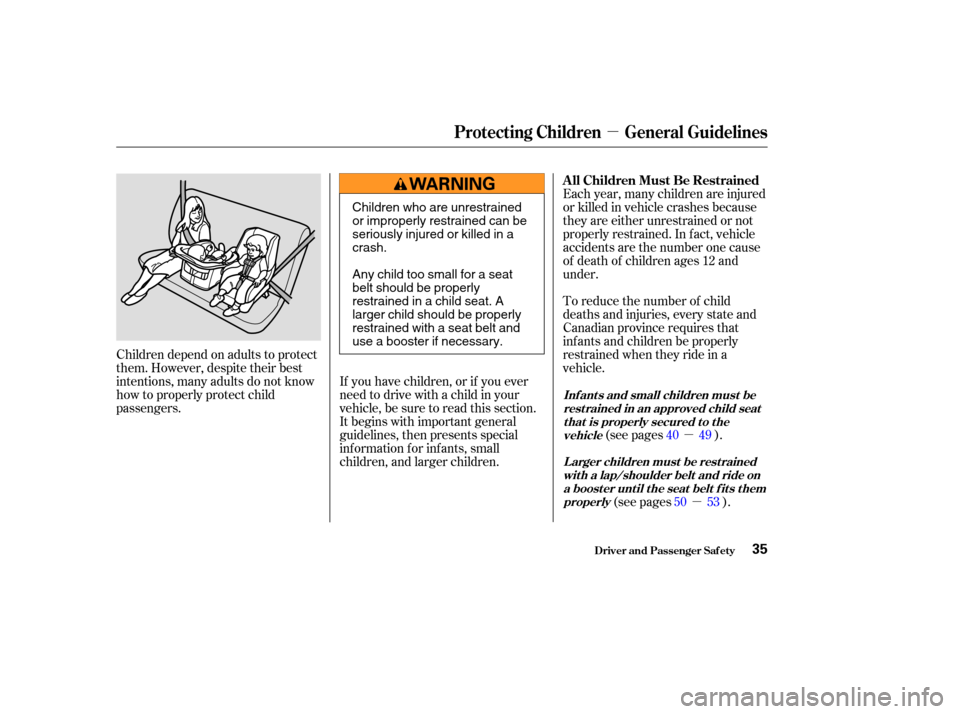
Children depend on adults to protect
them. However, despite their best
intentions, many adults do not know
how to properly protect child
passengers.
50 534940
Protecting Children General Guidelines
Driver and Passenger Saf ety
All Children Must Be Restrained
Inf ant s and small children must be
rest rained in an approved child seatt hat is properly secured t o t hevehicle
Larger children must be restrainedwit h a lap/shoulder belt and ride ona boost er unt il t he seat belt f it s t hemproperly
35
Children who are unrestrained
or improperly restrained can be
seriously injured or killed in a
crash.
Any child too small for a seat
belt should be properly
restrained in a child seat. A
larger child should be properly
restrained with a seat belt and
use a booster if necessary.

