Page 116 of 218
�µ�µ
�µ
CONT INUED
Use this position f or
normal driving. The drive position
has two modes, Drive (D) and
Second (S). You can select the
desired mode with the two select
buttons on the steering wheel. The
‘‘D’’ indicator remains lit in either
mode. Usethismodefor
everyday driving. The transmission
automatically adjusts to keep the
engine at the best speed f or driving
conditions. To help the engine warm
up f aster, the transmission will select
ratios that allow the engine to run at
higher speeds when it is cold.
In this mode, the
transmission selects a wider range of
ratios to give better acceleration.
Usethismodefordrivingupor
downhill. Along with the ‘‘D’’
indicator, the ‘‘S’’ indicator comes on
as a reminder.
Automatic Transmission (CVT)
Driving
Drive (D)
Drive Mode
Second (S) Mode
113
DRIVE MODE BUTTON
SECOND MODE BUTTON
‘‘D’’ INDICATOR
‘‘S’’ INDICATOR
Page 121 of 218

Always use the parking brake when
you park your vehicle. Make sure
the parking brake is set f irmly or
your vehicle may roll if it is parked
on an incline.
If your vehicle has an automatic
transmission, set the parking brake
bef ore you put the transmission in
Park. This keeps the vehicle f rom
moving and putting pressure on the
parking mechanism in the
transmission.If the vehicle is f acing uphill, turn
the f ront wheels away f rom the
curb. If you have a manual
transmission, put it in f irst gear.
If the vehicle is f acing downhill,
turn the front wheels toward the
curb. If you have a manual
transmission, put it in reverse gear.
Make sure the parking brake is
f ully released bef ore driving away.
Driving with the parking brake
partially set can overheat or
damage the rear brakes.Make sure the windows are closed.
Turn of f the lights.
Place any packages, valuables, etc.
in the storage box or take them
with you.
Lock the doors and the hatch with
the key or the remote transmitter.
Never park over dry leaves, tall
grass, or other f lammable
materials. The hot three way
catalytic converter could cause
these materials to catch on fire.
Parking T ips
Driving
Parking T ips
118
Page 122 of 218

Constant application of the brakes
when going down a long hill builds
up heat and reduces their ef f ective-
ness. Use the engine to assist the
brakes by taking your f oot of f the
accelerator and downshif ting to a
lower gear. Resting your f oot on the pedal keeps
the brakes applied lightly, builds up
heat, and reduces their ef f ectiveness.
It also keeps your brake lights on all
the time, conf using drivers behind
you.
Check the brakes after driving
through deep water. Apply the
brakes moderately to see if they f eelnormal. If not, apply them gently and
f requently until they do. Be extra
cautious in your driving.
The f ront disc brakes on all models
have audible brake wear indicators.
If the brake pads need replacing, you
will hear a distinctive, metallic
screeching sound when you apply
the brake pedal. If you do not have
the brake pads replaced, they will
screech all the time. It is normal f or
the brakes to occasionally squeal or
squeak when you apply them.
The hydraulic system that operates
the brakes has two separate circuits.
Each circuit works diagonally across
the vehicle (the lef t-f ront brake is
connected with the right-rear brake,
etc.). If one circuit should develop a
problem, you will still have braking
at two wheels.
Your Honda is equipped with f ront
disc brakes. The brakes on the rear
wheels are drum. A power assist
helps reduce the ef f ort needed on
thebrakepedal.TheABShelpsyou
retain steering control when braking
very hard.
Braking System
Driving
Braking System Design
Brake Wear Indicators
119
Front
Page 124 of 218
It only helps with the
steering control during braking. on loose or
uneven surf aces, such as gravel or
snow, than a vehicle without anti-
lock. Slow down and allow a greater
distance between vehicles under
those conditions. Your vehicle is not designed to tow a
trailer. Attempting to do so can void
your warranties.
such as trying to take a
corner too f ast or making a sudden
lane change. Always drive at a safe
speed f or the road and weather
conditions.
Always steer moderately
when you are braking hard. Severe
or sharp steering wheel movement
can still cause your vehicle to veer
into oncoming traffic or off the road.
Anti-Lock Brakes (ABS), Towing a Trailer
Driving
Important Saf ety Reminders
A BS does not reduce the time or
distance it takes to stop the
vehicle. A vehicle with A BS may require a
longer distance to stop
Towing a Trailer
A BS will not prevent a skid that
results f rom changing direction
abruptly,
A BS cannot prevent the loss of
stability.
121
Page 126 of 218

......................
Maintenance Saf ety .124
.................
Maintenance Schedule . 125
....................
Maintenance Record .129
..............................
Fluid Locations .132
........................
Adding Engine Oil .133
.........
Changing the Oil and Filter . 134
..............................
Engine Coolant .137
....................
Windshield Washers .139
.......................
Transmission Fluid .140
Automatic Transmission .....................................
(CVT) .140
5-speed Manual .........................
Transmission .141
................
Brake and Clutch Fluid . 142
....................................
Hood Latch .143
.............................................
Lights .144
.......................................
Seat Belts .149
.....................................
Floor Mats .149
..................
Dust and Pollen Filter . 150
................................
Roof Antenna .150
..........................
Rear Wheel Skirt .151
.................................
Wiper Blades .151
...............................................
Tires .154
...................
Checking the Battery . 160
.............................
Vehicle Storage .161
This section explains why it is
important to keep your vehicle well
maintained and how to f ollow basic
maintenance saf ety precautions.
This section also includes
Maintenance Schedules f or normal
driving and severe driving conditions,
a Maintenance Record, and instruc-
tions f or simple maintenance tasks
you may want to take care of
yourself .
If you have the skills and tools to per-
f orm more complex maintenance
tasks on your Honda, you may want
to purchase the Service Manual. See
page f or inf ormation on how to
obtain a copy, or see your Honda
dealer.
205
Maintenance
Maint enance123
Page 149 of 218
Install the socket back into the
headlight assembly. Turn it
clockwise to lock it in place.
Turn on the lights to make sure
the new bulb is working.To change the bulb on the driver’s
side, start the engine, turn the
steering wheel all the way to the
right, then turn of f the engine. To
change the bulb on the passenger’s
side, turn the steering wheel to the
lef t.
Use a Phillips-head screwdriver to
remove the screw f rom the top of
the f ender.Pull the inner f ender cover back.
Remove the socket from the
headlight assembly by turning it
one-quarter turn counterclockwise.
Pull the bulb straight out of its
socket. Push the new bulb straight
into the socket until it bottoms.
3.
2. 4.
5.
4.
5.
1.
Lights
Maint enance
Replacing the Front Side Marker/
Turn Signal Light Bulb
146
Page 154 of 218
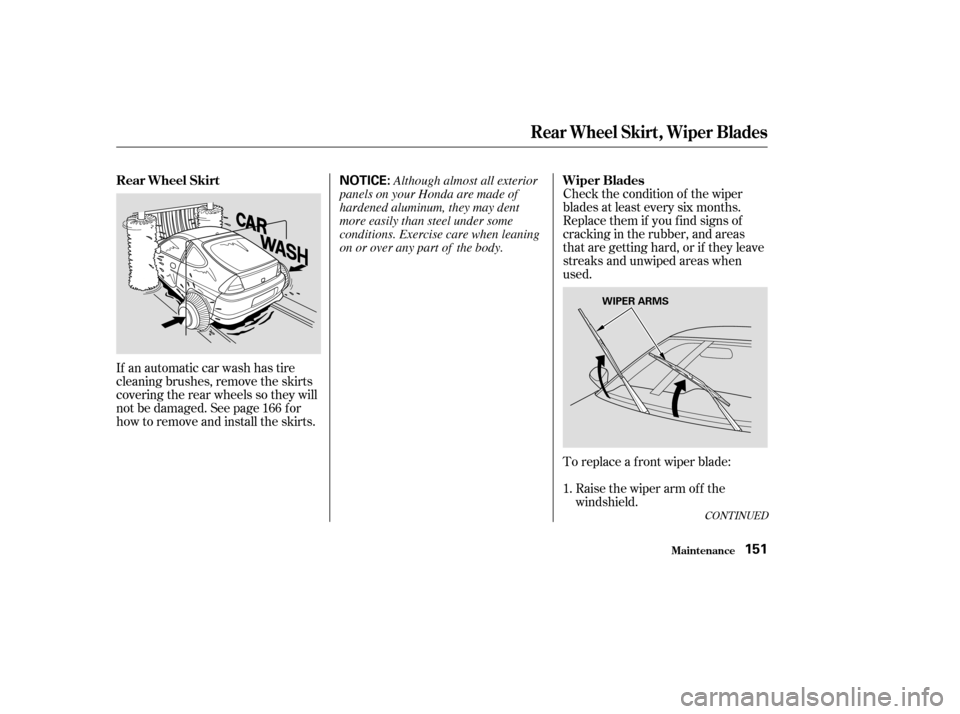
If an automatic car wash has tire
cleaning brushes, remove the skirts
covering the rear wheels so they will
not be damaged. See page f or
how to remove and install the skirts.Check the condition of the wiper
blades at least every six months.
Replace them if you f ind signs of
cracking in the rubber, and areas
that are getting hard, or if they leave
streaks and unwiped areas when
used.
To replace a f ront wiper blade:
Raise the wiper arm of f the
windshield.
1.
166
CONT INUED
Rear Wheel Skirt, Wiper Blades
Maint enance
Rear Wheel Skirt
Wiper Blades
151
NOTICE:
WIPER ARMS
Although almost all exterior
panels on your Honda are made of
hardened aluminum, they may dent
more easily than steel under some
conditions. Exercise care when leaning
on or over any part of the body.
Page 159 of 218

Have your dealer check the tires if
you f eel a consistent vibration while
driving. A tire should always be
rebalanced if it is removed f rom the
wheel. When you have new tires
installed, make sure they are
balanced. This increases riding
comf ort and tire lif e. For best results,
have the installer perform a dynamic
balance. In addition to proper inf lation,
correct wheel alignment helps to
decrease tire wear. If you f ind a tire
is worn unevenly, have your dealer
check the wheel alignment.
Your vehicle’s tires have wear
indicators molded into the tread.
When the tread wears down to that
point, you will see a 1/2 inch (12.7
mm) wide band running across the
tread. This shows there is less than
1/16 inch (1.6 mm) of tread lef t on
the tire. A tire that is this worn gives
very little traction on wet roads. You
should replace the tire if you can see
the tread wear indicator in three or
more places around the tire.
Every time you check inf lation, you
should also examine the tires f or
damage, f oreign objects, and wear.
Youshouldlookfor:
Bumps or bulges in the tread or
side of the tire. Replace the tire if
youfindeitherortheseconditions.
Cuts, splits, or cracks in the side
of the tire. Replace the tire if you
can see f abric or cord.
Excessive tread wear.
Tires
Maint enance
T ire Maintenance
Tire Inspection
156
NOTICE:
INDICATOR LOCATION MARKS
TREAD WEAR INDICATORS
Improper wheel weights can
damage your vehicle’s aluminum
wheels. Use only Honda wheel weights
f or balancing.