Page 135 of 256

Larger or smaller wheels and tires
can interf ere with the operation of
your vehicle’s anti-lock brakes and
other systems.
Do not modif y your steering wheel
or any other part of your
Supplemental Restraint System.
Modif ications could make the
system inef f ective. See the saf ety
precautions on page .
If you plan to modif y your vehicle,
consult with your Honda dealer.
Removing parts f rom your vehicle,
or replacing components with non-
Honda (af termarket) components
could seriously af f ect your vehicle’s
handling, stability, and reliability.
Some examples are:
Lowering your vehicle with an
aftermarket suspension kit that
signif icantly reduces ground
clearance can allow the
undercarriage to hit speed bumps
or other raised objects, which
could cause the airbags to deploy.
Raising your vehicle with an
af termarket suspension kit can
af f ect the handling and stability.
Af termarket wheels, because they
are a universal design, can cause
excessive stress on suspension
components. Improperly
replacing or covering f ront seat-
back covers can prevent your side
airbags f rom inf lating during a
collision. 29
Bef ore Driving
A ccessories and Modif ications
Additional Saf ety Precaution
Do not cover or replace f ront seat -
back covers wit hout consult ing aHonda dealer.
131
Page 140 of 256

Your Honda has a higher ground
clearance that allows you to travel
over bumps, obstacles, and rough
terrain. It also provides good
visibility so you can anticipate
problems earlier.
Because your vehicle rides higher
of f the ground, it has a high center
of gravity that can cause it to roll
over if you make abrupt turns. Utility
vehicles have a signif icantly higher
roll over rate than other types of
vehicles.
To prevent rollovers or loss of
control:Take corners at slower speeds
than you would with a passenger
vehicle.
Avoid sharp turns and abrupt
maneuvers whenever possible. Do not carry heavy cargo on the
roof . Do not modif y your vehicle in any
way that would raise the center of
gravity.
Your Honda is equipped with a f our-
wheel drive (4WD) system. When
the system senses a loss of front-
wheel traction, it automatically
transf ers some power to the rear
wheels. This gives you better
traction and mobility.
You still need to exercise the same
care when accelerating, steering, and
brakingthatyouwouldinatwo-
wheel drive vehicle.Four-wheel Drive Models
See page f or additional guidelinesf or driving of f -highway. 159
Driving Guidelines
Driving136
Page 141 of 256
Check that any items you may be
carrying with you inside are stored
properly or f astened down
securely. Visually check the tires. If a tire
looks low, use a gauge to check its
pressure. Check that the hood, tailgate and
hatch glass are f ully closed. Make sure all windows, mirrors,
and outside lights are clean and
unobstructed. Remove f rost, snow,
or ice.
Youshoulddothefollowingchecks
and adjustments bef ore you drive
your vehicle.
Check the seat adjustment (see
page ).
Check the adjustment of the
inside and outside mirrors (see
page ).
Check the steering wheel
adjustment (see page ).Make sure the doors and tailgate
are securely closed and locked.
Fasten your seat belt. Check that
your passengers have f astened
their seat belts (see page ).
When you start the engine, check
the gauges and indicator lights in
the instrument panel (see page
).
1.
2.
3.
4. 5.
6.
7.
8.
9.
10.
77
89 68 15
55
Driving Guidelines
Driving
Preparing to Drive
137
Page 151 of 256

Your Honda is equipped with disc
brakes at all f our wheels. A power
assist helps reduce the ef f ort needed
on the brake pedal. The ABS (on
vehicles equipped with ABS) helps
you retain steering control when
braking very hard.
Resting your f oot on the pedal keeps
the brakes applied lightly, builds up
heat, and reduces their ef f ectiveness.
It also keeps your brake lights on all
the time, conf using drivers behind
you.Constant application of the brakes
when going down a long hill builds
up heat and reduces their ef f ective-
ness. Use the engine to assist the
brakes by taking your f oot of f the
accelerator and downshif ting to a
lower gear.
Check your brakes af ter driving
through deep water. Apply the
brakes moderately to see if they f eel
normal. If not, apply them gently and
f requently until they do. Be extra
cautious and alert in your driving.
The hydraulic system that operates
the brakes has two separate circuits.
Each circuit works diagonally across
the vehicle (the lef t-f ront brake is
connected with the right-rear brake,
etc.). If one circuit should develop a
problem, you will still have braking
at two wheels.
Braking System
Driving
Braking System Design
147
Front
Page 152 of 256

If the brake pads need replacing, you
will hear a distinctive, metallic
screeching sound when you apply
the brake pedal. If you do not have
the brake pads replaced, they will
screech all the time. It is normal f or
the brakes to occasionally squeal or
squeak when you apply them.The ABS also balances the f ront-to-
rear braking distribution according
to vehicle loading.
this def eats the purpose of the ABS.
Let the ABS work f or you by always
keeping f irm, steady pressure on the
brake pedal as you steer away from
the hazard. This is sometimes
ref erred to as ‘‘stomp and steer.’’You will f eel a pulsation in the brake
pedal when the ABS activates, and
you may hear some noise. This is
normal: it is the ABS rapidly
pumpingthebrakes.Ondry
pavement, you will need to press on
thebrakepedalveryhardbeforethe
ABS activates. However, you may
feel the ABS activate immediately if
you are trying to stop on snow or ice.
The Anti-lock Brake System (ABS)
helps prevent the brakes f rom
locking up and helps you retain
steering control by pumping the
brakes rapidly, much f aster than a
person can do it.
You should never pump the brake pedal;
Standard f or EX model in the U.S., and
EX and EX-L models in Canada
Driving
Brake Wear Indicators Anti-lock Brakes
Braking System, Anti-lock Brakes (ABS)
148
Page 153 of 256

�Î
�Î
The ABS is self -checking each time
the vehicle is started and moved.
The ABS indicator will come on if
anything goes wrong. If the ABS
indicator comes on, the brakes still
work like a conventional system, but
without anti-lock. You should have a
dealer inspect your vehicle as soon
as possible. it only helps with steering
control during braking. You should
always maintain a saf e f ollowing
distance f rom other vehicles.
such as trying to take a
corner too f ast or making a sudden
lane change. Always drive at a safe,
prudent speed f or the road and
weather conditions.
Always steer moderately
when you are braking hard. Severe
or sharp steering wheel movement
can still cause your vehicle to veer
into oncoming traffic or off the road. on loose or
uneven surf aces, such as gravel or
snow, than a vehicle without anti-
lock. Slow down and allow a greater
distance between vehicles under
those conditions.
Anti-lock Brakes (ABS)
Driving
ABS Indicator A BS does not reduce the time or
distance it takes to stop the
vehicle;
A BS will not prevent a skid that
results f rom changing direction
abruptly,
A BS cannot prevent a loss of
stability.A vehicle with A BS may require a
longer distance to stopImport ant Saf et y Reminders
149
ABS INDICATOR
U.S. indicator shown
Page 155 of 256
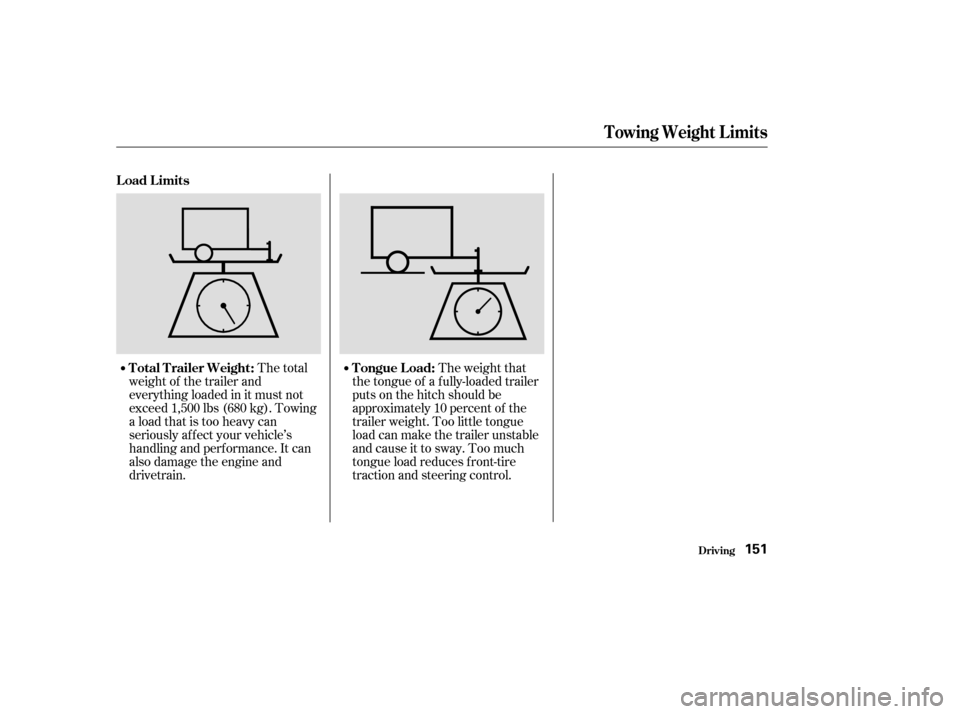
The total
weight of the trailer and
everything loaded in it must not
exceed 1,500 lbs (680 kg). Towing
a load that is too heavy can
seriously af f ect your vehicle’s
handling and perf ormance. It can
also damage the engine and
drivetrain. The weight that
the tongue of a f ully-loaded trailer
puts on the hitch should be
approximately 10 percent of the
trailer weight. Too little tongue
load can make the trailer unstable
and cause it to sway. Too much
tongue load reduces f ront-tire
traction and steering control.
Towing Weight Limits
Driving
Load Limits
T otal T railer Weight: T ongue L oad:
151
Page 160 of 256

Always drive slowly and have
someone guide you when backing up.
Grip the of the steering
wheel; then turn the wheel to the lef t
to get the trailer to move to the lef t,
andturnthewheelrighttomovethe
trailer to the right.
Crosswinds and air turbulence
caused by passing trucks can disrupt
your steering and cause trailer
swaying. When being passed by a
large vehicle, keep a constant speed
and steer straight ahead. Do not try
to make quick steering or braking
corrections.Follow all normal precautions when
parking, including f irmly setting the
parking brake and putting the
transmission in Park (automatic) or
in 1st or Reverse (manual). Also,
place wheel chocks at each of the
trailer’s tires.
When driving down hills, reduce
your speed and shif t down to 3rd
gear on the manual transmission,
and turn off the Over drive (O/D)
mode on the automatic transmission.
Do not ‘‘ride’’ the brakes.
bottom
Trailer Driving Tips
Driving
Backing Up
Handling Crosswinds and Buf f et ing Parking
Remember: It will take longer to
slow down and stop when towing
atrailer.
156