Page 144 of 231
�Ì�Ì
�Ì
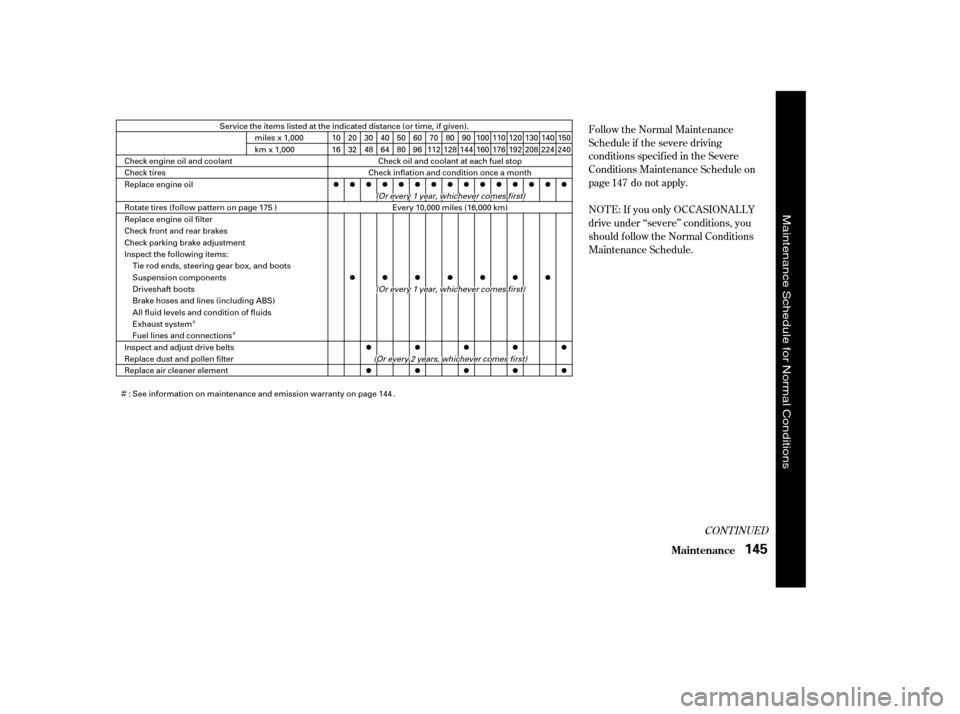
Follow the Normal Maintenance
Schedule if the severe driving
conditions specif ied in the Severe
Conditions Maintenance Schedule on
page do not apply.
NOT E: If you only OCCASIONALLY
drive under ‘‘severe’’ conditions, you
should f ollow the Normal Conditions
Maintenance Schedule.
CONT INUED
147
Maint enance
145
miles x 1,000
km x 1,000
Service the items listed at the indicated distance (or time, if given).
Every 10,000 miles (16,000 km)
((OOrreevveerryy11yyeeaarr,,wwhhiicchheevveerrccoommeessffiirrsstt))
Check inflation and condition once a monthCheck oil and coolant at each fuel stop
((OOrreevveerryy11yyeeaarr,,wwhhiicchheevveerrccoommeessffiirrsstt))
70
112 90
144
((OOrreevveerryy22yyeeaarrss,,wwhhiicchheevveerrccoommeessffiirrsstt))
10 16 20323048406450806096 80
128 120192150240
100160 140224
110176 130208
See information on maintenance and emission warranty on page .
Check engine oil and coolant
Check tires
Replace engine oil
Rotate tires (follow pattern on page 175 )
Replace engine oil filter
Check front and rear brakes
Check parking brake adjustment
Inspect the following items:
Tie rod ends, steering gear box, and boots
Suspension components
Driveshaft boots
Brake hoses and lines (including ABS)
All fluid levels and condition of fluids
Exhaust system
Fuel lines and connections
Inspect and adjust drive belts
Replace dust and pollen filter
Replace air cleaner element
: 144
Maintenance Schedule for Normal Conditions
�����—�����—�����y�
������
������y���
�(���%�������y���
�����y
Page 146 of 231
�µ
�Î�Ì �Ì�Ì
�Î
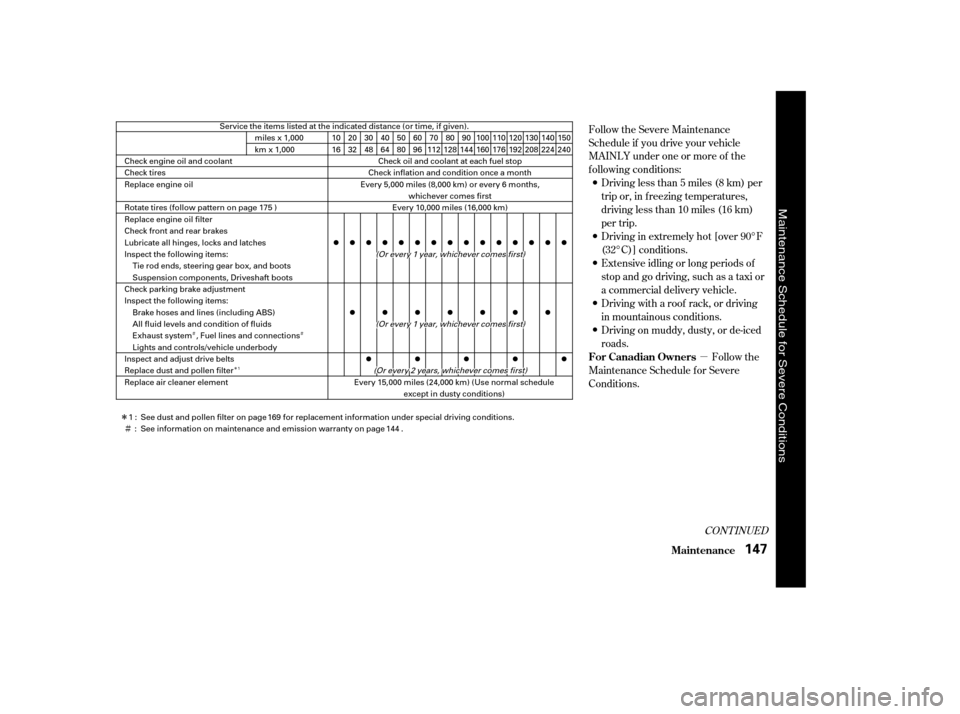
Follow the Severe Maintenance
Schedule if you drive your vehicle
MAINLY under one or more of the
f ollowing conditions:
Extensive idling or long periods of
stop and go driving, such as a taxi or
a commercial delivery vehicle.
Driving with a roof rack, or driving
in mountainous conditions.
Driving less than 5 miles (8 km) per
trip or, in f reezing temperatures,
driving less than 10 miles (16 km)
per trip.
Driving in extremely hot [over 90°F
(32°C)] conditions.
Driving on muddy, dusty, or de-iced
roads.
Follow the
Maintenance Schedule f or Severe
Conditions.
CONT INUED
For Canadian Owners
Maint enance
147
miles x 1,000
km x 1,000 Check oil and coolant at each fuel stop
Service the items listed at the indicated distance (or time, if given).
Every 10,000 miles (16,000 km)
Check inflation and condition once a month
Every 5,000 miles (8,000 km) or every 6 months,
whichever comes first
((OOrreevveerryy11yyeeaarr,,wwhhiicchheevveerrccoommeessffiirrsstt))
10 16 508070
112 110176130208
2032 4064609680
128 100160120192140224
((OOrreevveerryy11yyeeaarr,,wwhhiicchheevveerrccoommeessffiirrsstt))
((OOrreevveerryy22yyeeaarrss,,wwhhiicchheevveerrccoommeessffiirrsstt))Every 15,000 miles (24,000 km) (Use normal schedule
except in dusty conditions)
30 48
90
144 150240
See information on maintenance and emission warranty on page .
See dust and pollen filter on page for replacement information under special driving conditions.
Check engine oil and coolant
Check tires
Replace engine oil
Rotate tires (follow pattern on page 175 )
Replace engine oil filter
Check front and rear brakes
Lubricate all hinges, locks and latches
Inspect the following items:
Tie rod ends, steering gear box, and boots
Suspension components, Driveshaft boots
Check parking brake adjustment
Inspect the following items: Brake hoses and lines (including ABS)
All fluid levels and condition of fluids
Exhaust system , Fuel lines and connections
Lights and controls/vehicle underbody
Inspect and adjust drive belts
Replace dust and pollen filter
Replace air cleaner element
1: : 169
144
1
Maintenance Schedule for Severe Conditions
�����—�����—�����y�
���������
���y���
�(���%�������y���
�����y
Page 171 of 231

The f ollowing pages give more
detailed inf ormation on how to take
care of your tires and what to do
when they need to be replaced.
To saf ely operate your vehicle, your
tires must be the proper type and
size, in good condition with adequate
tread, and correctly inf lated.
The following chart shows the
recommended cold tire pressures f or
most normal driving conditions and
speed.
Keeping the tires properly inf lated
provides the best combination of
handling, tread lif e, and riding
comf ort.
Thecompactsparetirepressureis:
Underinf lated tires wear unevenly,
adversely affect handling and fuel
economy, and are more likely to
fail from being overheated.
Overinf lated tires can make your
vehicleridemoreharshly,are
more prone to damage f rom road
hazards, and wear unevenly.
We recommend that you visually
check your tires every day. If you
think a tire might be low, check it
immediately with a tire gauge.
Tire Size Cold Tire Pressure for Normal Driving
Tire Size Cold Tire Pressure for Normal Driving
Tire Size Cold Tire Pressure for Normal Driving(U.S.: DX, HX, Canada:DX)
(Canada: LX)
(U.S.: LX, EX, Canada:Si)
Tires
Maint enance
Recommended T ire Pressures f or Normal DrivingInf lation
172
60 psi (420 kPa , 4.2 kgf/cm)
P185/70R14 87S 30 psi (210 kPa , 2.1 kgf/cm
)
30 psi (210 kPa , 2.1 kgf/cm
)
P195/60R15 87H 30 psi (210 kPa , 2.1 kgf/cm
)
P185/65R15 86H
Using tires that are excessively
worn or improperly inflated can
cause a crash in which you can
be seriously hurt or killed.
Follow all instructions in this
owner’s manual regarding tire
inflation and maintenance.
�����—�����—�����y�
�������������y���
�(���%�������y���
�����y
Page 180 of 231

This section covers the more
common problems that motorists
experience with their vehicles. It
gives you inf ormation about how to
safely evaluate the problem and what
to do to correct it. If the problem has
stranded you on the side of the road,
you may be able to get going again.
If not, you will also f ind instructions
on getting your vehicle towed.......................
Compact Spare Tire . 182
....................
Changing a Flat Tire . 183
.............
If the Engine Won’t Start . 189
................................
Jump Starting . 191
..............
If the Engine Overheats . 192
.........
Low Oil Pressure Indicator . 195
..........
Charging System Indicator . 195
.......
Malf unction Indicator Lamp . 196
...............
Brake System Indicator . 197
..................
Closing the Moonroof . 198
..............................................
Fuses . 199
..........................
Fuse Locations . 201
......................
Emergency Towing . 203
Taking Care of the Unexpected
T aking Care of t he Unexpect ed181
�����—�����—�����y�
�������������y���
�(���%�������y���
�����y
Page 182 of 231
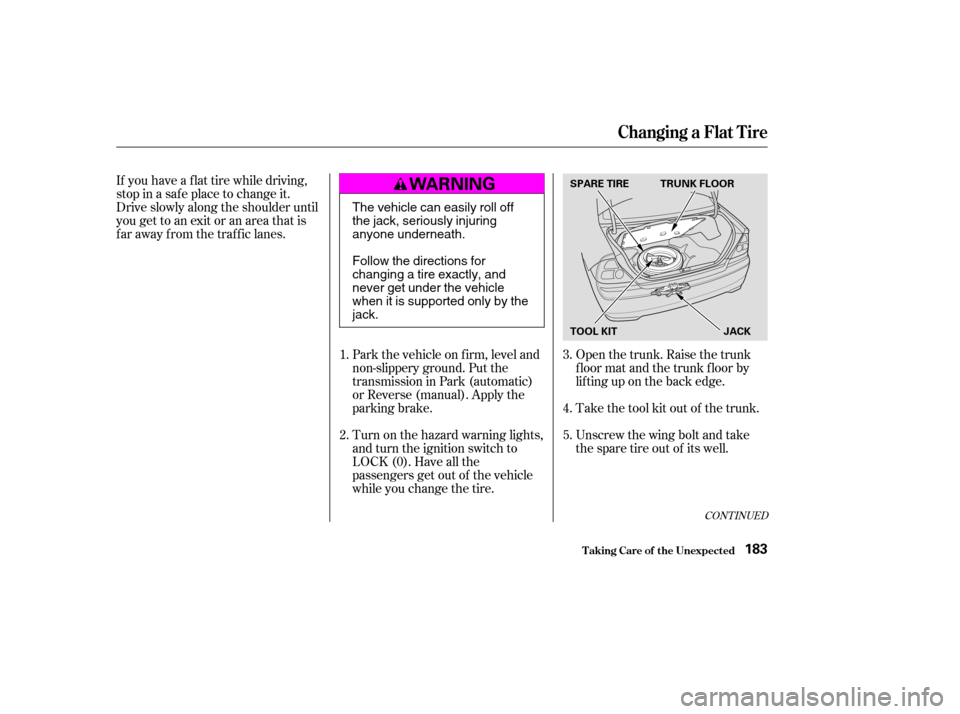
Park the vehicle on f irm, level and
non-slippery ground. Put the
transmission in Park (automatic)
or Reverse (manual). Apply the
parking brake.
Turn on the hazard warning lights,
and turn the ignition switch to
LOCK (0). Have all the
passengers get out of the vehicle
while you change the tire.Take the tool kit out of the trunk.
Unscrew the wing bolt and take
the spare tire out of its well.
Open the trunk. Raise the trunk
f loor mat and the trunk f loor by
lif ting up on the back edge.
If you have a f lat tire while driving,
stop in a saf e place to change it.
Drive slowly along the shoulder until
you get to an exit or an area that is
far away from the traffic lanes.
5.
4.
3.
2.
1.
CONT INUED
Changing a Flat T ire
T aking Care of t he Unexpect ed183
SPARE TIRE TRUNK FLOOR
TOOL KIT JACK
The vehicle can easily roll off
the jack, seriously injuring
anyone underneath.
Follow the directions for
changing a tire exactly, and
never get under the vehicle
when it is supported only by thejack.
�����—�����—�����y�
�������������y���
�(���%�������y���
�����y
Page 184 of 231
CONT INUED
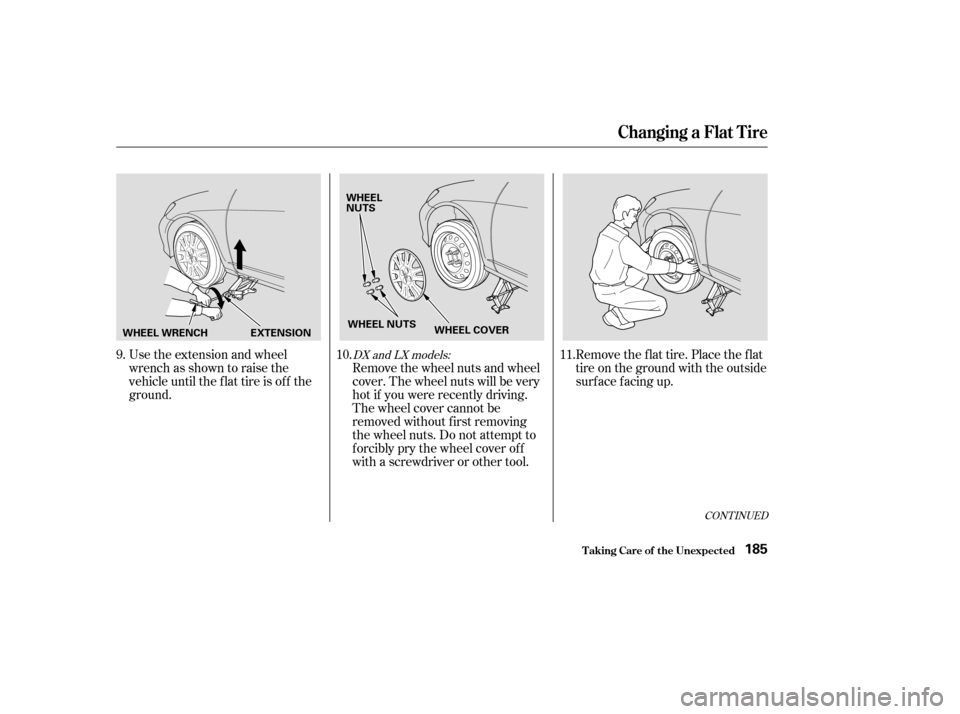
Use the extension and wheel
wrench as shown to raise the
vehicle until the f lat tire is of f the
ground.Remove the wheel nuts and wheel
cover. The wheel nuts will be very
hot if you were recently driving.
The wheel cover cannot be
removed without f irst removing
the wheel nuts. Do not attempt to
f orcibly pry the wheel cover of f
with a screwdriver or other tool.Remove the flat tire. Place the flat
tire on the ground with the outside
surface facing up.
9.
10. 11.DX and LX models:
Changing a Flat T ire
T aking Care of t he Unexpect ed185
WHEEL WRENCH EXTENSION WHEEL
NUTS
WHEEL NUTS WHEEL COVER
�����—�����—�����y�
���������
���y���
�(���%�������y���
�����y
Page 185 of 231
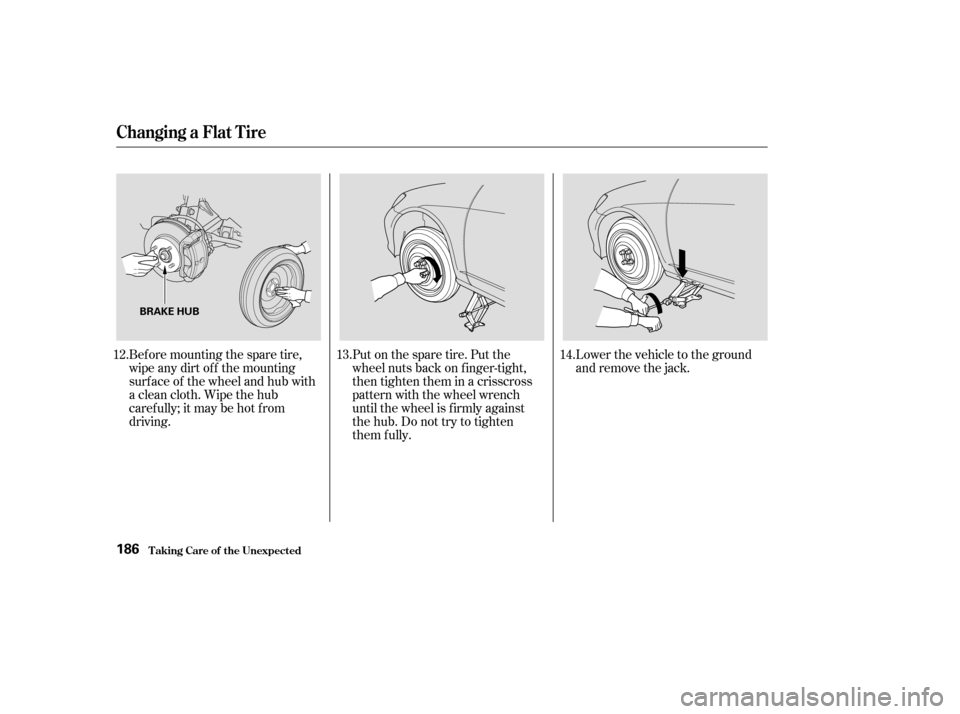
Bef ore mounting the spare tire,
wipeanydirtoff themounting
surface of the wheel and hub with
a clean cloth. Wipe the hub
carefully;itmaybehotfrom
driving.Put on the spare tire. Put the
wheel nuts back on f inger-tight,
then tighten them in a crisscross
pattern with the wheel wrench
until the wheel is f irmly against
the hub. Do not try to tighten
them f ully.Lower the vehicle to the ground
and remove the jack.
12. 13.
14.
Changing a Flat T ire
T aking Care of t he Unexpect ed186
BRAKE HUB
�����—�����—�����y�
�����������
�y���
�(���%�������y���
�����y
Page 186 of 231
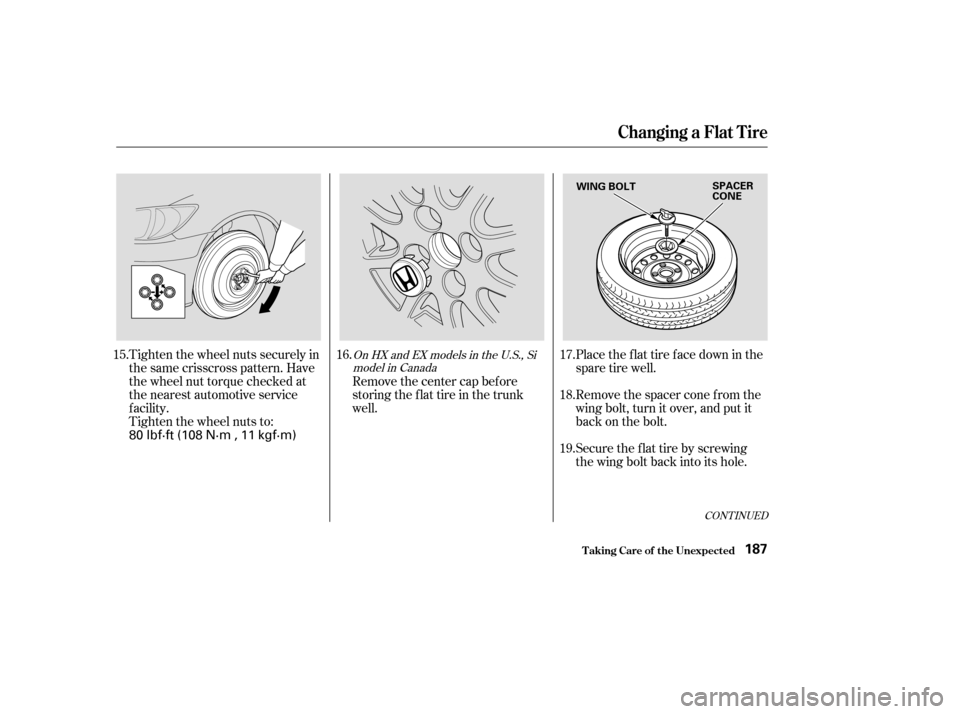
Tighten the wheel nuts securely in
the same crisscross pattern. Have
the wheel nut torque checked at
the nearest automotive service
f acility.
Tighten the wheel nuts to:Remove the center cap before
storing the f lat tire in the trunk
well.Place the flat tire face down in the
spare tire well.
Remove the spacer cone f rom the
wing bolt, turn it over, and put it
back on the bolt.
Secure the f lat tire by screwing
the wing bolt back into its hole.
15. 16. 17.
18. 19.
CONT INUED
On HX and EX models in the U.S., Simodel in Canada
Changing a Flat T ire
T aking Care of t he Unexpect ed187
WING BOLT SPACER CONE
80 lbf·ft (108 N·m , 11 kgf·m)
�����—�����—�����y�
�������������y���
�(���%�������y���
�����y