Page 34 of 231

Child Seat Type
A child who is at least one year old,
and who fits within the child seat
maker’s weight and height limits,
should be restrained in a f orward-
f acing, upright child seat.
Of the different seats available, we
recommend those that have a f ive-
point harness system as shown.We also recommend that a small
child stay in the child seat as long as
possible, until the child reaches the
weight or height limit f or the seat.
We strongly recommend placing a
forward-facing child seat in a back
seat, not the f ront.
If the vehicle seat is too
f ar f orward, or the child’s head is
thrown f orward during a collision, an
inf lating airbag can strike the child
with enough force to cause very
serious or f atal injuries. If it is necessary to put a f orward-
f acing child seat in the f ront, move
the vehicle seat as far to the rear as
possible, be sure the child seat is
f irmly secured to the vehicle, and the
child is properly strapped in the seat.
Protecting Small Children
Child Seat Placement
Placing a f orward-f acing child seat int he f ront seat of a vehicle equippedwith a passenger’s airbag can behazardous.
Protecting Inf ants and Small Children
Driver and Passenger Saf ety35
Placing a forward-facing child
seat in the front seat can result
in serious injury or death if the
front airbag inflates.
Ifyoumustplaceaforward-
facing child seat in front, move
the vehicle seat as far back as
possible, and properly restrain
the child.
�����—�����—�����y�
�������������y���
�(���%�������y���������y
Page 42 of 231
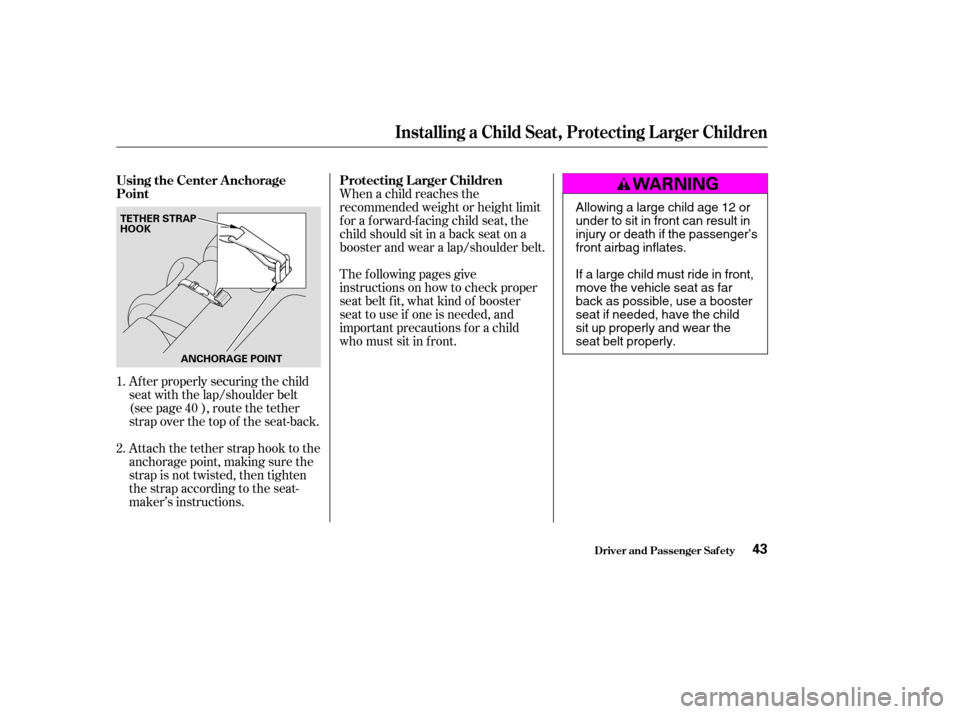
Af ter properly securing the child
seat with the lap/shoulder belt
(see page ), route the tether
strap over the top of the seat-back.
Attach the tether strap hook to the
anchorage point, making sure the
strap is not twisted, then tighten
the strap according to the seat-
maker’s instructions.When a child reaches the
recommended weight or height limit
for a forward-facing child seat, the
child should sit in a back seat on a
booster and wear a lap/shoulder belt.
The f ollowing pages give
instructions on how to check proper
seat belt f it, what kind of booster
seat to use if one is needed, and
important precautions f or a child
who must sit in f ront.
1. 2. 40
Using the Center A nchorage
Point
Protecting L arger Children
Installing a Child Seat, Protecting L arger Children
Driver and Passenger Saf ety43
TETHER STRAP
HOOK
ANCHORAGE POINTAllowing a large child age 12 or
under to sit in front can result in
injury or death if the passenger’s
front airbag inflates.
If a large child must ride in front,
move the vehicle seat as far
back as possible, use a booster
seat if needed, have the child
sit up properly and wear the
seat belt properly.
�����—�����—�����y�
���������
���y���
�(���%�������y���������y
Page 44 of 231

Some states also require children to
use a booster until they reach a
given age or weight (e.g., 6 years or
60lbs).Besuretocheckcurrent
laws in the state or states where you
intend to drive.
Booster seats can be high-back or
low-back. Whichever style you select,
make sure the booster meets f ederal
saf ety standards and that you f ollow
the booster seat maker’s instructions.The National Highway Traffic Safety
Administration and Transport
Canada recommend that all children
ages 12 and under be properly
restrained in the back seat.
The back seat is the safest place for
a child of any age or size.
If the passenger’s f ront airbag
inf lates in a moderate to severe
f rontal collision, the airbag can cause
serious injuries to a child who is
unrestrained, improperly restrained,
sitting too close to the airbag, or out
of position.
The side airbag also poses risks. If
any part of a larger child’s body is in
the path of a deploying side airbag,
the child could receive possibly
serious injuries.
A child may continue using a booster
seat until the tops of their ears are
even with the top of the vehicle’s or
booster’s seat-back. A child of this
height should be tall enough to use
the lap/shoulder belt without a
booster.
If a child who uses a booster must be
in f ront, move the vehicle seat as f ar
back as possible and be sure the
child is wearing the seat belt
properly.
CONT INUED
Protecting L arger Children
Driver and Passenger Saf ety
When Can a Larger Child Sit in Front
45
�����—�����—�����y�
�������������y���
�(���%�������y���������y
Page 48 of 231
On models without side airbagsOn models with side airbags
Driver and Passenger Saf ety
Saf ety L abels
49
HOOD
�����—�����—�����y�
�������������y���
�(���%�������y���������y
Page 52 of 231
�Î
�Î
CONT INUED
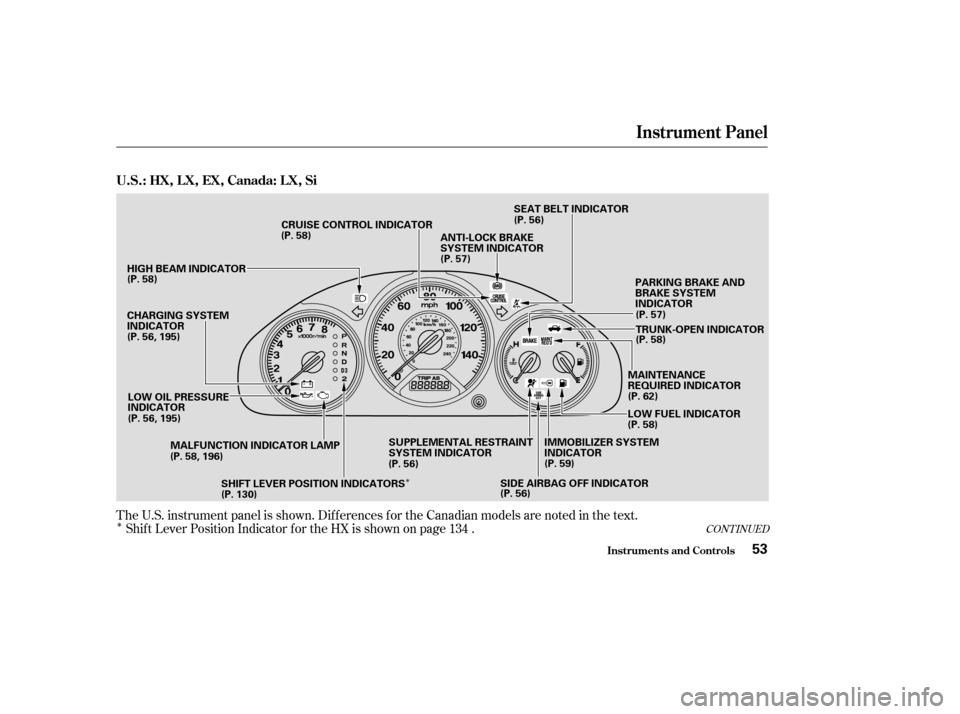
The U.S. instrument panel is shown. Dif f erences f or the Canadian models are noted in the text.
Shif t Lever Position Indicator f or the HX is shown on page 134 .
Instrument Panel
Inst rument s and Cont rols
U.S.:HX,LX,EX,Canada:LX,Si
53
IMMOBILIZER SYSTEM
INDICATOR MAINTENANCE
REQUIRED INDICATOR
SUPPLEMENTAL RESTRAINT
SYSTEM INDICATOR
HIGH BEAM INDICATOR
CHARGING SYSTEM
INDICATOR
LOW OIL PRESSURE
INDICATOR MALFUNCTION INDICATOR LAMP CRUISE CONTROL INDICATOR
TRUNK-OPEN INDICATOR
ANTI-LOCK BRAKE
SYSTEM INDICATOR
LOW FUEL INDICATORPARKING BRAKE AND
BRAKE SYSTEM
INDICATOR
(P. 58)
(P. 58)
(P. 56, 195)
(P. 130)
SHIFT LEVER POSITION INDICATORS (P. 56)
(P. 56)(P. 59) (P. 58)
(P. 62) (P. 58)
(P. 57)
(P. 56)
(P. 57)
SIDE AIRBAG OFF INDICATORSEAT BELT INDICATOR
(P. 58, 196)
(P. 56, 195)
�����—�����—�����y�
�������������y���
�(���%�������y���������y
Page 53 of 231
Instrument Panel
Inst rument s and Cont rols
Canada: DX
54
LOW OIL PRESSURE
INDICATORDAYTIME RUNNING
LIGHTS INDICATOR
MALFUNCTION INDICATOR LAMP WASHER LEVEL
INDICATOR
TRUNK-OPEN INDICATOR
IMMOBILIZER SYSTEM
INDICATOR
CHARGING SYSTEM
INDICATOR MAINTENANCE REQUIRED
INDICATORPARKING BRAKE AND
BRAKE SYSTEM
INDICATOR
LOW FUEL INDICATOR
SUPPLEMENTAL RESTRAINT SYSTEM INDICATOR
(P. 56)
(P. 59)
(P. 56, 195)
(P. 56, 195) HIGH BEAM INDICATOR(P. 58)
(P. 62) (P. 57)
(P. 58) (P. 58)
(P. 57)
(P. 56)
(P. 58)
SIDE AIRBAG OFF INDICATOR
(P. 58, 196) SEAT BELT INDICATOR
(P. 56)
�����—�����—�����y�
�������������y���
�(���%�������y���������y
Page 54 of 231
Instrument Panel
Inst rument s and Cont rols
U.S.: DX
55
SUPPLEMENTAL RESTRAINT SYSTEM INDICATOR
IMMOBILIZER SYSTEM
INDICATOR
LOW OIL PRESSURE
INDICATOR
MAINTENANCE REQUIRED INDICATOR
TRUNK-OPEN INDICATOR
PARKING BRAKE AND
BRAKE SYSTEM
INDICATOR
HIGH BEAM INDICATOR LOW FUEL INDICATOR
CHARGING SYSTEM
INDICATOR MALFUNCTION INDICATOR LAMP
(P. 56)
(P. 59)
(P. 56, 195)
(P. 56, 195)
(P. 56)(P. 58)
(P. 62) (P. 57)
(P. 58)
(P. 56)
(P. 58)
SIDE AIRBAG OFF INDICATOR
(P. 58, 196) SEAT BELT INDICATOR
�����—�����—�����y�
�������������y���
�(���%�������y���������y
Page 55 of 231

The instrument panel has many
indicators to give you important
inf ormation about your vehicle.If this indicator comes on when the
engine is running, the battery is not
being charged. For more inf ormation,
see page .
The engine can be severely damaged
if this indicator f lashes or stays on
when the engine is running. For
complete inf ormation, see page .
This indicator comes on when you
turn the ignition switch to ON (II). If
it comes on at any other time, it
indicates a potential problem with
your f ront airbags or automatic seat
belt tensioners. On models equipped
with side airbags, this light will also
alert you to a potential problem with
your side airbags or passenger’s side
airbag automatic cutoff system. For
complete inf ormation, see page .
This indicator comes on when you
turn the ignition switch to ON (II). If
it comes on at any other time, it
indicates that the passenger’s side
airbag has automatically shut off.
For more inf ormation, see page .
The seat belt system includes an
indicator on the instrument panel
and a beeper to remind you and your
passengers to f asten your seat belts.
If you turn the ignition switch to ON
(II) bef ore f astening your belt, the
beeper sounds and the indicator
f lashes. If you do not f asten your
seat belt bef ore the beeper stops, the
indicator stops f lashing but remainson.
If you continue driving without
f astening your seat belt, the beeper
sounds and the indicator f lashes
again at regular intervals.
26
27 195
195
Only on models equipped with side
airbags
Supplemental Restraint
System Indicator Charging System
Indicator
L ow Oil Pressure
Indicator
Side Airbag Of f Indicator
Seat Belt Indicator
Inst rument s and Cont rols
Instrument Panel Indicators
56
�����—�����—�����y�
���������
���y���
�(���%�������y���������y