Page 11 of 231

The National Highway Traffic Safety
Administration and Transport
Canada recommend that drivers
allow at least 10 inches (25 cm)
between the center of the steering
wheel and the chest.
If you cannot get f ar enough away
f rom the steering wheel and still
reach the controls, we recommend
that you investigate whether some
type of adaptive equipment may help.Once your seat is adjusted correctly,
rock it back and f orth to make sure it
is locked into position. See page
for how to adjust the front seats.
A f ront passenger should also adjust
the seat-back to an upright position,
but as f ar f rom the dashboard as
possible. A passenger who sits too
close to the dashboard could be
injured if the f ront airbag inf lates. 76
Protecting A dults and Teens
Driver and Passenger Saf ety12
Sitting too close to a front
airbag can result in serious
injury or death if the front
airbags inflate.
Always sit as far back from the
front airbags as possible.
�����—�����—�����y�
���������
���y���
�(���%�������y�����
���y
Page 12 of 231
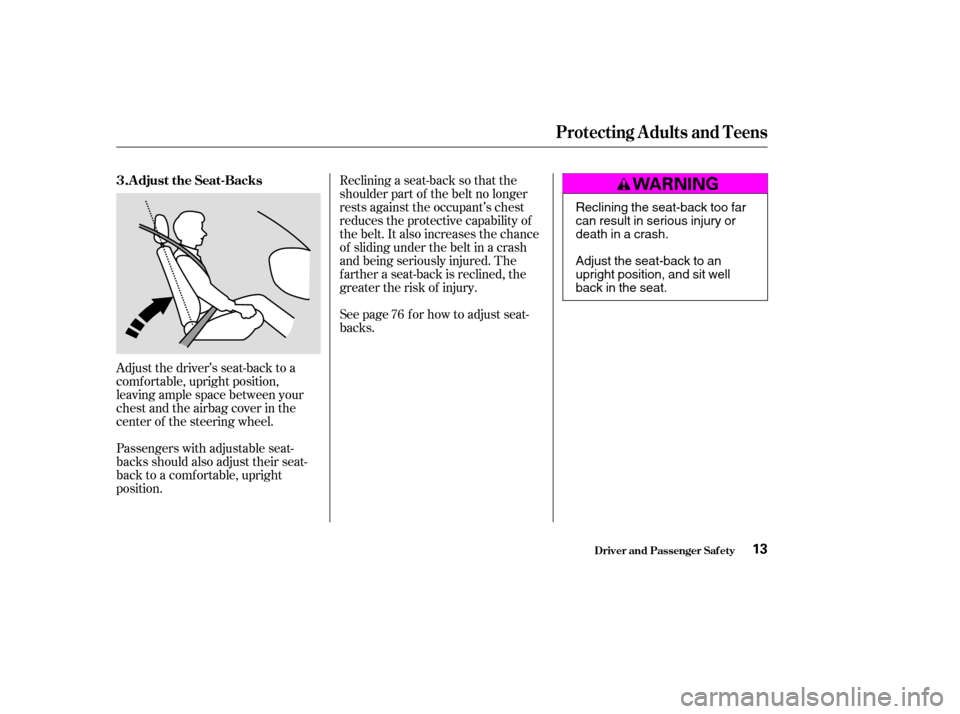
Adjust the driver’s seat-back to a
comf ortable, upright position,
leaving ample space between your
chest and the airbag cover in the
center of the steering wheel.
Passengers with adjustable seat-
backs should also adjust their seat-
back to a comf ortable, upright
position.Reclining a seat-back so that the
shoulder part of the belt no longer
rests against the occupant’s chest
reduces the protective capability of
the belt. It also increases the chance
of sliding under the belt in a crash
and being seriously injured. The
farther a seat-back is reclined, the
greater the risk of injury.
See page f or how to adjust seat-
backs.
76
Protecting A dults and Teens
Driver and Passenger Saf ety
Adjust the Seat-Backs
3.
13
Reclining the seat-back too far
can result in serious injury or
death in a crash.
Adjust the seat-back to an
upright position, and sit well
back in the seat.
�����—�����—�����y�
�����������
�y���
�(���%�������y�����
���y
Page 15 of 231
Pull up on the shoulder belt to
remove any slack, then check that
the belt rests across the center of
your chest and over your shoulder.
This spreads the f orces of a crash
over the strongest bones in your
upper body.This could cause
very serious injuries in a crash.
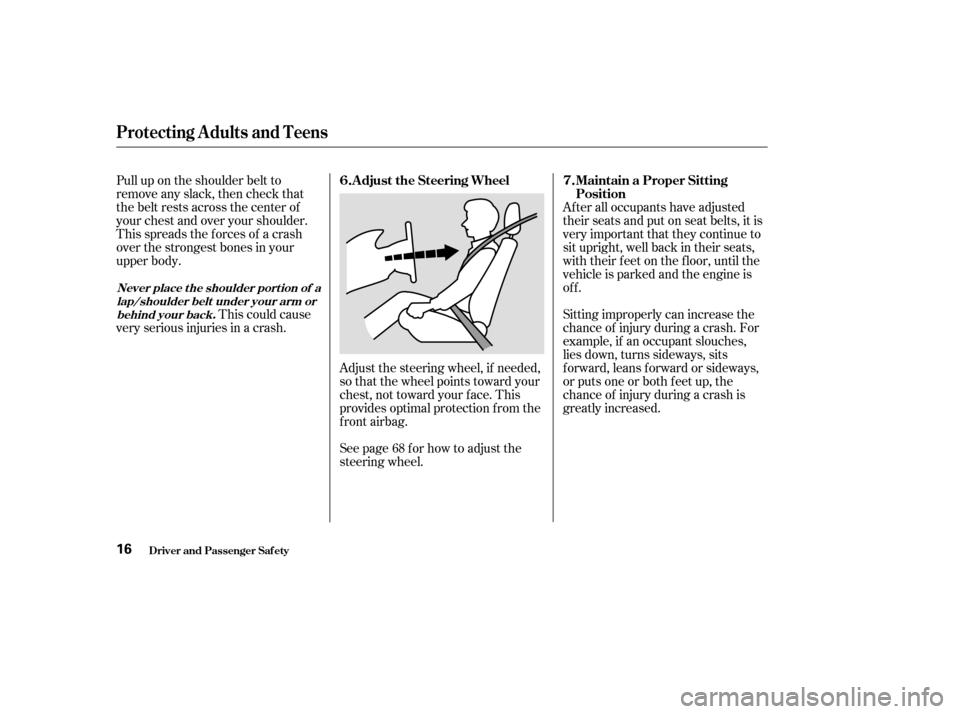
Adjust the steering wheel, if needed,
so that the wheel points toward your
chest, not toward your f ace. This
provides optimal protection f rom the
f ront airbag.
See page f or how to adjust the
steering wheel.After all occupants have adjusted
their seats and put on seat belts, it is
very important that they continue to
sit upright, well back in their seats,
with their feet on the floor, until the
vehicle is parked and the engine is
of f .
Sitting improperly can increase the
chance of injury during a crash. For
example, if an occupant slouches,
lies down, turns sideways, sits
forward, leans forward or sideways,
or puts one or both f eet up, the
chance of injury during a crash is
greatly increased.
68
Protecting A dults and Teens
Driver and Passenger Saf ety
Never place t he shoulder port ion of a lap/shoulder belt under your arm orbehind your back.
Adjust the Steering Wheel Maintain a Proper Sitting Position
6.
7.
16
�����—�����—�����y�
�������������y���
�(���%�������y�����
���y
Page 16 of 231
In addition, an occupant who is out of
position in the f ront seat can be
seriously or f atally injured in a crash
by striking interior parts of the
vehicle or being struck by an
inf lating f ront airbag. Being struck
by an inf lating side airbag can
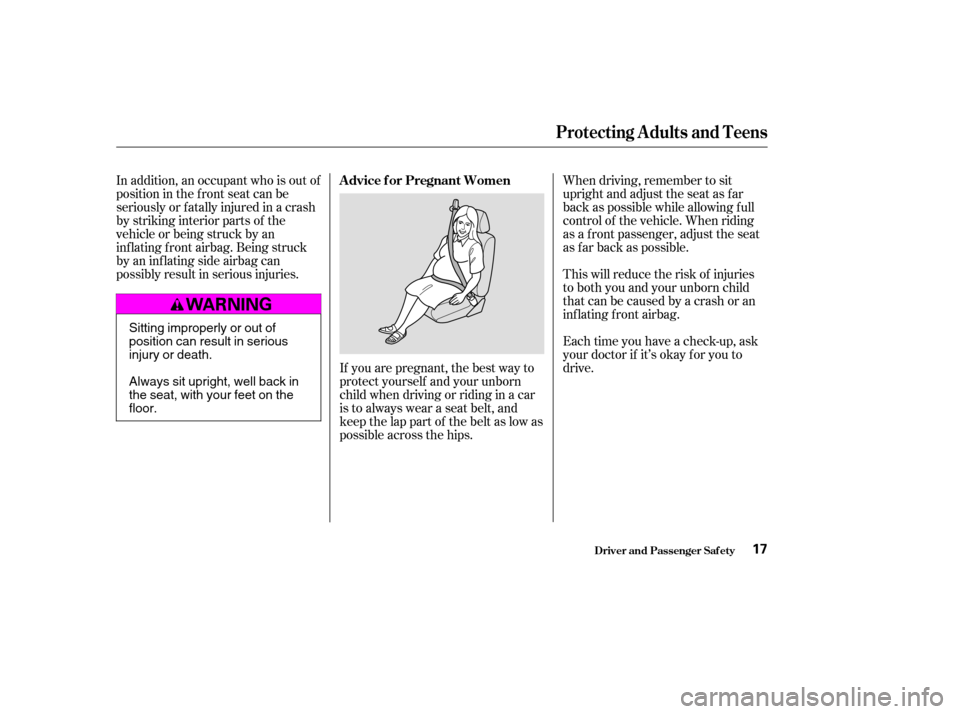
possibly result in serious injuries.If you are pregnant, the best way to
protect yourself and your unborn
child when driving or riding in a car
is to always wear a seat belt, and
keep the lap part of the belt as low as
possible across the hips.When driving, remember to sit
upright and adjust the seat as f ar
back as possible while allowing f ull
control of the vehicle. When riding
as a f ront passenger, adjust the seat
as far back as possible.
This will reduce the risk of injuries
to both you and your unborn child
that can be caused by a crash or an
inflating front airbag.
Each time you have a check-up, ask
your doctor if it’s okay f or you to
drive.
Protecting A dults and Teens
Driver and Passenger Saf ety
Advice f or Pregnant Women
17
Sitting improperly or out of
position can result in serious
injury or death.
Always sit upright, well back in
the seat, with your feet on thefloor.
�����—�����—�����y�
�������������y���
�(���%�������y���������y
Page 17 of 231
If they do, they
could be very seriously injured in a
crash.
Devices intended to improve
occupant comf ort or reposition the
shoulder part of a seat belt can
severely compromise the
protective capability of the seat
belt and increase the chance of
serious injury in a crash. Carrying hard or sharp
objects on your lap, or driving with
a pipe or other sharp objects in
your mouth, can result in injuries
if your f ront airbag inf lates.
If your
hands or arms are close to an
airbag cover, they could be injured
if the front airbag inflates.
Objects on
the covers marked ‘‘SRS AIRBAG’’
could interf ere with the proper
operation of the airbags. Or, if the
airbags inflate, the objects could
be propelled inside the vehicle and
hurt someone if the airbags inf late. If a side airbag inf lates, a
cupholderorotherhardobject
attached on or near the door could
be propelled inside the vehicle and
hurt someone.
Protecting A dults and Teens
Driver and Passenger Saf ety
Additional Saf ety Precautions
T wo people should never use t he
same seat belt .
Do not put any accessories on seatbelts. Do not place hard or sharp object s
bet ween yourself and a f rontairbag.
K eep your hands and arms awayf rom t he airbag covers.
Do not at t ach or place object s onthe f ront airbag covers. On models wit h side airbags, do
not at t ach hard object s on or neara door.
18
�����—�����—�����y�
������
������y���
�(���%�������y�������
�y
Page 19 of 231
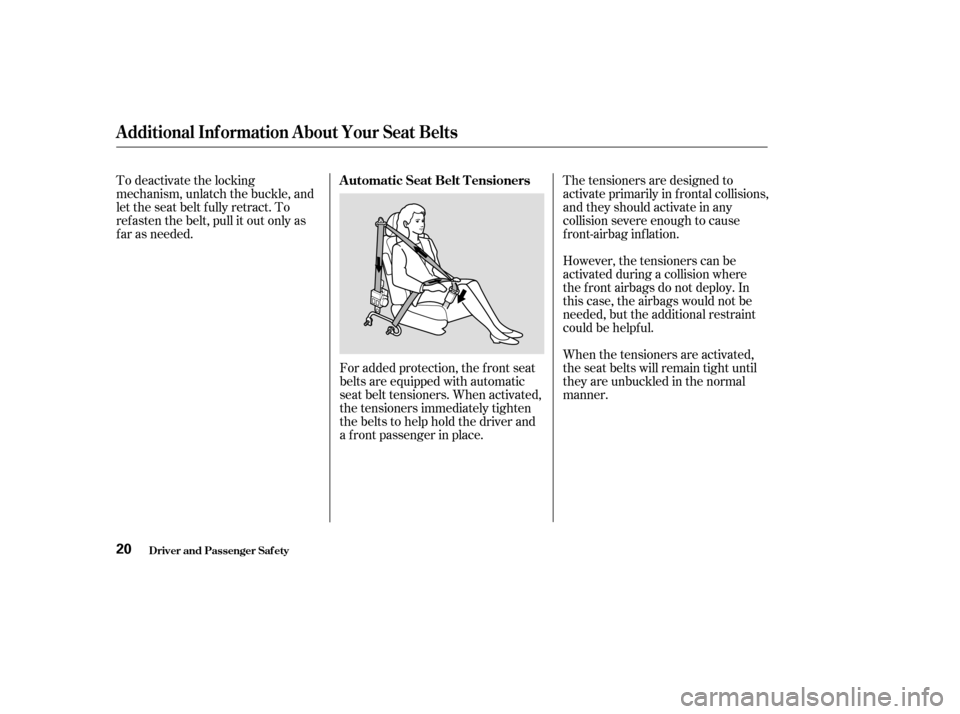
For added protection, the f ront seat
belts are equipped with automatic
seat belt tensioners. When activated,
the tensioners immediately tighten
the belts to help hold the driver and
a f ront passenger in place.The tensioners are designed to
activate primarily in f rontal collisions,
andtheyshouldactivateinany
collision severe enough to cause
front-airbag inflation.
When the tensioners are activated,
the seat belts will remain tight until
they are unbuckled in the normal
manner.
To deactivate the locking
mechanism, unlatch the buckle, and
let the seat belt f ully retract. To
ref asten the belt, pull it out only as
f ar as needed.
However, the tensioners can be
activated during a collision where
the f ront airbags do not deploy. In
this case, the airbags would not be
needed, but the additional restraint
could be helpf ul.
A utomatic Seat Belt T ensioners
Additional Inf ormation About Your Seat Belts
Driver and Passenger Saf ety20
�����—�����—�����y�
������
������y���
�(���%�������y���������y
Page 21 of 231

Your airbag system includes:Two SRS (Supplemental Restraint
System) f ront airbags. The driver’s
airbag is stored in the center of
the steering wheel; the f ront
passenger’sairbagisstoredinthe
dashboard. Both are marked ‘‘SRS
AIRBAG.’’
one f or the driver and one f or a
f ront passenger. The airbags are
stored in the outer edges of the
seat-backs. Both are marked
‘‘SIDE AIRBAG’’ (see page ).
Automatic front seat belt
tensioners (see page ).
Sensors that can detect a
moderate to severe frontal impact
or side impact in models equipped
with side airbags. A sophisticated electronic system
that continually monitors and
records inf ormation about the
sensors, the control unit, the
airbag activators, and driver and
frontpassengerseatbeltusewhen
the ignition is in the ON (II)
position.
If you ever have a moderate to
severe f rontal collision, sensors will
detect the vehicle’s rapid
deceleration. If the rate of
deceleration is high enough, the
control unit will instantly inf late the
driver’s and f ront passenger’s f ront
airbags, at the time and with the
f orce needed.
Emergency backup power in case
your vehicle’s electrical system is
disconnected in a crash.
An indicator on the instrument
panel that alerts you to a possible
problem with your airbags (see
page ).
an indicator on the dashboard that
alerts you that the passenger’s
side airbag has been turned of f
(see page ).
25
20 26
27
On models equipped with side airbags, On models equipped with side airbags,
Airbag System Components How Your Front Airbags Work
Additional Inf ormation About Your Airbags
Driver and Passenger Saf ety22
�����—�����—�����y�
������
������y���
�(���%�������y���������y
Page 22 of 231
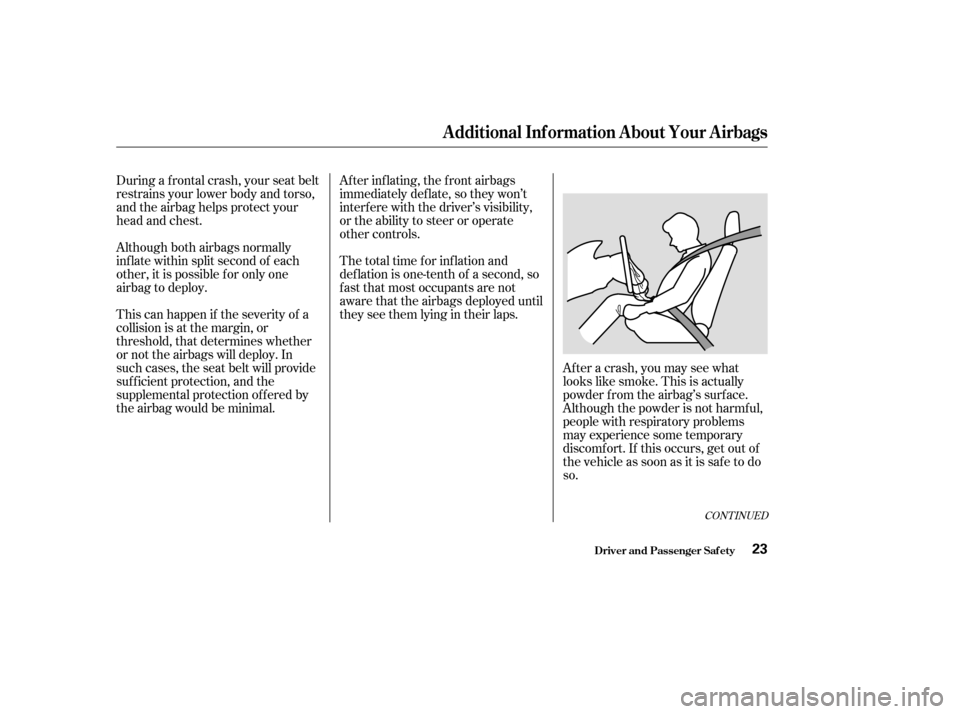
During a f rontal crash, your seat belt
restrains your lower body and torso,
and the airbag helps protect your
head and chest.Af ter inf lating, the f ront airbags
immediately def late, so they won’t
interf ere with the driver’s visibility,
or the ability to steer or operate
other controls.
The total time for inflation and
def lation is one-tenth of a second, so
f ast that most occupants are not
aware that the airbags deployed until
they see them lying in their laps.
After a crash, you may see what
looks like smoke. This is actually
powder f rom the airbag’s surf ace.
Although the powder is not harmf ul,
people with respiratory problems
mayexperiencesometemporary
discomf ort. If this occurs, get out of
the vehicle as soon as it is saf e to do
so.
Although both airbags normally
inf late within split second of each
other, it is possible f or only one
airbag to deploy.
This can happen if the severity of a
collision is at the margin, or
threshold, that determines whether
or not the airbags will deploy. In
such cases, the seat belt will provide
suf f icient protection, and the
supplemental protection of f ered by
the airbag would be minimal.
CONT INUED
Additional Inf ormation About Your Airbags
Driver and Passenger Saf ety23
�����—�����—�����y�
������
������y���
�(���%�������y���������y