Page 117 of 231
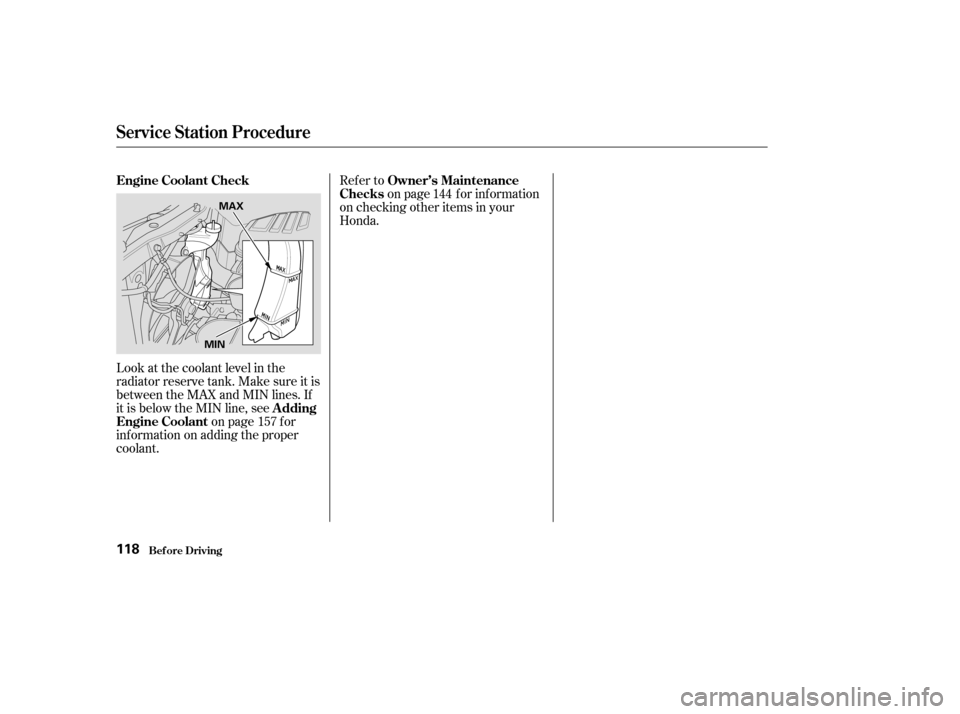
Look at the coolant level in the
radiator reserve tank. Make sure it is
between the MAX and MIN lines. If
it is below the MIN line, seeon page f or
inf ormation on adding the proper
coolant. Refer to
on page f or inf ormation
on checking other items in your
Honda.
157 144
Service Station Procedure
Engine Coolant Check
A dding
Engine Coolant Owner’s Maintenance
Checks
Bef ore Driving118
MAX
MIN
�����—�����—�����y�
���������
���y���
�(���%�������y���
���
�y
Page 118 of 231
Try to maintain a constant speed.
Everytimeyouslowdownand
speed up, your vehicle uses extra
fuel.Usethecruisecontrolwhen
appropriate.
Combine several short trips into
one.
The air conditioning puts an extra
load on the engine which makes it
usemorefuel.Usethefresh-air
ventilation when possible.
an underinf lated tire
causes more ‘‘rolling resistance,’’
which uses f uel.
The build-up of snow or mud on
your vehicle’s underside adds
weight and rolling resistance.
Frequent cleaning helps your f uel
mileage and reduces the chance of
corrosion.
Drive moderately. Rapid
acceleration, abrupt cornering and
hard braking use more f uel.
Always maintain your vehicle
according to the maintenance
schedule. See
(see page
).
Always drive in the highest gear
possible. 144
For example,
Improving Fuel Economy
Owner’s
Maintenance Checks
Fuel Economy
Bef ore Driving119
�����—�����—�����y�
�������������y���
�(���%�������y���
�����y
Page 124 of 231
This section gives you tips on
starting the engine under various
conditions, and how to operate the
5-speed manual and automatic
transmissions. It also includes impor-
tant inf ormation on parking your
vehicle, and the braking system.........................
Preparing to Drive . 126
.......................
Starting the Engine . 127
....
5-speed Manual Transmission . 128
..............
Automatic Transmission . 130
.
Automatic Transmission (CVT) . 134
...........................................
Parking . 137
.............................
Braking System . 138
...........................
Towing a Trailer . 138
...............
Anti-lock Brakes (ABS) . 139
Driving
Driving125
�����—�����—�����y�
�������������y���
�(���%�������y���
�����y
Page 125 of 231
Fasten your seat belt. Check that
your passengers have f astened
their seat belts (see page ).
When you start the engine, check
the gauges and indicator lights in
the instrument panel (see page).
Make sure the doors are securely
closed and locked.
Check the steering wheel
adjustment (see page ).
Check the adjustment of the
inside and outside mirrors (see
page ).
Check that any items you may be
carrying are stored properly or
f astened down securely.
Check the seat adjustment (see
page ).
Youshoulddothefollowingchecks
and adjustments every day bef ore
you drive your vehicle.
Make sure all windows, mirrors,
and outside lights are clean and
unobstructed. Remove f rost, snow,
or ice.
Check that the hood and trunk are
f ully closed.
Visually check the tires. If a tire
looks low, use a gauge to check its
pressure.
1. 2. 3. 4.
9.
8.
7.
6.
5.
10.
76
83 68 14
53
Driving
Preparing to Drive
126
�����—�����—�����y�
�������������y���
�(���%�������y���
�����y
Page 126 of 231

If the engine does not start within
15 seconds, or starts but stalls
right away, repeat step 4 with the
accelerator pedal pressed halfway
down. If the engine starts, release
pressure on the accelerator pedal
so the engine does not race.
If the engine fails to start, press
the accelerator pedal all the way
downandholdittherewhile
starting to clear flooding. If the
engine still does not start, return
to step 5.
Apply the parking brake.
In cold weather, turn of f all
electrical accessories to reduce
the drain on the battery.
Make sure the shif t lever is in
Park. Press on the brake pedal.
Push the clutch pedal down all the
way.
Without touching the accelerator
pedal, turn the ignition key to the
START (III) position. Do not hold
the key in START for more than
15 seconds at a time. If the engine
does not start right away, pause
f or at least 10 seconds bef ore
trying again. 5. 6.
1. 2. 3. 4.
Manual Transmission:
Automatic Transmission:
Starting the Engine
Driving127
NOTICE: The engine is harder to start
in cold weather. Also, the thinner air
f ound at altitudes above 8,000 f eet
(2,400 meters) adds to this problem.
�����—�����—�����y�
�������������y���
�(���%�������y���
�����y
Page 127 of 231
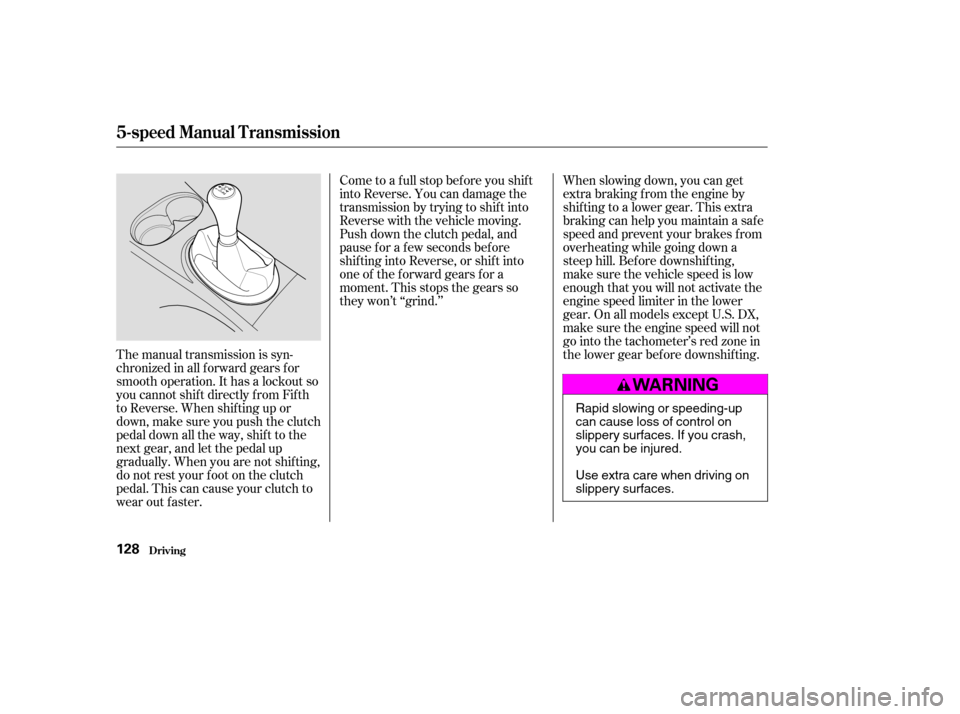
The manual transmission is syn-
chronizedinallforwardgearsfor
smooth operation. It has a lockout so
you cannot shift directly from Fifth
to Reverse. When shif ting up or
down,makesureyoupushtheclutch
pedal down all the way, shift to the
next gear, and let the pedal up
gradually. When you are not shif ting,
do not rest your f oot on the clutch
pedal. This can cause your clutch to
wear out faster.Come to a full stop before you shift
into Reverse. You can damage the
transmission by trying to shif t into
Reverse with the vehicle moving.
Push down the clutch pedal, and
pause f or a f ew seconds bef ore
shif ting into Reverse, or shif t into
one of the f orward gears f or a
moment. This stops the gears so
they won’t ‘‘grind.’’
When slowing down, you can get
extra braking from the engine by
shifting to a lower gear. This extra
braking can help you maintain a safe
speed and prevent your brakes f rom
overheating while going down a
steep hill. Bef ore downshif ting,
make sure the vehicle speed is low
enough that you will not activate the
engine speed limiter in the lower
gear. On all models except U.S. DX,
make sure the engine speed will not
go into the tachometer’s red zone in
the lower gear bef ore downshif ting.
5-speed Manual T ransmission
Driving128
Rapid slowing or speeding-up
can cause loss of control on
slippery surfaces. If you crash,
you can be injured.
Use extra care when driving on
slippery surfaces.
�����—�����—�����y�
�������������y���
�(���%�������y���
���
�y
Page 128 of 231

Normal acceleration15 mph (24 km/h)
27 mph (43 km/h)
39 mph (63 km/h)
53 mph (85 km/h)
Shif t up
1st to 2nd
2nd to 3rd 3rd to 4th4th to 5th
Shif t up
1st to 2nd
2nd to 3rd 3rd to 4th4th to 5th 9mph(14km/h)
20 mph (32 km/h)
33 mph (53 km/h)
48 mph (77 km/h) If you exceed the maximum speed
f or the gear you are in, the engine
speed will enter into the tachometer’s
red zone. If this occurs, you may f eel
the engine cut in and out. This is
caused by a limiter in the engine’s
computer controls. The engine will
run normally when you reduce the
RPM below the red zone.
Bef ore downshif ting, make sure the
engine will not go into the
tachometer’s red zone.
If you exceed the maximum speed
f or the gear you are in, you may f eel
the engine cut in and out. This is
caused by a limiter in the engine’s
computer controls. The engine will
run normally when you reduce the
engine speed by upshif ting or
slowing down.
Bef ore downshif ting, make sure the
vehicle speed is low enough that you
will not activate the engine speed
limiter in the lower gear.
Drive in the highest gear that lets
the engine run and accelerate
smoothly. This will give you the best
f uel economy and ef f ective emis-
sions control. The f ollowing shif t
points are recommended:
Cruise from acceleration
All models except U.S. DX
U.S. DX model
Recommended Shif t Points Engine Speed L imiter
5-speed Manual T ransmission
Driving129
�����—�����—�����y�
�������������y���
�(���%�������y���
�����y
Page 130 of 231
�µ
�µ �µ
�µ
�µ
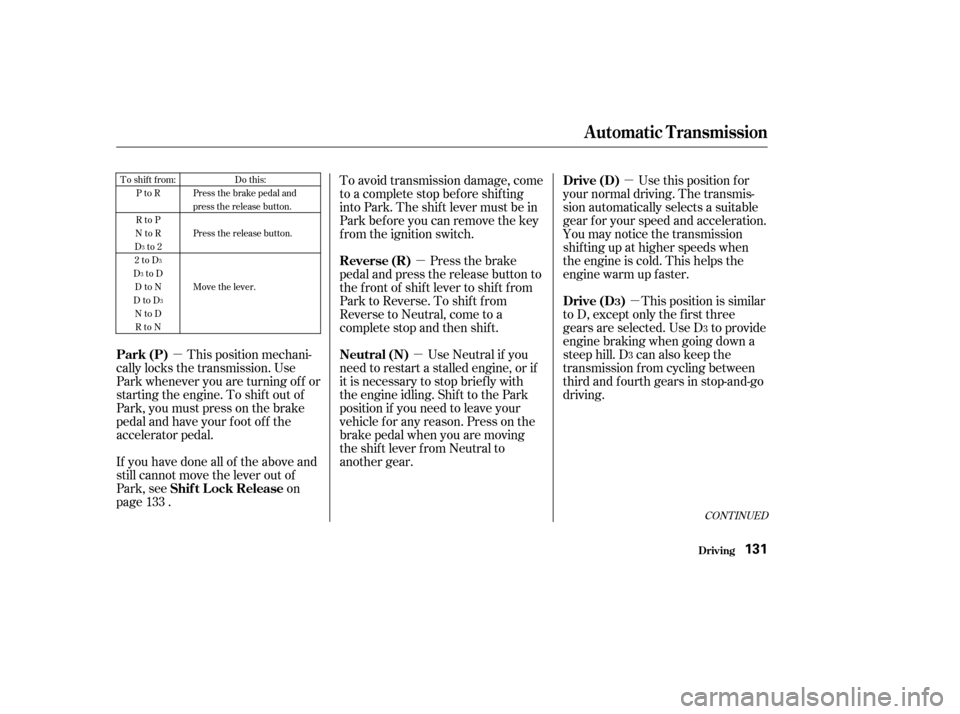
To shift from: PtoR
RtoP
NtoR
Dto2
2toD
DtoD DtoN
DtoD NtoDRtoN Do this:
Press the brake pedal and
press the release button.
Press the release button.
Move the lever.
3
3
3 3
3
3
To avoid transmission damage, come
to a complete stop bef ore shif ting
into Park. The shif t lever must be in
Park bef ore you can remove the key
from the ignition switch. Press the brake
pedal and press the release button to
the f ront of shif t lever to shif t f rom
Park to Reverse. To shif t f rom
Reverse to Neutral, come to a
completestopandthenshift.
Use Neutral if you
need to restart a stalled engine, or if
it is necessary to stop brief ly with
the engine idling. Shif t to the Park
position if you need to leave your
vehicle for any reason. Press on the
brake pedal when you are moving
the shift lever from Neutral to
another gear. Use this position f or
your normal driving. The transmis-
sion automatically selects a suitable
gear f or your speed and acceleration.
You may notice the transmission
shif ting up at higher speeds when
the engine is cold. This helps the
engine warm up f aster.
This position is similar
to D, except only the first three
gears are selected. Use D to provide
engine braking when going down a
steep hill. D can also keep the
transmission f rom cycling between
third and f ourth gears in stop-and-go
driving.
This position mechani-
cally locks the transmission. Use
Park whenever you are turning of f or
starting the engine. To shif t out of
Park, you must press on the brake
pedal and have your f oot of f the
accelerator pedal.
If you have done all of the above and
still cannot move the lever out of
Park, see on
page . 133
CONT INUED
Reverse (R)
Neutral (N) Drive (D)
Drive (D )
Park (P)
Shif t L ock Release
3
Automatic Transmission
Driving131
�����—�����—�����y�
�������������y���
�(���%�������y���
�����y