Page 164 of 231
CONT INUED
If you need to change a headlight
bulb on the passenger’s side, remove
the bolt from the stay and push the
battery toward windshield to obtain
enough working space.Remove the electrical connector
f rom the bulb by pushing on the
tab and pulling the connector
down.
Remove the bulb by turning it one-
quarter turn counterclockwise.Push the electrical connector back
onto the bulb. Make sure it is on
all the way.
Turn on the headlights to test the
new bulb.
Put the battery back to its original
position, reinstall the bolt in the
stay and tighten it securely.
Reinstall the power steering
reservoir.
(Passenger’s side)
(Driver’s side)
Insert the new bulb into the hole
and turn it one-quarter turn clock-
wise to lock it in place.
2. 3. 4. 5.6. 7.
Lights
Maint enance165
STAY
TAB
BULB
CONNECTOR
�����—�����—�����y�
�������������y���
�(���%�������y���
�����y
Page 169 of 231
Check the condition of the wiper
blades at least every six months.
Replace them if you f ind signs of
cracking in the rubber, areas that are
getting hard, or if they leave streaks
and unwiped areas when used.Raise the wiper arm of f the
windshield.
Disconnect the blade assembly
fromthewiperarmbypushingin
the lock tab. Hold the lock tab in
while you push the blade assembly
toward the base of the arm.Remove the blade f rom its holder
by grasping the tabbed end of the
blade. Pull f irmly until the tabs
come out of the holder.
2.
1.
3.
Wiper Blades
Maint enance170
LOCK TABBLADEDo not open the hood when the wiper
arms are raised, or you will damage the
hood and wiper arms.
�����—�����—�����y�
�������������y���
�(���%�������y���
�����y
Page 177 of 231
�µ
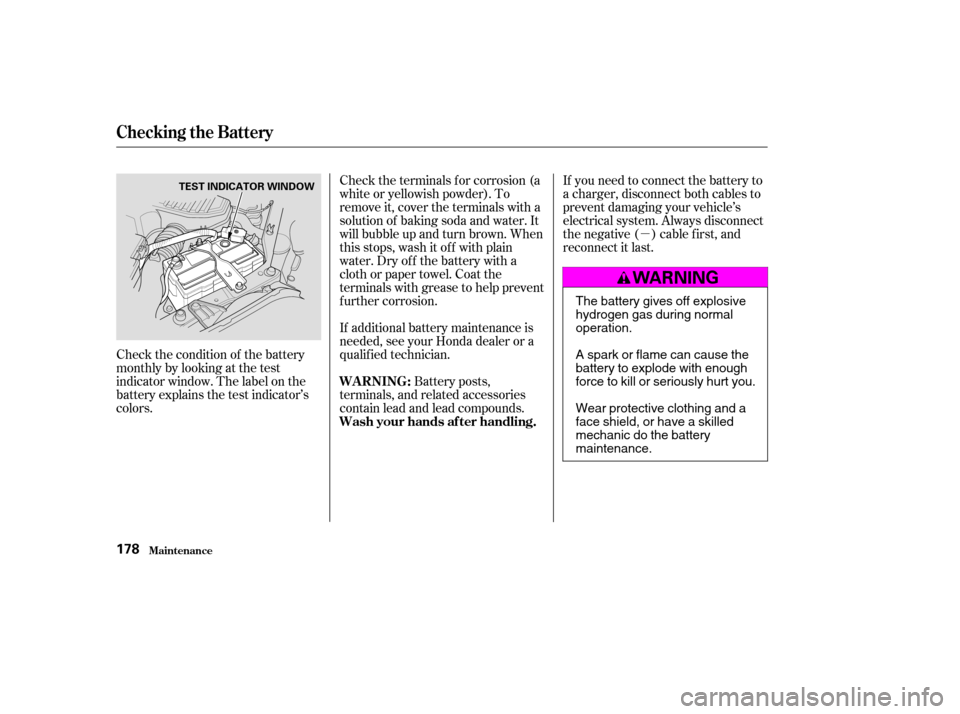
Check the condition of the battery
monthlybylookingatthetest
indicator window. The label on the
battery explains the test indicator’s
colors. If additional battery maintenance is
needed, see your Honda dealer or a
qualif ied technician.
Battery posts,
terminals, and related accessories
contain lead and lead compounds. If you need to connect the battery to
a charger, disconnect both cables to
prevent damaging your vehicle’s
electrical system. Always disconnect
the negative ( ) cable first, and
reconnect it last.
Check the terminals f or corrosion (a
white or yellowish powder). To
remove it, cover the terminals with a
solution of baking soda and water. It
will bubble up and turn brown. When
this stops, wash it of f with plain
water. Dry off the battery with a
cloth or paper towel. Coat the
terminals with grease to help prevent
f urther corrosion.
WARNING:
Wash your hands af ter handling.
Checking the Battery
Maint enance178
TEST INDICATOR WINDOW
The battery gives off explosive
hydrogen gas during normaloperation.
A spark or flame can cause the
battery to explode with enough
force to kill or seriously hurt you.
Wear protective clothing and a
face shield, or have a skilled
mechanic do the batterymaintenance.
�����—�����—�����y�
���������
�
�y���
�(���%�������y���
���
�y
Page 178 of 231
If you need to park your vehicle f or
an extended period (more than one
month), there are several things you
should do to prepare it f or storage.
Proper preparation helps prevent
deterioration and makes it easier to
get your vehicle back on the road. If
possible, store your vehicle indoors.Fill the f uel tank.
Change the engine oil and f ilter. Block the rear wheels.
If the vehicle is to be stored f or a
longer period, it should be
supported on jackstands so the
tires are of f the ground.
Leave one window open slightly (if
the car is being stored indoors).
Disconnect the battery.
Support the f ront wiper blade
arms with a f olded towel or rag so
they do not touch the windshield.
To minimize sticking, apply a
silicone spray lubricant to all door
and trunk seals. Also, apply a
vehiclebodywaxtothepainted
surfaces that mate with the door
and trunk seals.
Wash and dry the exterior
completely.
Cleantheinterior.Makesurethe
carpeting, floor mats, etc. are
completely dry.
Leave the parking brake off. Put
the transmission in Reverse
(5-speed manual) or Park
(automatic). Cover the vehicle with a
‘‘breathable’’ cover, one made
f rom a porous material such as
cotton. Non-porous materials, such
as plastic sheeting, trap moisture,
which can damage the paint.
If possible, run the engine f or a
while periodically until it reaches
full operating temperature (the
cooling f an cycle on and of f twice).
Pref erably once a month.
If you store your vehicle f or 12
months or longer, have your Honda
dealer perf orm the inspections called
f or in the 24 months/30,000 miles
maintenance schedule (Normal
Conditions) as soon as you take it
out of storage (see page ). The
replacements called f or in the
maintenance schedule are not
needed unless the vehicle has
actually reached that time or mileage. 145
Vehicle Storage
Maint enance179
�����—�����—�����y�
�������������y���
�(���%�������y���
�����y
Page 180 of 231
This section covers the more
common problems that motorists
experience with their vehicles. It
gives you inf ormation about how to
safely evaluate the problem and what
to do to correct it. If the problem has
stranded you on the side of the road,
you may be able to get going again.
If not, you will also f ind instructions
on getting your vehicle towed.......................
Compact Spare Tire . 182
....................
Changing a Flat Tire . 183
.............
If the Engine Won’t Start . 189
................................
Jump Starting . 191
..............
If the Engine Overheats . 192
.........
Low Oil Pressure Indicator . 195
..........
Charging System Indicator . 195
.......
Malf unction Indicator Lamp . 196
...............
Brake System Indicator . 197
..................
Closing the Moonroof . 198
..............................................
Fuses . 199
..........................
Fuse Locations . 201
......................
Emergency Towing . 203
Taking Care of the Unexpected
T aking Care of t he Unexpect ed181
�����—�����—�����y�
�������������y���
�(���%�������y���
�����y
Page 189 of 231
In this case, the starter motor’s
speed sounds normal, or even f aster
than normal, when you turn the
ignition switch to START (III), but
the engine does not run.Are you using the proper starting
procedure? Ref er to on page .
Are you using a properly coded
key? An improperly coded key will
cause the immobilizer system
indicator in the instrument panel
to blink rapidly (see page ). Do you have f uel? Check the f uel
gauge; the low f uel indicator may
not be working.
There may be an electrical
problem, such as no power to the
f uel pump. Check all the f uses
(see page ).
If youfindnothingwrong,youwill
need a qualif ied technician to f ind
the problem. See
on page .
127 199 203
70
If theEngineWon’tStart
T aking Care of t he Unexpect ed
T he Starter Operates Normally Starting the
Engine Emergency
Towing
190
�����—�����—�����y�
�������������y���
�(���%�������y���
�����y
Page 192 of 231

If you do not see steam or spray,
leave the engine running and
watch the temperature gauge. If
the high heat is due to overloading,
the engine should start to cool
down almost immediately. If it
does, wait until the temperature
gauge comes down to the midpoint,
then continue driving.
If the temperature gauge stays at
the red mark, turn of f the engine.Look f or any obvious coolant leaks,
such as a split radiator hose.
Everything is still extremely hot,
so use caution. If you f ind a leak, it
must be repaired bef ore you
continue driving (see
on page ).
If you don’t f ind an obvious leak,
check the coolant level in the
radiator reserve tank. Add coolant
if the level is below the MIN mark.
Saf ely pull to the side of the road.
Put the transmission in Neutral or
Park, and set the parking brake.
Turn of f all the accessories, and
turn on the hazard indicator.
If you see steam and/or spray
coming f rom under the hood, turn
of f the engine. Wait until you see
no more signs of steam or spray,
then open the hood.
1. 2.
3. 4.5. 6.
203
CONT INUED
If theEngineOverheats
T aking Care of t he Unexpect ed
Emergency
Towing
193
�����—�����—�����y���������������y���
�(���%�������y���
�����y
Page 193 of 231
If there was no coolant in the
reserve tank, you may need to add
coolant to the radiator. Let the
engine cool down until the pointer
reaches the middle of the tempera-
ture gauge, or lower, bef ore check-
ing the radiator.Using gloves or large heavy cloth,
turn the radiator cap
counterclockwise without pushing
down to the first stop. After the
pressure releases, push down on
the cap, and turn it until it comes
off.Put the radiator cap back on
tightly. Run the engine and watch
the temperature gauge. If it goes
back to the red mark, the engine
needs repair (see
on page ).
If the temperature stays normal,
check the coolant level in the
radiator reserve tank. If it has
gone down, add coolant to the
MAX mark. Put the cap back on
tightly.
Start the engine, and set the
temperature control dial to
maximum. Add coolant to the
radiator up to the base of the f iller
neck. If you do not have the
proper coolant mixture available,
you can add plain water.
Remember to have the cooling
system drained and ref illed with
the proper mixture as soon as you
can.
7.
8. 9.10. 11.
203
If theEngineOverheats
T aking Care of t he Unexpect ed
Emergency
Towing
194
Removing the radiator cap
while the engine is hot can
cause the coolant to spray out,
seriously scalding you.
Always let the engine and
radiator cool down before
removing the radiator cap.
�����—�����—�����y���������������y���
�(���%�������y���
�����y


