2004 GMC SIERRA Rear axle
[x] Cancel search: Rear axlePage 384 of 588
Fifth wheel or gooseneck kingpin weight should be 15 to
25 percent of the trailer weight up to the maximum
amount speci®ed in the trailering chart for your vehicle.
See ªWeight of theTrailerº, and ªFifth-Wheel and
Gooseneck Traileringº in this section.
Do not exceed the maximum allowable tongue weight
for your vehicle. Choose the shortest hitch extension
that will position the hitch ball closest to the vehicle. This
will help reduce the effect of trailer tongue weight on
the rear axle.
After you have loaded the trailer, weigh the trailer and
then the tongue separately, to see if the weights
are proper. If they are not, you may be able to get them
right by moving some items around in the trailer.Total Weight on Your Vehicle's Tires
Be sure your vehicle's tires are in¯ated to the upper limit
for cold tires. You'll ®nd these numbers on the
Certi®cation label at the rear edge of the driver's door or
see Loading Your Vehicle for more information. Then
be sure you don't go over the GVW limit for your vehicle,
or the GAWR, including the weight of the trailer
tongue. If you use a weight distributing hitch, make sure
you don't go over the rear axle limit before you apply
the weight distribution spring bars.
Hitches
It's important to have the correct hitch equipment.
Crosswinds, large trucks going by and rough roads are
a few reasons why you'll need the right hitch.
4-88
Page 386 of 588
Fifth Wheel and Gooseneck Trailering
Fifth wheel and gooseneck trailers can be used with
many pickup models. These trailers place a larger
percentage of the weight (kingpin weight) on the tow
vehicle than conventional trailers. Make sure this weight
does not cause the vehicle to exceed GAWR or GVWR.
Fifth wheel or gooseneck kingpin weight should be 15 to
25 percent of the trailer weight up to the maximum
amount speci®ed in the trailering chart for your vehicle.
See ªWeight of the Trailerº in this section for more
information.
The hitch should be located in the pickup bed so that
it's centerline is over or slightly in front of the rear axle.
Take care that it is not so far forward that it will
contact the back of the cab in sharp turns. This is
especially important for short box pickups. Trailer pin
box extensions and sliding ®fth wheel hitch assemblies
can help this condition. There should be at least six
inches of clearance between the top of the pickup box
and the bottom of the trailer shelf that extends over
the box.
Make sure the hitch is attached to the tow vehicle frame
rails. Do not use the pickup box for support.
Safety Chains
You should always attach chains between your vehicle
and your trailer. Cross the safety chains under the
tongue of the trailer to help prevent the tongue from
contacting the road if it becomes separated from
the hitch. Instructions about safety chains may be
provided by the hitch manufacturer or by the trailer
manufacturer. If you are towing a trailer up to 5,000 lbs.
(2 271 kg) with a factory-installed step bumper, you
may attach the safety chains to the attaching points on
the bumper. If you are towing a trailer up to your
vehicle's trailer rating limit you may attach the safety
chains to the attaching point on the hitch platform. If you
are towing with an aftermarket hitch follow the trailer
or hitch manufacturer's recommendation for attaching
safety chains. Always leave just enough slack so
you can turn with your rig. Never allow safety chains to
drag on the ground.
4-90
Page 391 of 588

When You Are Ready to Leave After
Parking on a Hill
1. Apply your regular brakes and hold the pedal down
while you:
·Start your engine
·Shift into a gear
·Release the parking brake
2. Let up on the brake pedal.
3. Drive slowly until the trailer is clear of the chocks.
4. Stop and have someone pick up and store the
chocks.
Maintenance When Trailer Towing
Your vehicle will need service more often when you're
pulling a trailer. SeeScheduled Maintenance on
page 6-4for more information. Things that are especially
important in trailer operation are automatic transmission
¯uid (don't over®ll), engine oil, axle lubricant, belt,
cooling system and brake system. Each of these is
covered in this manual, and the Index will help you ®nd
them quickly. If you're trailering, it's a good idea to
review these sections before you start your trip.
Check periodically to see that all hitch nuts and bolts
are tight.
Trailer Wiring Harness
Your vehicle is equipped with one of the following wiring
harnesses for towing a trailer or hauling a slide-in
camper.
Basic Trailer Wiring
All regular, extended cab crew cab pickups have a
six-wire trailer towing harness.
The six-wire harness is located at the rear of the vehicle
and is tied to the vehicle's frame. The harness requires
the installation of a trailer-wiring harness connector,
which is available through your dealer.
4-95
Page 401 of 588

Service............................................................5-3
Doing Your Own Service Work.........................5-3
Adding Equipment to the Outside of Your
Vehicle......................................................5-4
Fuel................................................................5-4
Gasoline Octane............................................5-4
Gasoline Speci®cations....................................5-5
California Fuel...............................................5-5
Additives.......................................................5-6
Fuels in Foreign Countries...............................5-6
Filling Your Tank............................................5-7
Filling a Portable Fuel Container.......................5-9
Checking Things Under the Hood....................5-10
Hood Release..............................................5-10
Engine Compartment Overview.......................5-12
Engine Oil...................................................5-18
Engine Air Cleaner/Filter................................5-23
Automatic Transmission Fluid (Except Allison
Transmission
ž) ..........................................5-25
Automatic Transmission Fluid (Allison
Transmission
ž) ..........................................5-28
Manual Transmission Fluid.............................5-31
Hydraulic Clutch...........................................5-32
Engine Coolant.............................................5-33
Coolant Surge Tank Pressure Cap..................5-36
Engine Overheating.......................................5-36Cooling System............................................5-39
Engine Fan Noise.........................................5-44
Power Steering Fluid.....................................5-45
Windshield Washer Fluid................................5-46
Brakes........................................................5-48
Battery........................................................5-52
Jump Starting...............................................5-53
Rear Axle.......................................................5-59
Four-Wheel Drive............................................5-60
Noise Control System.....................................5-62
Tampering with Noise Control System
Prohibited.................................................5-62
Bulb Replacement..........................................5-64
Halogen Bulbs..............................................5-64
Headlamps..................................................5-64
Front Turn Signal, Sidemarker and Daytime
Running Lamps.........................................5-66
Roof Marker Lamps......................................5-67
Center High-Mounted Stoplamp (CHMSL) and
Cargo Lamp.............................................5-69
Pickup Box Identi®cation and Fender Marker
Lamps.....................................................5-70
Taillamps.....................................................5-71
Replacement Bulbs.......................................5-74
Section 5 Service and Appearance Care
5-1
Page 459 of 588
Rear Axle
When to Check Lubricant
It is not necessary to regularly check rear axle ¯uid
unless you suspect there is a leak or you hear an
unusual noise. A ¯uid loss could indicate a problem.
Have it inspected and repaired..
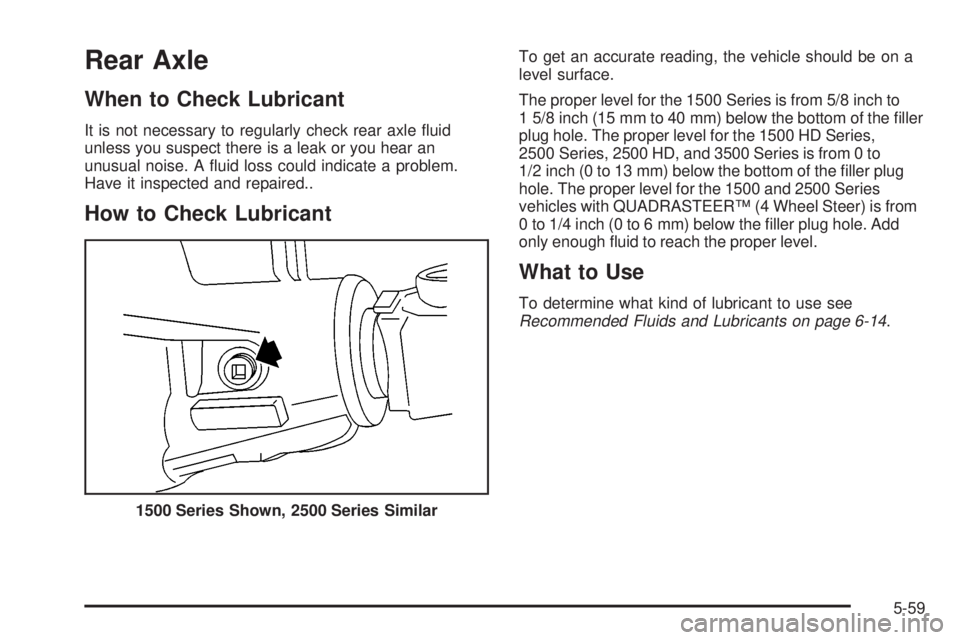
How to Check Lubricant
To get an accurate reading, the vehicle should be on a
level surface.
The proper level for the 1500 Series is from 5/8 inch to
1 5/8 inch (15 mm to 40 mm) below the bottom of the ®ller
plug hole. The proper level for the 1500 HD Series,
2500 Series, 2500 HD, and 3500 Series is from 0 to
1/2 inch (0 to 13 mm) below the bottom of the ®ller plug
hole. The proper level for the 1500 and 2500 Series
vehicles with QUADRASTEERŸ (4 Wheel Steer) is from
0 to 1/4 inch (0 to 6 mm) below the ®ller plug hole. Add
only enough ¯uid to reach the proper level.
What to Use
To determine what kind of lubricant to use seeRecommended Fluids and Lubricants on page 6-14.
1500 Series Shown, 2500 Series Similar
5-59
Page 482 of 588
Belt:A rubber coated layer of cords that is located
between the plies and the tread. Cords may be made
from steel or other reinforcing materials.
Bead:The tire bead contains steel wires wrapped by
steel cords that hold the tire onto the rim.
Bias Ply Tire:A pneumatic tire in which the plies are
laid at alternate angles less than 90 degrees to the
centerline of the tread.
Cold In¯ation Pressure:The amount of air pressure in
a tire, measured in pounds per square inch (psi) or
kilopascals (kPa) before a tire has built up heat
from driving. See
In¯ation - Tire Pressure on page 5-84.
Curb Weight:This means the weight of a motor
vehicle with standard and optional equipment including
the maximum capacity of fuel, oil and coolant, but
without passengers and cargo.
DOT Markings:A code molded into the sidewall of a
tire signifying that the tire is in compliance with the U.S.
Department of Transportation motor vehicle safety
standards. The DOT code includes the Tire Identi®cation
Number (TIN), an alphanumeric designator which can
also identify the tire manufacturer, production plant,
brand and date of production.
GVWR:Gross Vehicle Weight Rating, see
Loading
Your Vehicle on page 4-57.GAWR FRT:Gross Axle Weight Rating for the front
axle, see
Loading Your Vehicle on page 4-57.
GAWR RR:Gross Axle Weight Rating for the rear axle,
see
Loading Your Vehicle on page 4-57.
Intended Outboard Sidewall:The side of an
asymmetrical tire, that must always face outward when
mounted on a vehicle.
Kilopascal (kPa):The metric unit for air pressure.
There are 6.9 kPa's to one psi.
Light Truck (LT-Metric) Tire:A tire used on light duty
trucks and some multipurpose passenger vehicles.
Load Index:An assigned number ranging from 1 to 279
that corresponds to the load carrying capacity of a
tire.
Maximum In¯ation Pressure:The maximum air
pressure to which a cold tire may be in¯ated. The
maximum air pressure is molded onto the sidewall.
Maximum Load Rating:The load rating for a tire at the
maximum permissible in¯ation pressure for that tire.
Maximum Loaded Vehicle Weight:The sum of curb
weight; accessory weight; vehicle capacity weight;
and production options weight.
5-82
Page 494 of 588
Tire Chains
{CAUTION:
If your vehicle has dual wheels or P265/75R16,
LT265/75R16 or P265/70R17 size tires, don't
use tire chains. They can damage your vehicle
because there's not enough clearance. Tire
chains used on a vehicle without the
properamount of clearance can cause damage
to thebrakes, suspension or other vehicle
parts. Thearea damaged by the tire chains
could cause you to lose control of your vehicle
and you or others may be injured in a crash.
Use another type of traction device only if its
manufacturer recommends it for use on your
vehicle and tire size combination and road
CAUTION: (Continued)
CAUTION: (Continued)
conditions. Follow that manufacturer's
instructions. To help avoid damage to your
vehicle, drive slowly, readjust or remove the
device if it's contacting your vehicle, and don't
spin your wheels.
If you do ®nd traction devices that will ®t,
install them on the rear tires.²
Notice:If your vehicle does not have dual wheels
and is equipped with a tire size other than
P265/75R16, LT265/75R16 or P265/70R17, use tire
chains only where legal and only when you
must. Use chains that are the proper size for your
tires. Install them on the tires of the rear axle. Don't
use chains on the tires of the front axle. Tighten
them as tightly as possible with the ends securely
fastened. Drive slowly and follow the chain
manufacturer's instructions. If you can hear the
chains contacting your vehicle, stop and retighten
them. If the contact continues, slow down until
it stops. Driving too fast or spinning the wheels with
chains on will damage your vehicle.
5-94
Page 502 of 588
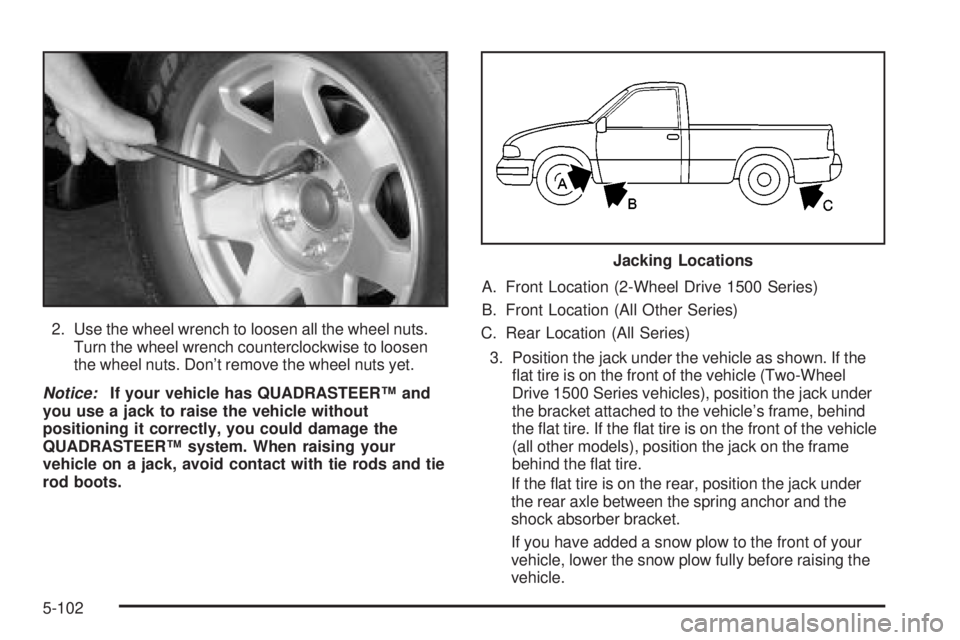
2. Use the wheel wrench to loosen all the wheel nuts.
Turn the wheel wrench counterclockwise to loosen
the wheel nuts. Don't remove the wheel nuts yet.
Notice:If your vehicle has QUADRASTEERŸ and
you use a jack to raise the vehicle without
positioning it correctly, you could damage the
QUADRASTEERŸ system. When raising your
vehicle on a jack, avoid contact with tie rods and tie
rod boots.A. Front Location (2-Wheel Drive 1500 Series)
B. Front Location (All Other Series)
C. Rear Location (All Series)
3. Position the jack under the vehicle as shown. If the
¯at tire is on the front of the vehicle (Two-Wheel
Drive 1500 Series vehicles), position the jack under
the bracket attached to the vehicle's frame, behind
the ¯at tire. If the ¯at tire is on the front of the vehicle
(all other models), position the jack on the frame
behind the ¯at tire.
If the ¯at tire is on the rear, position the jack under
the rear axle between the spring anchor and the
shock absorber bracket.
If you have added a snow plow to the front of your
vehicle, lower the snow plow fully before raising the
vehicle.
Jacking Locations
5-102