Page 360 of 588
Adding a Snow Plow or Similar
Equipment
Before installing a snow plow on your vehicle, here are
some things you will need to know:
Notice:If your vehicle does not have the snow
plow prep package, adding a plow can damage your
vehicle, and the repairs would not be covered by
warranty. Unless your vehicle was built to carry
a snow plow, do not add one to your vehicle. If your
vehicle has the snow plow option called RPO VYU
(snow plow prep package), then the payload
your vehicle can carry will be reduced when a snow
plow is installed. Your vehicle can be damaged if
either the front or rear axle ratings, or the GVW, are
exceeded.
Q:How do I know if my vehicle can handle a
snow plow?
A:Some vehicles are built with a special package,
called RPO VYU (snow plow prep package). If
your vehicle has this option, you can add a plow to
it, provided certain weights, such as the weights
on the vehicle's axles and the GVW, are not
exceeded.
Q:How heavy can a snow plow safely be?
A:The plow your vehicle can carry depends on many
things, such as:
·The options your vehicle came with, and the weight
of those options,
·The weight and number of passengers you intend
to carry,
·The weight of items you have added to your
vehicle, like a tool box or truck cap,
·The total weight of any additional cargo you intend
to carry.
Say, for example, you have a 700 lb. (318 kg) snow
plow. The total weight of all occupants and cargo inside
the cab should not exceed 300 lb. (135 kg). This
means that you may only be able to carry one
passenger. But, even this may be too much if you have
got other equipment already adding to the weight of
your vehicle.
4-64
Page 361 of 588
Here are some guidelines for safely carrying a snow
plow on your vehicle:
·Make sure the weight on the front and rear axles
does not exceed the axle rating for each.
·For the front axle, if more cargo or passengers
must be carried, appropriate counter ballast must be
installed rear of the rear axle. Counter ballast
must be properly secured so it will not move during
driving.
·Follow the snow plow manufacturer's
recommendations regarding rear ballast. Rear
ballast may be required to ensure a proper front and
rear weight distribution ratio, even though the
actual weight at the front axle may be less than the
front axle rating.
·The snow plow manufacturer or installer can assist
you in determining the amount of rear ballast
required, to help make sure your snowplow/vehicle
combination does not exceed the GVW rating,
the front and rear axle ratings, and the front and
rear weight distribution ratio.
·The total vehicle must not exceed the GVW rating.
Q:What is front axle reserve capacity, and how do
I calculate it?
A:Front axle reserve capacity is the difference
between your front GAWR and the front axle
weight of your truck with full fuel and passengers.
Basically, it is the amount of weight you can
add to your front axle before reaching your
front GAWR.
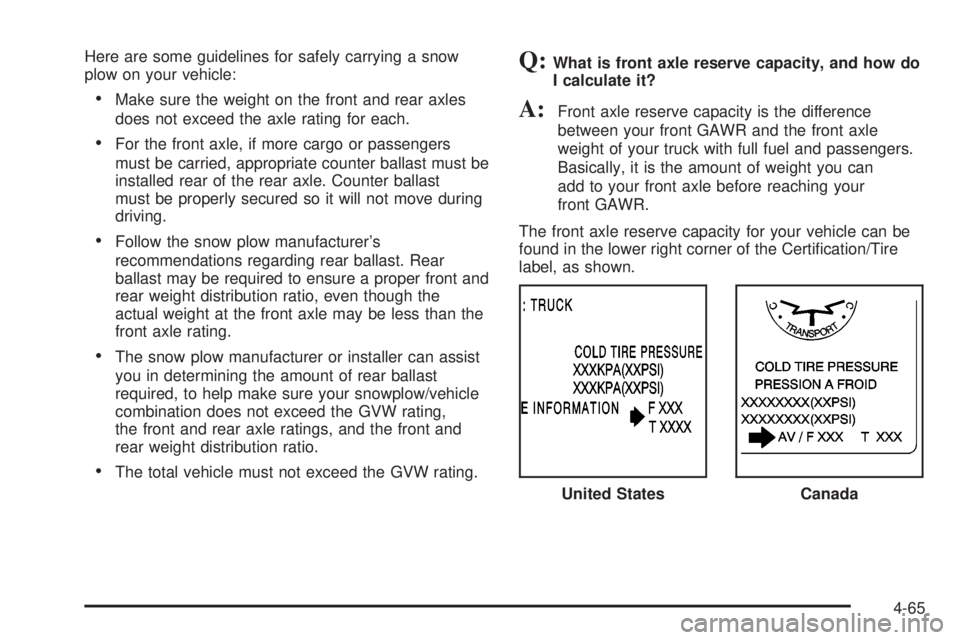
The front axle reserve capacity for your vehicle can be
found in the lower right corner of the Certi®cation/Tire
label, as shown.
United States
Canada
4-65
Page 362 of 588
In order to calculate the amount of weight any front
accessory, such as a snow plow, is adding to the front
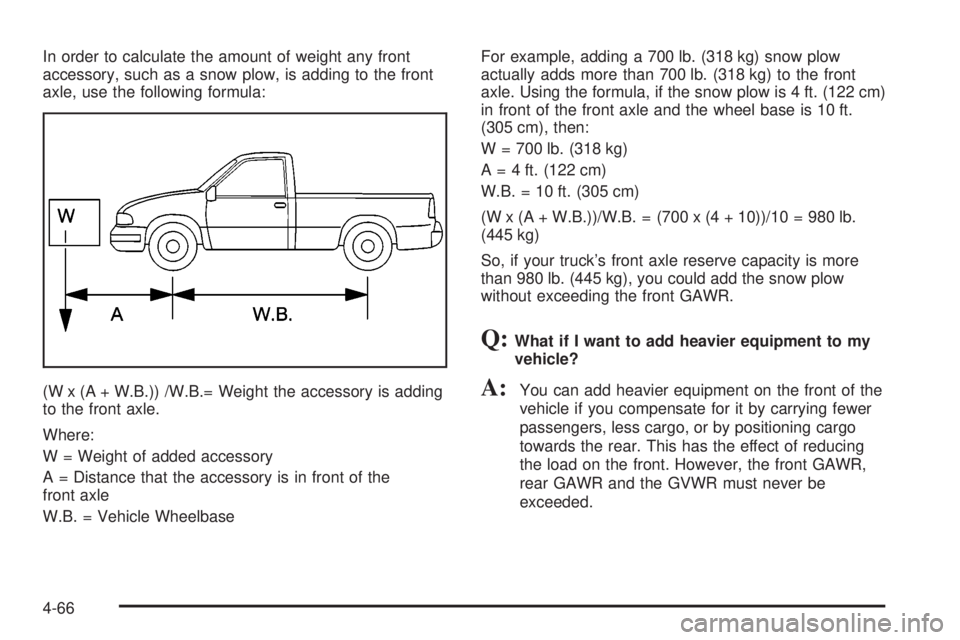
axle, use the following formula:
(W x (A + W.B.)) /W.B.= Weight the accessory is adding
to the front axle.
Where:
W = Weight of added accessory
A = Distance that the accessory is in front of the
front axle
W.B. = Vehicle WheelbaseFor example, adding a 700 lb. (318 kg) snow plow
actually adds more than 700 lb. (318 kg) to the front
axle. Using the formula, if the snow plow is 4 ft. (122 cm)
in front of the front axle and the wheel base is 10 ft.
(305 cm), then:
W = 700 lb. (318 kg)
A = 4 ft. (122 cm)
W.B. = 10 ft. (305 cm)
(W x (A + W.B.))/W.B. = (700 x (4 + 10))/10 = 980 lb.
(445 kg)
So, if your truck's front axle reserve capacity is more
than 980 lb. (445 kg), you could add the snow plow
without exceeding the front GAWR.
Q:What if I want to add heavier equipment to my
vehicle?
A:You can add heavier equipment on the front of the
vehicle if you compensate for it by carrying fewer
passengers, less cargo, or by positioning cargo
towards the rear. This has the effect of reducing
the load on the front. However, the front GAWR,
rear GAWR and the GVWR must never be
exceeded.
4-66
Page 363 of 588
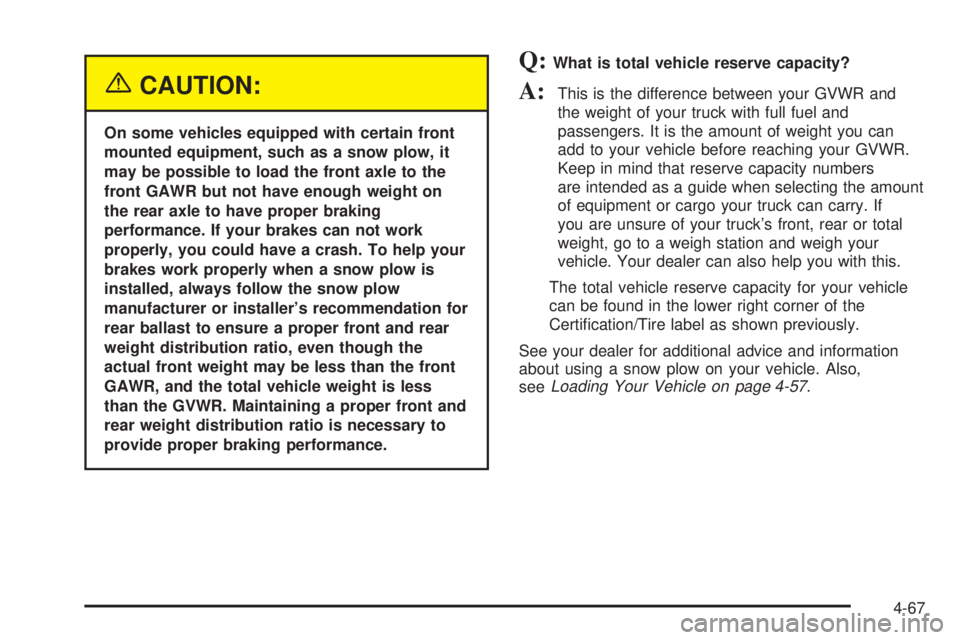
{CAUTION:
On some vehicles equipped with certain front
mounted equipment, such as a snow plow, it
may be possible to load the front axle to the
front GAWR but not have enough weight on
the rear axle to have proper braking
performance. If your brakes can not work
properly, you could have a crash. To help your
brakes work properly when a snow plow is
installed, always follow the snow plow
manufacturer or installer's recommendation for
rear ballast to ensure a proper front and rear
weight distribution ratio, even though the
actual front weight may be less than the front
GAWR, and the total vehicle weight is less
than the GVWR. Maintaining a proper front and
rear weight distribution ratio is necessary to
provide proper braking performance.
Q:What is total vehicle reserve capacity?
A:This is the difference between your GVWR and
the weight of your truck with full fuel and
passengers. It is the amount of weight you can
add to your vehicle before reaching your GVWR.
Keep in mind that reserve capacity numbers
are intended as a guide when selecting the amount
of equipment or cargo your truck can carry. If
you are unsure of your truck's front, rear or total
weight, go to a weigh station and weigh your
vehicle. Your dealer can also help you with this.
The total vehicle reserve capacity for your vehicle
can be found in the lower right corner of the
Certi®cation/Tire label as shown previously.
See your dealer for additional advice and information
about using a snow plow on your vehicle. Also,
see
Loading Your Vehicle on page 4-57.
4-67
Page 365 of 588
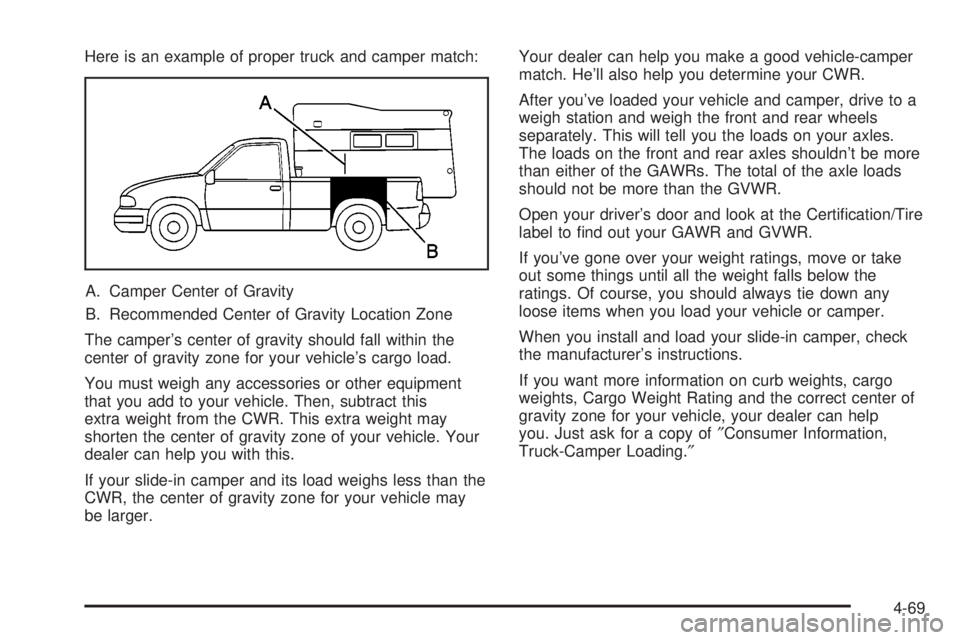
Here is an example of proper truck and camper match:
A. Camper Center of Gravity
B. Recommended Center of Gravity Location Zone
The camper's center of gravity should fall within the
center of gravity zone for your vehicle's cargo load.
You must weigh any accessories or other equipment
that you add to your vehicle. Then, subtract this
extra weight from the CWR. This extra weight may
shorten the center of gravity zone of your vehicle. Your
dealer can help you with this.
If your slide-in camper and its load weighs less than the
CWR, the center of gravity zone for your vehicle may
be larger.Your dealer can help you make a good vehicle-camper
match. He'll also help you determine your CWR.
After you've loaded your vehicle and camper, drive to a
weigh station and weigh the front and rear wheels
separately. This will tell you the loads on your axles.
The loads on the front and rear axles shouldn't be more
than either of the GAWRs. The total of the axle loads
should not be more than the GVWR.
Open your driver's door and look at the Certi®cation/Tire
label to ®nd out your GAWR and GVWR.
If you've gone over your weight ratings, move or take
out some things until all the weight falls below the
ratings. Of course, you should always tie down any
loose items when you load your vehicle or camper.
When you install and load your slide-in camper, check
the manufacturer's instructions.
If you want more information on curb weights, cargo
weights, Cargo Weight Rating and the correct center of
gravity zone for your vehicle, your dealer can help
you. Just ask for a copy of²Consumer Information,
Truck-Camper Loading.²
4-69
Page 380 of 588
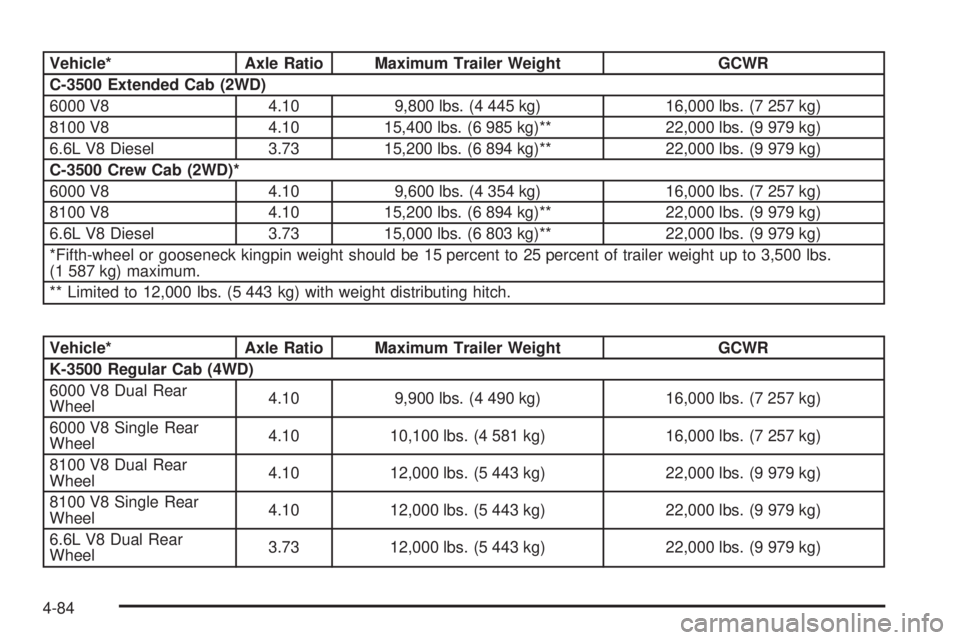
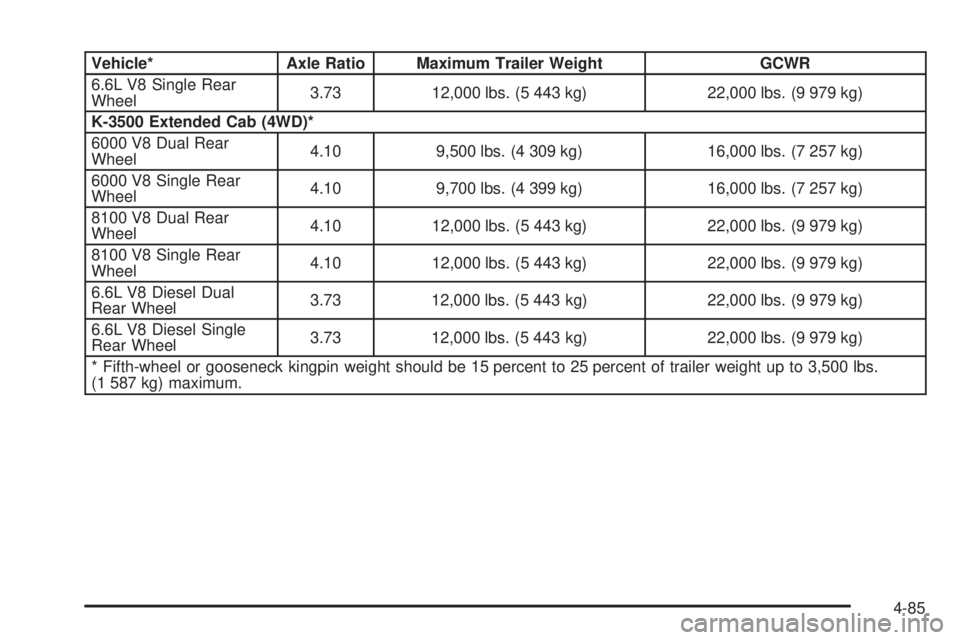
Vehicle* Axle Ratio Maximum Trailer Weight GCWR
C-3500 Extended Cab (2WD)
6000 V8 4.10 9,800 lbs. (4 445 kg) 16,000 lbs. (7 257 kg)
8100 V8 4.10 15,400 lbs. (6 985 kg)** 22,000 lbs. (9 979 kg)
6.6L V8 Diesel 3.73 15,200 lbs. (6 894 kg)** 22,000 lbs. (9 979 kg)
C-3500 Crew Cab (2WD)*
6000 V8 4.10 9,600 lbs. (4 354 kg) 16,000 lbs. (7 257 kg)
8100 V8 4.10 15,200 lbs. (6 894 kg)** 22,000 lbs. (9 979 kg)
6.6L V8 Diesel 3.73 15,000 lbs. (6 803 kg)** 22,000 lbs. (9 979 kg)
*Fifth-wheel or gooseneck kingpin weight should be 15 percent to 25 percent of trailer weight up to 3,500 lbs.
(1 587 kg) maximum.
** Limited to 12,000 lbs. (5 443 kg) with weight distributing hitch.
Vehicle* Axle Ratio Maximum Trailer Weight GCWR
K-3500 Regular Cab (4WD)
6000 V8 Dual Rear
Wheel4.10 9,900 lbs. (4 490 kg) 16,000 lbs. (7 257 kg)
6000 V8 Single Rear
Wheel4.10 10,100 lbs. (4 581 kg) 16,000 lbs. (7 257 kg)
8100 V8 Dual Rear
Wheel4.10 12,000 lbs. (5 443 kg) 22,000 lbs. (9 979 kg)
8100 V8 Single Rear
Wheel4.10 12,000 lbs. (5 443 kg) 22,000 lbs. (9 979 kg)
6.6L V8 Dual Rear
Wheel3.73 12,000 lbs. (5 443 kg) 22,000 lbs. (9 979 kg)
4-84
Page 381 of 588
Vehicle* Axle Ratio Maximum Trailer Weight GCWR
6.6L V8 Single Rear
Wheel3.73 12,000 lbs. (5 443 kg) 22,000 lbs. (9 979 kg)
K-3500 Extended Cab (4WD)*
6000 V8 Dual Rear
Wheel4.10 9,500 lbs. (4 309 kg) 16,000 lbs. (7 257 kg)
6000 V8 Single Rear
Wheel4.10 9,700 lbs. (4 399 kg) 16,000 lbs. (7 257 kg)
8100 V8 Dual Rear
Wheel4.10 12,000 lbs. (5 443 kg) 22,000 lbs. (9 979 kg)
8100 V8 Single Rear
Wheel4.10 12,000 lbs. (5 443 kg) 22,000 lbs. (9 979 kg)
6.6L V8 Diesel Dual
Rear Wheel3.73 12,000 lbs. (5 443 kg) 22,000 lbs. (9 979 kg)
6.6L V8 Diesel Single
Rear Wheel3.73 12,000 lbs. (5 443 kg) 22,000 lbs. (9 979 kg)
* Fifth-wheel or gooseneck kingpin weight should be 15 percent to 25 percent of trailer weight up to 3,500 lbs.
(1 587 kg) maximum.
4-85
Page 382 of 588
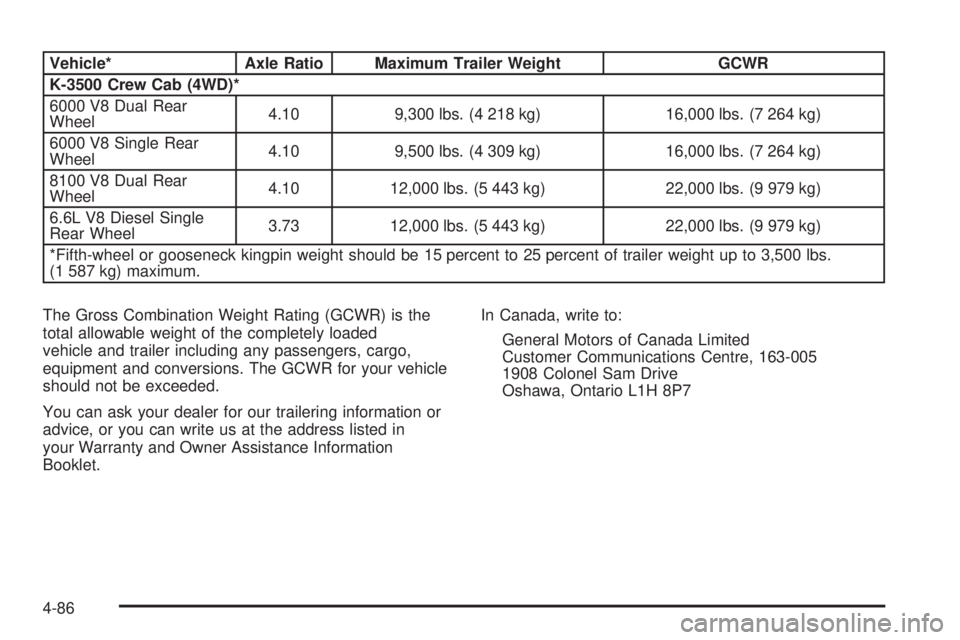
Vehicle* Axle Ratio Maximum Trailer Weight GCWR
K-3500 Crew Cab (4WD)*
6000 V8 Dual Rear
Wheel4.10 9,300 lbs. (4 218 kg) 16,000 lbs. (7 264 kg)
6000 V8 Single Rear
Wheel4.10 9,500 lbs. (4 309 kg) 16,000 lbs. (7 264 kg)
8100 V8 Dual Rear
Wheel4.10 12,000 lbs. (5 443 kg) 22,000 lbs. (9 979 kg)
6.6L V8 Diesel Single
Rear Wheel3.73 12,000 lbs. (5 443 kg) 22,000 lbs. (9 979 kg)
*Fifth-wheel or gooseneck kingpin weight should be 15 percent to 25 percent of trailer weight up to 3,500 lbs.
(1 587 kg) maximum.
The Gross Combination Weight Rating (GCWR) is the
total allowable weight of the completely loaded
vehicle and trailer including any passengers, cargo,
equipment and conversions. The GCWR for your vehicle
should not be exceeded.
You can ask your dealer for our trailering information or
advice, or you can write us at the address listed in
your Warranty and Owner Assistance Information
Booklet.In Canada, write to:
General Motors of Canada Limited
Customer Communications Centre, 163-005
1908 Colonel Sam Drive
Oshawa, Ontario L1H 8P7
4-86