Page 235 of 420

{CAUTION:
Snow can trap exhaust gases under your
vehicle. This can cause deadly CO (carbon
monoxide) gas to get inside. CO could
overcome you and kill you. You can not see it
or smell it, so you might not know it is in your
vehicle. Clear away snow from around the
base of your vehicle, especially any that is
blocking your exhaust pipe. And check around
again from time to time to be sure snow does
not collect there.
Open a window just a little on the side of the
vehicle that is away from the wind. This will
help keep CO out.Run your engine only as long as you must. This saves
fuel. When you run the engine, make it go a little faster
than just idle. That is, push the accelerator slightly.
This uses less fuel for the heat that you get and it keeps
the battery charged. You will need a well-charged battery
to restart the vehicle, and possibly for signaling later on
with your headlamps. Let the heater run for a while.
Then, shut the engine off and close the window almost
all the way to preserve the heat. Start the engine
again and repeat this only when you feel really
uncomfortable from the cold. But do it as little as
possible. Preserve the fuel as long as you can.
To help keep warm, you can get out of the vehicle and
do some fairly vigorous exercises every half hour or
so until help comes.
4-43
Page 236 of 420
If You Are Stuck: In Sand, Mud,
Ice or Snow
In order to free your vehicle when it is stuck, you will
need to spin the wheels, but you do not want to
spin your wheels too fast. The method known as
“rocking” can help you get out when you are stuck,
but you must use caution.
{CAUTION:
If you let your tires spin at high speed,
they can explode, and you or others could
be injured. And, the vehicle can overheat.
CAUTION: (Continued)
CAUTION: (Continued)
That could cause an engine compartment re
or other damage. When you are stuck, spin the
wheels as little as possible. Do not spin the
wheels above 35 mph (55 km/h) as shown on
the speedometer.
Notice:Spinning your wheels can destroy parts of
your vehicle as well as the tires. If you spin the
wheels too fast while shifting your transmission
back and forth, you can destroy your transmission.
For information about using tire chains on your
vehicle, seeTire Chains on page 5-72.
4-44
Page 253 of 420
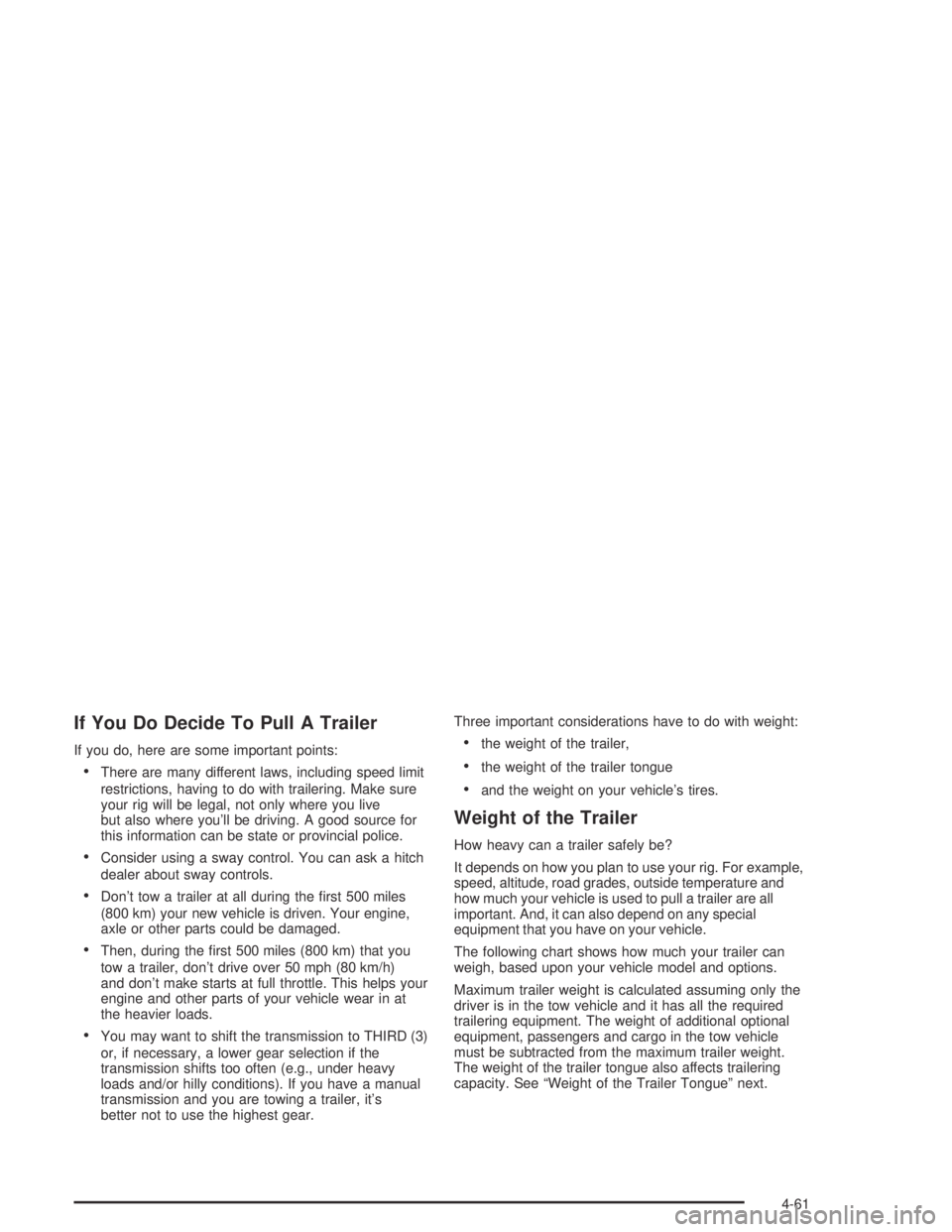
If You Do Decide To Pull A Trailer
If you do, here are some important points:
There are many different laws, including speed limit
restrictions, having to do with trailering. Make sure
your rig will be legal, not only where you live
but also where you’ll be driving. A good source for
this information can be state or provincial police.
Consider using a sway control. You can ask a hitch
dealer about sway controls.
Don’t tow a trailer at all during the rst 500 miles
(800 km) your new vehicle is driven. Your engine,
axle or other parts could be damaged.
Then, during the rst 500 miles (800 km) that you
tow a trailer, don’t drive over 50 mph (80 km/h)
and don’t make starts at full throttle. This helps your
engine and other parts of your vehicle wear in at
the heavier loads.
You may want to shift the transmission to THIRD (3)
or, if necessary, a lower gear selection if the
transmission shifts too often (e.g., under heavy
loads and/or hilly conditions). If you have a manual
transmission and you are towing a trailer, it’s
better not to use the highest gear.Three important considerations have to do with weight:
the weight of the trailer,
the weight of the trailer tongue
and the weight on your vehicle’s tires.
Weight of the Trailer
How heavy can a trailer safely be?
It depends on how you plan to use your rig. For example,
speed, altitude, road grades, outside temperature and
how much your vehicle is used to pull a trailer are all
important. And, it can also depend on any special
equipment that you have on your vehicle.
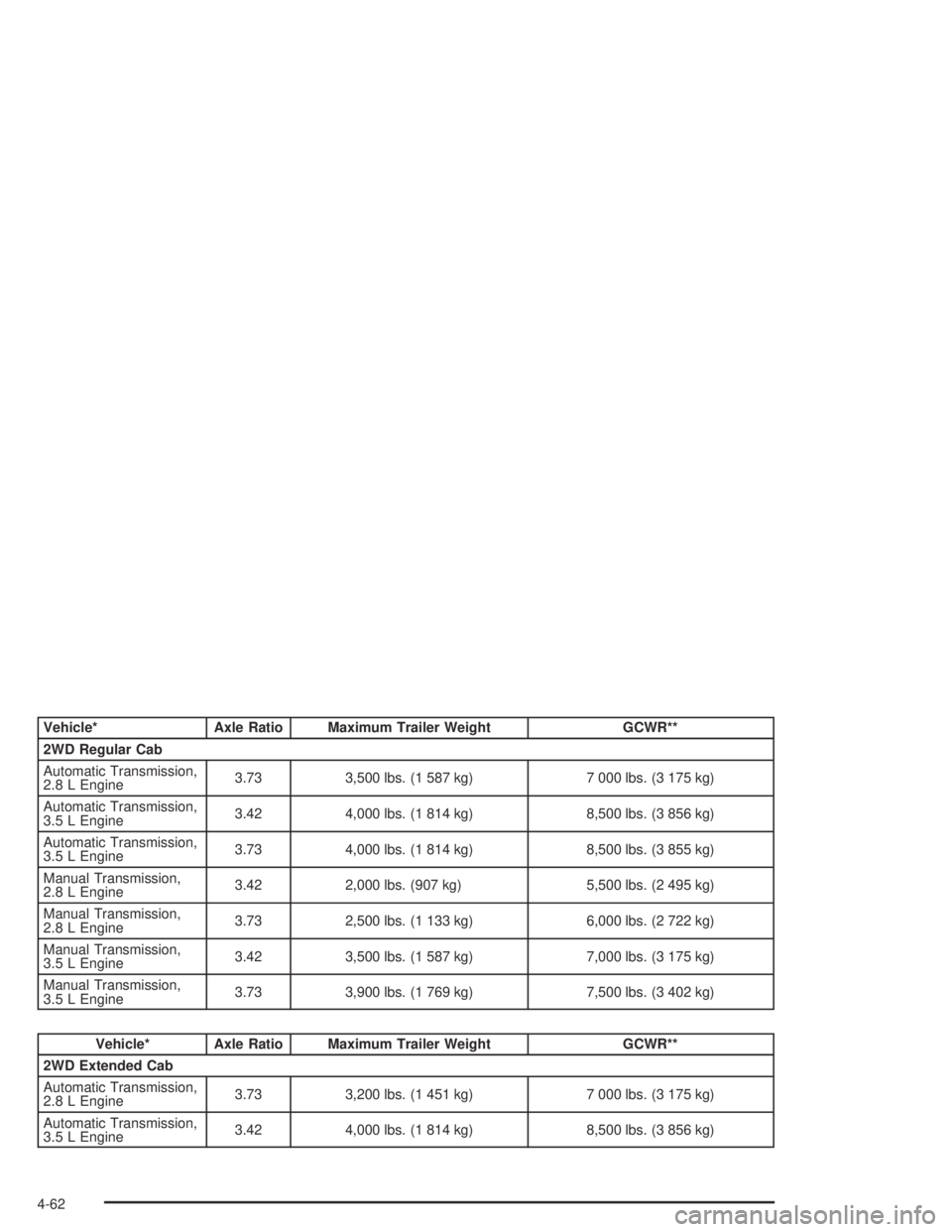
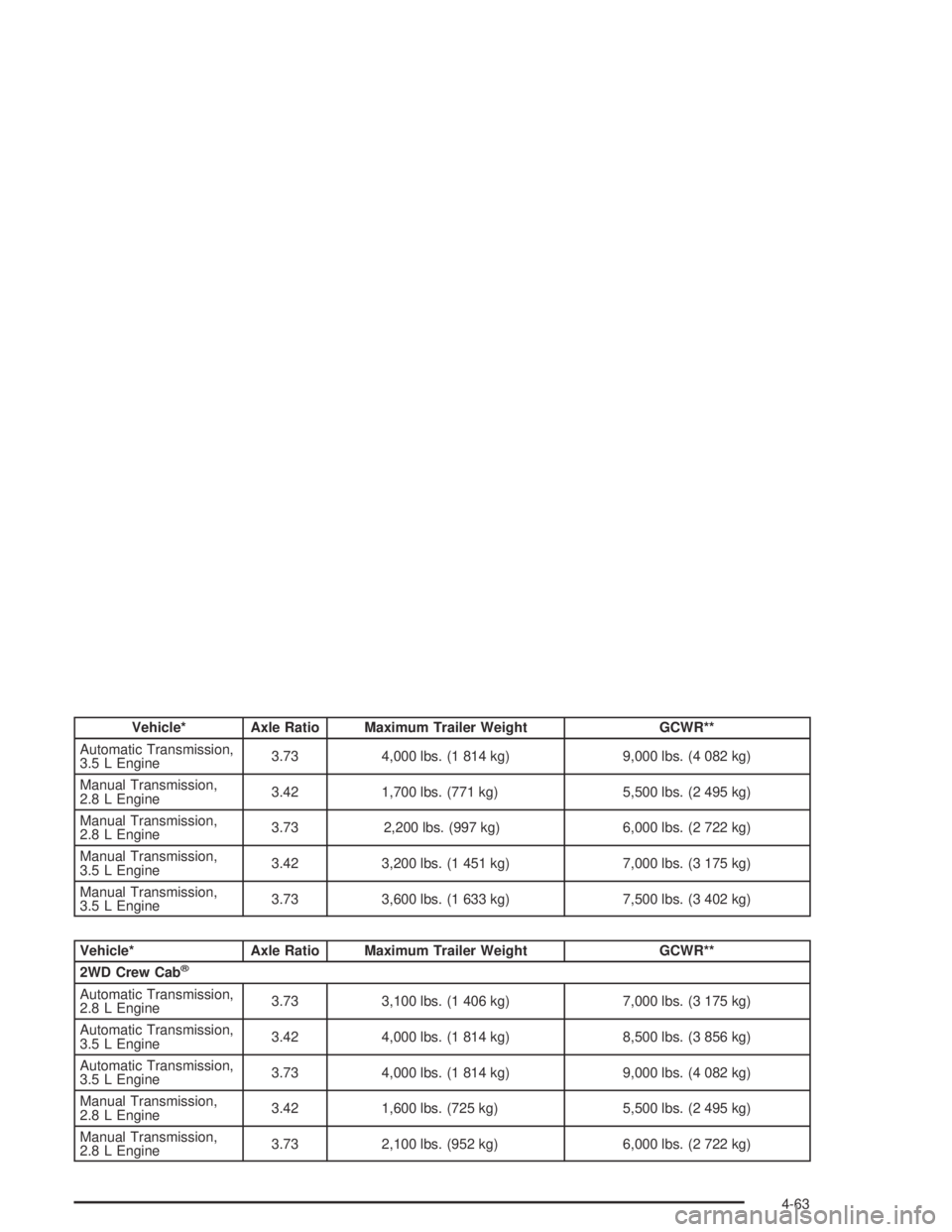
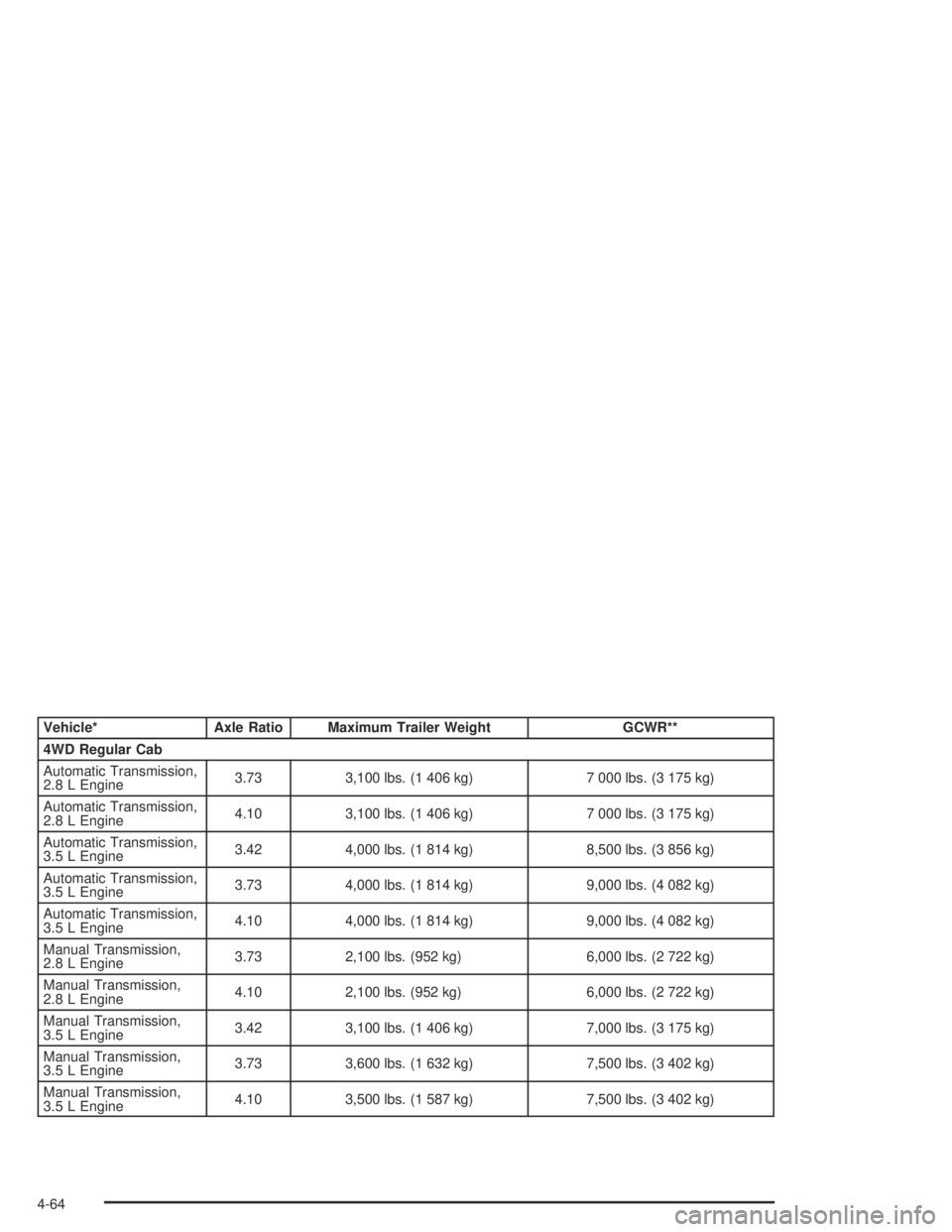
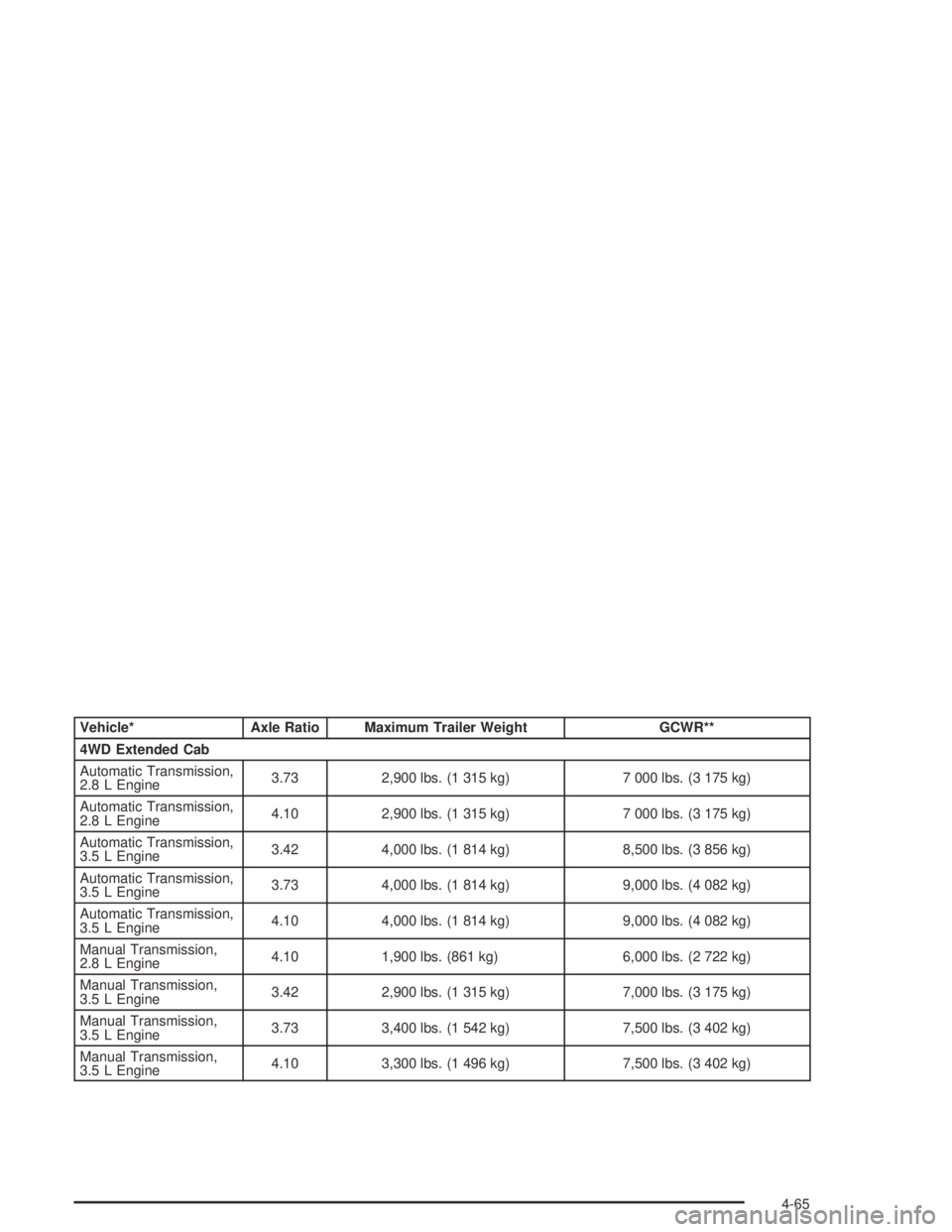
The following chart shows how much your trailer can
weigh, based upon your vehicle model and options.
Maximum trailer weight is calculated assuming only the
driver is in the tow vehicle and it has all the required
trailering equipment. The weight of additional optional
equipment, passengers and cargo in the tow vehicle
must be subtracted from the maximum trailer weight.
The weight of the trailer tongue also affects trailering
capacity. See “Weight of the Trailer Tongue” next.
4-61
Page 254 of 420
Vehicle* Axle Ratio Maximum Trailer Weight GCWR**
2WD Regular Cab
Automatic Transmission,
2.8 L Engine3.73 3,500 lbs. (1 587 kg) 7 000 lbs. (3 175 kg)
Automatic Transmission,
3.5 L Engine3.42 4,000 lbs. (1 814 kg) 8,500 lbs. (3 856 kg)
Automatic Transmission,
3.5 L Engine3.73 4,000 lbs. (1 814 kg) 8,500 lbs. (3 855 kg)
Manual Transmission,
2.8 L Engine3.42 2,000 lbs. (907 kg) 5,500 lbs. (2 495 kg)
Manual Transmission,
2.8 L Engine3.73 2,500 lbs. (1 133 kg) 6,000 lbs. (2 722 kg)
Manual Transmission,
3.5 L Engine3.42 3,500 lbs. (1 587 kg) 7,000 lbs. (3 175 kg)
Manual Transmission,
3.5 L Engine3.73 3,900 lbs. (1 769 kg) 7,500 lbs. (3 402 kg)
Vehicle* Axle Ratio Maximum Trailer Weight GCWR**
2WD Extended Cab
Automatic Transmission,
2.8 L Engine3.73 3,200 lbs. (1 451 kg) 7 000 lbs. (3 175 kg)
Automatic Transmission,
3.5 L Engine3.42 4,000 lbs. (1 814 kg) 8,500 lbs. (3 856 kg)
4-62
Page 255 of 420
Vehicle* Axle Ratio Maximum Trailer Weight GCWR**
Automatic Transmission,
3.5 L Engine3.73 4,000 lbs. (1 814 kg) 9,000 lbs. (4 082 kg)
Manual Transmission,
2.8 L Engine3.42 1,700 lbs. (771 kg) 5,500 lbs. (2 495 kg)
Manual Transmission,
2.8 L Engine3.73 2,200 lbs. (997 kg) 6,000 lbs. (2 722 kg)
Manual Transmission,
3.5 L Engine3.42 3,200 lbs. (1 451 kg) 7,000 lbs. (3 175 kg)
Manual Transmission,
3.5 L Engine3.73 3,600 lbs. (1 633 kg) 7,500 lbs. (3 402 kg)
Vehicle* Axle Ratio Maximum Trailer Weight GCWR**
2WD Crew Cab
®
Automatic Transmission,
2.8 L Engine3.73 3,100 lbs. (1 406 kg) 7,000 lbs. (3 175 kg)
Automatic Transmission,
3.5 L Engine3.42 4,000 lbs. (1 814 kg) 8,500 lbs. (3 856 kg)
Automatic Transmission,
3.5 L Engine3.73 4,000 lbs. (1 814 kg) 9,000 lbs. (4 082 kg)
Manual Transmission,
2.8 L Engine3.42 1,600 lbs. (725 kg) 5,500 lbs. (2 495 kg)
Manual Transmission,
2.8 L Engine3.73 2,100 lbs. (952 kg) 6,000 lbs. (2 722 kg)
4-63
Page 256 of 420
Vehicle* Axle Ratio Maximum Trailer Weight GCWR**
4WD Regular Cab
Automatic Transmission,
2.8 L Engine3.73 3,100 lbs. (1 406 kg) 7 000 lbs. (3 175 kg)
Automatic Transmission,
2.8 L Engine4.10 3,100 lbs. (1 406 kg) 7 000 lbs. (3 175 kg)
Automatic Transmission,
3.5 L Engine3.42 4,000 lbs. (1 814 kg) 8,500 lbs. (3 856 kg)
Automatic Transmission,
3.5 L Engine3.73 4,000 lbs. (1 814 kg) 9,000 lbs. (4 082 kg)
Automatic Transmission,
3.5 L Engine4.10 4,000 lbs. (1 814 kg) 9,000 lbs. (4 082 kg)
Manual Transmission,
2.8 L Engine3.73 2,100 lbs. (952 kg) 6,000 lbs. (2 722 kg)
Manual Transmission,
2.8 L Engine4.10 2,100 lbs. (952 kg) 6,000 lbs. (2 722 kg)
Manual Transmission,
3.5 L Engine3.42 3,100 lbs. (1 406 kg) 7,000 lbs. (3 175 kg)
Manual Transmission,
3.5 L Engine3.73 3,600 lbs. (1 632 kg) 7,500 lbs. (3 402 kg)
Manual Transmission,
3.5 L Engine4.10 3,500 lbs. (1 587 kg) 7,500 lbs. (3 402 kg)
4-64
Page 257 of 420
Vehicle* Axle Ratio Maximum Trailer Weight GCWR**
4WD Extended Cab
Automatic Transmission,
2.8 L Engine3.73 2,900 lbs. (1 315 kg) 7 000 lbs. (3 175 kg)
Automatic Transmission,
2.8 L Engine4.10 2,900 lbs. (1 315 kg) 7 000 lbs. (3 175 kg)
Automatic Transmission,
3.5 L Engine3.42 4,000 lbs. (1 814 kg) 8,500 lbs. (3 856 kg)
Automatic Transmission,
3.5 L Engine3.73 4,000 lbs. (1 814 kg) 9,000 lbs. (4 082 kg)
Automatic Transmission,
3.5 L Engine4.10 4,000 lbs. (1 814 kg) 9,000 lbs. (4 082 kg)
Manual Transmission,
2.8 L Engine4.10 1,900 lbs. (861 kg) 6,000 lbs. (2 722 kg)
Manual Transmission,
3.5 L Engine3.42 2,900 lbs. (1 315 kg) 7,000 lbs. (3 175 kg)
Manual Transmission,
3.5 L Engine3.73 3,400 lbs. (1 542 kg) 7,500 lbs. (3 402 kg)
Manual Transmission,
3.5 L Engine4.10 3,300 lbs. (1 496 kg) 7,500 lbs. (3 402 kg)
4-65
Page 258 of 420
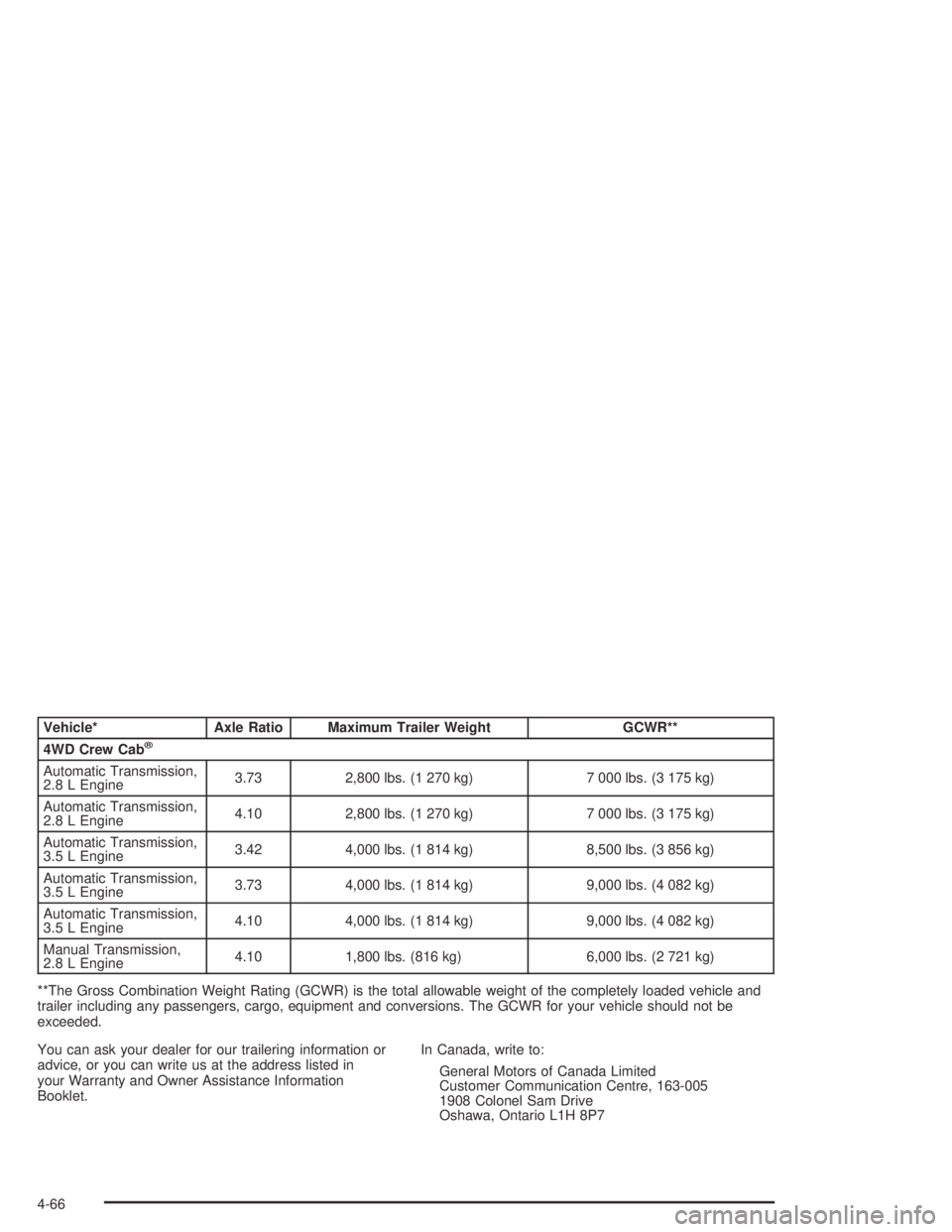
Vehicle* Axle Ratio Maximum Trailer Weight GCWR**
4WD Crew Cab
®
Automatic Transmission,
2.8 L Engine3.73 2,800 lbs. (1 270 kg) 7 000 lbs. (3 175 kg)
Automatic Transmission,
2.8 L Engine4.10 2,800 lbs. (1 270 kg) 7 000 lbs. (3 175 kg)
Automatic Transmission,
3.5 L Engine3.42 4,000 lbs. (1 814 kg) 8,500 lbs. (3 856 kg)
Automatic Transmission,
3.5 L Engine3.73 4,000 lbs. (1 814 kg) 9,000 lbs. (4 082 kg)
Automatic Transmission,
3.5 L Engine4.10 4,000 lbs. (1 814 kg) 9,000 lbs. (4 082 kg)
Manual Transmission,
2.8 L Engine4.10 1,800 lbs. (816 kg) 6,000 lbs. (2 721 kg)
**The Gross Combination Weight Rating (GCWR) is the total allowable weight of the completely loaded vehicle and
trailer including any passengers, cargo, equipment and conversions. The GCWR for your vehicle should not be
exceeded.
You can ask your dealer for our trailering information or
advice, or you can write us at the address listed in
your Warranty and Owner Assistance Information
Booklet.In Canada, write to:
General Motors of Canada Limited
Customer Communication Centre, 163-005
1908 Colonel Sam Drive
Oshawa, Ontario L1H 8P7
4-66