2004 GMC CANYON brake light
[x] Cancel search: brake lightPage 224 of 420
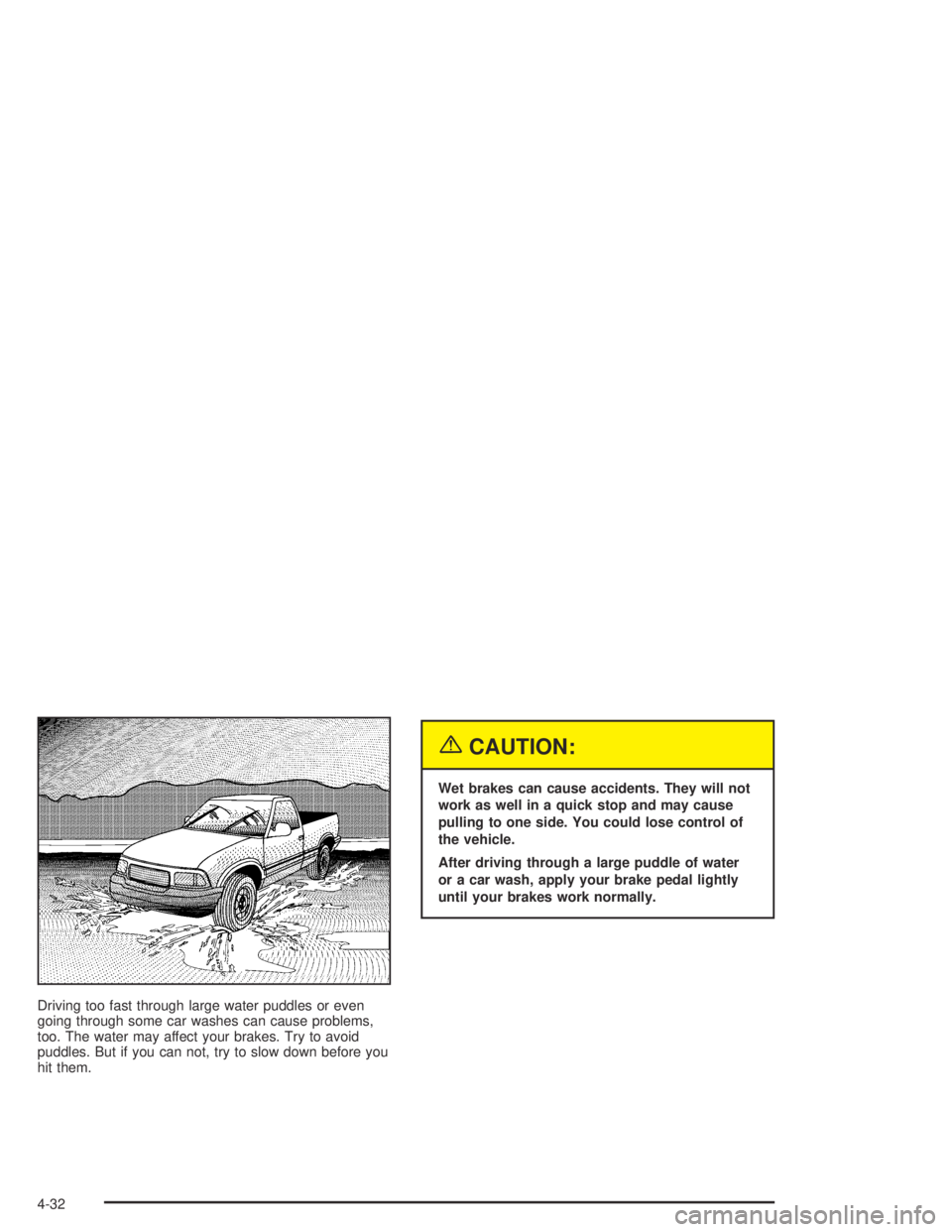
Driving too fast through large water puddles or even
going through some car washes can cause problems,
too. The water may affect your brakes. Try to avoid
puddles. But if you can not, try to slow down before you
hit them.
{CAUTION:
Wet brakes can cause accidents. They will not
work as well in a quick stop and may cause
pulling to one side. You could lose control of
the vehicle.
After driving through a large puddle of water
or a car wash, apply your brake pedal lightly
until your brakes work normally.
4-32
Page 304 of 420

Brake Wear
Your vehicle has front disc brakes and rear drum
brakes.
Disc brake pads have built-in wear indicators that make a
high-pitched warning sound when the brake pads are
worn and new pads are needed. The sound may come
and go or be heard all the time your vehicle is moving
(except when you are pushing on the brake pedal rmly).
{CAUTION:
The brake wear warning sound means that
soon your brakes will not work well. That
could lead to an accident. When you hear the
brake wear warning sound, have your vehicle
serviced.
Notice:Continuing to drive with worn-out brake
pads could result in costly brake repair.
Some driving conditions or climates may cause a brake
squeal when the brakes are rst applied or lightly
applied. This does not mean something is wrong with
your brakes.Properly torqued wheel nuts are necessary to help
prevent brake pulsation. When tires are rotated, inspect
brake pads for wear and evenly tighten wheel nuts in
the proper sequence to GM torque specications.
Rear drum brakes do not have wear indicators, but if
you ever hear a rear brake rubbing noise, have the rear
brake linings inspected immediately. Also, the rear
brake drums should be removed and inspected each
time the tires are removed for rotation or changing.
When you have the front brake pads replaced, have the
rear brakes inspected, too.
Brake linings should always be replaced as complete
axle sets.Brake Pedal Travel
See your dealer if the brake pedal does not return to
normal height, or if there is a rapid increase in
pedal travel. This could be a sign of brake trouble.
Brake Adjustment
Every time you make a brake stop, your brakes adjust
for wear.
5-40
Page 307 of 420

1. Check the other vehicle. It must have a 12-volt
battery with a negative ground system.
Notice:If the other vehicle’s system is not a 12-volt
system with a negative ground, both vehicles can
be damaged. Only use vehicles with 12-volt systems
with negative grounds to jump start your vehicle.
2. Get the vehicles close enough so the jumper cables
can reach, but be sure the vehicles aren’t touching
each other. If they are, it could cause a ground
connection you don’t want. You wouldn’t be able to
start your vehicle, and the bad grounding could
damage the electrical systems.
To avoid the possibility of the vehicles rolling, set
the parking brake rmly on both vehicles involved
in the jump start procedure. Put an automatic
transmission in PARK (P) or a manual transmission
in NEUTRAL before setting the parking brake.
If you have a four-wheel-drive vehicle, be sure the
transfer case is not in NEUTRAL (N).Notice:If you leave your radio or other accessories
on during the jump starting procedure, they could
be damaged. The repairs would not be covered
by your warranty. Always turn off your radio and
other accessories when jump starting your vehicle.
3. Turn off the ignition on both vehicles. Unplug
unnecessary accessories plugged into the cigarette
lighter or in the accessory power outlets. Turn off
the radio and all lamps that aren’t needed. This will
avoid sparks and help save both batteries. And it
could save your radio!
4. Open the hoods and locate the batteries. Find the
positive (+) and negative (-) terminal locations on
each vehicle. SeeEngine Compartment Overview
on page 5-12for more information on location of
the battery.
5-43
Page 370 of 420

Fuse Usage
15 Front Axle Actuator
16Antilock Brake System (ABS),
ABS module, Four-Wheel Drive,
Gravity Sensor
17Supplemental Inatable Restraint
System, Sensing and Diagnostic
Module, Air Bag Off Switch
18 Heated Seat
19Cruise Control Switch, Inside
Rearview Mirror, Transfer Case
Control Module, Brake Switch,
Clutch Disable
20 Electronic Throttle Control (ETC)
21 Power Door Locks
22 Injectors
23Ignition, Clutch Starter Switch,
Neutral Safety Back-Up Switch,
Ignition Coils 1-5, Air Conditioning
Relay
24 Transmission Solenoid
25 Powertrain Control Module (PCM)
26 Back-up Lights
27ERLS, Map Sensor, Can Purge
SolenoidFuse Usage
28 Rear Turn/Hazard Lights
29Driver’s Side RearTaillamp,
Passenger Side Air Bag Indicator
Lighting, Instrument Panel Dimming
Power (2WD/4WD switch lighting)
30 Powertrain Control Module (PCM) B
31 OnStar
32 Radio
33 Auxiliary Power 2
34 Truck Body Controller
35 Horn
36 Transfer Case Control Module
37Turn/Hazard/Courtesy/Cargo Lamps/
Mirrors
38 Cluster
39Rear Parking Lamp 1, Passenger’s
Side Taillamp, License Plate Lamps
40Front Park/Turn Lamps, Driver and
Passenger’s Side Power Window
Switches Lighting
41 Climate Control Fan
42 Power Windows
5-106
Page 379 of 420

MaintenanceI— Use MaintenanceIif the CHANGE
OIL light comes on within ten months since vehicle was
purchased or MaintenanceIIwas performed.MaintenanceII— Use MaintenanceIIif the previous
service performed was MaintenanceI. Always use
MaintenanceIIwhenever the light comes on ten months
or more since the last service or if the light has not
come on at all for one year.
Scheduled Maintenance
Service MaintenanceIMaintenanceII
Change engine oil and lter. Reset oil life system. SeeEngine Oil on
page 5-13.An Emission Control Service.•
•
Visually check for any leaks or damage.See footnote (g).••
Inspect engine air cleaner lter. If necessary, replace lter. SeeEngine Air
Cleaner/Filter on page 5-18.An Emission Control Service. See footnote †.••
Rotate tires and check ination pressures and wear. SeeTires on page 5-57.••
Inspect brake system.See footnote (a).••
Check engine coolant and windshield washer uid levels and add uid as needed.••
Perform any needed additional services. See “Additional Required Services” in
this section.••
Inspect suspension and steering components.See footnote (b).•
Inspect engine cooling system.See footnote (c).•
Inspect wiper blades.See footnote (d).•
Inspect restraint system components.See footnote (e).•
Lubricate body components.See footnote (f).•
Check transmission uid level and add uid as needed.•
6-5
Page 381 of 420

Maintenance Footnotes
†The U.S. Environmental Protection Agency or the
California Air Resources Board has determined that the
failure to perform this maintenance item will not nullify
the emission warranty or limit recall liability prior to
the completion of the vehicle’s useful life. We, however,
urge that all recommended maintenance services be
performed at the indicated intervals and the
maintenance be recorded.
(a)Visually inspect brake lines and hoses for proper
hook-up, binding, leaks, cracks, chang, etc. Inspect
drum brake linings for wear or cracks. Inspect disc brake
pads for wear and rotors for surface condition. Inspect
other brake parts, including drums, wheel cylinders,
calipers, parking brake, etc. Check parking brake
adjustment.
(b)Visually inspect front and rear suspension and
steering system for damaged, loose or missing parts or
signs of wear. Inspect power steering lines and
hoses for proper hook-up, binding, leaks, cracks,
chang, etc. Visually check constant velocity joints,
rubber boots and axle seals for leaks.(c)Visually inspect hoses and have them replaced if
they are cracked, swollen or deteriorated. Inspect
all pipes, ttings and clamps; replace with genuine GM
parts as needed. To help ensure proper operation,
a pressure test of the cooling system and pressure cap
and cleaning the outside of the radiator and air
conditioning condenser is recommended at least once
a year.
(d)Visually inspect wiper blades for wear or cracking.
Replace blade inserts that appear worn or damaged
or that streak or miss areas of the windshield.
(e)Make sure the safety belt reminder light and all your
belts, buckles, latch plates, retractors and anchorages
are working properly. Look for any other loose or
damaged safety belt system parts. If you see anything
that might keep a safety belt system from doing its
job, have it repaired. Have any torn or frayed safety belts
replaced. Also look for any opened or broken air bag
coverings, and have them repaired or replaced. (The air
bag system does not need regular maintenance.)
6-7
Page 405 of 420
A
ABS (Anti-Lock Brake System)..........................3-39
AC (Air Conditioning) OFF...............................3-39
Accessory Power Outlets.................................3-16
Adding Washer Fluid.......................................5-37
Additional Program Information........................... 7-9
Additives, Fuel................................................. 5-6
Add-On Electrical Equipment...........................5-103
Add-On Equipment..........................................4-58
Adjusting the Speakers
(Balance/Fade)............................3-46, 3-49, 3-58
After Off-Road Driving.....................................4-29
Air Bag
Off Light.....................................................3-26
Readiness Light..........................................3-25
Air Bag Systems.............................................1-60
Adding Equipment to Your
Air Bag-Equipped Vehicle..........................1-73
Air Bag Off Switch.......................................1-70
How Does an Air Bag Restrain?....................1-67
Servicing Your Air Bag-Equipped Vehicle.........1-72
What Makes an Air Bag Inate?....................1-67
What Will You See After an
Air Bag Inates?......................................1-68
When Should an Air Bag Inate?...................1-66
Where Are the Air Bags?..............................1-63
Air Cleaner/Filter, Engine.................................5-18Airbag Sensing and Diagnostic Module (SDM)......... 7-9
All Overseas Locations...................................... 7-5
AM ...............................................................3-68
AM-FM Radio.................................................3-44
Antenna, Fixed Mast.......................................3-68
Anti-lock Brake System..................................... 4-7
Anti-Lock Brake, System Warning Light..............3-29
Appearance Care............................................5-94
Care of Safety Belts....................................5-97
Chemical Paint Spotting..............................5-101
Cleaning the Inside of Your Vehicle................5-95
Cleaning the Outside of Your Vehicle..............5-98
Finish Damage..........................................5-100
Sheet Metal Damage..................................5-100
Underbody Maintenance.............................5-101
Vehicle Care/Appearance Materials...............5-102
Weatherstrips..............................................5-97
Approaching a Hill..........................................4-20
Ashtrays........................................................3-17
Assist Handles...............................................2-43
Audio System(s).............................................3-42
AM-FM Radio.............................................3-44
Care of Your CD Player...............................3-68
Care of Your CDs........................................3-68
Chime Level Adjustment...............................3-68
Fixed Mast Antenna.....................................3-68
Radio with CD............................................3-47
Radio with Six-Disc CD................................3-56
1
Page 406 of 420
Audio System(s) (cont.)
Setting the Time for Radios with
Radio Data Systems (RDS).......................3-43
Setting the Time for Radios without
Radio Data Systems (RDS).......................3-43
Theft-Deterrent Feature................................3-67
Understanding Radio Reception.....................3-68
Automatic Door Locks.....................................3-38
Automatic Headlamp System............................3-13
Automatic Transmission...................................2-18
Fluid..........................................................5-19
Operation...................................................2-21
B
Backing Up....................................................4-70
BATTERY......................................................3-39
Battery..........................................................5-41
Battery Replacement......................................... 2-6
Battery Run-Down Protection............................3-16
Battery Warning Light......................................3-27
Bed Rails......................................................2-43
Before Leaving on a Long Trip.........................4-36
Before You Go Off-Roading..............................4-16
Brake
Parking......................................................2-29
System Warning Light..................................3-28
Brake Adjustment............................................5-40Brake Fluid....................................................5-38
Brake Pedal Travel.........................................5-40
Brake Wear...................................................5-40
BRAKES.......................................................3-40
Brakes..........................................................5-38
Braking........................................................... 4-6
Braking in Emergencies..................................... 4-9
Break-In, New Vehicle.....................................2-16
Bulb Replacement...........................................5-50
Center High-Mounted Stoplamp (CHMSL)........5-53
Front Turn Signal, Sidemarker and
Daytime Running Lamps...........................5-52
Halogen Bulbs............................................5-50
Headlamps.................................................5-50
Replacement Bulbs......................................5-54
Taillamps, Turn Signal, Stoplamps and
Back-up Lamps........................................5-53
Buying New Tires...........................................5-68
C
California Fuel.................................................. 5-6
Canada........................................................... 7-4
Canadian Owners................................................ ii
Canadian Roadside Assistance........................... 7-7
Capacities and Specications..........................5-108
Carbon Monoxide...................4-40, 4-60, 2-10, 2-34
2