2004 FORD SUPER DUTY battery
[x] Cancel search: batteryPage 23 of 64
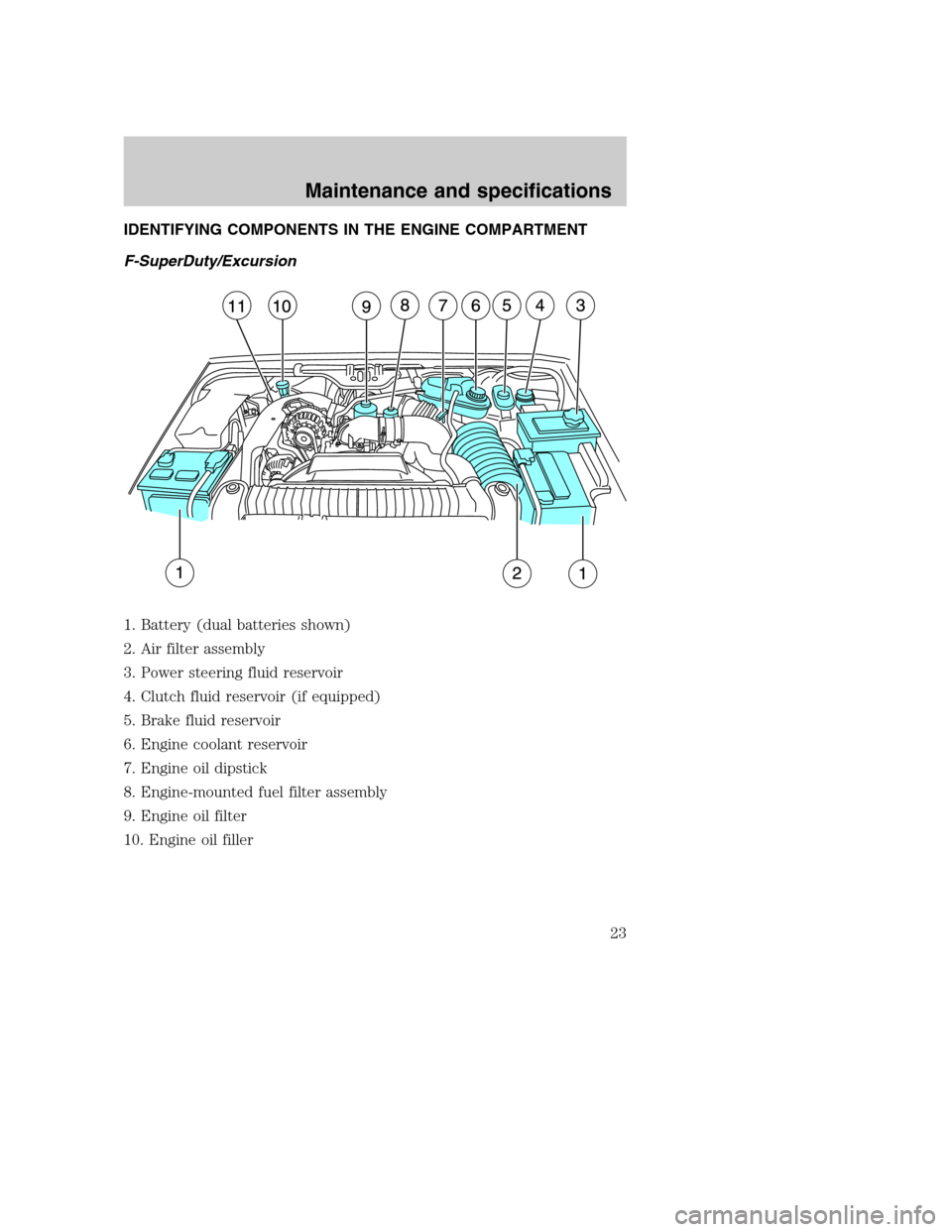
IDENTIFYING COMPONENTS IN THE ENGINE COMPARTMENT
F-SuperDuty/Excursion
1. Battery (dual batteries shown)
2. Air filter assembly
3. Power steering fluid reservoir
4. Clutch fluid reservoir (if equipped)
5. Brake fluid reservoir
6. Engine coolant reservoir
7. Engine oil dipstick
8. Engine-mounted fuel filter assembly
9. Engine oil filter
10. Engine oil filler
Maintenance and specifications
Maintenance and specifications
23
Page 31 of 64
If you are operating your vehicle under any of these conditions, observe
the following service procedures:
•Change engine oil and filter every 8,000 km (5,000 miles).
•Use Motorcraft oil or an equivalent oil conforming to Ford
Specification WSS-M2C171–D or API categories CI-4, CI–4/SL or
DHD-1. If CI-4 oil is not available, CH-4 is acceptable.
For more information refer theGeneral owner’s informationsection of
this supplement.
REPLACING THE AIR FILTER ELEMENT
When replacing the air filter element, use the Motorcraft air filter
element listed. Refer to theMotorcraft part numberschart in this
section.
Note: Do not start your engine with the air cleaner removed and do not
remove it while the engine is running.
Failure to use the correct air filter element may result in severe
engine damage.
1. Remove the air filter element from the housing, taking care to prevent
dirt from falling into the engine air intake.
2. Clean the air filter housing and cover to ensure good sealing.
3. Install a new air filter element. Be careful not to crimp the filter edges
between the air filter housing and cover. This could cause damage to the
air filter element and possible severe damage to the engine.
When servicing the air filter, always be sure that the auxiliary
hose is not kinked or obstructed. Failure to do so may result in
severe engine damage when driving through deep water and/or
encountering unusually heavy precipitation conditions.
ENGINE COOLANT
Checking engine coolant
The concentration and level of engine coolant should be checked at the
mileage intervals listed in the scheduled maintenance guide. The coolant
concentration should be maintained at 50/50 coolant and distilled water,
which equates to a freeze point of -36°C (-34°F). Coolant concentration
testing is possible with a hydrometer or antifreeze tester (such as the
Rotunda Battery and Antifreeze Tester, 014–R1060). The level of coolant
should be maintained at the“cold full”of“cold fill range”level in the
coolant reservoir. If the level falls below, add coolant per the instructions
in theAdding engine coolantsection.
Maintenance and specifications
31
Page 37 of 64
If you experience difficult starting, rough idling, excessive exhaust
smoke, a decrease in engine performance or excess fuel consumption,
perform the following checks:
•a plugged air inlet system or engine air filter element.
•water in the fuel filter/water separator.
•a clogged fuel filter.
•contaminated fuel.
•air in the fuel system, due to loose connections.
•an open or pinched sensor hose.
•low engine oil level.
•wrong fuel or oil viscosity for climactic conditions.
If these checks do not help you correct the engine performance problem
you are experiencing, consult an authorized dealer.
FUELING
Do not use starting fluid such as ether or gasoline in the Diesel
air intake system. Such fluids can cause immediate explosive
damage to the engine and possible personal injury.
If you fuel your vehicle at a truck stop, you may notice that the fuel
nozzle may shut off every 5–10 seconds. This is due to the flow rates
being designed for larger heavy duty trucks. You may have to fuel at a
slower rate (don’t depress the nozzle trigger fully).
Do not run your Diesel vehicle out of fuel as this will allow air to enter
the fuel system which will make restarting difficult. Longer engine
cranking time may be required once air is in the fuel system. If air enters
the fuel system (either through running the fuel tank(s) empty or during
a fuel filter change), the engine will self-purge the trapped air once it
starts running. The engine may run roughly and produce white smoke
while air is in the fuel system; this is normal and should stop after a
short time.
MINOR TROUBLESHOOTING GUIDE
If the engine won’t crank
Turn on the headlights. If the lights are dim, do not go on at all or if
when the ignition is turned to START the lights become dim or go out,
the battery connections may be loose or corroded, or the battery may be
Maintenance and specifications
37
Page 38 of 64
discharged. If there is a clicking or stuttering sound coming from the
engine compartment when you turn the key to START, this may also
indicate a loose or corroded battery connection.
Check the battery connections at the battery posts, cable connection to
the engine grounding point and at the starter connection.
If a discharged battery is suspected, have it checked and corrected.
•For vehicles with manual transmissions, the clutch pedalmustbe fully
depressed in order for the starter to operate.
•For vehicles with automatic transmissions, the gearshift lever must be
in Park or Neutral in order for the starter to operate.
•Try operating the starter switch several times. Should the switch be
corroded, this operation may clean the contacts or make the switch
temporarily operable until you can reach the dealer.
•If all electrical connections are tight and you need assistance to start,
seeJump Startingin theRoadside emergencieschapter of your
owner guide.
If engine cranks but won’t start
Prolonged starter cranking (in excess of 30 seconds) could cause
damage to the starter motor.
•Check the fuel gauge. You may be out of fuel. If the gauge shows that
there is fuel in the tank, the trouble may be in the electrical system or
the fuel system. If equipped with an auxiliary tank, be sure that the
tank control switch is set for the tank with fuel and not on an empty
tank.
•Leaving the ignition key ON for over two minutes without starting may
make starting difficult because the glow plugs will cease activation.
Reset the system by turning the ignition key to OFF and then back to
ON again.
If the engine runs hot
The following could cause the engine to overheat:
•Lack of coolant.
•Dirty cooling system.
•Plugged radiator fins, charge air cooler, A/C condenser and/or oil
cooler.
•Driving with frozen coolant.
•Sticking thermostat.
Maintenance and specifications
38
Page 39 of 64
•Overloading or pulling heavy trailers during hot weather.
•Grill or radiator air blockage.
•Slipping or missing drive belt.
•Plugged or very dirty air cleaner element.
If fuses burn out
Burned-out or blown fuses usually indicate an electrical short-circuit,
although a fuse may occasionally burn out from vibration. Insert a second
fuse. If this fuse immediately burns out and you cannot locate the cause,
return your vehicle to your dealer for a circuit check.
Replacement fuses and circuit breakers must always be the same
rating as the original equipment shown. Never replace a fuse or
circuit breaker with one of a higher rating. Higher rated fuses or circuit
breakers could allow circuit overloading in the event of a circuit
malfunction, resulting in severe vehicle damage or personal injury due
to fire.
Refer to the“Owner Guide”for replacement of fuses.
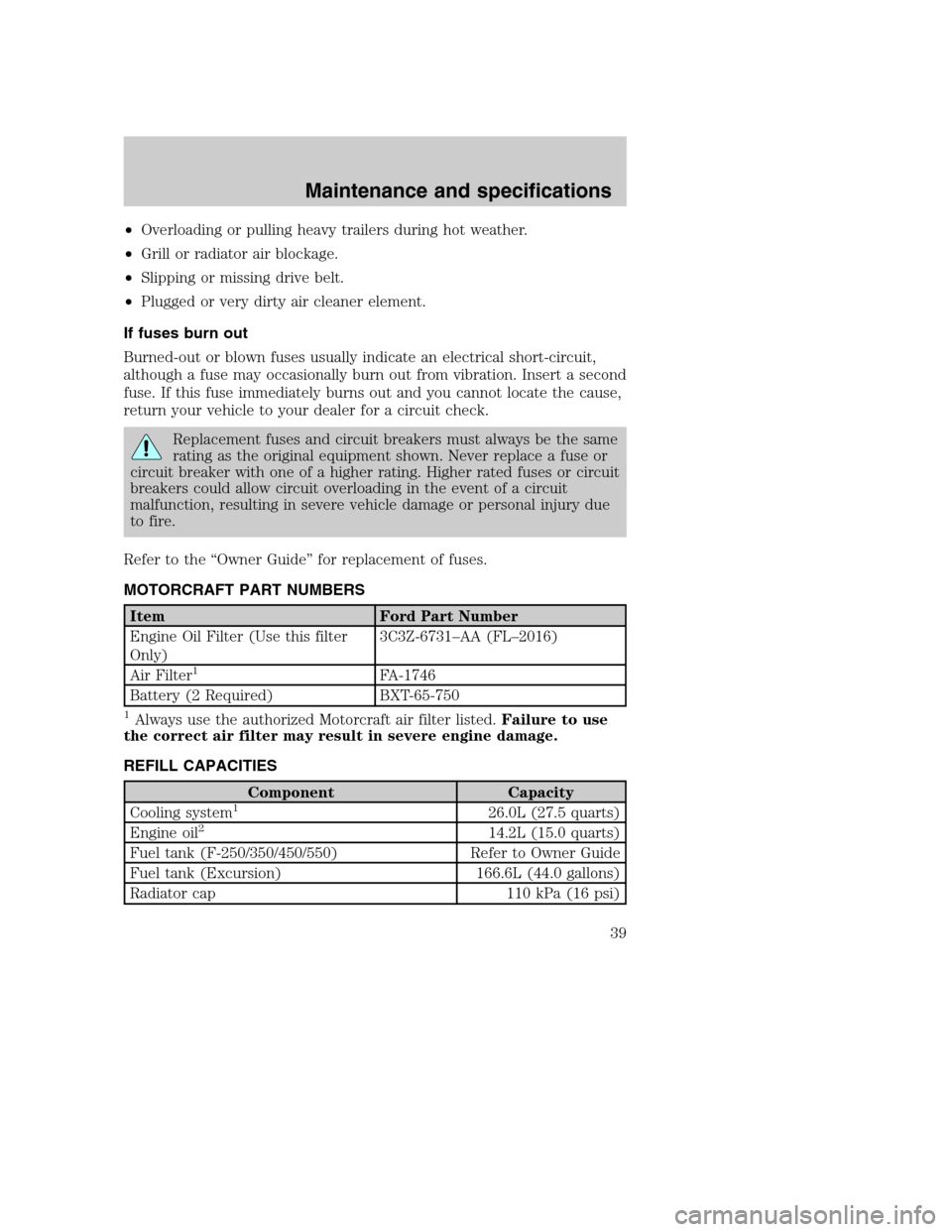
MOTORCRAFT PART NUMBERS
Item Ford Part Number
Engine Oil Filter (Use this filter
Only)3C3Z-6731–AA (FL–2016)
Air Filter
1FA-1746
Battery (2 Required) BXT-65-750
1Always use the authorized Motorcraft air filter listed.Failure to use
the correct air filter may result in severe engine damage.
REFILL CAPACITIES
Component Capacity
Cooling system126.0L (27.5 quarts)
Engine oil214.2L (15.0 quarts)
Fuel tank (F-250/350/450/550) Refer to Owner Guide
Fuel tank (Excursion) 166.6L (44.0 gallons)
Radiator cap 110 kPa (16 psi)
Maintenance and specifications
39
Page 46 of 64
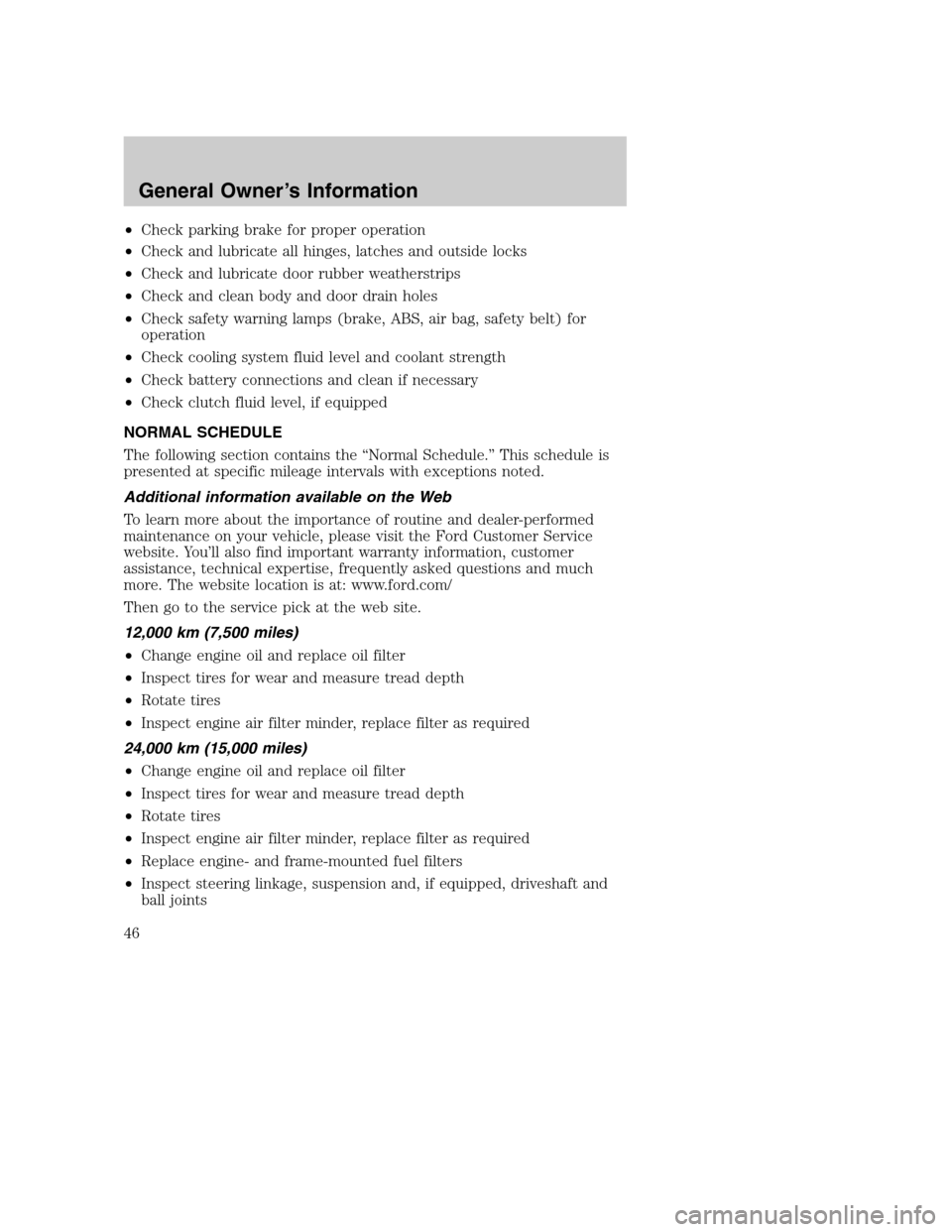
•Check parking brake for proper operation
•Check and lubricate all hinges, latches and outside locks
•Check and lubricate door rubber weatherstrips
•Check and clean body and door drain holes
•Check safety warning lamps (brake, ABS, air bag, safety belt) for
operation
•Check cooling system fluid level and coolant strength
•Check battery connections and clean if necessary
•Check clutch fluid level, if equipped
NORMAL SCHEDULE
The following section contains the“Normal Schedule.”This schedule is
presented at specific mileage intervals with exceptions noted.
Additional information available on the Web
To learn more about the importance of routine and dealer-performed
maintenance on your vehicle, please visit the Ford Customer Service
website. You’ll also find important warranty information, customer
assistance, technical expertise, frequently asked questions and much
more. The website location is at: www.ford.com/
Then go to the service pick at the web site.
12,000 km (7,500 miles)
•Change engine oil and replace oil filter
•Inspect tires for wear and measure tread depth
•Rotate tires
•Inspect engine air filter minder, replace filter as required
24,000 km (15,000 miles)
•Change engine oil and replace oil filter
•Inspect tires for wear and measure tread depth
•Rotate tires
•Inspect engine air filter minder, replace filter as required
•Replace engine- and frame-mounted fuel filters
•Inspect steering linkage, suspension and, if equipped, driveshaft and
ball joints
General Owner’s Information
46