Page 140 of 248
Fuse/RelayLocation Fuse Amp
Rating Power Distribution Box
Description
14 —Not used
15 30A** Anti-lock Brake System (ABS) (solenoids)
16 —Not used
17 40A** ABS (motor)
18 —Not used
19 20A** Engine fan
20 —Not used
21 10A* PCM
22 —Not used
23 20A* Fuel pump
24 —Not used
25 10A* A/C clutch solenoid
26 —Not used
27 —Not used
28 —Not used
29 —Not used
30 —Not used
31 —Not used
32 —Not used
33 —Not used
34 —Not used
35 —Not used
36 —Not used
37 —Not used
38 7.5A* Trailer tow (right turn)
39 —Not used
40 —Not used
41 15A* HEGOs
42 7.5A* Trailer tow (left turn)
43 —Not used
2004 Ranger (ran)
Owners Guide (post-2002-fmt)
USA English (fus)
Roadside Emergencies
140
Page 143 of 248
Fuse/RelayLocation Fuse Amp
Rating Power Distribution Box
Description
14 —Not used
15 30A** Anti-lock Brake System (ABS) (solenoids)
16 —Not used
17 40A** ABS (motor)
18 —Not used
19 —Not used
20 —Not used
21 10A* PCM
22 —Not used
23 20A* Fuel pump
24 —Not used
25 10A* A/C clutch solenoid
26 —Not used
27 20A* 4x4 module
28 —Not used
29 —Not used
30 —Not used
31 15A* Foglamps
32 —Not used
33 —Not used
34 —Not used
35 —Not used
36 —Not used
37 —Not used
38 7.5A* Trailer tow (right turn)
39 —Not used
40 —Not used
41 15A* HEGOs
42 7.5A* Trailer tow (left turn)
43 —Not used
2004 Ranger (ran)
Owners Guide (post-2002-fmt)
USA English (fus)
Roadside Emergencies
143
Page 145 of 248

It is not recommended that the vehicle be operated in 4WD modes with
a“temporary ”(i.e. dissimilar size) spare. If 4WD operation is necessary,
do not operate above speeds of 16 km/h (10 mph) or for distances above
80 km (50 miles).
If you use the temporary spare tire continuously or do not follow
these precautions, the tire could fail, causing you to lose control
of the vehicle, possibly injuring yourself or others.
When driving with the temporary spare tire do not:
• Exceed 80 km/h (50 mph)
• Load the vehicle beyond maximum vehicle load rating listed on the
Safety Compliance Label
• Tow a trailer
• Use more than one temporary spare tire at a time
• Use snow chains on the end of the vehicle with the temporary spare
tire
Use of a temporary spare tire at any wheel location can lead to
impairment of the following:
• Handling, stability and braking performance
• Comfort and noise
• Ground clearance and parking at curbs
• Winter driving capability
• Wet weather driving capability
Conventional spare tire information
If you have the spare tire that is the same size as your other road tires,
you can use the spare as you would any of the other tires. The spare tire
will be equivalent to your road tires, although it may not have the same
appearance (black-side wall instead of outlined-white letters).
2004 Ranger (ran)
Owners Guide (post-2002-fmt)
USA English (fus)
Roadside Emergencies
145
Page 146 of 248

Location of the spare tire and tools
The spare tire and tools for your vehicle are stowed in the following
locations:
Tool Location
Spare tire Under the vehicle, just forward of the rear bumper
Jack, jack handle, wheel nut wrench Regular Cab: behind the passenger
seat, underneath the jack and tools
cover on the floor
SuperCab: stowed in the passenger
side rear cab compartment or
behind the jump seat in a separate
tool bag
Four-door models: stowed behind
the front seats, between jump
seats and underneath jack and
tools cover.
Key, spare tire lock (if equipped) In the glove box
Removing the spare tire
1. Assemble the jack handle to the lug wrench as shown in the
illustrations.
When connecting the jack handle, assemble the following:
• one handle extension and one
typical extension. To assemble,
slide parts together. To
disconnect, depress button and
pull apart.
• one wheel nut wrench. Depress
button and slide together.
2004 Ranger (ran)
Owners Guide (post-2002-fmt)
USA English (fus)
Roadside Emergencies
146
Page 150 of 248

10. Remove the jack and fully
tighten the lug nuts, in the order
shown, to 135 Nm (100 lb-ft). Note
that these tightening specifications
are for nut and bolt threads that are
free of dirt and rust. Use only Ford
recommended (1/2–20) replacement
fasteners.
11. Stow the flat tire. Refer to
Stowing the flat/spare tire.
12. Stow the jack and lug wrench. Make sure the jack is fastened so it
does not rattle when you drive.
13. Unblock the wheels.
Stowing the flat/spare tire
Note: Failure to follow spare tire stowage instructions may result in
failure of cable or loss of spare tire.
1. Lay the tire on the ground with the valve stem facing up.
2. Slide the wheel partially under the vehicle and install the wire and
retainer through the center of the wheel.
3. Turn the jack handle clockwise until the tire is raised to its original
position underneath the vehicle. The effort to turn the jack handle
increases significantly as the tire contacts the frame. The spare tire
carrier will ratchet when the tire is in the fully stowed position. The
spare tire carrier has a built-in ratchet feature that will not allow you to
overtighten. If the spare tire carrier ratchets with very little effort, take
the vehicle to your dealer for assistance at your earliest convenience.
4. Check that the tire lies flat against the frame assembly. Push against
the tire to make sure it is tightly sealed under the vehicle. Loosen and
retighten, if necessary. Failure to properly stow the spare tire may result
in failure of the winch cable and loss of the spare tire.
5. Repeat this tightness check procedure when servicing the spare tire
pressure (every six months, per scheduled maintenance guide), or at any
time that the spare tire is disturbed through service of other
components.
6. Install the spare tire lock (if equipped) into the access hole above the
rear bumper with the spare tire lock key (if equipped) and jack handle.1
4
3
2
5
2004 Ranger (ran)
Owners Guide (post-2002-fmt)
USA English (fus)
Roadside Emergencies
150
Page 156 of 248
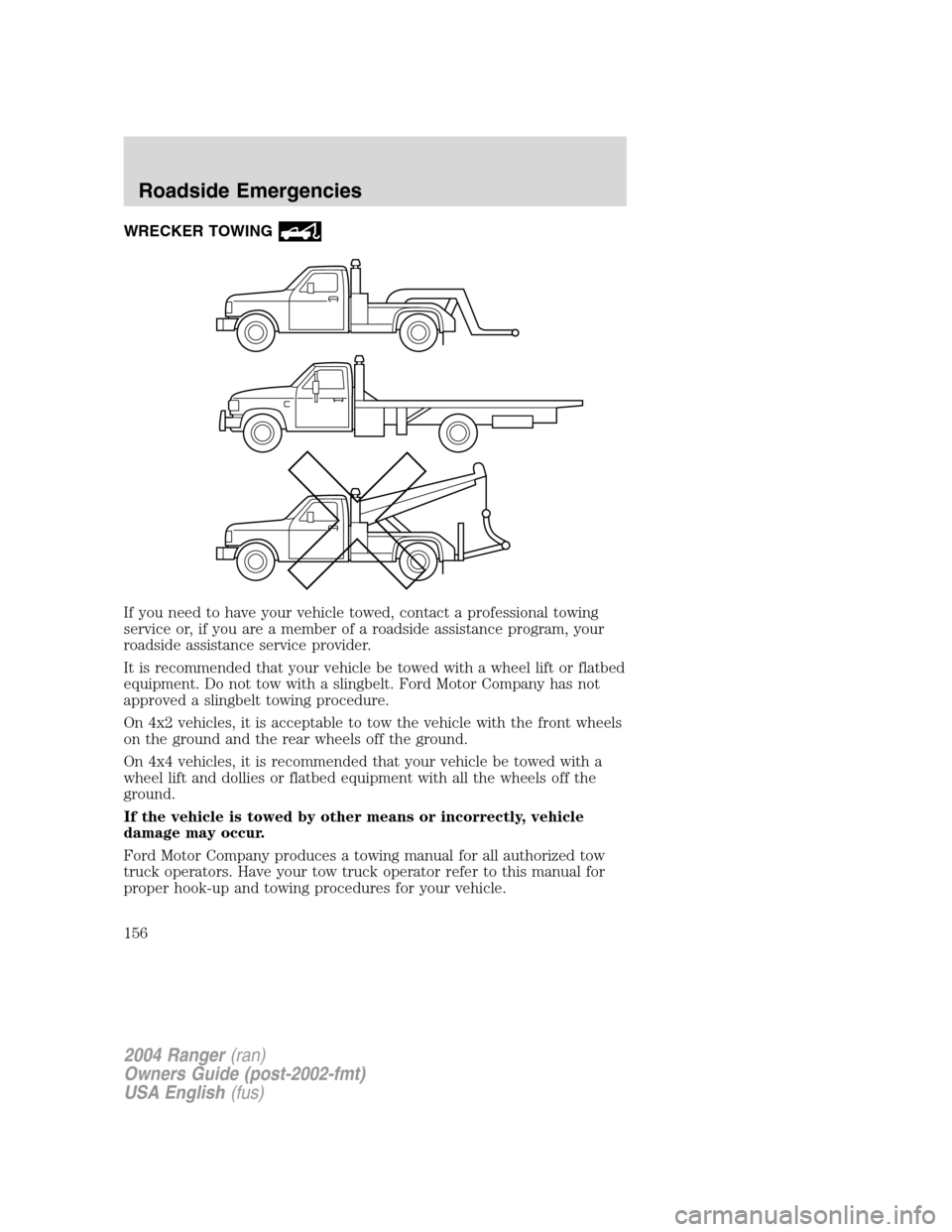
WRECKER TOWING
If you need to have your vehicle towed, contact a professional towing
service or, if you are a member of a roadside assistance program, your
roadside assistance service provider.
It is recommended that your vehicle be towed with a wheel lift or flatbed
equipment. Do not tow with a slingbelt. Ford Motor Company has not
approved a slingbelt towing procedure.
On 4x2 vehicles, it is acceptable to tow the vehicle with the front wheels
on the ground and the rear wheels off the ground.
On 4x4 vehicles, it is recommended that your vehicle be towed with a
wheel lift and dollies or flatbed equipment with all the wheels off the
ground.
If the vehicle is towed by other means or incorrectly, vehicle
damage may occur.
Ford Motor Company produces a towing manual for all authorized tow
truck operators. Have your tow truck operator refer to this manual for
proper hook-up and towing procedures for your vehicle.
2004 Ranger(ran)
Owners Guide (post-2002-fmt)
USA English (fus)
Roadside Emergencies
156
Page 159 of 248
In the United States, a warranty dispute must be submitted to the
Dispute Settlement Board before taking action under the Magnuson-Moss
Warranty Act, or to the extent allowed by state law, before pursuing
replacement or repurchase remedies provided by certain state laws. This
dispute handling procedure is not required prior to enforcing state
created rights or other rights which are independent of the
Magnuson-Moss Warranty Act or state replacement or repurchase laws.
FORD EXTENDED SERVICE PLAN
You can get more protection for your new car or light truck by
purchasing Ford Extended Service Plan (Ford ESP) coverage. Ford ESP
is an optional service contract which is backed by Ford Motor Company
or Ford Motor Service Company (in the U.S.) and Ford of Canada (in
Canada). It provides the following:
•Benefits during the warranty period depending on the plan you
purchase (such as: reimbursement for rentals; coverage for certain
maintenance and wear items).
• Protection against covered repair costs after your Bumper-to-Bumper
Warranty expires.
You may purchase Ford ESP from any participating Ford and Lincoln
Mercury and Ford of Canada dealer. There are several plans available in
various time, distance and deductible combinations which can be tailored
to fit your own driving needs. Ford ESP also offers reimbursement
benefits for towing and rental coverage.
When you buy Ford ESP, you receive Peace-of-Mind protection
throughout the United States and Canada, provided by a network of
more than 5,000 participating Ford or Lincoln Mercury and Ford of
Canada dealers.
If you did not take advantage of the Ford Extended Service Plan at the
time of purchasing your vehicle, you may still be eligible. Since this
information is subject to change, please ask your dealer for complete
details about Ford Extended Service Plan coverage options, or visit the
Ford ESP website at www.ford-esp.com.
2004 Ranger (ran)
Owners Guide (post-2002-fmt)
USA English (fus)
Customer Assistance
159
Page 167 of 248

WASHING THE EXTERIOR
Wash your vehicle regularly with cool or lukewarm water and a neutral
Ph shampoo, such as Motorcraft Detail Wash (ZC-3–A), which is available
from your dealer.
• Never use strong household detergents or soap, such as dish washing
or laundry liquid. These products can discolor and spot painted
surfaces.
• Never wash a vehicle that is “hot to the touch ”or during exposure to
strong, direct sunlight.
• Always use a clean sponge or carwash mitt with plenty of water for
best results.
• Dry the vehicle with a chamois or soft terry cloth towel in order to
eliminate water spotting.
• It is especially important to wash the vehicle regularly during the
winter months, as dirt and road salt are difficult to remove and cause
damage to the vehicle.
• Immediately remove items such as gasoline, diesel fuel, bird droppings
and insect deposits because they can cause damage to the vehicle ’s
paintwork and trim over time.
• Remove any exterior accessories, such as antennas, before entering a
car wash.
• Suntan lotions and insect repellents can damage any painted
surface; if these substances come in contact with your vehicle,
wash off as soon as possible.
• If your vehicle is equipped with running boards, do not use
rubber, plastic and vinyl protectant products on the running
board surface, as the area may become slippery.
WAXING
Applying a polymer paint sealant to your vehicle every six months will
assist in reducing minor scratches and paint damage.
• Wash the vehicle first.
• Do not use waxes that contain abrasives.
• Do not allow paint sealant to come in contact with any non-body
(low-gloss black) colored trim, such as grained door handles, roof
racks, bumpers, side moldings, mirror housings or the windshield cowl
area. The paint sealant will “gray ”or stain the parts over time.
2004 Ranger (ran)
Owners Guide (post-2002-fmt)
USA English (fus)
Cleaning
Cleaning
167

