Page 59 of 248

Tips:
•A maximum of eight keys can be coded to your vehicle.
• Only use Securilock �keys.
• You must have two previously programmed coded keys (keys that
already operate your vehicle ’s engine) and the new unprogrammed
key(s) readily accessible.
• If no previously programmed coded keys are available, you must take
your vehicle to your dealer to have the spare key(s) programmed.
1. Insert a previously programmed
coded key into the ignition.
2. Turn the ignition from the 3 (OFF)
position to the 4 (ON) position. Keep
the ignition in the 4 (ON) position
for at least one second, but no more
than 10 seconds.
3. Turn the ignition to the 3 (OFF)
position, and remove the coded key
from the ignition.
4. Within ten seconds of removing the previously programmed coded key,
insert the other previously programmed coded key into the ignition.
5. Turn the ignition from the 3 (OFF) position to the 4 (ON) position.
Keep the ignition in the 4 (ON) position for at least one second but not
more than 10 seconds.
6. Turn the ignition to the 3 (OFF) position, and remove the second key
from the ignition.
7. Within twenty seconds of removing the previously programmed coded
key, insert the unprogrammed key (new/valet key) into the ignition.
8. Turn the ignition from the 3 (OFF) position to the 4 (ON) position.
Keep the ignition in the 4 (ON) position for at least one second.
9. Your new unprogrammed key is now programmed.
If the key has been successfully programmed it will start the vehicle ’s
engine and the theft indicator light will illuminate for three seconds and
then go out. If the key was not successfully programmed, it will not start
your vehicle ’s engine and the theft indicator light will flash on and off
rapidly. If failure repeats, bring your vehicle to your dealer to have the
new key(s) programmed.
To program additional new unprogrammed key(s), repeat this procedure
from step 1 for each additional key.
3
2
1
5
4
2004 Ranger (ran)
Owners Guide (post-2002-fmt)
USA English (fus)
Locks and Security
59
Page 60 of 248
SEATING
Notes:
Reclining the seatback can cause an occupant to slide under the
seat’s safety belt, resulting in severe personal injuries in the
event of a collision.
Do not pile cargo higher than the seatbacks to reduce the risk of
injury in a collision or sudden stop.
Adjusting the front manual seat
Never adjust the driver ’s seat or seatback when the vehicle is
moving.
Always drive and ride with your seatback upright and the lap
belt snug and low across the hips.
Lift the release bar to move seat
forward or backward. Ensure that
the seat is locked into place.
Pull lever located at the side of the
seat cushion up to adjust seatback.
2004 Ranger (ran)
Owners Guide (post-2002-fmt)
USA English (fus)
Seating and Safety Restraints
Seating and Safety Restraints
60
Page 61 of 248
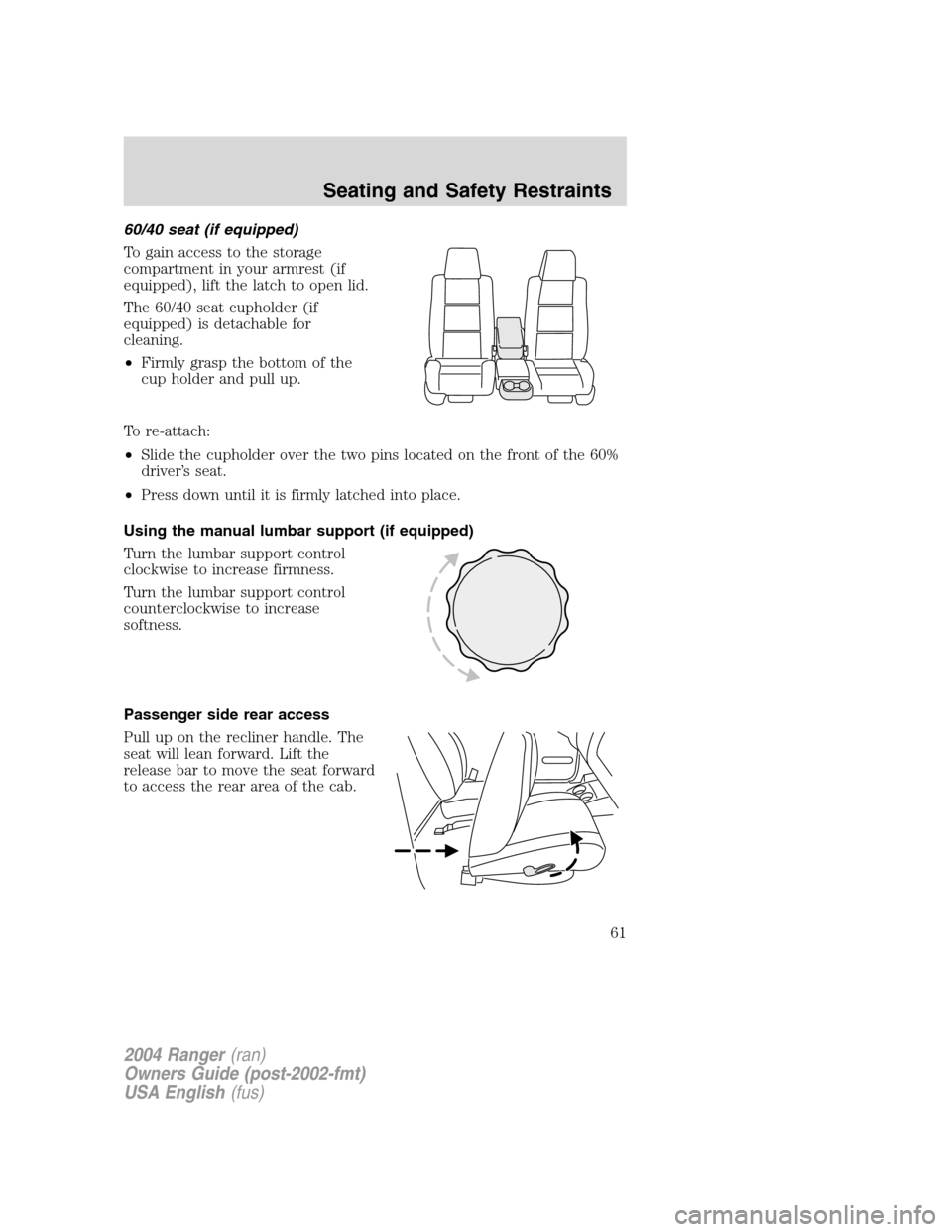
60/40 seat (if equipped)
To gain access to the storage
compartment in your armrest (if
equipped), lift the latch to open lid.
The 60/40 seat cupholder (if
equipped) is detachable for
cleaning.
•Firmly grasp the bottom of the
cup holder and pull up.
To re-attach:
• Slide the cupholder over the two pins located on the front of the 60%
driver ’s seat.
• Press down until it is firmly latched into place.
Using the manual lumbar support (if equipped)
Turn the lumbar support control
clockwise to increase firmness.
Turn the lumbar support control
counterclockwise to increase
softness.
Passenger side rear access
Pull up on the recliner handle. The
seat will lean forward. Lift the
release bar to move the seat forward
to access the rear area of the cab.
2004 Ranger (ran)
Owners Guide (post-2002-fmt)
USA English (fus)
Seating and Safety Restraints
61
Page 62 of 248

To return seat to original position, slide the seat bottom back, then push
the seatback up to lock it in place. The seat will lock, and you will have
to use the release bar to move the seat back to the original position.
REAR SEATS
Center facing jump seat (2 door SuperCab) (if equipped)
To open, pull inboard and down on the seat handle.
To stow the seat, pull seat bottom back to the fully upright position.
Do not install a child seat in a center facing jump seat.
Center facing jump seat (4 door SuperCab) (if equipped)
To open, pull seat assembly down,
then raise seatback.
To stow the seat, fold seat back
down and raise seat assembly to the
fully upright position.
Do not install a child seat in
a center facing jump seat.
Booster seats must be installed only in seating positions
equipped with a combination lap/shoulder belt.
SAFETY RESTRAINTS
Safety restraints precautions
Always drive and ride with your seatback upright and the lap
belt snug and low across the hips.
To reduce the risk of injury, make sure children sit where they
can be properly restrained.
2004 Ranger (ran)
Owners Guide (post-2002-fmt)
USA English (fus)
Seating and Safety Restraints
62
Page 64 of 248

Combination lap and shoulder belts
1. Insert the belt tongue into the
proper buckle (the buckle closest to
the direction the tongue is coming
from) until you hear a snap and feel
it latch. Make sure the tongue is
securely fastened in the buckle.
2. To unfasten, push the release
button and remove the tongue from
the buckle.
The front outboard safety restraints in the vehicle are combination lap
and shoulder belts. The front passenger outboard safety belt has two
types of locking modes described below:
Vehicle sensitive mode
This is the normal retractor mode, which allows free shoulder belt length
adjustment to your movements and locking in response to vehicle
movement. For example, if the driver brakes suddenly or turns a corner
sharply, or the vehicle receives an impact of approximately 8 km/h (5
mph) or more, the combination safety belts will lock to help reduce
forward movement of the driver and passengers.
Automatic locking mode
The automatic locking mode is not available on the driver safety belt.
In this mode, the shoulder belt is automatically pre-locked. The belt will
still retract to remove any slack in the shoulder belt. The automatic
locking mode is not available on the driver safety belt.
2004 Ranger(ran)
Owners Guide (post-2002-fmt)
USA English (fus)
Seating and Safety Restraints
64
Page 65 of 248

This mode should be usedany timea child safety seat is installed in a
passenger front seat. Refer to Safety restraints for children orSafety
seats for children later in this chapter.
How to use the automatic locking mode
• Buckle the combination lap and
shoulder belt.
• Grasp the shoulder portion and
pull downward until the entire
belt is pulled out.
• Allow the belt to retract. As the belt retracts, you will hear a clicking
sound. This indicates the safety belt is now in the automatic locking
mode.
How to disengage the automatic locking mode
Disconnect the combination lap/shoulder belt and allow it to retract
completely to disengage the automatic locking mode and activate the
vehicle sensitive (emergency) locking mode.
After any vehicle collision, the seat belt system at all outboard
seating positions (except driver, which has no “automatic locking
retractor ”feature) must be checked by a qualified technician to verify
that the “automatic locking retractor ”feature for child seats is still
functioning properly. In addition, all safety belts should be checked for
proper function.
2004 Ranger (ran)
Owners Guide (post-2002-fmt)
USA English (fus)
Seating and Safety Restraints
65
Page 66 of 248

BELT AND RETRACTOR ASSEMBLY MUST BE REPLACED if
the safety belt assembly“automatic locking retractor ”feature or
any other safety belt function is not operating properly when checked
according to the procedures in Workshop Manual.
Failure to replace the Belt and Retractor assembly could
increase the risk of injury in collisions.
Energy Management Feature
• This vehicle has a safety belt system with an energy management
feature at the front outboard seating positions to help further reduce
the risk of injury in the event of a head-on collision.
• This safety belt system has a retractor assembly that is designed to
pay out webbing in a controlled manner. This feature is designed to
help reduce the belt force acting on the occupant ’s chest.
Safety belt pretensioner
Your vehicle is equipped with safety belt pretensioners at the driver and
front outboard passenger seating positions.
The safety belt pretensioners are designed to activate during certain
frontal or near-frontal collisions with sufficient longitudinal deceleration.
A safety belt pretensioner is a device which tightens the webbing of the
lap and shoulder belts in such a way that they fit more snugly against
the body.
The driver and front outboard passenger safety belt system (including
retractors, buckle assembly, pretensioner assembly with seat and height
adjusters) must be replaced if the vehicle is involved in a collision that
results in the activation of the safety belt pretensioners. Refer to the
Safety belt maintenance section in this chapter.
Failure to replace the safety belt assembly under the above
conditions could result in severe personal injuries in the event of
a collision.
2004 Ranger (ran)
Owners Guide (post-2002-fmt)
USA English (fus)
Seating and Safety Restraints
66
Page 67 of 248
Front safety belt height adjustment
Your vehicle has safety belt height adjustments for the driver and front
passenger. Adjust the height of the shoulder belt so the belt rests across
the middle of your shoulder.
•Regular Cab and 4 –door Super
Cab
• 2–door SuperCab
To lower the shoulder belt height, push the button and slide the height
adjuster down. To raise the height of the shoulder belt, slide the height
adjuster up. Pull down on the height adjuster to make sure it is locked in
place.
Position the safety belt height adjusters so that the belt rests
across the middle of your shoulder. Failure to adjust the safety
belt properly could reduce the effectiveness of the seat belt and
increase the risk of injury in a collision.
2004 Ranger (ran)
Owners Guide (post-2002-fmt)
USA English (fus)
Seating and Safety Restraints
67