Page 167 of 240
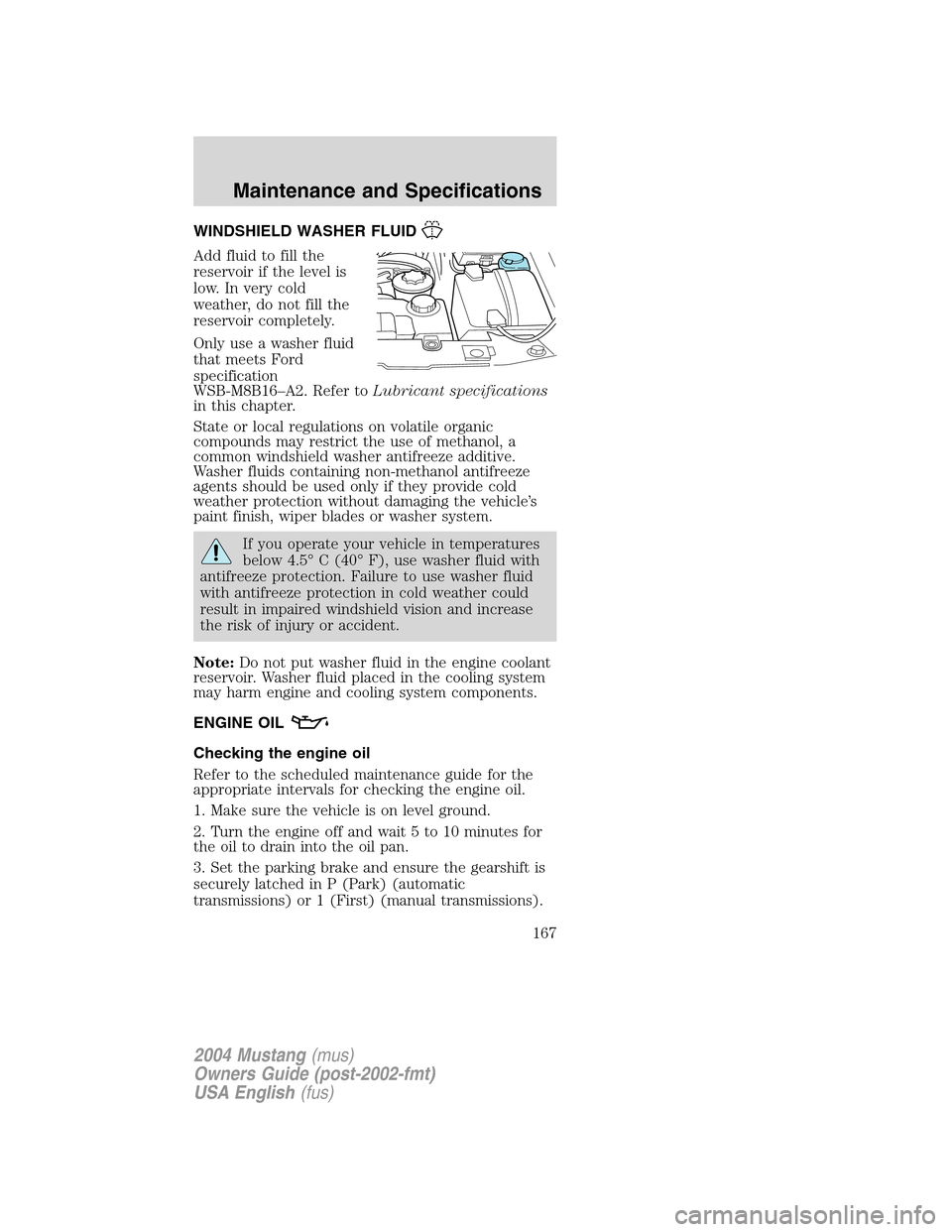
WINDSHIELD WASHER FLUID
Add fluid to fill the
reservoir if the level is
low. In very cold
weather, do not fill the
reservoir completely.
Only use a washer fluid
that meets Ford
specification
WSB-M8B16–A2. Refer toLubricant specifications
in this chapter.
State or local regulations on volatile organic
compounds may restrict the use of methanol, a
common windshield washer antifreeze additive.
Washer fluids containing non-methanol antifreeze
agents should be used only if they provide cold
weather protection without damaging the vehicle’s
paint finish, wiper blades or washer system.
If you operate your vehicle in temperatures
below 4.5°C (40°F), use washer fluid with
antifreeze protection. Failure to use washer fluid
with antifreeze protection in cold weather could
result in impaired windshield vision and increase
the risk of injury or accident.
Note:Do not put washer fluid in the engine coolant
reservoir. Washer fluid placed in the cooling system
may harm engine and cooling system components.
ENGINE OIL
Checking the engine oil
Refer to the scheduled maintenance guide for the
appropriate intervals for checking the engine oil.
1. Make sure the vehicle is on level ground.
2. Turn the engine off and wait 5 to 10 minutes for
the oil to drain into the oil pan.
3. Set the parking brake and ensure the gearshift is
securely latched in P (Park) (automatic
transmissions) or 1 (First) (manual transmissions).
2004 Mustang(mus)
Owners Guide (post-2002-fmt)
USA English(fus)
Maintenance and Specifications
167
Page 174 of 240
•Always dispose of
automotive batteries
in a responsible
manner. Follow your
local authorized
standards for
disposal. Call your
local authorized
recycling center to find out more about recycling
automotive batteries.
ENGINE COOLANT
Checking engine coolant
The concentration and level of engine coolant should
be checked at the mileage intervals in the scheduled
maintenance guide. The coolant concentration
should be maintained at 50/50 coolant and water,
which equates to a freeze point of -36°C (-34°F).
Coolant concentration testing is possible with a
hydrometer or antifreeze tester (such as the
Rotunda Battery and Antifreeze Tester, 014–R1060).
The level of coolant should be maintained at the
“cold full”of“cold fill range”level in the coolant
reservoir. If the level falls below, add coolant per the
instructions in theAdding Engine Coolantsection.
Your vehicle was factory-filled with a 50/50 engine
coolant and water concentration. If the
concentration of coolant falls below 40% or above
60%, the engine parts could become damaged or not
work properly.A50–50 mixture of coolant and
water provides the following:
•freeze protection down to -36°C (-34°F)
•boiling protection up to 129°C (265°F)
•protection against rust and other forms of
corrosion
•enables calibrated gages to function properly
LEAD
RETURN
RECYCLE
2004 Mustang(mus)
Owners Guide (post-2002-fmt)
USA English(fus)
Maintenance and Specifications
174
Page 187 of 240

Cleaner air
Ford endorses the use of reformulated
“cleaner-burning”gasolines to improve air quality.
Running out of fuel
Avoid running out of fuel because this situation may
have an adverse affect on powertrain components.
If you have run out of fuel:
•You may need to cycle the ignition from OFF to
ON several times after refueling, to allow the fuel
system to pump the fuel from the tank to the
engine.
•Your“Service Engine Soon”indicator may come
on. For more information on the“Service Engine
Soon”indicator, refer to theInstrument cluster
chapter.
Fuel Filter
For fuel filter replacement, see your dealer or a
qualified service technician. Refer to the scheduled
maintenance guide for the appropriate intervals for
changing the fuel filter.
Replace the fuel filter with an authorized
Motorcraft part. The customer warranty may
be void for any damage to the fuel system if an
authorized Motorcraft fuel filter is not used.
ESSENTIALS OF GOOD FUEL ECONOMY
Measuring techniques
Your best source of information about actual fuel
economy is you, the driver. You must gather
information as accurately and consistently as
possible. Fuel expense, frequency of fill-ups or fuel
gauge readings are NOT accurate as a measure of
fuel economy. We do not recommend taking fuel
economy measurements during the first 1,600 km
(1,000 miles) of driving (engine break-in period).
You will get a more accurate measurement after
3,000 km–5,000 km (2,000 miles-3,000 miles).
2004 Mustang(mus)
Owners Guide (post-2002-fmt)
USA English(fus)
Maintenance and Specifications
187
Page 196 of 240
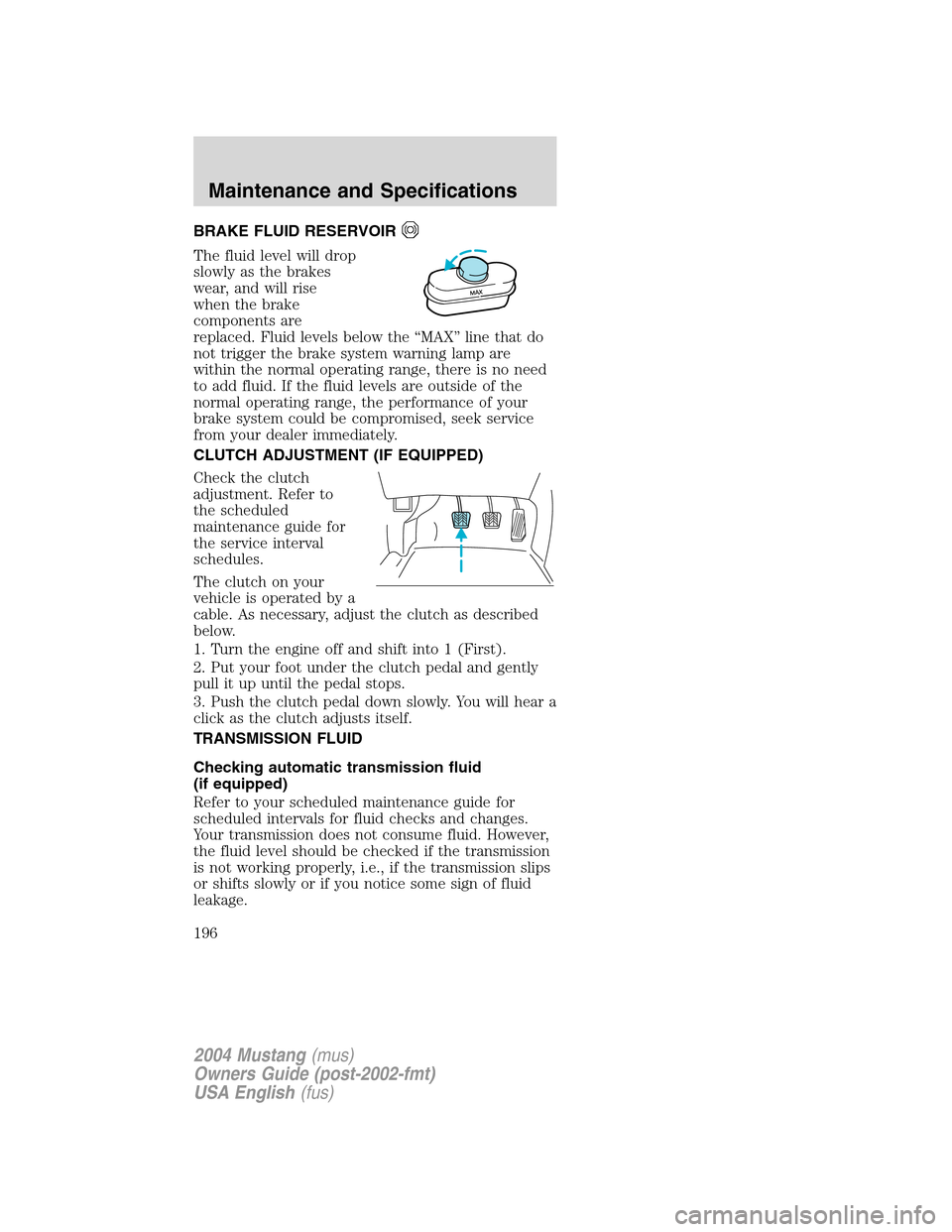
BRAKE FLUID RESERVOIR
The fluid level will drop
slowly as the brakes
wear, and will rise
when the brake
components are
replaced. Fluid levels below the“MAX”line that do
not trigger the brake system warning lamp are
within the normal operating range, there is no need
to add fluid. If the fluid levels are outside of the
normal operating range, the performance of your
brake system could be compromised, seek service
from your dealer immediately.
CLUTCH ADJUSTMENT (IF EQUIPPED)
Check the clutch
adjustment. Refer to
the scheduled
maintenance guide for
the service interval
schedules.
The clutch on your
vehicle is operated by a
cable. As necessary, adjust the clutch as described
below.
1. Turn the engine off and shift into 1 (First).
2. Put your foot under the clutch pedal and gently
pull it up until the pedal stops.
3. Push the clutch pedal down slowly. You will hear a
click as the clutch adjusts itself.
TRANSMISSION FLUID
Checking automatic transmission fluid
(if equipped)
Refer to your scheduled maintenance guide for
scheduled intervals for fluid checks and changes.
Your transmission does not consume fluid. However,
the fluid level should be checked if the transmission
is not working properly, i.e., if the transmission slips
or shifts slowly or if you notice some sign of fluid
leakage.
M
A
X
2004 Mustang(mus)
Owners Guide (post-2002-fmt)
USA English(fus)
Maintenance and Specifications
196