2004 FORD MUSTANG service
[x] Cancel search: servicePage 171 of 240

unnecessary and could lead to engine damage that is
not covered by Ford warranty.
Change your engine oil according to the appropriate
schedule listed in the scheduled maintenance guide.
Ford production and aftermarket (Motorcraft) oil
filters are designed for added engine protection and
long life. If a replacement oil filter is used that does
not meet Ford material and design specifications,
start-up engine noises or knock may be experienced.
It is recommended you use the appropriate
Motorcraft oil filter (or another brand meeting Ford
specifications) for your engine application.
BATTERY
Your vehicle is
equipped with a
Motorcraft
maintenance-free
battery which normally
does not require
additional water during
its life of service.
However, for severe usage or in high temperature
climates, check the battery electrolyte level. Refer to
the scheduled maintenance guide for the service
interval schedules.
Keep the electrolyte level in each cell up to the
“level indicator”. Do not overfill the battery
cells.
If the electrolyte level in the battery is low, you can
add plain tap water to the battery, as long as you do
not use hard water (water with a high mineral or
alkali content). If possible, however, try to only fill
the battery cells with distilled water. If the battery
needs water often, have the charging system
checked.
If your battery has a cover/shield, make sure it
is reinstalled after the battery has been
cleaned or replaced.
2004 Mustang(mus)
Owners Guide (post-2002-fmt)
USA English(fus)
Maintenance and Specifications
171
Page 175 of 240
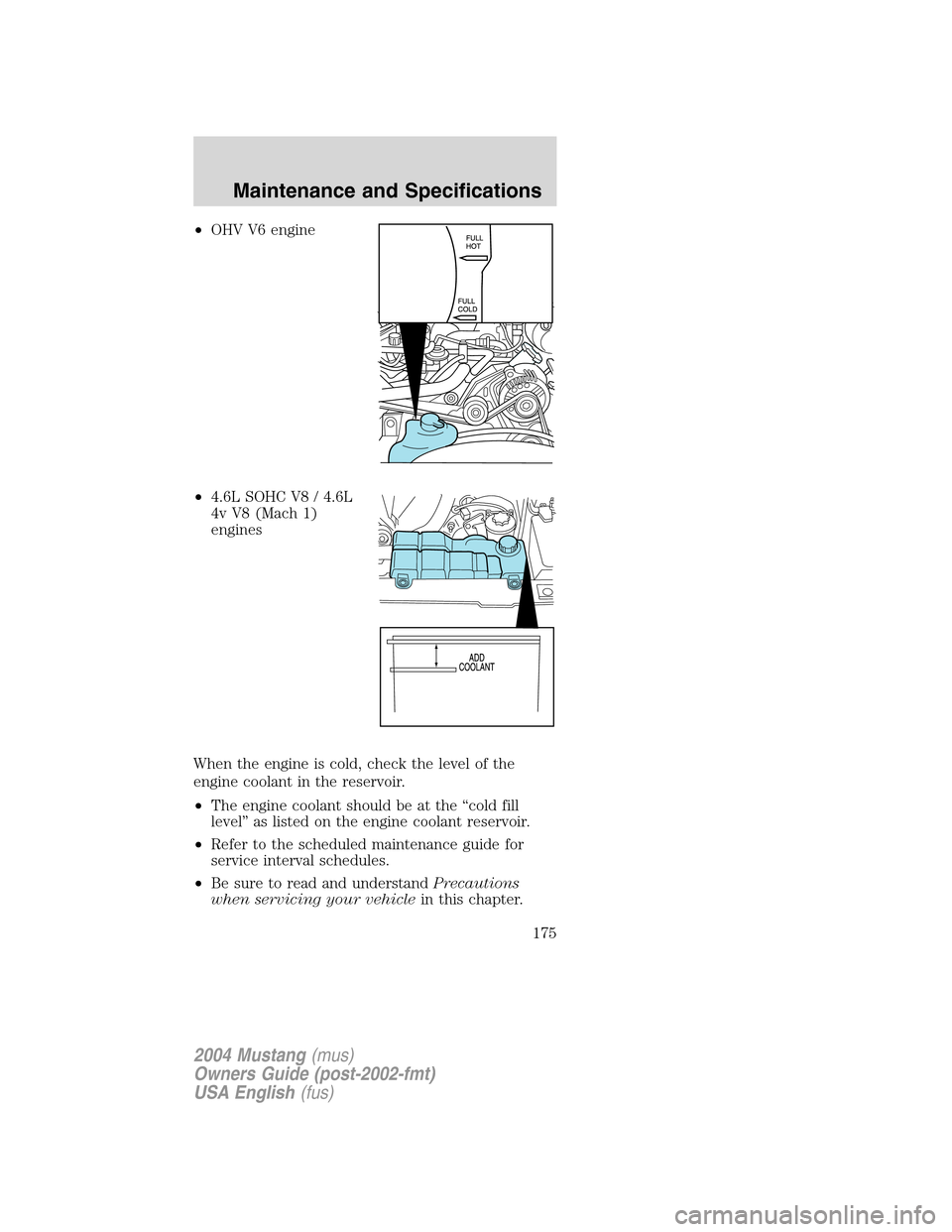
•OHV V6 engine
•4.6L SOHC V8 / 4.6L
4v V8 (Mach 1)
engines
When the engine is cold, check the level of the
engine coolant in the reservoir.
•The engine coolant should be at the“cold fill
level”as listed on the engine coolant reservoir.
•Refer to the scheduled maintenance guide for
service interval schedules.
•Be sure to read and understandPrecautions
when servicing your vehiclein this chapter.
2004 Mustang(mus)
Owners Guide (post-2002-fmt)
USA English(fus)
Maintenance and Specifications
175
Page 177 of 240
Mixing Motorcraft Speciality Orange Engine Coolant
or any orange-colored extended life product with
your factory filled coolant can result in degraded
corrosion protection.
•A large amount of water without engine coolant
may be added, in case of emergency, to reach a
vehicle service location. In this instance, the
cooling system must be drained and refilled with a
50/50 mixture of engine coolant and distilled
water as soon as possible. Water alone (without
engine coolant) can cause engine damage from
corrosion, overheating or freezing.
•Do not use alcohol, methanol or brine or any
engine coolants mixed with alcohol or
methanol antifreeze (coolant).Alcohol and
other liquids can cause engine damage from
overheating or freezing.
•Do not add extra inhibitors or additives to
the coolant.These can be harmful and
compromise the corrosion protection of the
engine coolant.
To reduce the risk of personal injury, make
sure the engine is cool before unscrewing
the coolant pressure relief cap. The cooling system
is under pressure; steam and hot liquid can come
out forcefully when the cap is loosened slightly.
If you must remove the pressure relief cap or
radiator cap (depending upon engine application),
follow these steps to avoid personal injury:
1. Before you remove the cap, turn the engine off
and let it cool.
2. When the engine is cool, wrap a thick cloth
around the cap. Slowly turn cap counterclockwise
until pressure begins to release.
3. Step back while the pressure releases.
4. When you are sure that all the pressure has been
released, use the cloth to turn it counterclockwise
and remove the cap.
2004 Mustang(mus)
Owners Guide (post-2002-fmt)
USA English(fus)
Maintenance and Specifications
177
Page 184 of 240
Use the following guidelines to avoid static build-up
when filling an ungrounded fuel container:
•Place approved fuel container on the ground.
•DO NOT fill a fuel container while it is in the
vehicle (including the cargo area).
•Keep the fuel pump nozzle in contact with the
fuel container while filling.
•DO NOT use a device that would hold the fuel
pump handle in the fill position.
Fuel Filler Cap
Your fuel tank filler cap has an indexed design with
a 1/8 turn on/off feature.
When fueling your vehicle:
1. Turn the engine off.
2. Carefully turn the filler cap counterclockwise 1/8
of a turn until it stops.
3. Pull to remove the cap from the fuel filler pipe.
4. To install the cap, align the tabs on the cap with
the notches on the filler pipe.
5. Turn the filler cap clockwise 1/8 of a turn until it
stops.
“Check Fuel Cap”illuminates when the ignition is
turned to the ON position to ensure your bulb is
working. When this light turns on, check the fuel
filler cap. Continuing to operate the vehicle with the
Check Fuel Cap light on, can activate the Service
Engine Soon warning. When the fuel filler cap is
properly re-installed, the light(s) will turn off after a
period of normal driving.It may take a long
period of time for the system to detect an
improperly installed fuel filler cap.
If you must replace the fuel filler cap, replace
it with a fuel filler cap that is designed for
your vehicle. The customer warranty may be
void for any damage to the fuel tank or fuel
system if the correct genuine Ford or
Motorcraft fuel filler cap is not used.
2004 Mustang(mus)
Owners Guide (post-2002-fmt)
USA English(fus)
Maintenance and Specifications
184
Page 185 of 240
The fuel system may be under pressure. If
the fuel filler cap is venting vapor or if you
hear a hissing sound, wait until it stops before
completely removing the fuel filler cap. Otherwise,
fuel may spray out and injure you or others.
If you do not use the proper fuel filler cap,
excessive pressure or vacuum in the fuel
tank may damage the fuel system or cause the fuel
cap to disengage in a collision, which may result in
possible personal injury.
Choosing the right fuel
Use only UNLEADED FUEL. The use of leaded fuel
is prohibited by law and could damage your vehicle.
Do not use fuel containing methanol. It can damage
critical fuel system components.
Your vehicle was not designed to use fuel or fuel
additives with metallic compounds, including
manganese-based additives.
Repairs to correct the effects of using a fuel for
which your vehicle was not designed may not be
covered by your warranty.
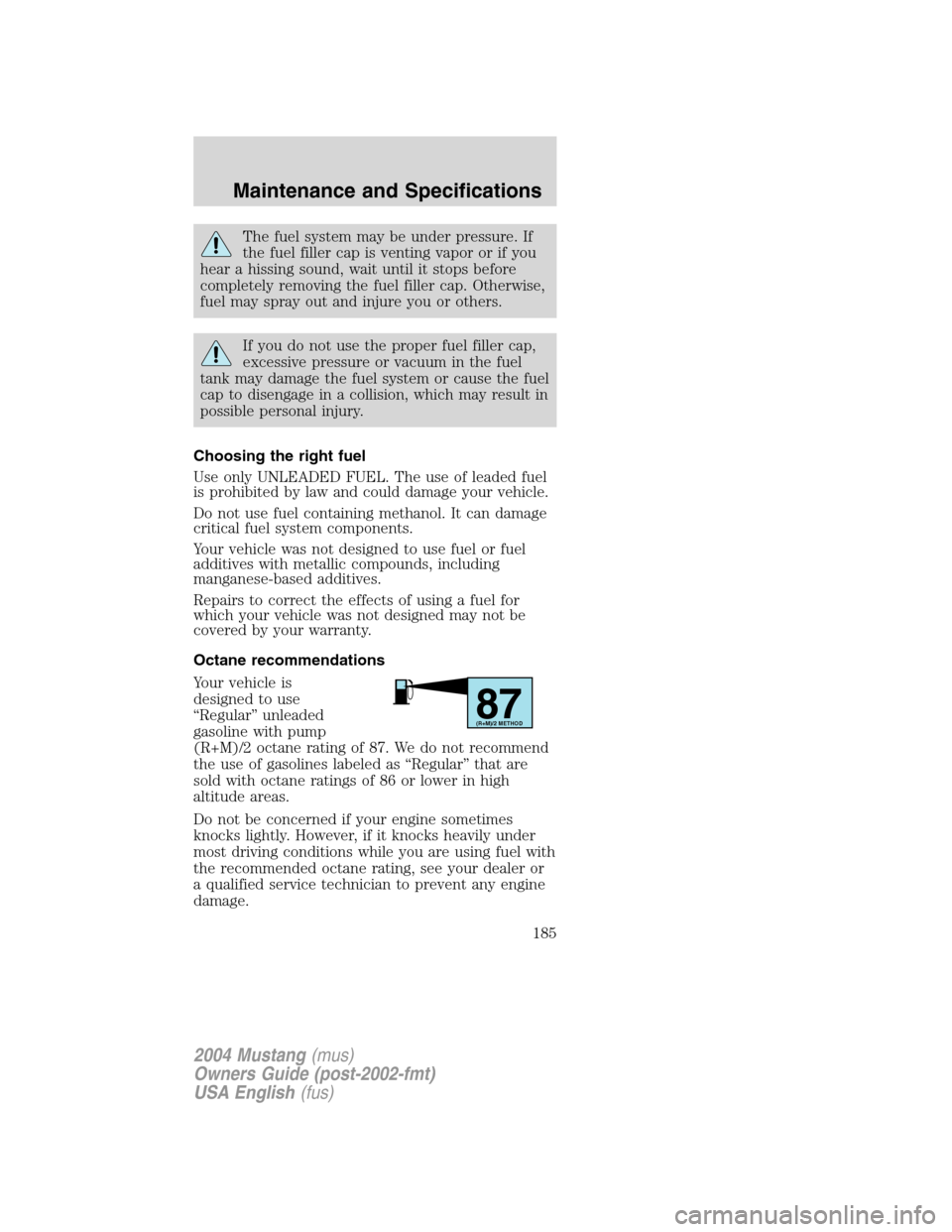
Octane recommendations
Your vehicle is
designed to use
“Regular”unleaded
gasoline with pump
(R+M)/2 octane rating of 87. We do not recommend
the use of gasolines labeled as“Regular”that are
sold with octane ratings of 86 or lower in high
altitude areas.
Do not be concerned if your engine sometimes
knocks lightly. However, if it knocks heavily under
most driving conditions while you are using fuel with
the recommended octane rating, see your dealer or
a qualified service technician to prevent any engine
damage.
87(R+M)/2 METHOD
2004 Mustang(mus)
Owners Guide (post-2002-fmt)
USA English(fus)
Maintenance and Specifications
185
Page 186 of 240
Mach 1
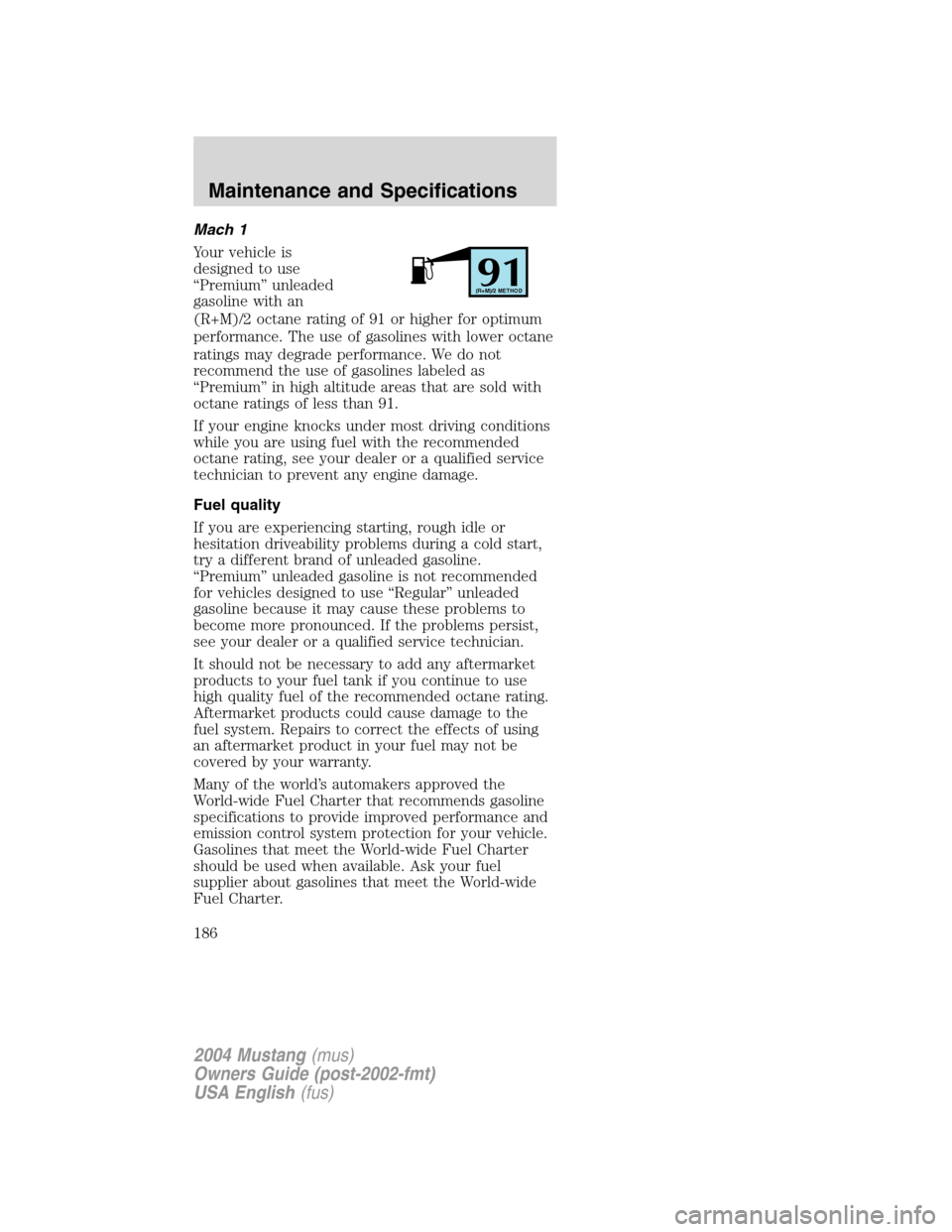
Your vehicle is
designed to use
“Premium”unleaded
gasoline with an
(R+M)/2 octane rating of 91 or higher for optimum
performance. The use of gasolines with lower octane
ratings may degrade performance. We do not
recommend the use of gasolines labeled as
“Premium”in high altitude areas that are sold with
octane ratings of less than 91.
If your engine knocks under most driving conditions
while you are using fuel with the recommended
octane rating, see your dealer or a qualified service
technician to prevent any engine damage.
Fuel quality
If you are experiencing starting, rough idle or
hesitation driveability problems during a cold start,
try a different brand of unleaded gasoline.
“Premium”unleaded gasoline is not recommended
for vehicles designed to use“Regular”unleaded
gasoline because it may cause these problems to
become more pronounced. If the problems persist,
see your dealer or a qualified service technician.
It should not be necessary to add any aftermarket
products to your fuel tank if you continue to use
high quality fuel of the recommended octane rating.
Aftermarket products could cause damage to the
fuel system. Repairs to correct the effects of using
an aftermarket product in your fuel may not be
covered by your warranty.
Many of the world’s automakers approved the
World-wide Fuel Charter that recommends gasoline
specifications to provide improved performance and
emission control system protection for your vehicle.
Gasolines that meet the World-wide Fuel Charter
should be used when available. Ask your fuel
supplier about gasolines that meet the World-wide
Fuel Charter.
91(R+M)/2 METHOD
2004 Mustang(mus)
Owners Guide (post-2002-fmt)
USA English(fus)
Maintenance and Specifications
186
Page 187 of 240

Cleaner air
Ford endorses the use of reformulated
“cleaner-burning”gasolines to improve air quality.
Running out of fuel
Avoid running out of fuel because this situation may
have an adverse affect on powertrain components.
If you have run out of fuel:
•You may need to cycle the ignition from OFF to
ON several times after refueling, to allow the fuel
system to pump the fuel from the tank to the
engine.
•Your“Service Engine Soon”indicator may come
on. For more information on the“Service Engine
Soon”indicator, refer to theInstrument cluster
chapter.
Fuel Filter
For fuel filter replacement, see your dealer or a
qualified service technician. Refer to the scheduled
maintenance guide for the appropriate intervals for
changing the fuel filter.
Replace the fuel filter with an authorized
Motorcraft part. The customer warranty may
be void for any damage to the fuel system if an
authorized Motorcraft fuel filter is not used.
ESSENTIALS OF GOOD FUEL ECONOMY
Measuring techniques
Your best source of information about actual fuel
economy is you, the driver. You must gather
information as accurately and consistently as
possible. Fuel expense, frequency of fill-ups or fuel
gauge readings are NOT accurate as a measure of
fuel economy. We do not recommend taking fuel
economy measurements during the first 1,600 km
(1,000 miles) of driving (engine break-in period).
You will get a more accurate measurement after
3,000 km–5,000 km (2,000 miles-3,000 miles).
2004 Mustang(mus)
Owners Guide (post-2002-fmt)
USA English(fus)
Maintenance and Specifications
187
Page 192 of 240
•Have the items listed in your scheduled
maintenance guide performed according to the
specified schedule.
The scheduled maintenance items listed in the
scheduled maintenance guide are essential to the life
and performance of your vehicle and to its emissions
system.
If other than Ford, Motorcraft or Ford-authorized
parts are used for maintenance replacements or for
service of components affecting emission control,
such non-Ford parts should be equivalent to genuine
Ford Motor Company parts in performance and
durability.
Do not park, idle, or drive your vehicle in
dry grass or other dry ground cover. The
emission system heats up the engine compartment
and exhaust system, which can start a fire.
Illumination of the“Service Engine Soon”light,
charging system warning light or the temperature
warning light, fluid leaks, strange odors, smoke or
loss of engine power, could indicate that the
emission control system is not working properly.
Exhaust leaks may result in entry of harmful
and potentially lethal fumes into the
passenger compartment.
Do not make any unauthorized changes to your
vehicle or engine. By law, vehicle owners and anyone
who manufactures, repairs, services, sells, leases,
trades vehicles, or supervises a fleet of vehicles are
not permitted to intentionally remove an emission
control device or prevent it from working.
Information about your vehicle’s emission system is
on the Vehicle Emission Control Information Decal
located on or near the engine. This decal identifies
engine displacement and gives some tune up
specifications.
Please consult yourWarranty Guidefor complete
emission warranty information.
2004 Mustang(mus)
Owners Guide (post-2002-fmt)
USA English(fus)
Maintenance and Specifications
192