Page 111 of 240
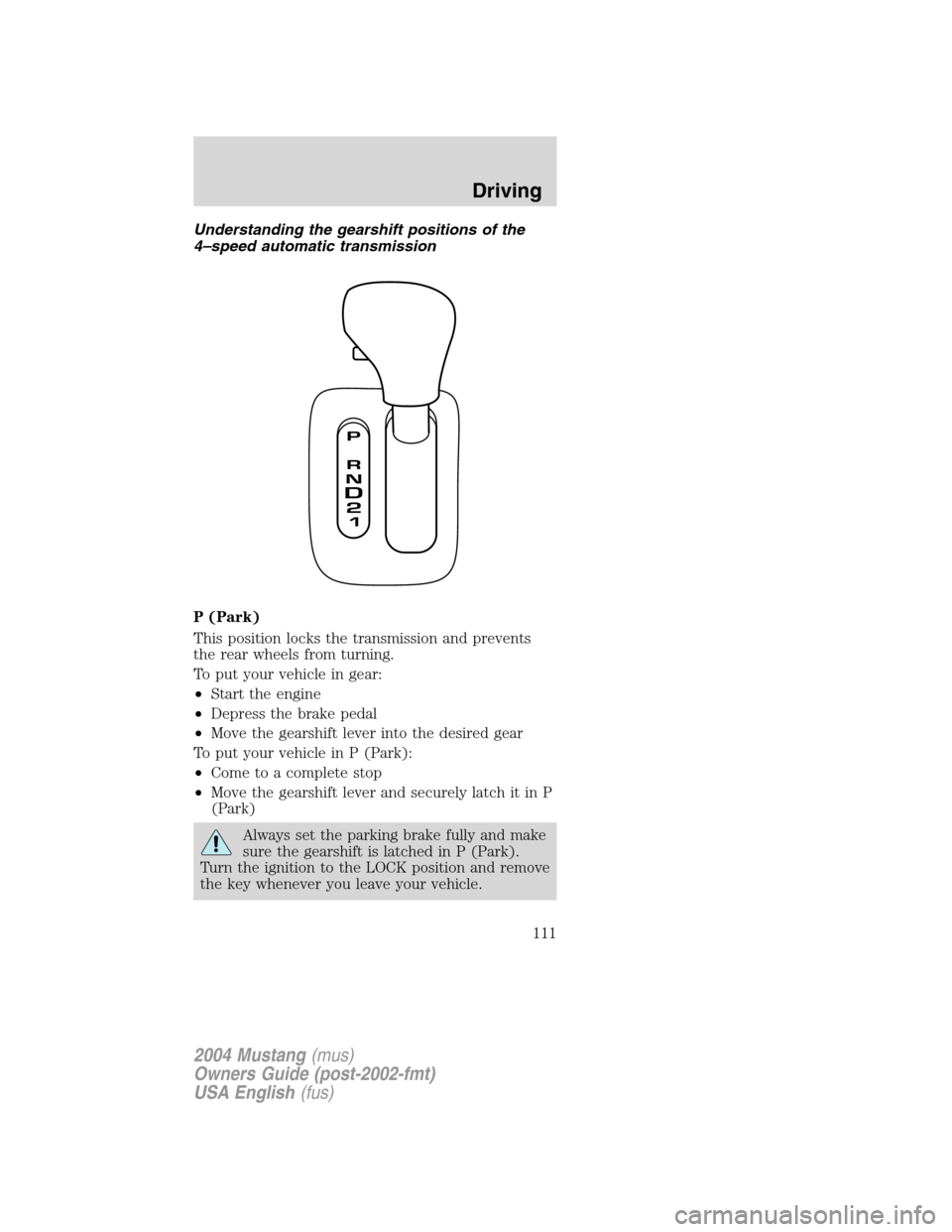
Understanding the gearshift positions of the
4–speed automatic transmission
P (Park)
This position locks the transmission and prevents
the rear wheels from turning.
To put your vehicle in gear:
•Start the engine
•Depress the brake pedal
•Move the gearshift lever into the desired gear
To put your vehicle in P (Park):
•Come to a complete stop
•Move the gearshift lever and securely latch it in P
(Park)
Always set the parking brake fully and make
sure the gearshift is latched in P (Park).
Turn the ignition to the LOCK position and remove
the key whenever you leave your vehicle.
2004 Mustang(mus)
Owners Guide (post-2002-fmt)
USA English(fus)
Driving
111
Page 112 of 240
R (Reverse)
With the gearshift lever in R (Reverse), the vehicle
will move backward. Always come to a complete
stop before shifting into and out of R (Reverse).
N (Neutral)
With the gearshift lever in N (Neutral), the vehicle
can be started and is free to roll. Hold the brake
pedal down while in this position.
D (Overdrive)
The normal driving
position for the best
fuel economy.
Transmission operates
in gears one through
four.
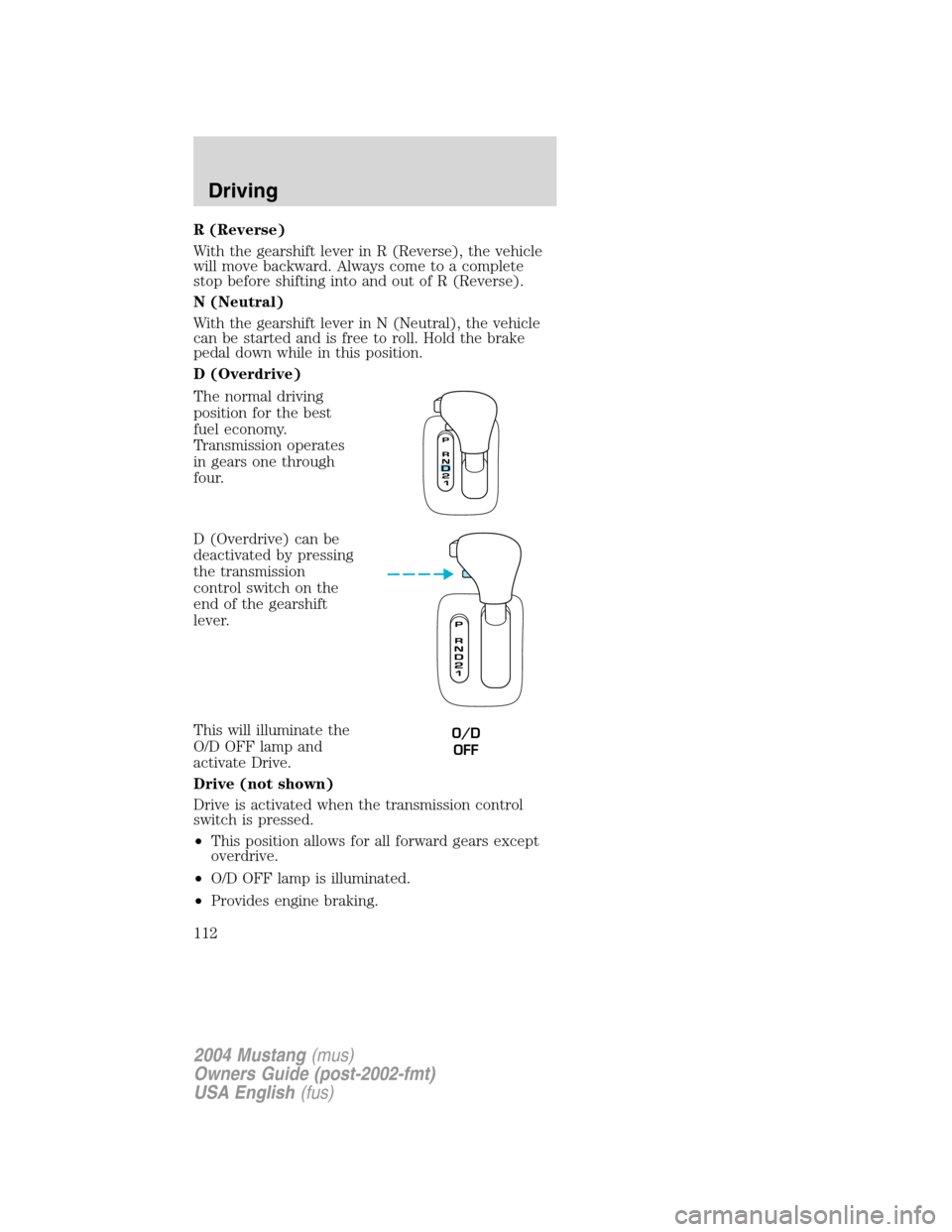
D (Overdrive) can be
deactivated by pressing
the transmission
control switch on the
end of the gearshift
lever.
This will illuminate the
O/D OFF lamp and
activate Drive.
Drive (not shown)
Drive is activated when the transmission control
switch is pressed.
•This position allows for all forward gears except
overdrive.
•O/D OFF lamp is illuminated.
•Provides engine braking.
O/D
OFF
2004 Mustang(mus)
Owners Guide (post-2002-fmt)
USA English(fus)
Driving
112
Page 113 of 240
•Use when driving conditions cause excessive
shifting from O/D to other gears. Examples: city
traffic, hilly terrain, heavy loads, trailer towing
and when engine braking is required.
•To return to O/D (overdrive mode), press the
transmission control switch. The O/D OFF lamp
will not be illuminated.
•O/D (Overdrive) is automatically returned each
time the key is turned off.
2 (Second)
This position allows for second gear only.
•Provides engine braking.
•Use to start-up on slippery roads.
•To return to D (Overdrive), move the gearshift
lever into the D (Overdrive) position.
•Selecting 2 (Second) at higher speeds will cause
the transmission to downshift to second gear at
the appropriate vehicle speed.
1 (First)
•Provides maximum engine braking.
•Allows upshifts by moving gearshift lever.
•Will not downshift into 1 (First) at high speeds;
allows for 1 (First) when vehicle reaches slower
speeds.
Forced downshifts
•Allowed in D (Overdrive) or Drive.
•Depress the accelerator to the floor.
•Allows transmission to select an appropriate gear.
If your vehicle gets stuck in mud or snow
If your vehicle gets stuck in mud or snow, it may be
rocked out by shifting from forward and reverse
gears, stopping between shifts in a steady pattern.
Press lightly on the accelerator in each gear.
Do not rock the vehicle if the engine is not at
normal operating temperature or damage to
the transmission may occur.
2004 Mustang(mus)
Owners Guide (post-2002-fmt)
USA English(fus)
Driving
113
Page 114 of 240
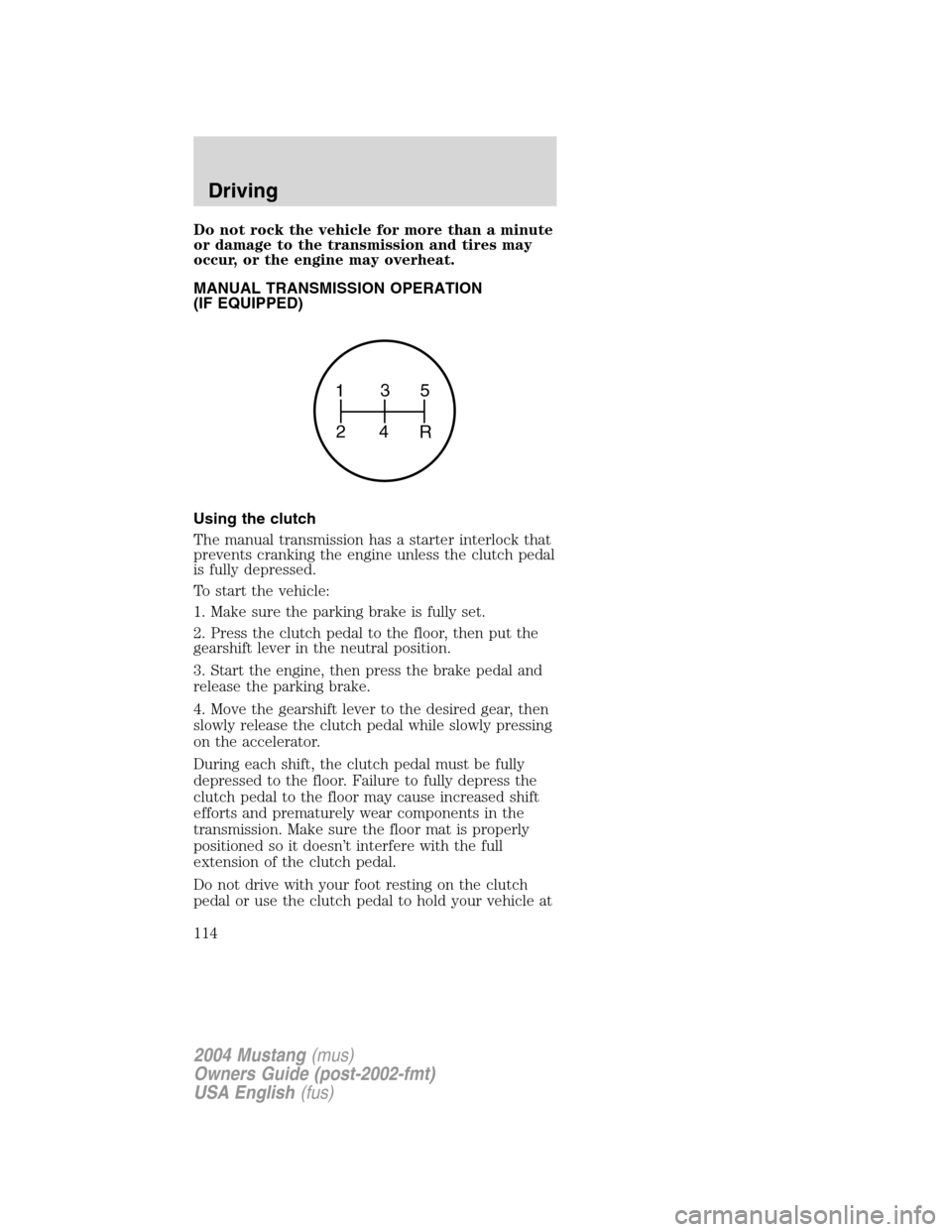
Do not rock the vehicle for more than a minute
or damage to the transmission and tires may
occur, or the engine may overheat.
MANUAL TRANSMISSION OPERATION
(IF EQUIPPED)
Using the clutch
The manual transmission has a starter interlock that
prevents cranking the engine unless the clutch pedal
is fully depressed.
To start the vehicle:
1. Make sure the parking brake is fully set.
2. Press the clutch pedal to the floor, then put the
gearshift lever in the neutral position.
3. Start the engine, then press the brake pedal and
release the parking brake.
4. Move the gearshift lever to the desired gear, then
slowly release the clutch pedal while slowly pressing
on the accelerator.
During each shift, the clutch pedal must be fully
depressed to the floor. Failure to fully depress the
clutch pedal to the floor may cause increased shift
efforts and prematurely wear components in the
transmission. Make sure the floor mat is properly
positioned so it doesn’t interfere with the full
extension of the clutch pedal.
Do not drive with your foot resting on the clutch
pedal or use the clutch pedal to hold your vehicle at
135
24
R
2004 Mustang(mus)
Owners Guide (post-2002-fmt)
USA English(fus)
Driving
114
Page 116 of 240
Do not park your vehicle in Neutral, it may
move unexpectedly and injure someone. Use
1 (First) gear and set the parking brake fully.
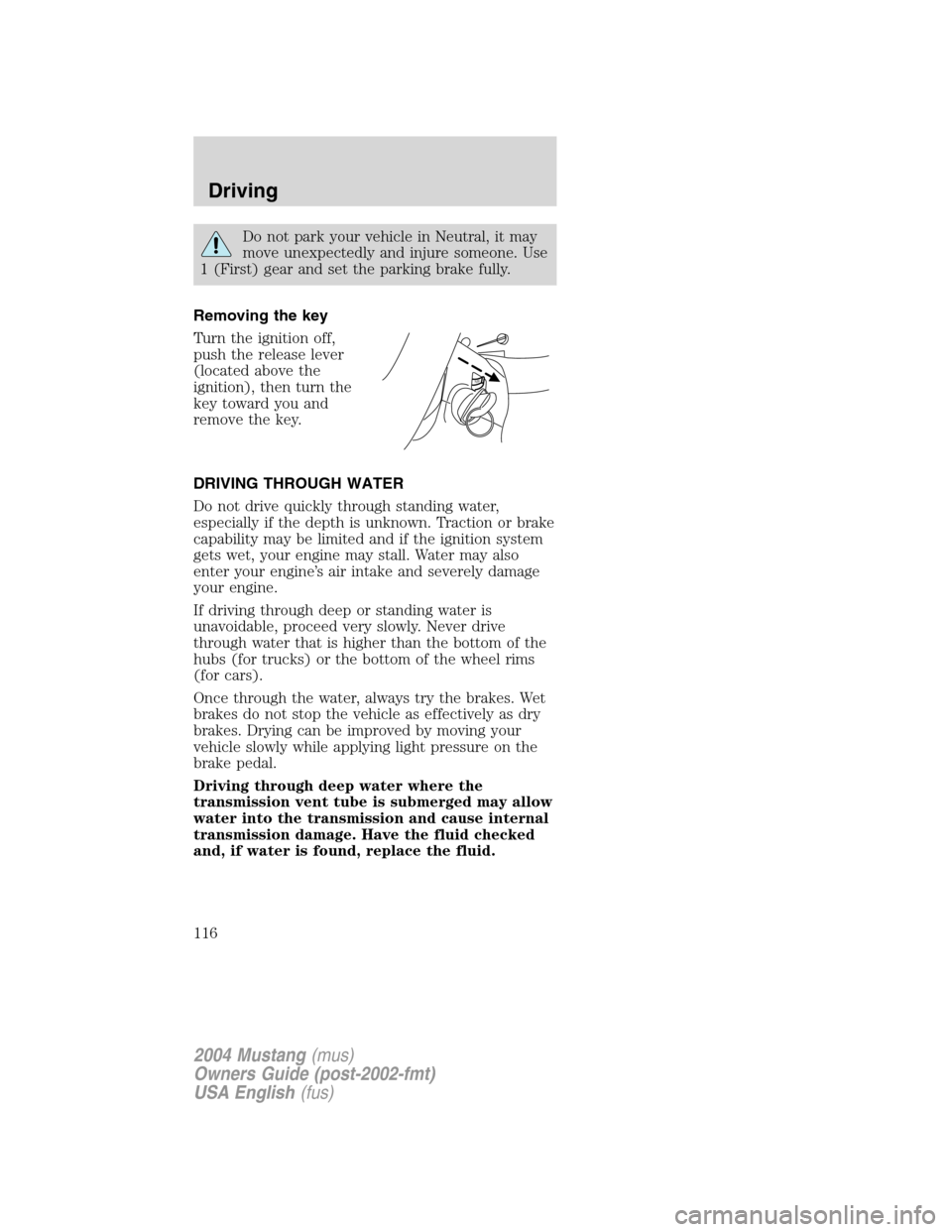
Removing the key
Turn the ignition off,
push the release lever
(located above the
ignition), then turn the
key toward you and
remove the key.
DRIVING THROUGH WATER
Do not drive quickly through standing water,
especially if the depth is unknown. Traction or brake
capability may be limited and if the ignition system
gets wet, your engine may stall. Water may also
enter your engine’s air intake and severely damage
your engine.
If driving through deep or standing water is
unavoidable, proceed very slowly. Never drive
through water that is higher than the bottom of the
hubs (for trucks) or the bottom of the wheel rims
(for cars).
Once through the water, always try the brakes. Wet
brakes do not stop the vehicle as effectively as dry
brakes. Drying can be improved by moving your
vehicle slowly while applying light pressure on the
brake pedal.
Driving through deep water where the
transmission vent tube is submerged may allow
water into the transmission and cause internal
transmission damage. Have the fluid checked
and, if water is found, replace the fluid.
PUSH
2004 Mustang(mus)
Owners Guide (post-2002-fmt)
USA English(fus)
Driving
116
Page 118 of 240
Exceeding the Safety Certification Label
axle weight rating limits could result in
substandard vehicle handling, performance, engine,
transmission and/or structural damage, serious
damage to the vehicle, loss of control and personal
injury.
Note:For trailer towing information refer toTrailer
Towingfound in this chapter or the RV and Trailer
Towing Guide provided by your dealership.
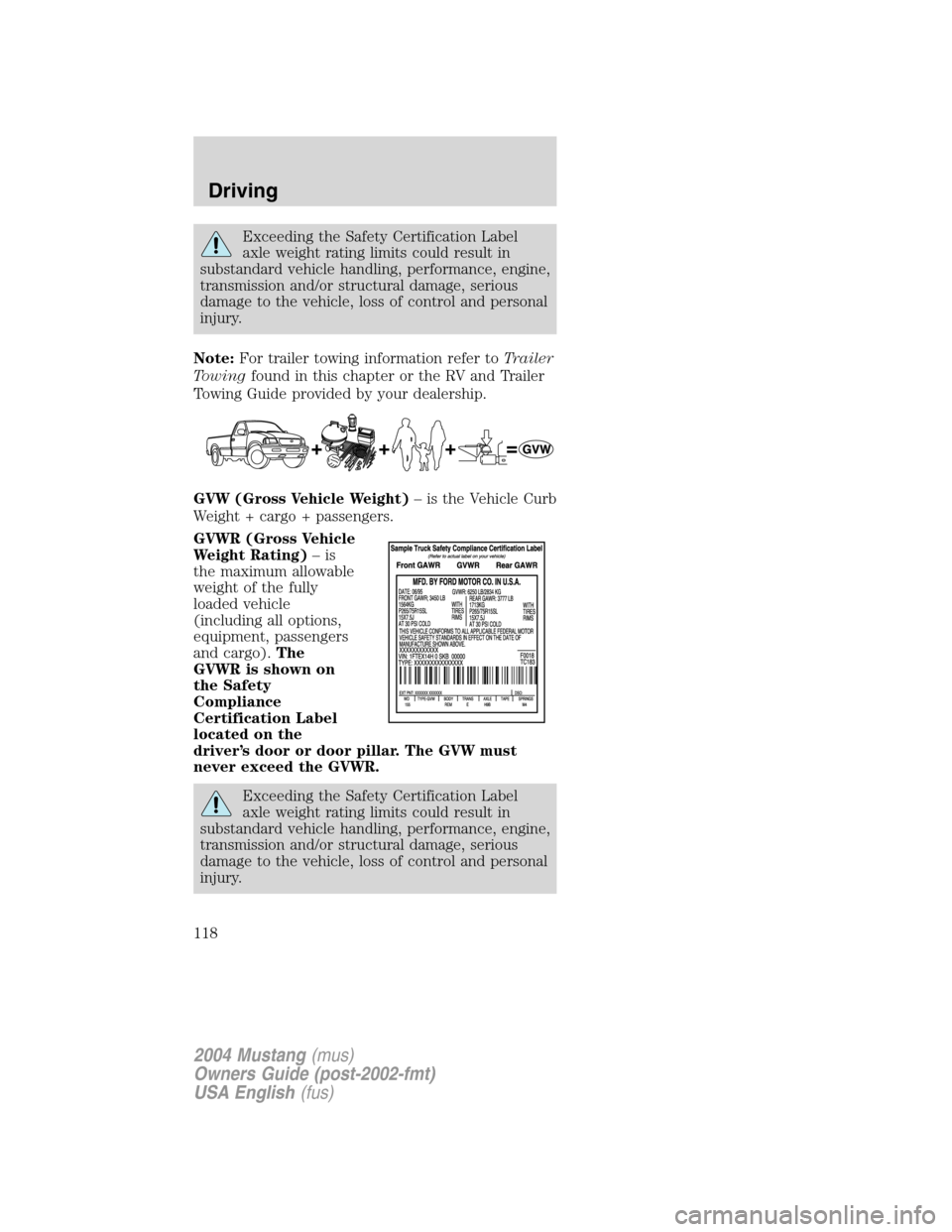
GVW (Gross Vehicle Weight)–is the Vehicle Curb
Weight + cargo + passengers.
GVWR (Gross Vehicle
Weight Rating)–is
the maximum allowable
weight of the fully
loaded vehicle
(including all options,
equipment, passengers
and cargo).The
GVWR is shown on
the Safety
Compliance
Certification Label
located on the
driver’s door or door pillar. The GVW must
never exceed the GVWR.
Exceeding the Safety Certification Label
axle weight rating limits could result in
substandard vehicle handling, performance, engine,
transmission and/or structural damage, serious
damage to the vehicle, loss of control and personal
injury.
2004 Mustang(mus)
Owners Guide (post-2002-fmt)
USA English(fus)
Driving
118
Page 124 of 240

HAZARD FLASHER
The hazard flasher is
located on the steering
column, just behind the
steering wheel. The
hazard flashers will
operate when the
ignition is in any
position or if the key is
not in the ignition.
Push in the flasher control and all front and rear
direction signals will flash. Press the flasher control
again to turn them off. Use it when your vehicle is
disabled and is creating a safety hazard for other
motorists.
Note:With extended use, the flasher may run down
your battery.
FUEL PUMP SHUT-OFF SWITCH
FUEL
RESET
This device stops the electric fuel pump from
sending fuel to the engine when your vehicle has
had a substantial jolt.
After an accident, if the engine cranks but does not
start, this switch may have been activated.
The fuel pump shut-off
switch is located on
the left side of the
trunk between the left
rear tail light and the
trunk liner, and to the
left of the hole in the
trunk liner
To reset the switch:
1. Turn the ignition OFF.
2. Check the fuel system for leaks.
3. If no leaks are apparent, reset the switch by
pushing in on the reset button.
4. Turn the ignition ON.
2004 Mustang(mus)
Owners Guide (post-2002-fmt)
USA English(fus)
Roadside Emergencies
124
Page 126 of 240
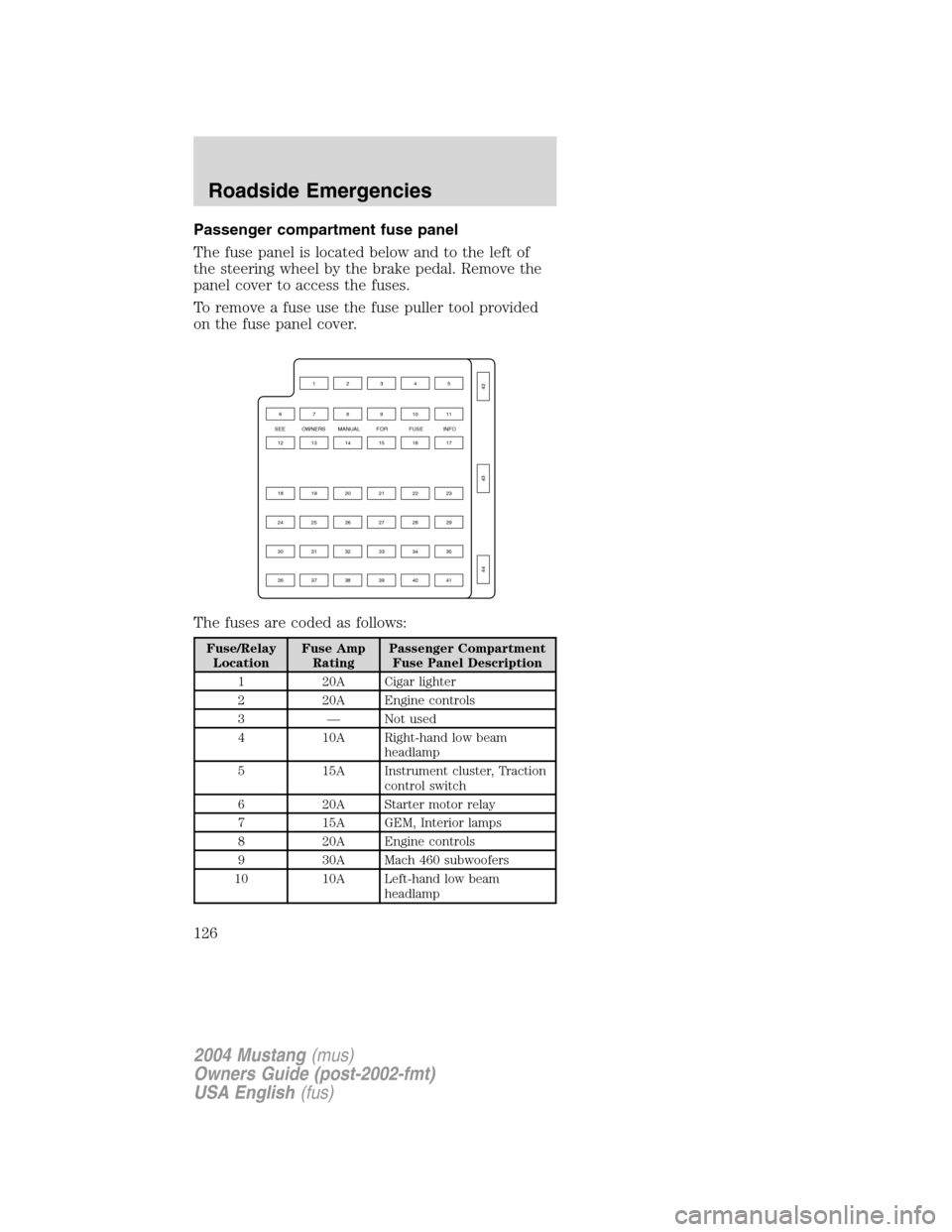
Passenger compartment fuse panel
The fuse panel is located below and to the left of
the steering wheel by the brake pedal. Remove the
panel cover to access the fuses.
To remove a fuse use the fuse puller tool provided
on the fuse panel cover.
The fuses are coded as follows:
Fuse/Relay
LocationFuse Amp
RatingPassenger Compartment
Fuse Panel Description
1 20A Cigar lighter
2 20A Engine controls
3—Not used
4 10A Right-hand low beam
headlamp
5 15A Instrument cluster, Traction
control switch
6 20A Starter motor relay
7 15A GEM, Interior lamps
8 20A Engine controls
9 30A Mach 460 subwoofers
10 10A Left-hand low beam
headlamp
SEE OWNERS MANUAL FOR FUSE INFO
4212345
76891011
131214151617
191820212223
252426272829
313032333435
373638394041
43
44
2004 Mustang(mus)
Owners Guide (post-2002-fmt)
USA English(fus)
Roadside Emergencies
126