2004 FORD FOCUS warning
[x] Cancel search: warningPage 115 of 232
4. Start the vehicle.
If it is necessary to use the above procedure to move the gearshift lever,
it is possible that a fuse has blown or the vehicle’s brakelamps are not
operating properly. Refer toFuses and relaysin theRoadside
emergencieschapter.
Do not drive your vehicle until you verify that the brakelamps
are working.
Always set the parking brake fully and make sure the gearshift is
latched in P (Park). Turn the ignition to the LOCK position and
remove the key whenever you leave your vehicle.
If the parking brake is fully released, but the brake warning lamp
remains illuminated, the brakes may not be working properly.
See your dealer or a qualified service technician.
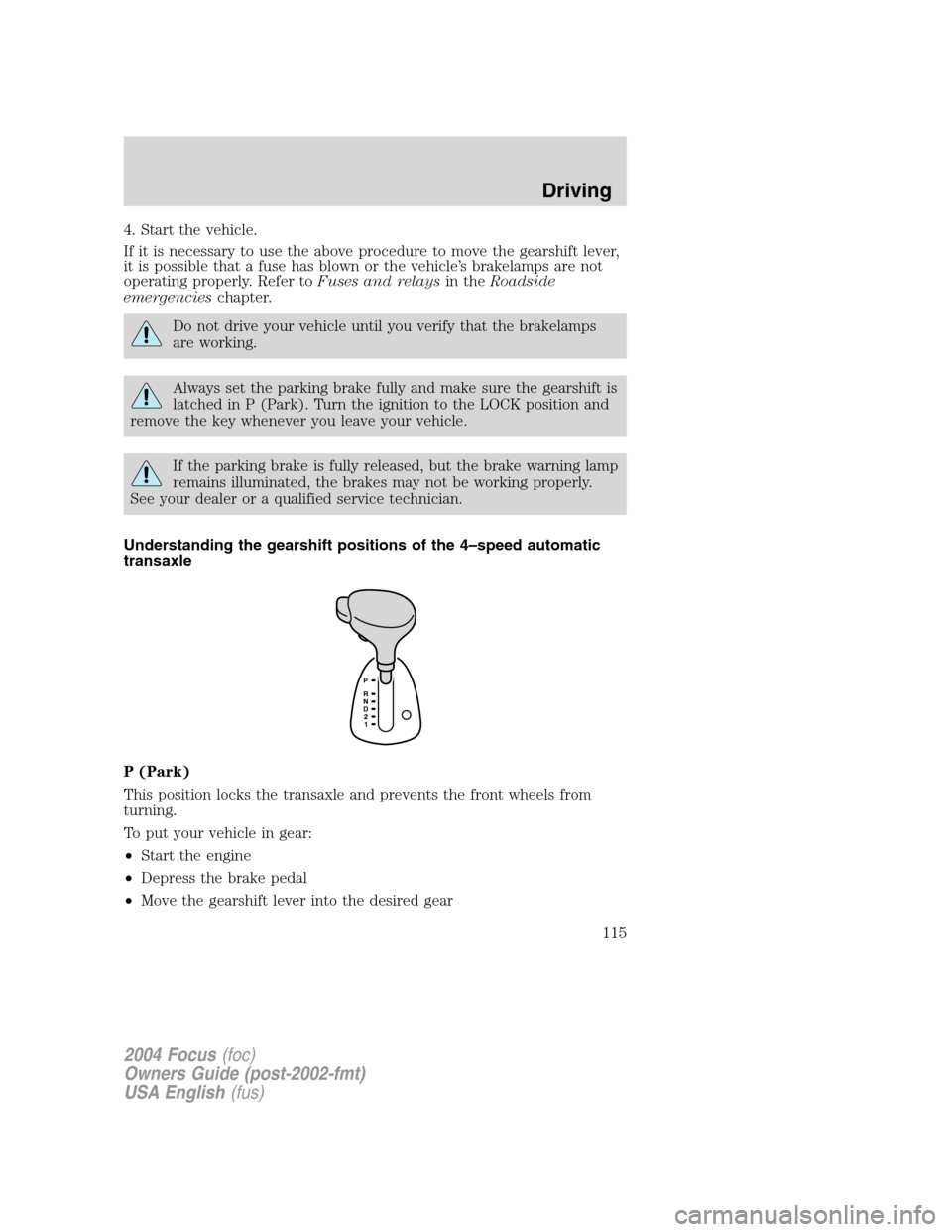
Understanding the gearshift positions of the 4–speed automatic
transaxle
P (Park)
This position locks the transaxle and prevents the front wheels from
turning.
To put your vehicle in gear:
•Start the engine
•Depress the brake pedal
•Move the gearshift lever into the desired gear
2004 Focus(foc)
Owners Guide (post-2002-fmt)
USA English(fus)
Driving
115
Page 139 of 232

6. The vehicle jacking points are
depicted on the yellow warning label
on the jack shown here. Depending
on which tire is to be changed,
locate the jack at the half-moon
cutout located approximately 15 cm
(6 inches) from the front wheel
opening (1) or approximately 38 cm
(15 inches) from the rear wheel
opening (2).
Jack at the specified locations
to avoid damage to the vehicle.
7. Remove the lug nuts with the lug wrench.
8. Replace the flat tire with the spare tire, making sure the valve stem is
facing outward. Reinstall the lug nuts until the wheel is snug against the
hub. Do not fully tighten the lug nuts until the wheel has been lowered.
9. Lower the wheel by turning the jack handle counterclockwise.
10. Remove the jack and fully
tighten the lug nuts in the order
shown.
11. Put flat tire, jack and lug wrench
away. Make sure the jack is fastened
so it does not rattle when you drive.
Unblock the wheels.
JUMP STARTING YOUR VEHICLE
The gases around the battery can explode if exposed to flames,
sparks, or lit cigarettes. An explosion could result in injury or
vehicle damage.
Batteries contain sulfuric acid which can burn skin, eyes and
clothing, if contacted.
1
4 3
2
2004 Focus(foc)
Owners Guide (post-2002-fmt)
USA English(fus)
Roadside Emergencies
139
Page 179 of 232

•NEVER increase the coolant concentration above 60%.
•Increased engine coolant concentrations above 60% will
decrease the overheat protection characteristics of the engine
coolant and may cause engine damage.
•Refer to the chart on the coolant container to ensure the
coolant concentration in your vehicle will provide adequate
freeze protection at the temperatures in which you drive in the
winter months.
If you drive in extremely hot climates:
•It is still necessary to maintain the coolant concentration
above 40%.
•NEVER decrease the coolant concentration below 40%.
•Decreased engine coolant concentrations below 40% will
decrease the corrosion protection characteristics of the engine
coolant and may cause engine damage.
•Decreased engine coolant concentrations below 40% will
decrease the freeze protection characteristics of the engine
coolant and may cause engine damage.
•Refer to the chart on the coolant container to ensure the
coolant concentration in your vehicle will provide adequate
protection at the temperatures in which you drive.
Vehicles driven year-round in non-extreme climates should use a 50/50
mixture of engine coolant and distilled water for optimum cooling system
and engine protection.
How fail-safe cooling works
If the engine begins to overheat:
•The engine coolant temperature
gauge will move to the red (hot)
area.
•The“Multi-function warning light:
automatic transaxle/cooling
system”will illuminate (2.0L
Zetec engine only).
•The“Check Engine”indicator light will illuminate.
If the engine reaches a preset over-temperature condition, the engine
will automatically switch to alternating cylinder operation. Each disabled
cylinder acts as an air pump and cools the engine.
2004 Focus(foc)
Owners Guide (post-2002-fmt)
USA English(fus)
Maintenance and Specifications
179
Page 188 of 232
It is important to note the box in the lower left corner of the window
sticker. These numbers represent the Range of L/100 km (MPG)
expected on the vehicle under optimum conditions. Your fuel economy
may vary depending upon the method of operation and conditions.
EMISSION CONTROL SYSTEM
Your vehicle is equipped with various emission control components and a
catalytic converter which will enable your vehicle to comply with
applicable exhaust emission standards. To make sure that the catalytic
converter and other emission control components continue to work
properly:
•Use only the specified fuel listed.
•Avoid running out of fuel.
•Do not turn off the ignition while your vehicle is moving, especially at
high speeds.
•Have the items listed in your scheduled maintenance guide performed
according to the specified schedule.
The scheduled maintenance items listed in the scheduled maintenance
guide are essential to the life and performance of your vehicle and to its
emissions system.
If other than Ford, Motorcraft or Ford-authorized parts are used for
maintenance replacements or for service of components affecting
emission control, such non-Ford parts should be equivalent to genuine
Ford Motor Company parts in performance and durability.
Do not park, idle, or drive your vehicle in dry grass or other dry
ground cover. The emission system heats up the engine
compartment and exhaust system, which can start a fire.
Illumination of the
indicator, charging system warning light or the
temperature warning light, fluid leaks, strange odors, smoke or loss of
engine power, could indicate that the emission control system is not
working properly.
Exhaust leaks may result in entry of harmful and potentially
lethal fumes into the passenger compartment.
Do not make any unauthorized changes to your vehicle or engine. By
law, vehicle owners and anyone who manufactures, repairs, services,
2004 Focus(foc)
Owners Guide (post-2002-fmt)
USA English(fus)
Maintenance and Specifications
188
Page 189 of 232

sells, leases, trades vehicles, or supervises a fleet of vehicles are not
permitted to intentionally remove an emission control device or prevent
it from working. Information about your vehicle’s emission system is on
the Vehicle Emission Control Information Decal located on or near the
engine. This decal identifies engine displacement and gives some tune up
specifications.
Please consult yourWarranty Guidefor complete emission warranty
information.
On board diagnostics (OBD-II)
Your vehicle is equipped with a computer that monitors the engine’s
emission control system. This system is commonly known as the On
Board Diagnostics System (OBD-II). This OBD-II system protects the
environment by ensuring that your vehicle continues to meet
government emission standards. The OBD-II system also assists the
service technician in properly servicing your vehicle. When theCheck
Engine/Service Engine Soonlight illuminates, the OBD-II system has
detected a malfunction. Temporary malfunctions may cause yourCheck
Engine/Service Engine Soonlight to illuminate. Examples are:
1. The vehicle has run out of fuel. (The engine may misfire or run
poorly.)
2. Poor fuel quality or water in the fuel.
3. The fuel cap may not have been securely tightened.
These temporary malfunctions can be corrected by filling the fuel tank
with good quality fuel and/or properly tightening the fuel cap. After three
driving cycles without these or any other temporary malfunctions
present, theCheck Engine/Service Engine Soonlight should turn off.
(A driving cycle consists of a cold engine startup followed by mixed
city/highway driving.) No additional vehicle service is required.
If theCheck Engine/Service Engine Soonlight remains on, have your
vehicle serviced at the first available opportunity.
Readiness for Inspection/Maintenance (I/M) testing
In some localities, it may be a legal requirement to pass an I/M test of
the on-board diagnostics system. If your
indicator is on, refer to the
description in theWarning lights and chimessection of the
Instrument Clusterchapter. Your vehicle may not pass the I/M test with
the
indicator on.
If the vehicle’s powertrain system or its battery has just been serviced,
the on-board diagnostics system is reset to a“not ready for I/M test”
2004 Focus(foc)
Owners Guide (post-2002-fmt)
USA English(fus)
Maintenance and Specifications
189
Page 199 of 232
12.Treadwear, Traction and Temperature Grades
•Treadwear:The treadwear grade is a comparative rating based on the
wear rate of the tire when tested under controlled conditions on a
specified government test course. For example, a tire graded 150
would wear one and one-half (1
1⁄2) times as well on the government
course as a tire graded 100.
•Traction:The traction grades, from highest to lowest are AA, A, B,
and C. The grades represent the tire’s ability to stop on wet pavement
as measured under controlled conditions on specified government test
surfaces of asphalt and concrete. A tire marked C may have poor
traction performance.
•Temperature:The temperature grades are A (the highest), B and C,
representing the tire’s resistance to the generation of heat and its
ability to dissipate heat when tested under controlled conditions on a
specified indoor laboratory test wheel.
13.Maximum Permissible Inflation Pressure:Tire manufactures
maximum permissible pressure and/or the pressure at which the
maximum load can be carried by the tire. This pressure is normally
higher than the manufacturer’s recommended cold inflation pressure
which can be found on either the tire label or certification label which is
located on the structure by the trailing edge of the driver’s door or the
edge of the driver’s door. The cold inflation pressure should never be set
lower than the recommended pressure on the label.
Note:You may not find this information on all tires because it is not
required by federal law.
The tire suppliers may have additional markings, notes or warnings such
as standard load, radial tubeless, etc.
2004 Focus(foc)
Owners Guide (post-2002-fmt)
USA English(fus)
Maintenance and Specifications
199
Page 222 of 232

A
Air bag supplemental restraint
system ..............................89–90, 93and child safety seats ..............91
description ..........................90, 93
disposal ......................................95
driver air bag ......................91, 94
indicator light ...........................93
operation .............................91, 94
passenger air bag ...............91, 94
side air bag ................................93
Air cleaner filter .......................207
Antifreeze
(see Engine coolant) ................175
Anti-lock brake system
(see Brakes) ..............................111
Anti-theft system ........................70 arming the system ....................70
disarming a triggered system ..70
Automatic transaxle fluid, adding ............................191
fluid, checking ........................191
fluid, specification ..................212
Automatic transmission ............114 driving an automatic
overdrive .................................115
fluid, refill capacities ..............208
Auxiliary power point .................52
Axle lubricant specifications ..........210
refill capacities ........................208
B
Battery .......................................173 acid, treating emergencies .....173
jumping a disabled battery ....139
maintenance-free ....................173
replacement, specifications ...207 servicing ..................................173
BeltMinder ...................................84
Brakes ........................................111 anti-lock ...................................111
anti-lock brake system (ABS)
warning light ...........................112
fluid, checking and adding ....190
fluid, refill capacities ..............208
fluid, specifications .........210, 212
lubricant specifications ..210, 212
parking ....................................112
shift interlock ..........................114
C
Capacities for refilling fluids ....208
Cargo cover .................................59
Cell phone use ............................58
Certification Label ....................215
Child safety restraints ................96 child safety belts ......................96
Child safety seats ........................99 attaching with tether straps ..103
in front seat ............................100
in rear seat ..............................100
LATCH .....................................105
Cigar lighter Power Point ..............................52
Cleaning your vehicle engine compartment ..............158
instrument panel ....................161
interior .....................................162
plastic parts ............................161
washing ....................................157
waxing .....................................157
wheels ......................................158
wiper blades ............................161
Climate control (see Air
conditioning or Heating) ......34–35
2004 Focus (foc)
Owners Guide (post-2002-fmt)
USA English (fus)
Index
Index
222
Page 224 of 232

choosing the right fuel ...........183
comparisons with EPA fuel
economy estimates .................187
detergent in fuel .....................184
filling your vehicle with fuel .180,182, 185
filter, specifications ........184, 207
fuel pump shut-off switch .....127
improving fuel economy ........185
octane rating ...................183, 212
quality ......................................184
running out of fuel .................184
safety information relating to
automotive fuels .....................180
Fuel pump shut-off switch .......127
Fuses ..................................128 –129
G
Gas cap (see Fuel cap) ............182
Gas mileage
(see Fuel economy) .................185
Gauges .........................................14
H
Hazard flashers .........................127
Headlamps ...................................38 aiming ........................................39
bulb specifications ....................42
daytime running lights .............38
flash to pass ..............................39
high beam .................................39
turning on and off ....................38
Heating heater only system ...................34
Hood ..........................................165
I
Ignition ...............................107, 212 Infant seats (see Safety seats) ..99
Inspection/maintenance (I/M)
testing ........................................189
Instrument panel
cleaning ...................................161
cluster ........................................10
lighting up panel and interior .39
J
Jump-starting your vehicle ......139
K
Keyless entry system autolock .....................................61
Keys positions of the ignition .........107
L
Lamps bulb replacement
specifications chart ..................42
daytime running light ...............38
fog lamps ...................................38
headlamps .................................38
headlamps, flash to pass ..........39
instrument panel, dimming .....39
interior lamps ...........................42
Lane change indicator
(see Turn signal) ........................41
Lights, warning and indicator ....10 anti-lock brakes (ABS) ..........112
Load limits .................................119
Locks autolock .....................................61
childproof ..................................62
Lubricant specifications ...210, 212
2004 Focus (foc)
Owners Guide (post-2002-fmt)
USA English (fus)
Index
224